

 Flashlight
 Solar
Extension Cable
Solar
Extension Cable


What Can 1,000 Watts Power? 2026 Guide to Real Appliances & RuntimeWhat Can 1,000 Watts Power? A 2026 Guide to Real Appliances and Runtime
So, what can 1,000 watts power, in plain English? Honestly speaking, just about every camping and home-backup gadget regular folks actually plug in, provided whatever's drawing stays under a kilowatt of steady pull.
The fridge keeps cold all day. CPAP hums along through the night. Laptops, fans, lights, modems all share the outlet. Microwaves work for short reheat bursts. An induction burner runs solo on low. Locked-out gear is short and specific: anything holding well above a kilowatt continuously, meaning electric clothes dryers, the full electric range, central air. The real catch isn't even the power number. The watts-versus-watt-hours confusion bites buyers more than any spec mix-up.
Across years, matching real campers and homeowners to inverters, the same questions show up in our inbox every Monday. Will it run a fridge? A CPAP overnight? Morning coffee? Yes, yes, and yes, though only one at any given moment. Pile all of them on simultaneously and things trip fast. What follows covers appliance math, runtime numbers logged from real trips, and the honest short list of stuff a kilowatt simply won't run.
Watts vs Watt-Hours: The One Spec Most Buyers Mix Up
Two numbers, same packaging. Buyers see "1000" twice and figure it's one spec. Wrong unit lands on the doorstep that way.

Alt: watts watt-hours one spec buyers scene for what can 1000 watts power
Watts: The Pipe Size
Instantaneous push, basically. Plugging a six-hundred-watt appliance into a thousand-watt inverter lets it cruise without strain. Plug a fourteen-hundred-watt appliance into the same inverter, however, and it trips on contact. The pipe-size analogy fits the moment you start checking real loads against the inverter rating.
Watt-Hours: The Tank
Tank size, not pipe size. With a kilowatt-hour battery on hand, a 1,000W appliance drains the whole pack in around sixty minutes. Drop your load to a hundred watts and the same tank carries through ten hours instead. Run a quiet fifty-watt fridge off it and runtime stretches close to seventeen hours of compressor cycling before recharge.
Side-by-Side Memory Aid
|
Spec |
Unit |
What It Tells You |
Example |
|
1,000W |
watts |
What plugs in at once |
One 800W microwave |
|
1,000Wh |
watt-hours |
How long it lasts |
~17 hours on a 50W fridge |
|
Surge |
watts (peak) |
Brief overload margin |
Compressor 600-800W spike |
|
Charge time |
hours |
How fast to refill |
AC: under 1 hr; Solar: 8-14 hr |
Most "1,000-watt power station" listings pair a one-kilowatt output with 800-1,200Wh underneath. Same headline number, different roles. The U.S. Department of Energy keeps a public list of typical appliance wattage ranges [1], and matching real loads against that list is the fastest way the math clicks. Our Portable Power Station Calculator takes the headache out.
Skip either number before buying and the wrong unit comes home.
What Can 1,000 Watts Power, Honestly?
Most loads drawing under 1,000W continuously. List below, DOE data plus clamp-meter readings.
|
Appliance |
Continuous Draw |
Surge |
Runs on 1,000W? |
|
Mini fridge |
50-100W |
200W |
Yes, all day |
|
Full-size fridge |
100-200W |
600-800W |
Yes, watch the surge |
|
CPAP (no humidifier) |
30-60W |
n/a |
Yes, all night |
|
CPAP with humidifier |
60-100W |
n/a |
Yes, all night |
|
Laptop |
45-100W |
n/a |
Yes, plus tablet/phones |
|
Coffee maker (drip) |
600-900W |
n/a |
Yes, one at a time |
|
Microwave (compact) |
700-900W |
1,200W briefly |
Yes, short bursts |
|
Electric kettle |
1,000-1,500W |
n/a |
Borderline (compact only) |
|
Toaster |
800-1,200W |
n/a |
Borderline |
|
Induction burner |
800-1,800W |
n/a |
One element, low setting |
|
Box fan |
50-100W |
n/a |
Yes |
|
WiFi router + modem |
10-20W |
n/a |
Yes, all day |
|
LED string lights |
5-15W |
n/a |
Yes |
|
Power tools (drill, jigsaw) |
400-900W |
1,500W |
Yes, watch surge |
|
32-inch TV |
50-80W |
n/a |
Yes |
|
Oxygen concentrator |
350-600W |
700W |
Yes |
|
Electric blanket |
50-200W |
n/a |
Yes, all night |
Nine-ish out of every ten camping and home-backup loads fit under the 1,000W cap. The 10% that doesn't? Pure resistive heat: dryers, ranges, peak space heaters.

Alt: can 1,000 watts power, honestly diagram for what can 1000 watts power
Filter that catches buyers: read surge too, not just the steady column. Motors (fridges, AC compressors, drills) spike 3-5x the steady number for half a second. Pure sine wave inverters take it. Modified sine wave gear chokes and trips.
What 1,000 Watts Cannot Run, No Matter What Anyone Says

1,000 watts cannot run, matter diagram for what can 1000 watts power
The Hard "No" List
Hairdryers running on high. Electric clothes dryers, full size. Resistive space heaters with the dial near peak. Electric ranges (the entire cooktop, not a single element). Central A/C. Welders. Tankless water heaters. Anything wired for two-forty volts gets locked out automatically; a 1,000W power station's a single-phase 120V box, and split-phase appliances expect wiring it simply doesn't supply.
Why Inverters Cut Power, Not Choke
Mechanism's blunt. Each of those loads sits above one kilowatt continuously. Inverter sees overload, trips off, done. Some units cut cleanly without drama. Others retry once before locking out. None of them push power past their spec sheet, regardless of which brand's printed on the case.
Overload Combinations That Trip Customers Up
- Toaster + microwave together: combined trips over.
- 1,500W heater on "high": trips in a minute.
- Hair dryer at full: 1,400-1,800W. Only "warm" works.
- Coffee + toaster + oven on one outlet: weekly scenario.
- Mini split A/C startup spike: 1,200-1,800W trips it.
Smart load sequencing handles most of the combos above, though stepping up to a 1,500-2,000W class inverter gives more home backup power headroom on heavy starts. Both matter — sequence what you can, oversize where the math says you must. Our blog on what you can run on a 1,000-watt inverter covers the surprise-overload gear.
How Long Will a 1,000Wh Battery Actually Last?
The Runtime Formula
Formula first. Examples after.
Our notes use one rule: runtime hours equals battery capacity in watt-hours, times 0.85 for inverter efficiency, divided by your load in watts. That 0.85 multiplier is the DC-to-AC conversion loss any reasonable LiFePO4 unit shows under normal draw.
Worked Examples on a 1,024Wh Battery
So, here's how the math actually plays out on a real unit. Pick a kilowatt-hour pack, run a small fifty-watt fridge off it, and the equation lands somewhere near seventeen hours of theoretical runtime. Step that fridge load up to two hundred watts (think a larger full-size unit) and the same battery falls to roughly four hours of compressor-on time. Reality is gentler though, because fridges don't run their compressor straight through the day, they cycle 30-40% of the time across normal use. So net cooling on a single charge ends up sitting comfortably past twelve hours in most real setups.
Runtime numbers logged from real customer trips on 1,000Wh class units:
- 50W mini fridge: ~17 hr compressor, ~50 hr cooling
- 100W full fridge: ~9 hr compressor, ~26 hr cooling
- 50W CPAP: ~17 hr continuous (two nights)
- 75W laptop: ~12 hr typing
- 800W microwave: ~1 hr total, ~30 reheats
- 100W TV: ~9 hr streaming
- 30W LED lights: ~29 hr
- 600W coffee maker: ~1.4 hr brewing, 8-10 pots
Real loads vary across the day. Phone chargers idle near zero between top-offs. Laptops sleep. Fridges cycle. A camper running fridge + lights + phone + occasional CPAP burns through a 1,000Wh battery in 14-18 hours of mixed use. We've logged this across hundreds of trips.
Which OUKITEL 1,000-Watt-Class Stations Should You Pick?
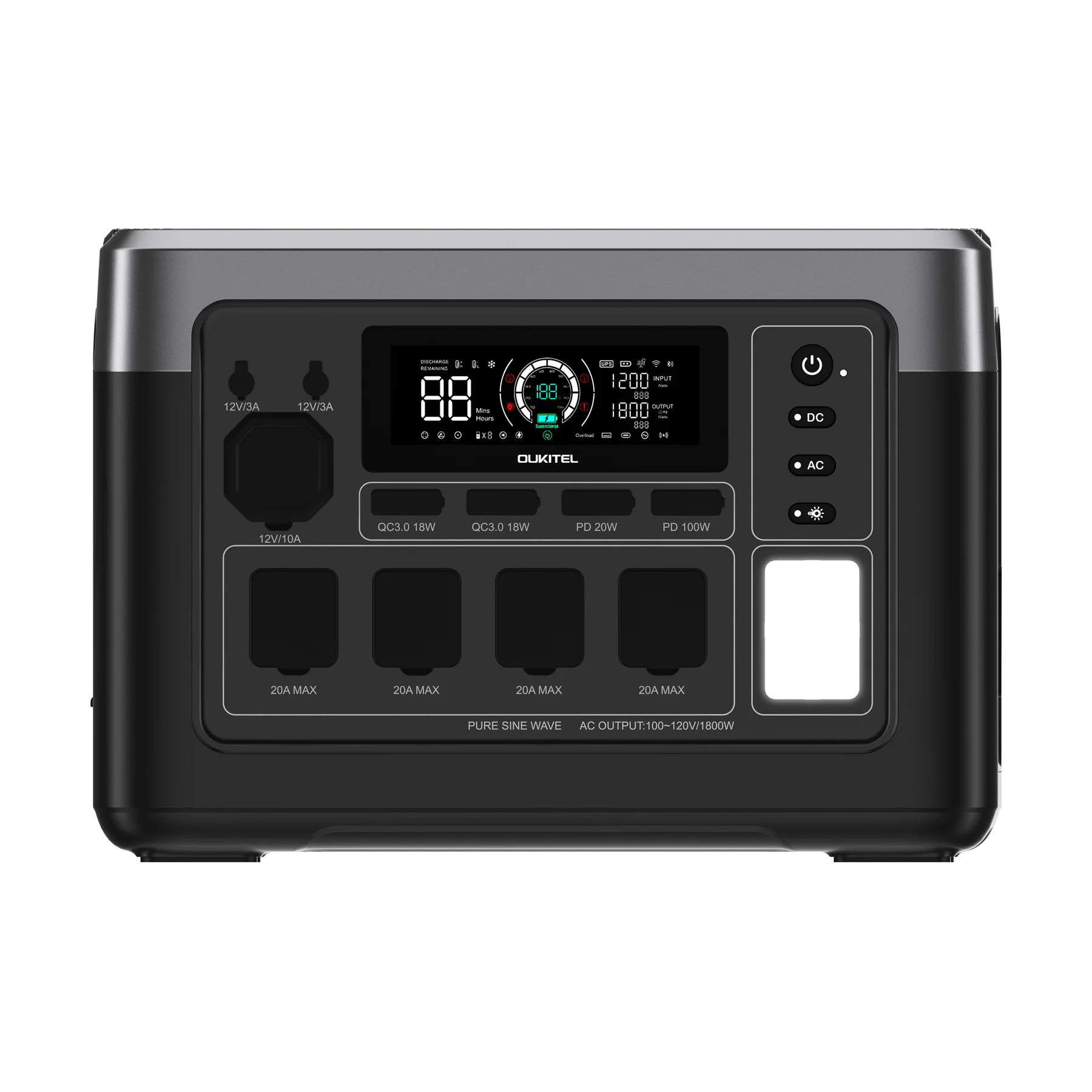
Our default 1,000W class pick is the OUKITEL P1000 PLUS portable power station. 1,024Wh LFP capacity. 1,800W continuous AC inverter (the 1,000W threshold becomes moot with motor surge headroom). AC fast-charge to 80% in under 40 minutes. Quiet under 500W draws (29dB), tent-friendly. Check current pricing on the product page.
 Alt: OUKITEL P1000 PLUS Portable Power Station 1800W/1024Wh
Quick spec snapshot for the P1000 PLUS:
- Capacity: 1,024 Wh LFP
- AC continuous: 1,800 W
- AC surge: 3,600 W
- Weight: 26 lb
- AC charge (0→80%): 39 minutes
- PV input ceiling: 200 W
- Best for: home backup + camping at the 1,000W tier
The P1000 PLUS runs LiFePO4 chemistry rated for 3,000+ cycles to 80% capacity. The U.S. Environmental Protection Agency tracks lithium-ion safety and recycling guidance [2], and LFP's track record in the camping segment has been clean across the brands we've tested. The DOE Office of Electricity tracks the broader residential energy storage market and reports deployments accelerated through 2024-2025 [4], with LFP chemistry leading most of that growth.
How Long Can 1,000 Watts Power Your Trip on Solar Alone?
Depends on sun and panel. Less than the marketing photo suggests.
Field math runs harsher than the spec sticker. A 100W panel? Real output 60-75W on a clear day. Shade, dust, tilt, sun angle, time of year all skim output. A 200W panel rides 120-150W during the four-hour midday peak before falling off. Full top-up of a 1,024Wh battery via 200W panel: 8-14 hours of useful sunlight, easily a two-day affair.
Battery capacity owns your overnight runtime; panel wattage owns multi-day off-grid power. Both matter, and panel size is usually where buyers under-spec for sustained loads. We routinely double whatever spec sheets recommend.
At the 1,000Wh tier on a weekend trip:
- 100W of panel: barely keeps phones and lights topped off
- 200W of panel: enough to refill CPAP + lights + phone overnight loss
- 400W of panel: covers a fridge + CPAP + the rest with comfortable margin
The OUKITEL 200W foldable solar panel is our go-to pairing with the P1000 PLUS. Charge AC the day before; solar slows the drain, not starts from zero. Our Portable Power Station Calculator sizes panels against any battery + load combo.
For storm-prone trips, the National Weather Service recommends emergency preparedness gear including backup power for radios and lights [3]. Solar matters more when grid's out for days, not one rainy night.
Pick the Right 1,000W Class for Your Use
Three-step shortcut we walk new buyers through:
- Tally continuous loads. Fridge 75W. Lights 20W. Phone 5W. CPAP 50W. About 150W steady. Multiply by hours used; daily watt-hour budget.
- Pad capacity 30-50% above that budget. A 200Wh-per-day camper rests easier with 1,000Wh than 600Wh.
- Pin inverter rating to your biggest steady load with surge headroom. A 1,000W microwave needs at least 1,200W AC spec.
For 1,000W tier camping and home backup, our default is the OUKITEL P1000 PLUS, available solo or bundled with a 100W solar panel for weekend trips.
FAQs
What can 1,000 watts power for camping and home backup?
Almost every common load people actually use, just one at a time. A fridge (50-200W), CPAP (30-100W), laptop (45-100W), LED lights (5-30W), WiFi router (10-20W), 32-inch TV (50-80W). Even quick microwave or drip-coffee bursts. Sub-1,000W steady? Fair game.
Where it gets tight is stacking two heavy loads at once. Two 600W appliances cross the limit together. Sequence beats stacking, every time.
Yes/no by category:
- Refrigerator: yes, full-size included.
- CPAP overnight: two nights on a 1,000Wh battery.
- Laptop work-from-camp: easy, all day.
- Microwave: yes, bursts under 5 minutes.
- Hair dryer: low/warm only.
- Coffee maker: yes, solo brew cycle.
Can 1,000 watts run a refrigerator?
Full-size units included, yes. Continuous draw on a typical fridge falls between one and two hundred watts. The startup surge is what to watch. When the compressor kicks on, you'll see a brief spike around six to eight hundred watts for half a second. Modern power stations at this tier ship with pure sine wave inverters that absorb that spike cleanly.
Runtime on a 1,000Wh battery? Pure compressor-on time runs 4-9 hours. Catch is, real fridges only run their compressor 30-40% of the day. Net cooling per battery cycle: 13-26 hours.
Three checks before plugging in:
- Inverter spec is pure sine wave, not modified sine.
- Surge wattage rating is 800W minimum.
- No other major appliance shares the inverter during compressor kicks.
How long will a 1,000Wh battery run a CPAP?
Full night for sure. Two if the unit's lean.
CPAP machines without humidifier average 30-60W. Turn the humidifier on and draw jumps into the 60-100W range. The math on a kilowatt-hour pack at 50W draw, times 0.85 inverter efficiency, divided by 50, lands near seventeen hours. That's two full eight-hour nights with margin left to top off a phone.
Guidance we share with every CPAP customer setting up:
- Humidifier off on trips. Saves a steady 30-40W.
- Heated hose stays off below 50°F outside.
- Look for travel-mode settings on the CPAP itself.
- 12V DC support? Use a DC cable, skip inverter losses.
- Trip-test the rig at home first. Never rely on untested gear overnight.
Can a 1,000W inverter power a microwave?
Short bursts, definitely. Compact microwaves in the 700-900W range run comfortably on a 1,000W inverter. Anything larger (1,200W class up) sits borderline and often trips on the startup spike alone.
Two-minute reheats hit hardest. Each pulls roughly 25-30 watt-hours. Translation: a fresh kilowatt-hour gets you about 30 reheats solo. Real camping mixes microwave with fridge and lighting, which drops that closer to 12-15 events per battery cycle.
Habits worth carrying into any camp microwave use:
- Read input wattage off the label, not cooking-power. Input draw is what the inverter sees.
- Bursts under two minutes. Easier on inverter and battery.
- Let the fridge run alone for ten minutes after, letting voltage settle.
- Don't stack the microwave against another big load.
What appliances draw less than 1,000 watts?
More than buyers expect. Almost all plug-in residential gear stays under 1,000W steady: fridges, TVs, laptops, fans, lighting, routers, consoles, blenders, slow cookers, CPAP, oxygen gear, small tools. Rule of thumb: heat-making things push past 1,000W; motors and solid-state circuitry land comfortably under.
Categories under the 1,000W ceiling:
- Consumer electronics. TVs and laptops barely register.
- Kitchen prep tools. Blenders cruise, slow cookers idle low.
- Cooling steady-state. Fridges, fans, mini-splits in the 50-200W zone.
- Medical equipment across the board.
- LED lighting at any reasonable scale.
- Handheld tools. Drill, jigsaw, sander.
Over the line you'll mostly find resistive heat: ovens, dryers, hairdryers on full, peak-setting heaters, full-size kettles.
Is 1,000 watts enough for an electric kettle?
Borderline, and the answer hinges on which kettle. Travel kettles rated at 1,000W or less work great on a 1,000W inverter. Standard 1,500W home kettles? They trip the unit before the water even gets warm.
Mechanism's blunt. A 1,500W kettle pulls flat 1,500W the moment you flip the switch. Inverter reads 50% overload, cuts within a second. Some units retry once and recover. Most lock out, needing a manual reset.
Two ways out if kettle matters on your trips:
- Buy a travel kettle (800-1,000W, usually 0.5-0.8L). Job done — widely available online at modest cost.
- Step the rig up to a 1,500-2,000W inverter, which also unlocks larger toasters and brief induction work.
Can a 1,000W power station run a coffee maker?
Yes, but only as the headliner load on the inverter. Drip coffee makers sit at 600-900W continuous during the brew cycle. Comfortably within the 1,000W envelope.
Brew time runs 5-10 minutes for a full pot, pulling 75-150Wh total. Translation: a 1,000Wh battery brews 6-13 pots per charge. We've seen morning coffee paired with overnight CPAP on a single battery without mid-day recharge.
Habits that keep camp coffee reliable:
- Brew first thing, while the battery's topped off.
- No microwave or toaster running while the pot's going.
- Pod machines (Keurig, Nespresso) hit 1,200-1,500W and need a bigger inverter.
- French press or pour-over sidesteps the wattage problem completely.
What's the difference between 1,000W and 1,000Wh?
Rate vs tank. 1,000W (watts) is an instantaneous power-draw figure. Pipe size. 1,000Wh (watt-hours) is total energy stored in the battery. That's the tank. People merge them constantly because boxes print both numbers in the same font size.
Anything called a "1,000W power station" usually wraps an 800-1,200Wh battery. The W tells what plugs in. The Wh tells how long it lasts.
Memory aid we hand customers:
- W is for "what fits the outlet."
- Wh is for "what's left in the tank."
- Wh × 0.85 ÷ load W = approximate runtime hours.
- Surge wattage gets its own watch column (motors spike 3-5x).
Sources
- U.S. Department of Energy (DOE), Estimating Appliance and Home Electronic Energy Use (2024)
- U.S. Environmental Protection Agency (EPA), Used Lithium-Ion Batteries (2024)
- National Weather Service (NWS), Weather Safety (2025)
- U.S. Department of Energy (DOE) Office of Electricity, Energy Storage Program (2025)


Looking for something else?
How Easy Is a Portable Power Station to Use? A Beginner’s Guide
LEARN MORE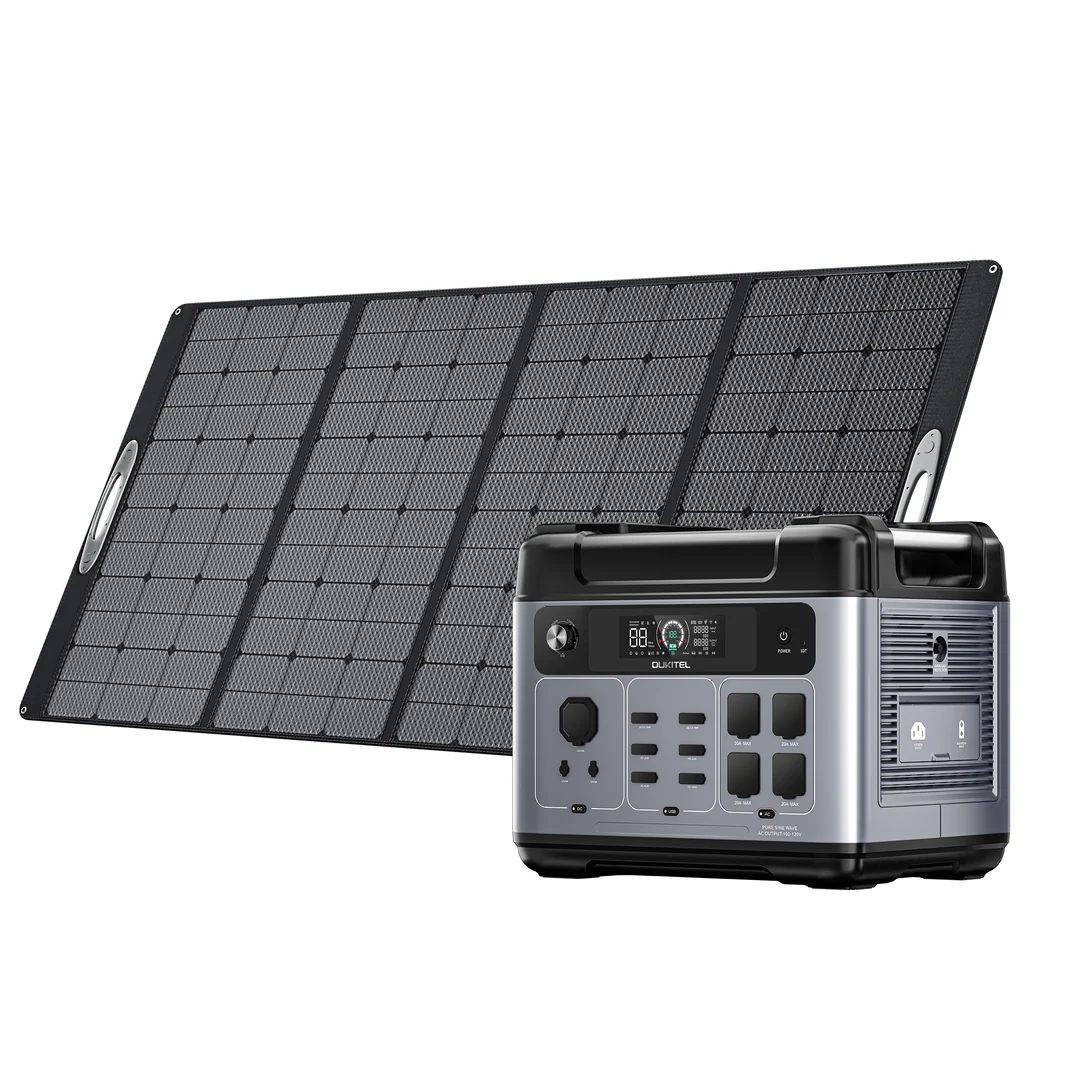
Cold-Weather Power: Best Portable Power Stations for Winter Camping
LEARN MORE
What is a Portable Power Station & How It’s Used
LEARN MORE
5 Must-Have Portable Power Solutions for a Stress-Free Christmas
LEARN MORELooking for something else?
Power Station Calculator: How to Estimate Output & Recharge Time
LEARN MORE
Solar Panel Voltage: Understanding Output and Regulation
LEARN MORE
How Do Solar Panels Work: From Sunlight to Home Energy
LEARN MOREYou may also like

OUKITEL P5000 Pro+400W Solar Generator
OUKITEL BP2000+400W Solar Generator

OUKITEL P5000+2*400W Solar Generator

OUKITEL P5000 Pro+2*400W Solar Generator
OUKITEL BP3000 Portable Power Station 3200W | 2048Wh

OUKITEL BP2000+2*400W Solar Generator
Further reading
Best Solar Generator for Home Backup: 2026 Buyer's Guide
How Long Do Portable Power Stations Last? 2026 Lifespan and Runtime Guide