








 Flashlight
 Solar
Extension Cable
Solar
Extension Cable


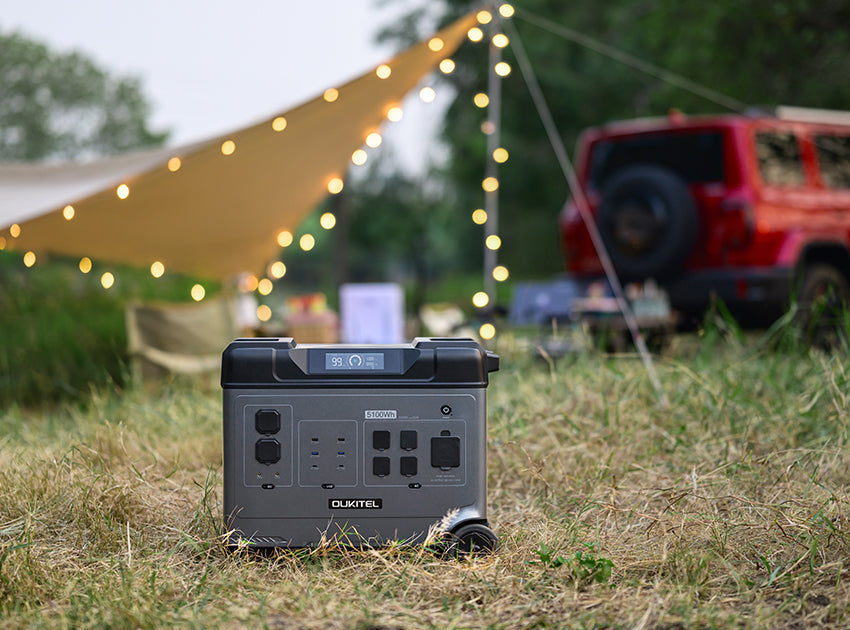
How Long Do Portable Power Stations Last? (2025 Lifespan & Care Guide)
With today’s LiFePO₄ batteries, a quality portable power station typically lasts 8–10 years (often longer) and 3,000–5,000+ cycles before capacity falls to ~80%. Actual lifespan depends on battery chemistry, depth of discharge, temperature, charge rate, and how you store it.
What a portable power station is (and isn’t)
A portable power station is a rechargeable battery + inverter + charge controller with multiple outputs (AC, 12 V DC, USB/USB-C). It doesn’t include solar panels by default—you can add compatible panels for off-grid recharging. Compared with fuel generators, stations are silent, fume-free, and low-maintenance, making them ideal for outages, camping, RV/van life, and work sites.
-
Capacity (Wh/kWh): how much energy the battery stores.
-
Cycle: one full charge + discharge (not necessarily in one go).
-
Depth of Discharge (DoD): how much of the battery you use each cycle.
-
Calendar aging: capacity lost over time even without cycling (chemistry + temperature driven).
The big lever: battery chemistry
|
Chemistry
|
Typical cycles to ~80% capacity
|
What it means for you
|
|
LiFePO₄ (LFP)
|
3,000–5,000+ cycles
|
Excellent longevity + stability; best for frequent cycling, hot/cold swings, home backup.
|
|
NMC/NCA (lithium-ion)
|
~500–1,500+ cycles
|
Lighter per Wh; good for weight-sensitive travel, but shorter cycle life.
|
Modern high-quality stations (including OUKITEL models) lean heavily on LiFePO₄, which is why real-world lifespans now commonly stretch to 8–10 years with good care—and beyond for light/occasional users.
What actually determines lifespan
-
Cycle count & DoD
-
Shallow cycles (e.g., 20–80%) age the pack more slowly than full 0–100% cycles.
-
If you can, stay mostly in the 20–80% window for daily use.
-
-
Temperature
-
Heat accelerates aging; cold reduces performance (temporarily) and can stress charging.
-
Ideal storage: ~20 °C (68 °F), dry, shaded, ventilated.
-
-
Charge rate (C-rate)
-
Frequent max-rate fast charging heats the pack. Use fast charge when you need speed; otherwise charge at moderate rates.
-
-
Resting SoC & storage
-
Don’t leave it empty for long.
-
For long storage, park it around 40–60% State of Charge and top up every 3–6 months.
-
-
Load & inverter stress
-
Running near maximum AC output continuously generates heat; budget headroom.
-
Realistic lifespan expectations
-
Frequent users (several cycles per week): 6–9 years before ~80% capacity.
-
Mixed users (weekends, seasonal backup): 8–10+ years likely.
-
Occasional users (emergency-only, well stored): Calendar aging governs—10–12+ years is plausible.
The “3–10 years” you often see online reflects older chemistries and harsher usage. With LiFePO₄ and reasonable care, 8–10 years is now a practical planning number.
How long does it run per charge? (Runtime basics)
Runtime depends on battery Wh, inverter losses, and device watts.
Estimated runtime (hours) ≈ (Battery Wh × 0.85–0.95) ÷ Load Watts
-
Use 0.90 as a simple planning factor for AC loads.
-
Motors/compressors (fridges, pumps) have startup surge—ensure your inverter’s surge rating covers that momentary spike.
Examples (round-numbers):
-
1,024 Wh station → 100 W router/lights: (1024×0.9)/100 ≈ 9.2 h
-
2,048 Wh station → 300 W fridge duty-cycle average: (2048×0.9)/300 ≈ 6.1 h (longer in real time if the compressor cycles)
Care & maintenance checklist (do this to hit 8–10 years)
-
Keep it cool & ventilated. Do not cover vents; avoid hot car trunks or direct sun.
-
Store at 40–60% SoC for >1 month idle; recheck every 3–6 months.
-
Operate mostly in 20–80% daily; charge to 100% right before big outings, not weeks in advance.
-
Avoid chronic max load. Budget 20–30% inverter headroom.
-
Use proper cables. Short, thick-gauge for higher DC loads.
-
Firmware/app updates. Grab BMS and display fixes when available.
-
Keep it clean & dry. Wipe dust; avoid moisture and corrosive environments.
Capacity, output & longevity: how to “right-size”
If your station is always near empty or frequently at max output, it runs hot and ages faster. Pick a capacity that fits your daily Wh with 20–30% reserve, and an inverter that exceeds your simultaneous watts + surge comfortably.
|
Typical use
|
Better long-term pick
|
|
Router, lights, phones
|
~500–1,000 Wh, 600–1,000 W inverter
|
|
Camping/van life + DC fridge
|
~1,000–2,000 Wh, 1,500–2,400 W inverter
|
|
Home backup (fridge + lights + devices)
|
2,000–5,000 Wh, 2,000–3,600 W inverter, solar input
|
|
Modular “stay powered” setups
|
Expandable 2–16 kWh stack for multi-day resilience
|
About EPS/“UPS-like” switchover (clarity)
Many modern stations offer EPS/UPS-like functionality (fast transfer when grid fails), often spec’d <10 ms for typical electronics. It’s not the same as a dedicated online double-conversion UPS, but it’s very useful for routers, PCs, fridges during brief flickers. (For mission-critical medical/IT loads, follow device guidance.)
OUKITEL model highlights (cycle-life-first)
Keep this light and benefits-focused; link to PDPs as appropriate.
-
P1000 Plus (≈1,024 Wh / 1,800 W) — LiFePO₄ ~4,000 cycles, 80% in ~39 min, very low noise at light loads; great “daily carry + outage” hybrid.
-
P2001 Plus / BP2000 (≈2,048 Wh / 2,400 W) — LFP, 3,500+ cycles, fast AC & solid solar input; balanced for RV + home backup.
-
P5000 / P5000 Pro (≈5,120 Wh / 2,200–3,600 W) — LFP, up to ~5,000 cycles, large single-box capacity for overnight fridges + circuits; excellent for storm belts.
-
BP2000 + B2000 expansion — modular 2–16 kWh growth path; charge fast (dual AC+PV), plan multi-day resilience.
Myths vs reality
-
“Fast charging always kills the battery.” Occasional fast charges are fine. Chronic max-rate charging in high heat isn’t. Mix fast (when necessary) with moderate charging for best life.
-
“Always store at 100%.” For long storage, 40–60% SoC is healthier. Top up before trips.
-
“Running to 0% calibrates the battery.” Deep discharges add stress. Occasional full cycles for BMS recalibration are okay, but don’t make 0% a habit.
Frequently Asked Questions
How many years do portable power stations last?
With LiFePO₄, expect 8–10 years of practical life (and often longer for occasional users). You’ll still be able to use the unit after that; you’ll just have less capacity.
How many cycles is “good”?
3,000–5,000+ cycles to ~80% remaining is common for quality LFP packs. If you cycle weekly, that’s many years; if you cycle daily, you still get a long runway.
Does keeping it plugged in hurt it?
Not inherently, but heat is the enemy. If your unit trickle-tops continuously in a hot space, that’s not ideal. Keep it cool and let the BMS do its job.
What’s the best charge level for storage?
~40–60% SoC. Top up every 3–6 months. Don’t store near empty.
Can I use it in the cold?
Yes, but performance drops. Charging below 0 °C (32 °F) may be restricted by the BMS. Warm the unit before charging.
Will solar make it last longer?
Solar doesn’t change cycle life directly, but it reduces deep cycles if you top up frequently—helpful for longevity.


Looking for something else?

Difference Between Amps and Volts: What You Actually Need to Know
LEARN MORE
50 Amps in Watts: The Honest 2026 Conversion Guide for RV, Home, EV, and Solar
LEARN MORE
Can You Put Solar Panels on a Mobile Home? (Real-World Guide for 2026)
LEARN MORE
Do Portable Solar Panels Qualify for the 30% Credit?
LEARN MORELooking for something else?

Are Solar Generators Any Good? Here's the Real Answer
LEARN MORE
How Long Does a Portable Power Station Last? (Real Numbers)
LEARN MORE
Oukitel Power Exhibits at Solar & Storage Live Philippines 2026: Carry the Sun, Power Your Freedom
LEARN MOREYou may also like

OUKITEL B2000 Expansion Battery | 2048Wh
$699.00
$999.00

OUKITEL BP5000 PRO MAX Portable Power Station 5000W | 5120Wh
$1,999.00
$2,999.00

OUKITEL C01 Car Jump Starter 1350A | 80Wh | PD60W
$159.00
$299.00

OUKITEL BP2000 PRO Portable Power Station 3300W
$879.00
$1,599.00

OUKITEL P2001 Plus+400W Solar Generator
$1,248.00
$1,598.00

OUKITEL P2001 Plus+2*200W Solar Generator
$759.00
$999.00
Further reading

OUKITEL Power Brings Full-Scenario Energy Storage Solutions to Intersolar Middle East 2026 in Dubai
September 1–3, 2026 — Intersolar Middle East 2026 is taking place at the Dubai World Trade Centre, UAE. OUKITEL Power is showcasing its latest energy storage solutions at Hall H8, Booth C10, connec...

Portable Power Stations for Power Tools and Job Sites: Surge, Runtime and Safety
A portable power station for power tools has to clear three separate limits before it earns a place on the truck: continuous AC output for the running load, surge capability for the motor start, an...

Portable Power Station for Starlink: Runtime, Solar and Off-Grid Setup
A portable power station for Starlink has to satisfy two separate requirements, not one: enough output to run the hardware, and enough stored energy to hold the runtime you need. Those are differen...