








 Flashlight
 Solar
Extension Cable
Solar
Extension Cable


What Size Portable Power Station Do I Need: Complete Guide
Choosing a portable power station can feel like learning a new language. You’re bombarded with terms like "pure sine wave." "surge capacity." and "LiFePO4." But the most common question remains: What size portable power station do I need?
If you buy a unit that is too small, your coffee maker won't start. If you buy one that is too large. You’re paying for capacity and carrying weight that you’ll never use. This guide will take the guesswork out of the process, helping you calculate your specific needs so you can invest in the right portable power station with confidence.
The Golden Rule: Watts vs. Watt-Hours

Before we dive into the math, you must understand the two primary numbers on every spec sheet.
- Watts (W) = Output Power: This is "speed." It determines what devices you can run. If your hair dryer needs 1,500W and your power station only outputs 1,000W. It simply won't turn on.
- Watt-Hours (Wh) = Capacity: This is the "fuel tank." It determines how long you can run those devices. A 1,000Wh battery can theoretically power a 100W light for 10 hours.
Pro Tip: Always look for the Surge or Peak Power rating as well. Devices with motors (like fridges or pumps) need a massive burst of energy to start up before settling into their "running" wattage.
Step-by-Step: How to Calculate Your Needs
To find your perfect fit, follow this simple 3-step formula used by professionals.
Step A: List Your Devices and Their Wattage
Flip your devices over and look for the silver label. It will list the "W" (Watts). If it only lists Amps (A) and Volts (V). multiply them: $Watts = Amps \times Volts$.
|
Device |
Average Wattage |
|
Smartphone |
5W – 10W |
|
Laptop |
50W – 100W |
|
CPAP Machine |
30W – 60W |
|
Mini Fridge |
60W – 100W |
|
Coffee Maker |
1,000W – 1,500W |
|
Full-Size Refrigerator |
150W (Running) / 800W (Startup) |
Step B: Determine Runtime
How many hours a day will you use each device?
- Example: Running a 60W CPAP machine for 8 hours = $480Wh$.
Step C: Apply the "Efficiency Buffer"
No power station is 100% efficient. Energy is lost as heat during the conversion from DC to AC. A good rule of thumb is to assume 85% efficiency.
- Formula: $(Total Watt-Hours \div 0.85) = Your Minimum Capacity$
Matching Sizes to Your Lifestyle

To make it easier, we’ve categorized Oukitel’s power stations into three common "use cases."
The Weekend Warrior (Small: 500Wh – 1,000Wh)
Best for: Day trips, tailgating, and keeping phones/laptops charged.
If you just need to keep the music playing and the phones charged during a beach day, a compact unit like the Oukitel P800 (512Wh)is ideal. It’s light enough to carry with one hand but beefy enough to run a projector for a backyard movie night.
The Dedicated Camper (Medium: 1,000Wh – 2,400Wh)
Best for: 2–3 day camping trips. CPAP users, and van life.
At this size. You can comfortably run a 12V portable fridge 24/7 and still have plenty of juice for lights and fans. The Oukitel P2001 Plus (2400W/2048Wh) is the "sweet spot" for many. offering enough output to even run a microwave or an electric grill.
The Home Backup & Off-Grid Pro (Large: 2,000Wh – 5,000Wh+)
Best for: Extended blackouts. RV living. and powering high-draw appliances.
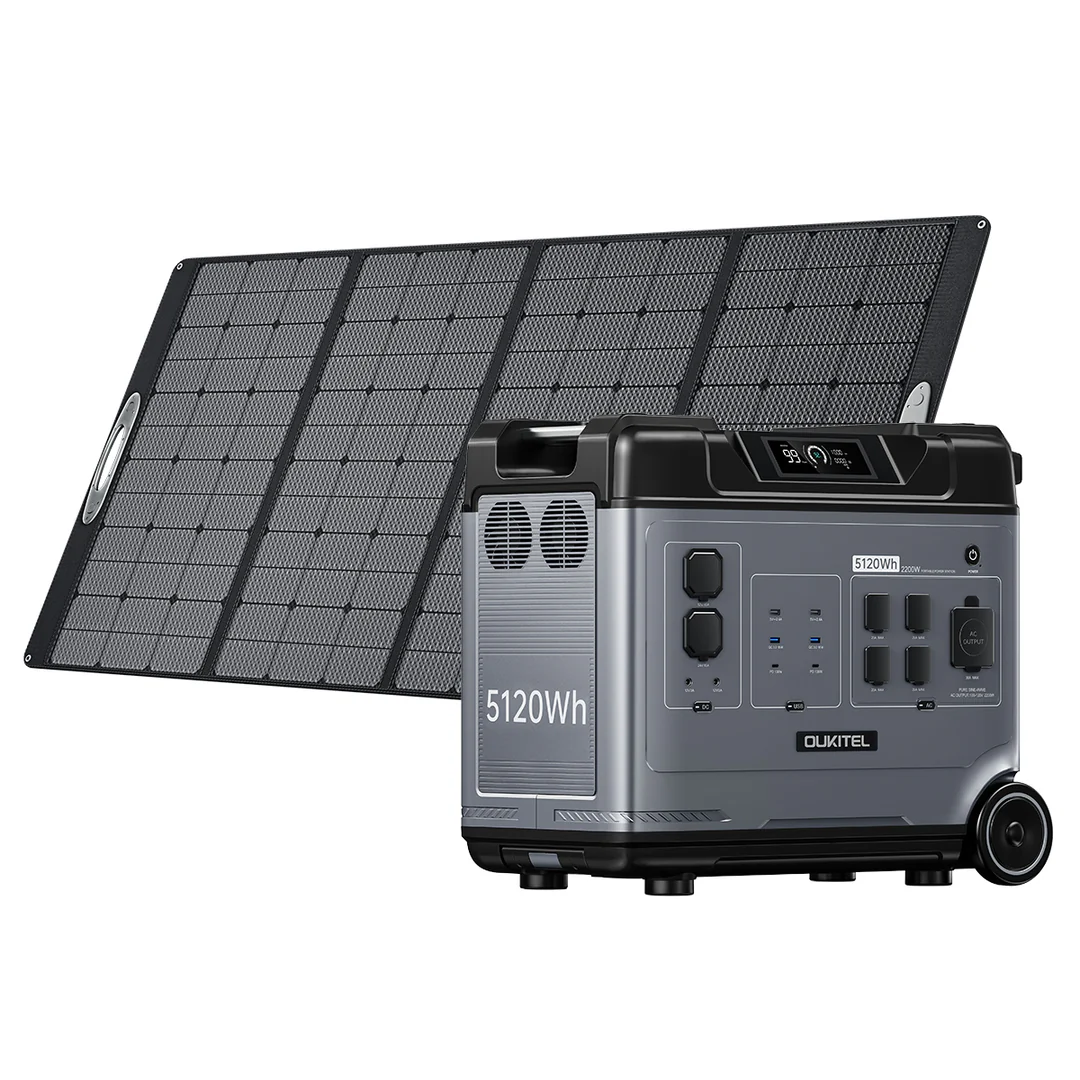
When the grid goes down. you need to keep the big fridge cold and the lights on. The Oukitel P5000 (5120Wh) is a beast in this category. With a 2200W output and a massive 5kWh capacity, it can keep a standard refrigerator running for nearly three days on a single charge.
Key Features to Look For in 2026

Size isn't everything. To get the best value for your money, ensure your power station includes these modern standards:
- LiFePO4 Battery Cells: Unlike older lithium batteries. LiFePO4 (Lithium Iron Phosphate) cells last for 3,500+ cycles. That’s nearly 10 years of daily use!
- UPS / EPS Function: Look for a unit with a <10ms switchover time. This allows the power station to act as an Uninterruptible Power Supply for your computer or home server.
- Fast Recharging: In 2026. you shouldn't have to wait 12 hours to charge. High-end units like the Oukitel P5000 can hit 80% charge in under 2 hours via a standard wall outlet.
- Solar Compatibility: Ensure the unit has a built-in MPPT controller for efficient solar charging.
Don't Forget Portability vs. Power
A 5000Wh battery is amazing. but it usually weighs over 100 lbs. If you plan on moving your power station frequently, look for models with built-in wheels and telescopic "suitcase" handles. This makes even the largest home backup units manageable for a single person to move from the garage to the living room.
CPAP and Medical Devices: Choosing for Reliability
For users who rely on a CPAP machine for sleep apnea, the question of "what size portable power station do I need" isn't just about convenience, it's about health.
- Average Draw: Most CPAP machines use between 30W and 60W.
- The Humidifier Factor: Turning on the heated humidifier or heated hose can triple your power consumption. jumping to 150W or more.
- Recommendation: If you plan to use a humidifier. look for a unit with at least 1,000Wh (like the Oukitel P1000 Plus ) to ensure you get a full 8 hours of sleep. If you use the machine in DC mode (without the humidifier), a smaller 500Wh unit can often last 2–3 nights.
Pro Tip: Using a DC converter cable for your CPAP instead of the standard AC plug can increase your battery efficiency by up to 20%, as it avoids the energy loss of the built-in inverter.
Battery Chemistry: Why LiFePO4 is the New Standard
When calculating the size you need, you also need to consider the longevity of that size. In 2026, the industry has shifted almost entirely to LiFePO4 (Lithium Iron Phosphate) chemistry.
- Cycle Life: Standard Lithium-ion batteries (NMC) typically last for 500 charge cycles before the capacity drops to 80%. LiFePO4 batteries. used in all modern Oukitel models. last for 3.500+ cycles.
- Safety: LiFePO4 is chemically stable and significantly less likely to overheat or catch fire. making it much safer for use inside a van, tent, or bedroom.
- Cost Over Time: While LiFePO4 units may be slightly heavier, they last 6–7 times longer than traditional lithium units. This means a 2.000Wh LiFePO4 station is a much better "size" investment for the long term than a cheaper, short-lived alternative.
Expandability: The "Grow-As-You-Go" Strategy
One of the biggest mistakes buyers make is buying a "fixed" size. If you think your power needs might grow perhaps, you're planning to add a portable heater or a larger fridge to your setup and later look for expandable power stations.
Some high-end units allow you to plug in "Expansion Batteries" (also known as B-units).
- Example: You might start with a 2,000Wh base unit for camping.
- The Expansion: When you decide to use it for whole-home backup. You can add two expansion batteries to reach a massive 10,000Wh+ capacity.
This modular approach prevents "buyer's remorse" by allowing you to increase your capacity without having to buy an entirely new primary power station.
Conclusion
If you are still asking. "What size portable power station do I need?". always lean slightly larger than your calculations. Having a 20% "safety margin" ensures that your battery won't die in the middle of the night, and it protects the long-term health of the battery cells by avoiding deep discharges.
Whether you're looking for a tiny companion for your next hike or a massive home backup solution, understanding your wattage is the first step toward energy freedom.
Frequently Asked Questions
Can a portable power station run a space heater?
Yes, but only if the output (Watts) is high enough. Most space heaters use 750W or 1.500W. You would need a medium-to-large station like the Oukitel P2001 plus to handle that load. and keep in mind it will drain the battery quickly.
How long will a 1000Wh power station last?
It depends on the load. If you are running a 100W device, it will last about 8.5 hours (after accounting for efficiency loss). If you are only charging a 10W phone, it could last for nearly 85 hours of active charging.
Is it worth getting a solar-compatible unit?
Absolutely. A power station without solar is just a big battery. With solar panels, it becomes a solar generator, allowing you to stay off-grid indefinitely as long as the sun is shining.
What is the difference between Rated Power and Surge Power?
Rated Power is what the unit can handle continuously. Surge Power is the short burst (usually 1-2 seconds) the unit can provide to start up motorized appliances like pumps or compressors.
Can I leave my power station plugged in all the time?
Most modern units with a Battery Management System (BMS), like those from Oukitel are designed to handle being plugged in. They will automatically stop charging once full to protect the battery.


Looking for something else?

Difference Between Amps and Volts: What You Actually Need to Know
LEARN MORE
50 Amps in Watts: The Honest 2026 Conversion Guide for RV, Home, EV, and Solar
LEARN MORE
Can You Put Solar Panels on a Mobile Home? (Real-World Guide for 2026)
LEARN MORE
Do Portable Solar Panels Qualify for the 30% Credit?
LEARN MORELooking for something else?

Are Solar Generators Any Good? Here's the Real Answer
LEARN MORE
How Long Does a Portable Power Station Last? (Real Numbers)
LEARN MORE
Oukitel Power Exhibits at Solar & Storage Live Philippines 2026: Carry the Sun, Power Your Freedom
LEARN MOREYou may also like

OUKITEL B2000 Expansion Battery | 2048Wh
OUKITEL BP5000 PRO MAX Portable Power Station 5000W | 5120Wh
OUKITEL C01 Car Jump Starter 1350A | 80Wh | PD60W

OUKITEL BP2000 PRO Portable Power Station 3300W

OUKITEL P2001 Plus+400W Solar Generator

OUKITEL P2001 Plus+2*200W Solar Generator
Further reading

OUKITEL Power Brings Full-Scenario Energy Storage Solutions to Intersolar Middle East 2026 in Dubai

Portable Power Stations for Power Tools and Job Sites: Surge, Runtime and Safety
