








 Flashlight
 Solar
Extension Cable
Solar
Extension Cable


Power Tool Battery Standardization: Benefits and Guidelines
If you own a cordless drill from one brand and a leaf blower from another, you have likely felt the frustration of having a drawer full of incompatible chargers. For years, the "walled garden" approach of tool manufacturers forced users to stick to a single brand or face the mounting costs of duplicate batteries.
However, 2026 marks a turning point. Power tool battery standardization is moving from a consumer dream to a market reality. Through industry alliances and the rise of universal adapters, the way we power our workshops is becoming more efficient, sustainable, and cost-effective.
What is Power Tool Battery Standardization?

At its core, battery standardization is the push for a common interface (the physical plug and electronic communication) that allows a single battery pack to work across multiple tool brands.
While we haven't reached a single "universal" battery for every brand on earth. We are seeing the rise of Battery Alliances. These are groups of manufacturers that agree to use the same battery technology.
- CAS (Cordless Alliance System): Over 45 brands. including Metabo and Steinel, use the exact same 18V battery.
- AmpShare: A collaboration between Bosch Professional and dozens of specialty brands.
- Power for All Alliance: A consumer-focused group including Bosch (Green line). Husqvarna. and Gardena.
The "DOGE" Mandate Rumors
Interestingly, in early 2025, discussions around a "Department of Government Efficiency" (DOGE) style approach to reducing consumer waste brought battery standardization into the political spotlight. The goal? To mandate that manufacturers use open-standard battery interfaces to reduce the millions of tons of electronic waste generated by proprietary "orphaned" batteries.
The Major Benefits of a Standardized System

Cost Savings
Power tool batteries are often the most expensive part of a tool kit. sometimes costing as much as $150 for a high-capacity pack. With standardization, you can buy "bare tools" (tools sold without batteries). saving you 30% to 50% on every new purchase.
Reduced Environmental Impact
An estimated 20 million power tool batteries are discarded annually in the US alone. Standardization extends the life of a battery; even if your old drill breaks, the battery remains useful for your new saw or sander. keeping heavy metals out of landfills.
Streamlined Workshop
Instead of a "charging station" that looks like a tangled web of wires, a standardized system allows you to use one or two high-speed chargers for every tool in your shed. This saves space and reduces the mental load of tracking which battery goes with which tool.
Power Tool Battery Standardization Chart: Compatibility at a Glance
While waiting for a global standard. many users rely on a power tool battery standardization chart to find cross-compatible brands or identify which adapters are safe to use.
|
Battery Brand |
Compatible System/Alliance |
Voltage Class |
Primary Focus |
|
Metabo |
CAS (Cordless Alliance System) |
18V |
Industrial/Heavy Duty |
|
Bosch Pro |
AmpShare |
18V |
Professional Trades |
|
Bosch Home |
Power For All |
18V |
DIY/Garden |
|
Milwaukee |
Proprietary (Adapters available) |
18V/M18 |
Professional/Automotive |
|
DeWalt |
Proprietary (Adapters available) |
20V Max* |
Construction |
Note: 20V Max and 18V Nominal are effectively the same voltage; 20V is a marketing term for the peak voltage at start-up.
Guidelines for Using Battery Adapters

If you aren't ready to buy into a new alliance. battery adapters are the current workaround. These plastic mounts sit between a DeWalt battery and a Milwaukee tool, for example. However, you must follow these safety guidelines:
- Avoid Over-Discharge: Many batteries (like Makita) have their protection circuitry inside the battery. while others (like DeWalt) have it in the tool. If you use a DeWalt battery on a Makita tool via a cheap adapter. you may accidentally drain the battery to 0V. permanently killing the cells.
- No Charging Through Adapters: Never attempt to charge a battery through an adapter on a different brand's charger. This is a significant fire risk.
- Monitor Heat: Adapters add resistance. If the tool feels unusually hot near the battery connection. stop using it immediately.
Maximizing Lifespan: The 40–80 Rule
Standardization makes batteries more versatile. but it doesn't make them invincible. To ensure your standardized packs last for years, apply the 40–80 Rule:
Lithium-ion batteries are happiest when their state-of-charge is kept between 40% and 80%.
- Avoid 0%: Deeply discharging your power tool battery causes chemical stress.
- Avoid Constant 100%: Leaving a battery on the charger at 100% for weeks creates "voltage stress" that degrades capacity.
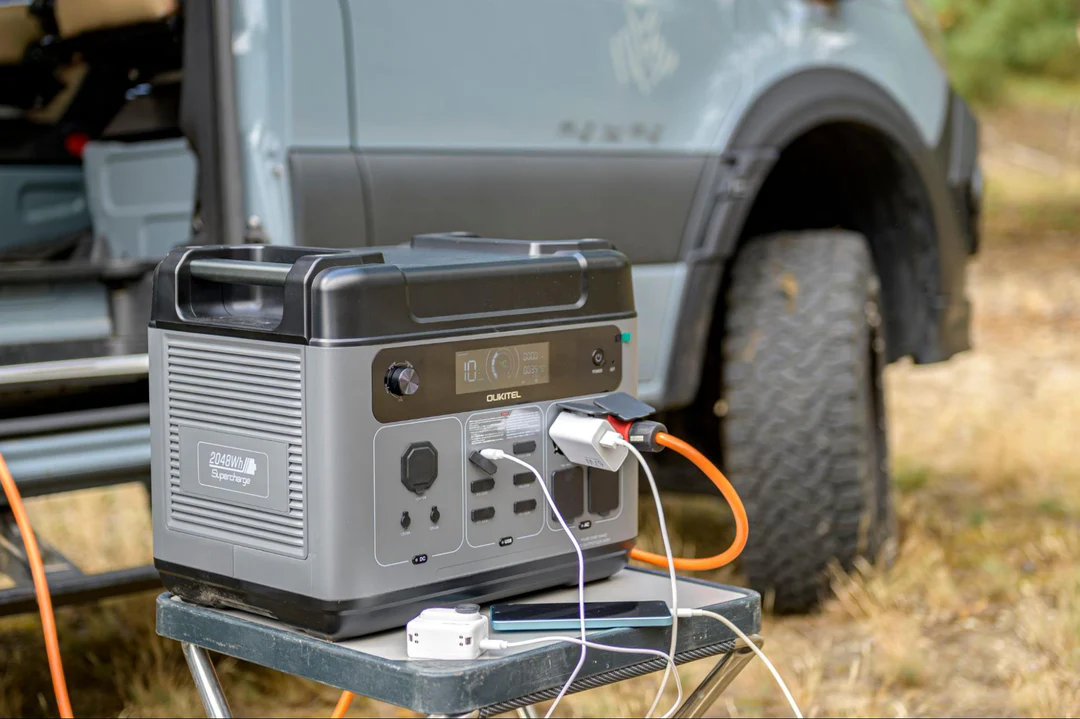
For those using their tools in off-grid environments or job sites without power, pairing your standardized batteries with a portable power station is the ultimate efficiency hack. You can use the power station to keep your batteries within the 40–80% "sweet spot" throughout the day, recharging them via solar panels while you work.
Future Trends: Toward Universal Energy
The future of power tools is likely headed toward the Watt-Hour (Wh) standard rather than just Volts and Amps. As we see more high-voltage tools (60V and 80V), standardized "smart batteries" that can communicate with the tool to provide the exact voltage required will become the norm.
Brands like Oukitel are already leading this charge in the portable power sector. using LiFePO4 chemistry that offers 3,000+ cycles far outlasting the 500–800 cycles of traditional power tool batteries.
The Rise of the "Digital Battery Passport"
By 2026, a major shift in battery standardization is the introduction of the Digital Battery Passport. This is a regulatory framework (pioneered in the EU but spreading globally) that requires every professional-grade battery to carry a scannable QR code.
- What it Tracks: The passport provides instant data on the battery’s material origins (cobalt. lithium. nickel). its carbon footprint during manufacturing. and its current "State of Health" (SoH).
- The Standardization Benefit: For users of Oukitel power stations, this means you can scan a battery to see exactly how many life cycles it has left before you commit it to a high-drain tool like a circular saw.
- End-of-Life Efficiency: This system standardizes the recycling process. as recyclers no longer have to guess the chemistry inside a pack.
Smart Alliances: CAS vs. AmpShare in 2026
Standardization has crystallized into two dominant "Smart Alliances" that now control a huge portion of the professional market. Choosing the right one is the best way to future-proof your toolbox.
The Cordless Alliance System (CAS)
Led by Metabo, this is the world’s most diverse 18V system. It includes over 45 manufacturers specializing in everything from heavy-duty construction to specialized plumbing and landscape tools. If you use CAS, you can move your battery from a Metabo drill to a Rothenberger pipe press without a second thought.
AmpShare (Powered by Bosch)
This is the professional-grade answer to universal power. AmpShare allows you to use Bosch Professional batteries on dozens of other brands like Fein and Wagner.
Guideline: If you are a general contractor. AmpShare is often the better choice due to the sheer volume of Bosch tools. If you are a specialized trade (like a roofer or HVAC tech), the CAS system offers more niche. high-performance tools that share a single battery platform.
Leveraging GaN Technology for Universal Charging
Standardization isn't just about the battery; it’s about the charger. In 2026. Gallium Nitride (GaN) technology has revolutionized how we keep our tool batteries ready.
- The Compact Hub: Traditional chargers are bulky and brand-specific. Modern GaN chargers are 40% smaller and often feature USB-C Power Delivery (PD) 3.1 ports.
- The Oukitel Advantage: High-capacity systems like the Oukitel P5000 can now act as a "Charging Hub" for multiple battery platforms simultaneously. By using a standardized GaN multi-port charger, you can charge your Milwaukee, DeWalt, and Bosch batteries from a single Oukitel AC outlet, significantly reducing the "charger clutter" in your workspace.
- Thermal Efficiency: GaN chargers run much cooler, which aligns perfectly with the 40–80 Rule. Lower heat during the charging process preserves the internal chemistry of your standardized packs. extending their life by up to 25%.
Final Summary Table: The Standardization Checklist
|
Feature |
Importance |
Why It Matters in 2026 |
|
Alliance Membership |
High |
Ensures a wide range of "Bare Tool" availability. |
|
LiFePO4 Chemistry |
Very High |
Provides 3,000+ cycles compared to 500 for standard Li-ion. |
|
Digital Passport |
Medium |
Critical for resale value and responsible recycling. |
|
GaN Charging |
High |
Reduces heat and allows for multi-brand charging hubs. |
Conclusion: Your Path to a Smarter Workshop
Power tool battery standardization is about more than just convenience, it’s about energy independence. By choosing tools within a recognized alliance and practicing smart battery management. you save money and reduce your carbon footprint.
Would you like me to help you identify which battery alliance fits your current tool collection?
Frequently Asked Questions
Can I use a 20V battery on an 18V tool?
Yes, in most cases. "20V Max" is a marketing term for the 18V nominal voltage. They are electrically compatible. provided the physical connection (or adapter) fits.
Does the 40–80 rule really matter for power tools?
Yes! While you often need 100% for a long project, keeping your batteries between 40–80% during storage and light use can double the number of years they remain effective.
What is the most widely compatible battery alliance?
Currently, the Cordless Alliance System (CAS) is the leader in the professional space with over 45 brands, while Power for All is the largest for home and garden tools.
Will using a battery adapter void my tool's warranty?
Almost certainly. Manufacturers generally state that using non-OEM (Original Equipment Manufacturer) batteries or adapters voids the warranty. Use them on older, out-of-warranty tools first.
How can a portable power station help with tool batteries?
A portable power station allows you to charge your standardized batteries anywhere. Instead of needing 10 batteries to last a day, you can rotate 3 batteries. keeping them charged via the power station and solar panels.


Looking for something else?

Difference Between Amps and Volts: What You Actually Need to Know
LEARN MORE
50 Amps in Watts: The Honest 2026 Conversion Guide for RV, Home, EV, and Solar
LEARN MORE
Can You Put Solar Panels on a Mobile Home? (Real-World Guide for 2026)
LEARN MORE
Do Portable Solar Panels Qualify for the 30% Credit?
LEARN MORELooking for something else?

Are Solar Generators Any Good? Here's the Real Answer
LEARN MORE
How Long Does a Portable Power Station Last? (Real Numbers)
LEARN MORE
Oukitel Power Exhibits at Solar & Storage Live Philippines 2026: Carry the Sun, Power Your Freedom
LEARN MOREYou may also like

OUKITEL P2001 Solar Generator

OUKITEL P1000 PLUS Portable Power Station 1800W | 1024Wh


OUKITEL BP2000 Portable Power Station 2200W | 2048Wh

OUKITEL P5000 Pro Portable Power Station 5120Wh | 3600W
OUKITEL P5000 Solar Generator for Home with 400W Solar Panel
Further reading

OUKITEL Power Brings Full-Scenario Energy Storage Solutions to Intersolar Middle East 2026 in Dubai

Portable Power Stations for Power Tools and Job Sites: Surge, Runtime and Safety
