








 Flashlight
 Solar
Extension Cable
Solar
Extension Cable


Watts to BTU/hr: How to Convert and Apply the Formula
Whether you are sizing a new air conditioner, planning an off-grid solar setup, or preparing for home emergencies, you will inevitably encounter different units of power and heat. Some appliances use Watts (W), while heating and cooling systems often use BTUs per hour (BTU/hr).
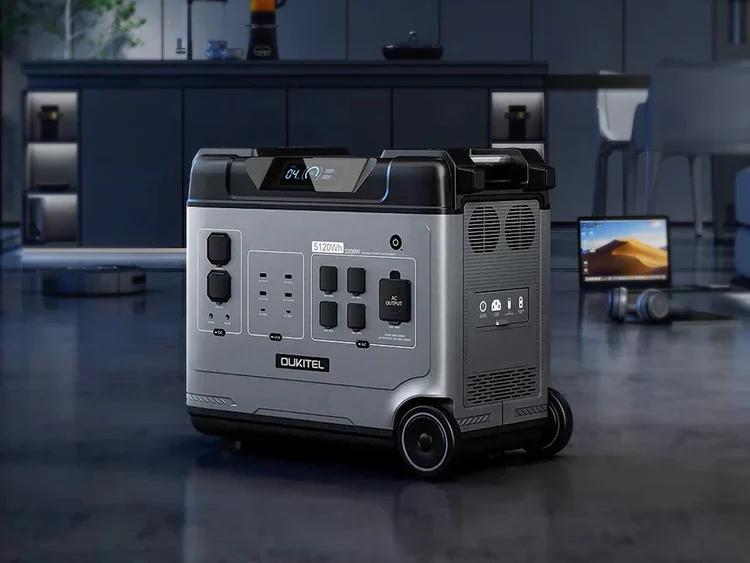
Understanding how to convert between these units is crucial for energy efficiency, proper sizing, and ensuring your equipment runs reliably. This guide breaks down the Watts to BTU/hr conversion, provides practical examples, and demonstrates how to use a portable power station like the OUKITEL P5000 for your energy needs.
Core Definitions: Watts vs. BTU/hr
Before diving into formulas, it’s important to know what you’re measuring:
What is a Watt?
A Watt (W) is the metric unit of power, representing the rate of energy transfer. One watt equals one joule per second. Electrical devices are commonly rated in watts to indicate how much energy they consume.
What is a BTU?
A British Thermal Unit (BTU) is a traditional unit of heat. One BTU represents the energy needed to raise the temperature of one pound of water by one degree Fahrenheit.
BTU per Hour (BTU/hr)
This measures the rate of heat transfer, similar to how watts measure electrical power. For example, an air conditioner rated at 12,000 BTU is actually outputting 12,000 BTU/hr.
The Universal Conversion Formula
The relationship between Watts and BTU/hr is defined by a constant:
To Convert Watts to BTU/hr:
BTU/hr=Watts×3.412\text{BTU/hr} = \text{Watts} \times 3.412BTU/hr=Watts×3.412
To Convert BTU/hr to Watts:
Watts=BTU/hr3.412\text{Watts} = \frac{\text{BTU/hr}}{3.412}Watts=3.412BTU/hr
Why 3.412?
One watt of electrical power generates roughly 3.412 BTUs of heat energy per hour. Using this decimal ensures precise calculations for HVAC and off-grid power systems.
Quick Reference Conversion Tables
Watts → BTU/hr
|
Watts (W) |
BTU/hr (Approx.) |
Typical Application |
|
100 |
341 |
Incandescent bulbs, laptops |
|
500 |
1,706 |
Small desktop PC |
|
1,000 |
3,412 |
Small space heater, toaster |
|
1,500 |
5,118 |
Standard electric heater |
|
2,000 |
6,824 |
Large electric grill |
BTU/hr → Watts
|
BTU/hr |
Watts (W) |
Typical Application |
|
5,000 |
1,465 |
Small window AC |
|
8,000 |
2,345 |
Medium bedroom AC |
|
12,000 |
3,517 |
1-ton mini split, large room AC |
|
18,000 |
5,275 |
Large living area cooling |
Real-World Application: Sizing Your Solar Generator

Converting Watts and BTU/hr is especially important for off-grid setups. Let’s consider a 5,000 BTU/hr air conditioner:
- Step 1: Convert to Watts
5,000÷3.412=1,465 Watts5,000 \div 3.412 = 1,465 \text{ Watts}5,000÷3.412=1,465 Watts
-
Step 2: Check your power station
A portable power station like the OUKITEL P5000 (5120Wh / 2200W) can easily handle this load. A smaller 1000W unit would fail to start the AC compressor. -
Step 3: Consider efficiency (EER)
High-efficiency ACs use less power. For example, an AC with an EER of 10 draws only 500W to deliver 5,000 BTU/hr of cooling.
Tip: Always check for startup surge requirements. AC compressors can temporarily draw 2–3× more power than their running wattage. The OUKITEL P5000’s 2200W output and 4000W surge handles most household ACs safely.
Efficiency Metrics: EER vs. COP

Understanding efficiency is key:
- EER (Energy Efficiency Ratio) = BTU/hr output ÷ Watts input
- COP (Coefficient of Performance) = Watts output ÷ Watts input (dimensionless)
- Conversion trick:
EER=COP×3.412\text{EER} = \text{COP} \times 3.412EER=COP×3.412
A heat pump with a COP of 3.0 is effectively delivering an EER of 10.2, providing 10.2 BTUs of heating/cooling per watt consumed.
Applications Beyond HVAC
- Home Backup Power: Space heaters, AC units, and refrigerators can be sized accurately with Watts ↔ BTU/hr conversions.
- Off-Grid Solar Systems: Pair the OUKITEL P5000 with solar panels to ensure sufficient energy for critical devices.
- Servers & Data Centers: Nearly 100% of electrical energy consumed by servers converts to heat. An 800W server with an 85% efficient PSU generates ~3,211 BTU/hr.
Sensible vs. Latent Heat:
Sensible heat lowers air temperature, while latent heat removes humidity. A proper BTU/hr calculation ensures comfort in humid climates.
Summary Table: HVAC Performance Metrics
|
Metric |
Formula |
Units |
Context |
|
Heat Load |
W × 3.412 |
BTU/hr |
Device heat output |
|
Cooling Power |
W × EER |
BTU/hr |
AC cooling capacity |
|
COP |
EER ÷ 3.412 |
Ratio |
Heating/Cooling efficiency |
|
Tons of Cooling |
BTU/hr ÷ 12,000 |
Tons |
Residential sizing |
Conclusion
Mastering Watts ↔ BTU/hr conversion is critical for energy efficiency, accurate HVAC sizing, and reliable off-grid power planning. Whether it’s a home AC, space heater, or server room, using the OUKITEL P5000 Portable Power Station ensures your devices have the power they need, even during blackouts or off-grid scenarios.
Frequently Asked Questions
How many Watts are in 12.000 BTU/hr?
A 12.000 BTU/hr unit is equivalent to approximately 3.517 Watts of thermal power. However, due to efficiency (EER), the actual electrical draw is often much lower (usually 1.000W to 1.500W).
Can I run a 5.000 BTU AC on a 1000W portable power station?
Probably not. While the running wattage might be around 500W–600W, the startup surge of the compressor often exceeds 1,500W, which would trip the safety sensors on a 1000W station.
What is the difference between BTU and BTU/hr?
BTU is a measurement of energy quantity. BTU/hr is a measurement of power. or the speed at which that energy is being used or moved.
How do I convert Kilowatts (kW) to BTU/hr?
Since 1 kW = 1.000 Watts. simply multiply the kW value by 3.412. For example, $2 \text{ kW} \times 3.412 = 6.824 \text{ BTU/hr}$.
Why do heaters use Watts and ACs use BTUs?
In the US. HVAC cooling capacity has traditionally been measured in BTUs. Electrical heating is measured in Watts because it is a direct 1:1 conversion of electrical resistance to heat.


Looking for something else?

Difference Between Amps and Volts: What You Actually Need to Know
LEARN MORE
50 Amps in Watts: The Honest 2026 Conversion Guide for RV, Home, EV, and Solar
LEARN MORE
Can You Put Solar Panels on a Mobile Home? (Real-World Guide for 2026)
LEARN MORE
Do Portable Solar Panels Qualify for the 30% Credit?
LEARN MORELooking for something else?

Are Solar Generators Any Good? Here's the Real Answer
LEARN MORE
How Long Does a Portable Power Station Last? (Real Numbers)
LEARN MORE
Oukitel Power Exhibits at Solar & Storage Live Philippines 2026: Carry the Sun, Power Your Freedom
LEARN MOREYou may also like

OUKITEL P2001 Plus+400W Solar Generator

OUKITEL P2001 Plus+2*200W Solar Generator

OUKITEL P2001 Plus+200W Solar Generator

OUKITEL BP3000 Portable Power Station 3200W | 2048Wh

OUKITEL P5000 Pro+400W Solar Generator

OUKITEL BP2000+400W Solar Generator
Further reading

OUKITEL Power Brings Full-Scenario Energy Storage Solutions to Intersolar Middle East 2026 in Dubai

Portable Power Stations for Power Tools and Job Sites: Surge, Runtime and Safety
