








 Flashlight
 Solar
Extension Cable
Solar
Extension Cable


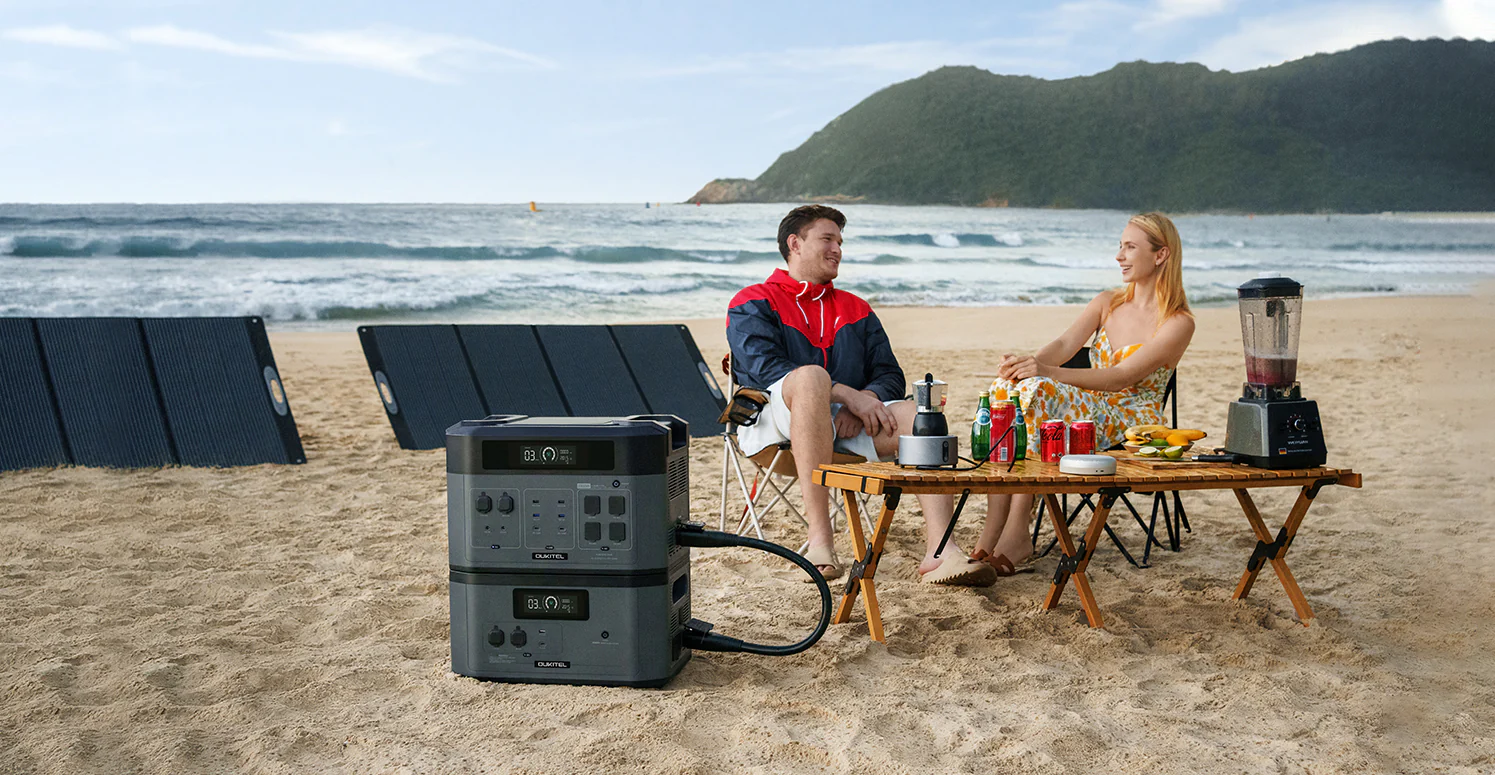
How Long Do Portable Power Stations Last? 2026 Lifespan and Runtime Guide
How long do portable power stations last? Two answers, because people are really asking two different things. On one charge, 30 minutes to five days. Over its life, a good LiFePO4 unit runs 10 to 25 years.
Here's what trips buyers up. The number on the box tells you how much energy is stored. Your appliance decides how fast it leaves. The years question is separate, and slower, because batteries fade a little at a time.
We've sized hundreds of these for hurricane prep, RV builds, and off-grid cabins. The two questions get mixed up constantly. Below: the runtime math, the real lifespan numbers, what wears a unit out, and which OUKITEL models go the distance.
How Long Does a Portable Power Station Last on One Charge?
Mostly math. Battery watt-hours times 0.85, divided by your load in watts, gives you the hours.
That 0.85 is the conversion loss every lithium unit pays turning stored DC into usable AC. Light loads barely feel it. Push past 80% of the inverter rating and it runs hot, dropping closer to 0.75.
Here's the runtime across four loads people actually run:
|
Battery |
50W CPAP |
100W Fridge |
500W Coffee |
1,500W Microwave |
|
500Wh |
~8 hr |
~4 hr |
~50 min |
not feasible |
|
1,024Wh |
~17 hr |
~9 hr |
~1.7 hr |
~30 min |
|
2,048Wh |
~35 hr |
~17 hr |
~3.5 hr |
~1.2 hr |
|
5,120Wh |
~87 hr |
~43 hr |
~8.7 hr |
~2.9 hr |
Fridges are the exception, and it works in your favor. The compressor only runs 30 to 40% of any hour, then rests. So real cooling time stretches 2.5 to 3 times past the math. A 1,024Wh unit shows 9 hours of pure compressor time on a 100W fridge. It keeps food cold for a full day.
How Long Do Portable Power Stations Last in Years?
Ten to twenty-five years for most owners. The chemistry is rated for thousands of cycles before it ever drops to 80% capacity.

[IMAGE: Alt: how long do portable power stations last in years - LiFePO4 cycle life chart by use intensity | 4:3 inline]
Run the numbers on one cycle a week, normal for RV or storm-prep use, and a 3,500-cycle battery has decades in it. The cells almost never quit first, though. The electronics do. Inverter parts, the BMS board, connectors.
How long yours lasts comes down to how hard you cycle it:
- Light use, 10 to 20 cycles a year: 25-plus years before you notice a thing
- Moderate use, 50 to 100 cycles a year: 15 to 20 years
- Heavy daily off-grid use, 300-plus cycles a year: 8 to 12 years
- Hot, humid climate, constant exposure: 7 to 10 years
- Standby backup, rarely cycled: 15 to 20 years
This is where chemistry decides everything. LFP runs 3,000 to 5,000-plus cycles. The NMC lithium in cheap units gives out at 500 to 1,000. The U.S. Environmental Protection Agency tracks lithium-ion safety and end-of-life handling, and the takeaway holds either way: LFP ages slower and runs more stable.
|
Metric |
LiFePO4 (LFP) |
NMC Lithium |
|
Cycles to 80% |
3,000 to 5,000+ |
500 to 1,000 |
|
Lifespan at weekly cycling |
Decades |
10 to 20 years |
|
Thermal stability |
Much more stable, lower runaway risk |
Higher risk under abuse |
|
Cold tolerance |
Works to around -4F |
Fades sooner |
|
Weight per Wh |
Heavier |
Lighter |
Which Factors Shorten a Power Station's Lifespan?
Five things age a unit faster than the rest. Almost all of them are habits you can fix.
Temperature Extremes
LFP loses 10 to 20% capacity in freezing cold, and charging while frozen does permanent harm. Heat above 113F ages it fast. Keep it between 50 and 80F and you sidestep both.
Deep Discharges, Over and Over
Running to empty every time stresses cells more than shallow cycling does. The BMS stops the drain around 5 to 10% to protect them. The habit still wears it down, though, so shallow beats deep.
Sitting Full or Empty for Months
At 100%, a battery loses 2 to 4% permanently each year. At 0%, the protection latch can kill cells outright. Park it at 50 to 80% for anything longer than a few weeks.
Fast Charging All the Time
Topping up in under an hour makes more heat, and doing it constantly cuts cycle life 15 to 25%. Mix it up. Fast when you need it, slow when you don't.
Skipping Firmware Updates
Old firmware runs cells outside their best voltage window. Update through the app every six months, and glance at the dashboard for warning flags while you're in there.
How Do Power Stations Age Over the Years?
LFP loss follows a curve you could set a watch to. First 100 cycles, no measurable drop. Cycles 100 to 1,000, about 5% total. From 1,000 to 3,000, another 15%, which is the 80% mark. Past that it still works fine. Just holds a little less.
The customer units we've tracked over five-plus years tell the same story every time:
- Year 1, around 50 cycles: full capacity, no change
- Year 3, around 150 cycles: 98 to 99%, nothing you'd feel
- Year 5, around 250 cycles: 95 to 97%, a mild dip
- Year 8, around 400 cycles: 92 to 94%, still strong
- Year 12, around 600 cycles: 87 to 90%, worth a check
- Year 20-plus, past 1,000 cycles: 80 to 85% if you've been gentle
Heat speeds that curve up 25 to 40%. Fast-charging, another 15 to 25%. Storing it full, another 10 to 15%. Flip those habits and a good unit lasts decades.
Should You Replace a Power Station That Has Lost Capacity?
Usually not. A unit at 80% still works completely. The only change is the tank size, so a 2,048Wh battery now holds about 1,638Wh.
For weekend campers, that gap barely registers. For storm prep sized to a specific outage, you might want more. A few clearer signals say it's time:
- Capacity past 70%, visibly cutting your coverage short
- BMS warnings that keep returning after a firmware update
- An inverter struggling to hold its rated continuous wattage
- Charging that stalls short of 100% on a full grid charge
- Cells running warmer than they used to during a normal session
Before buying new, look at expansion first. In our experience, an expansion battery beats a full replacement nine times out of ten for serious users on a good platform. Many premium units stack five to seven packs off one inverter. Plan for it at purchase, though. Not every model supports it.
Which OUKITEL Power Stations Last the Longest?
Every OUKITEL unit runs LiFePO4, so the whole lineup shares the same long-life base. What changes is capacity, output, and cycle rating.
OUKITEL P1000 Plus (Entry Pick)
The OUKITEL P1000 Plus carries 1,024Wh, 1,800W, and a 4,000-cycle rating to 80%, at about 26 pounds. Charges to 80% in 39 minutes, with a slow mode when you want to baby the cells. A decade-plus of weekend and emergency use, easy.

Alt: OUKITEL P1000 PLUS Portable Power Station 1800W/1024Wh
OUKITEL BP2000 (Our Workhorse)
The OUKITEL BP2000 starts at 2,048Wh and expands to 16,384Wh with B2000 packs. 2,200W continuous, 0 to 80% in 1.5 hours, switchover under 10 milliseconds. This is the one we point most buyers to for a decade of regular cycling.

Alt: OUKITEL BP2000 Portable Power Station 2200W/2048Wh
OUKITEL P5000 Pro (Long-Haul Flagship)
The OUKITEL P5000 Pro holds 5,120Wh and pushes 3,600W continuous, rated for 5,000 cycles to 80%. Built for partial-home backup that lasts a generation.
 Alt : OUKITEL P5000 Pro Portable Power Station 5120Wh/3600W
|
Spec |
P1000 Plus |
BP2000 |
P5000 Pro |
|
Capacity |
1,024Wh |
2,048Wh (to 16,384Wh) |
5,120Wh |
|
Output |
1,800W |
2,200W |
3,600W |
|
Chemistry |
LiFePO4 |
LiFePO4 |
LiFePO4 |
|
Cycles to 80% |
4,000 |
3,500+ |
5,000 |
|
EPS switchover |
<10ms |
<10ms |
<10ms |
|
Price |
Check current pricing |
Check current pricing |
Check current pricing |
Not sure which size fits your loads? Our portable power station sizing guide walks through it appliance by appliance.
How Do You Make a Power Station Last Longer?
Picking the right unit is half of it. The rest is care. Five habits add real years to any LFP unit:
- Store it at 50 to 80% for the long haul, not a full 100%
- Don't charge it when the cells are below freezing
- Run one full charge, then a deep discharge, every three months to keep the gauge honest
- Update the firmware twice a year
- Wipe the cooling vents clean once a month
Solar takes it further. Pair a panel with the unit and you can keep it topped off off-grid as long as the sun holds. The U.S. Department of Energy's solar technologies resources cover the longevity side of residential setups if you want the detail.
Pick a Power Station Built for the Long Haul
Three checks before you buy any portable power station:
- Confirm the chemistry is LiFePO4, not NMC. LFP runs 3,000 to 5,000-plus cycles versus 500 to 1,000. A decade of difference.
- Read the cycle rating to 80% capacity. Treat 3,000-plus as the modern floor. More is better.
- Check the warranty on the electronics. The cells outlive everything, so coverage on the inverter and BMS is what protects you.
For the best mix of lifespan and value, our default is the OUKITEL BP2000. On a tight budget that still needs decade-plus life, the P1000 Plus. For backup that lasts a generation, the P5000 Pro. Weighing it against a gas unit? Our home backup generators guide lays out the tradeoffs.
FAQs
How long can you run a TV on a portable power station?
Longer than the outage, usually. A 32-inch LED pulls 50 to 80W. A 55-inch smart TV, 80 to 120W. A 65-inch QLED climbs to 120 to 180W on bright HDR scenes. Match that draw to your battery and the hours fall right out.
On a typical 55-inch set:
- 500Wh battery: about 5 hours of streaming
- 1,024Wh battery: about 9 hours
- 2,048Wh battery: about 17 hours
- 5,120Wh battery: about 43 hours
- Add 15W if the WiFi router runs off it too
The TV almost never taps out first. Battery size sets the ceiling. Pick capacity for your worst expected outage and movie night is fine.
How long does a 200W portable power station last?
Not long, and the spec misleads. The 200W is the inverter rating, not the battery. Most units in this class carry just 200 to 300Wh. At 50W that's 3 to 5 hours. At 100W, 1.5 to 2.5. At full 200W, under an hour.
What it realistically covers:
- Phone charging: weeks of partial top-offs
- Laptop work: 2 to 4 hours
- LED string lights: 6 to 10 hours
- A small fan: 4 to 6 hours
- A mini fridge: 30 to 60 minutes, briefly
Camping gear, basically. Not home backup. For a fridge through a real outage, you want 1,000Wh or more.
How long does a 3,000W power station last?
Depends on the battery behind it. The 3,000W is the output ceiling, not the tank. These units carry 2,000 to 5,000Wh. At a light 100W load, 17 to 43 hours. At a full 3,000W pull, under an hour. Most use sits between.
Some grounded examples:
- 2,000Wh at a 200W average: about 8.5 hours
- 3,000Wh at 500W: about 5 hours
- 5,000Wh at 1,000W: about 4.5 hours
- 5,000Wh at 200W: around 21 hours
- 5,000Wh on a 50W CPAP: about 87 hours
The inverter buys surge room. The battery buys hours. Two specs. Don't confuse them.
How long will a 20,000mAh power bank last?
Barely a blip. 20,000mAh at 3.7V works out to about 74Wh of real storage. That tops off a phone, roughly 15Wh, about four times before it needs charging itself. Laptops drain it in minutes. Most banks are USB-only, so AC is off the table.
What 20,000mAh actually covers:
- Phone: 4 to 5 full charges
- Tablet: 1 to 2 charges
- Earbuds: 15 to 20 charges
- Laptop over USB-C PD: 30 to 60 minutes
- Small USB fan: 8 to 12 hours
Power bank is mobile-electronics tier. Power station is appliance tier. Different jobs entirely.
What's the difference between LFP and NMC chemistry for lifespan?
Cycle life, mostly, and the gap is wide. LFP is rated for 3,000-plus cycles to 80%. NMC gives out at 500 to 1,000. At one cycle a week, LFP runs decades while NMC fades in 10 to 20 years. LFP also runs much more stable, with significantly lower thermal runaway risk, and handles temperature swings better.
Why LFP took over the premium shelf:
- Three to six times the cycle life of NMC
- Much more stable under abuse
- Cold tolerance down to about -4F
- Better heat tolerance too
- The tradeoff: a bit heavier and bigger per Wh
Every reputable brand ships LFP across its premium lineup now. The extra weight is the price of a battery that lasts. Easy trade.
Do portable power stations lose charge sitting in storage?
Yes, slowly. Most modern units lose 1 to 3% a month to standby draw and self-discharge. A full 2,048Wh unit in a closet sheds 25 to 60Wh a month. Six months unplugged, that's 150 to 360Wh gone, still 80%-plus when you need it.
Standby loss by type:
- Cheap units with an always-on display: 3 to 5% a month
- Standard units with auto-off: 1 to 2% a month
- Premium units with deep-sleep: 0.5 to 1% a month
- Stored full: faster permanent loss
- Stored at 50%: minimal permanent loss
For storm prep, top it off each season and check it monthly. Don't leave it at 100% for years.
Is a portable power station worth buying?
For most people who use it more than once a year, yes. A 10 to 25-year lifespan spreads the cost over decades. It runs silent, and it's generally considered safe to use indoors since there are no fuel emissions. No oil, no fuel, no engine upkeep. Over a few storm seasons, the saved fuel runs close the gap with a gas generator.
When it might not be worth it:
- You'd use it less than once every three or four years
- Your grid is rock-solid and you never lose power
- You need an electric dryer or central AC running daily
- Your whole budget is under $200, where a power bank fits
For most US households, it's a yes. Size one tier above what you think you need. You grow into it.
What warranty should a portable power station have?
Look at the electronics, not the cells. LFP cells outlive nearly everything, so the coverage that matters is on the inverter and BMS, the parts that actually retire a unit. Longer coverage there signals a maker that trusts its build. Check the current terms before you buy, since they shift by model.
What to scan for in any warranty:
- Coverage on the inverter and BMS, not just the cells
- Whether normal cycle-based wear is included or excluded
- How cosmetic damage is defined, usually not covered
- The length of any registration or subscription window
- Whether expansion batteries carry their own terms
Read the fine print once. It says more about long-term confidence than any spec sheet. A maker that stands behind its electronics plans to stick around.
Sources
- U.S. Environmental Protection Agency (EPA), Used Lithium-Ion Batteries (2026)
- U.S. Department of Energy (DOE), Estimating Appliance and Home Electronic Energy Use
- U.S. Energy Information Administration (EIA), Use of Energy: Electricity Use in Homes
- U.S. Department of Energy (DOE),Planning a Home Solar Electric System


Looking for something else?

Difference Between Amps and Volts: What You Actually Need to Know
LEARN MORE
50 Amps in Watts: The Honest 2026 Conversion Guide for RV, Home, EV, and Solar
LEARN MORE
Can You Put Solar Panels on a Mobile Home? (Real-World Guide for 2026)
LEARN MORE
Do Portable Solar Panels Qualify for the 30% Credit?
LEARN MORELooking for something else?

Are Solar Generators Any Good? Here's the Real Answer
LEARN MORE
How Long Does a Portable Power Station Last? (Real Numbers)
LEARN MORE
Oukitel Power Exhibits at Solar & Storage Live Philippines 2026: Carry the Sun, Power Your Freedom
LEARN MOREYou may also like

OUKITEL B2000 Expansion Battery | 2048Wh
OUKITEL BP5000 PRO MAX Portable Power Station 5000W | 5120Wh
OUKITEL C01 Car Jump Starter 1350A | 80Wh | PD60W

OUKITEL BP2000 PRO Portable Power Station 3300W

OUKITEL P2001 Plus+400W Solar Generator

OUKITEL P2001 Plus+2*200W Solar Generator
Further reading

OUKITEL Power Brings Full-Scenario Energy Storage Solutions to Intersolar Middle East 2026 in Dubai

Portable Power Stations for Power Tools and Job Sites: Surge, Runtime and Safety
