








 Flashlight
 Solar
Extension Cable
Solar
Extension Cable


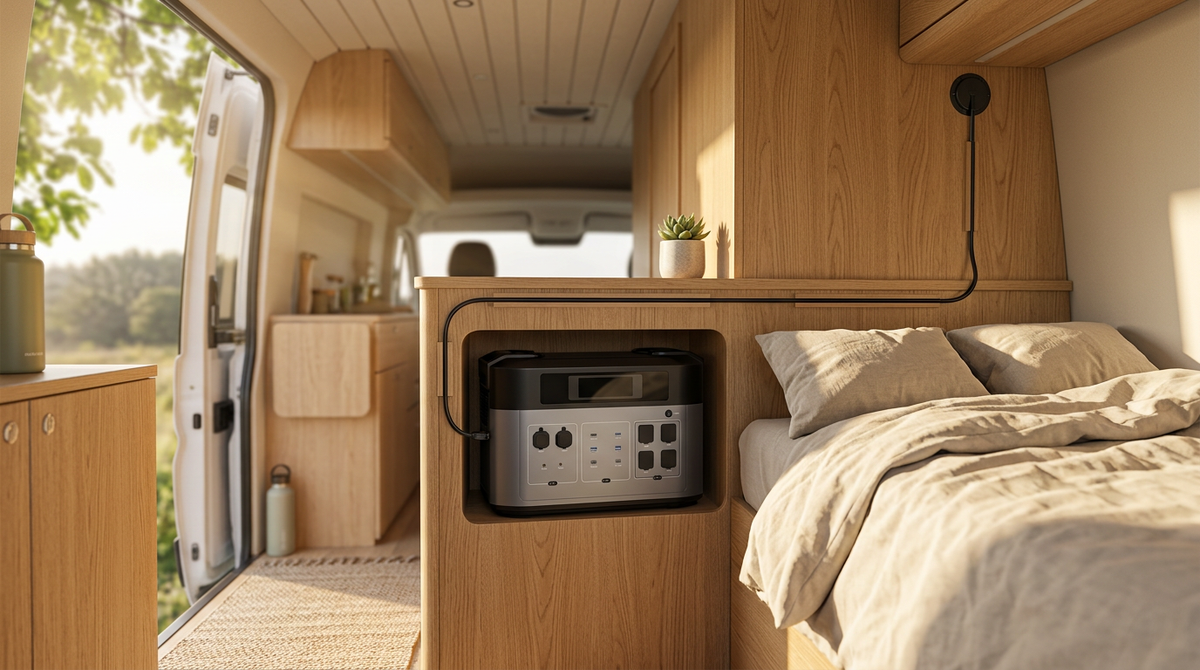
Portable Power Station for Van Life: 1-7 Day System Sizing Guide
How to size a portable power station for van life comes down to two numbers: your daily watt-hour consumption and your worst realistic gap between charges, not the largest capacity you can afford. Most travelers who end up unhappy with their system bought on capacity alone and discovered the limit somewhere else, usually the inverter or a 12V port.
Seven days off-grid does not require seven times the battery of a one-day trip. A van that drives most days replaces energy as it goes. A van parked under trees for four days does not. The gap between those two situations is larger than the gap between most capacity classes.
Below is the four-step method we use, plus the specification limits that decide whether a unit can actually run your gear.
What Size Portable Power Station Do You Need for Van Life?
Size the system around your daily energy budget and your charging opportunities. Two vans with identical appliance lists can need very different capacity if one drives daily and the other stays parked.
The base calculation is simple. Everything after it is adjustment.
Required capacity = daily watt-hours x days without reliable charging / usable capacity percentage
In plain terms: how much energy you use in a day, times the days you go without a proper charge, divided by the share of the battery you can actually use.
Usable capacity is the part most people skip. Rated watt-hours are not what reaches your appliances. Inverter conversion, standby draw, cold weather, and reserve settings all take a share. Planning at roughly 85 percent of rated capacity keeps estimates honest.
These classes are planning starting points, not runtime guarantees. Our general sizing guide covers the same math applied outside a van context. The battery sizing tiers below map common van life power needs to a capacity range, so find the row that matches how you travel rather than the largest one you can afford.
|
Class |
Typical Daily Budget |
Realistic Use Pattern |
Main Limitation |
|
Small, under 1,000Wh |
Under 300Wh |
Phones, lights, fans, short trips with daily charging |
Runs out by day two if a fridge is added |
|
Mid, 1,000 to 2,000Wh |
300 to 700Wh |
Fridge, fan, laptops, weekend and light remote work |
Recharge speed becomes the constraint |
|
Large, 2,000Wh and up |
700 to 1,200Wh |
Full-time living, connectivity gear, several appliances |
Weight and payload |
|
Expandable systems |
Grows with the build |
Needs that change season to season |
Costs more per watt-hour up front |
Add reserve on top of the calculated number. Inverter losses, colder nights, an unplanned appliance, battery aging, and a bad solar week all pull in the same direction.FEMA guidance on planning for extended outages makes the same point about home backup, and it applies just as cleanly to a van. Plan for the bad stretch, not the average one.
Is a Portable Power Station the Right System for Your Van?
A portable power station for van life puts the battery, inverter, charge controller, and outputs in one enclosure. That removes most of the wiring work an off-grid van build normally demands. It also removes most of the component-level flexibility.
The tradeoff is convenience against repairability. Neither answer is universally correct.
|
Situation |
All-in-One Unit |
Component Build |
|
Temporary or weekend conversion |
Strong fit |
Overbuilt for the use |
|
Rented or leased vehicle |
Strong fit, no modification |
Usually not permitted |
|
Power needed outside the van too |
Strong fit, carries out |
Fixed to the vehicle |
|
Permanent full-time build |
Workable, limited integration |
Strong fit |
|
Several hard-wired 12V circuits |
Awkward to splice in |
Strong fit |
|
Field repair matters |
Whole unit ships back |
Swap one component |
An integrated unit that fails takes the whole system with it, so warranty terms and support turnaround matter more on the road than they do at home.
Which Specifications Actually Decide Van-Life Performance?
Five specifications determine whether a unit works in a van: capacity, continuous output, surge output, charging input limits, and regulated 12V output current. The fifth matters because a full battery and a large inverter cannot compensate for an undersized DC port.
Capacity Versus Usable Energy
Capacity is stored energy in watt-hours, but the rated figure is not what reaches your appliances. In a real van setup, roughly 10 to 15 percent is lost to inverter conversion, standby draw, and reserve settings before a single device runs, and cold weather widens that gap further because lithium cells deliver less in the cold.
Plan at about 85 percent of the rating. A 1,024Wh unit running a 60W fridge returns an estimated 14 hours of continuous draw at that level, not the 17 the raw number suggests. Compressor cycling then stretches it considerably, which is why duty cycle matters so much.
Continuous Output, Surge, and Input Limits
Capacity decides how long. Output decides what will run at all. Continuous output must cover everything running at once, and surge output must cover the startup spike from any compressor, pump, or motor. A large battery paired with a small inverter is a common and frustrating mismatch.
Input limits matter just as much. A large battery you cannot refill quickly is a slow problem rather than an immediate one, so check maximum solar wattage, accepted voltage range, connector type, and AC charging rate before buying.
The jump from 2,200W to 3,300W continuous adds useful headroom when an induction burner or kettle overlaps with a cycling refrigerator. Confirm the actual simultaneous load and startup demand rather than treating the higher rating as automatically necessary.
|
Model |
Capacity |
Continuous Output |
AC Charge to 80% |
Expansion |
|
P1000 Plus |
1,024Wh |
1,800W (3,600W surge) |
About 39 min |
Not expandable |
|
BP2000 |
2,048Wh |
2,200W |
About 1.5 hr |
To 16,384Wh |
|
BP2000 Pro |
2,048Wh |
3,300W |
About 55 min |
To 16,384Wh |
Battery Chemistry and Cycle Life
Most current units use LiFePO4, which carries significantly lower thermal runaway risk than older lithium formulations and holds up better across many charge cycles. That suits the daily charge and discharge pattern of van life.
Cycle ratings describe test conditions, not a guaranteed lifespan. A rating of 3,500 cycles to 80 percent capacity assumes controlled temperature and charging. Heat, deep discharges, and long storage at full charge all shorten real service life.
Step 1: Calculate Your Van's Daily Watt-Hour Consumption
Everything downstream depends on this number. Guessing here guarantees a wrong system size, usually in the expensive direction.
List Every Device, With Its Real Numbers

[IMAGE: Alt: Van life power station sizing worksheet listing appliance wattage and daily watt-hour totals | 4:3]
Record each device with its running wattage, daily hours, whether it runs on 12V DC or 110V AC, and whether it cycles. Nameplate ratings are often the maximum rather than the average, so a plug-in meter or a 12V shunt monitor gives better data than the label. Group the audit into four categories so nothing gets missed:
- Climate: compressor fridge, roof vent fan, diesel or propane heater
- Utility: LED lighting, water pump, CPAP or other medical equipment
- Work: laptop, camera batteries, satellite internet terminal, phone charging
- Occasional: induction burner, coffee maker, heated blanket, tool and e-bike batteries
Copy this worksheet and fill one row per device. Total the final column to get your daily watt-hours.
|
Device |
Running Watts |
Hours/Day |
Duty Cycle |
12V or AC |
Daily Wh |
|
Total |
Do the Math for Steady Loads
For anything drawing a constant amount while on, multiply watts by hours of daily use. Watts x hours = daily watt-hours. The table below shows the format, using typical figures.
|
Device |
Running Watts |
Hours/Day |
Duty Cycle |
Daily Wh |
|
LED lighting |
10W |
5 |
100% |
50Wh |
|
Roof vent fan |
20W |
10 |
100% |
200Wh |
|
Laptop charging |
65W |
4 |
100% |
260Wh |
|
Satellite internet |
40W |
6 |
100% |
240Wh |
|
12V compressor fridge |
45W |
24 |
35% |
378Wh |
Those five items total roughly 1,128Wh per day. That is a working remote setup, not a minimal one, and it already exceeds what a small unit can deliver. EIA data onUse of Energy in Homes is useful for sanity-checking appliance draw when a nameplate rating looks wrong.
Adjust Cycling Appliances by Duty Cycle
Fridges, fans, pumps, and heaters do not draw continuously. A compressor fridge rated at 45W might run 30 to 50 percent of the hour depending on ambient temperature, insulation, and how often the door opens.
Both errors here are common. Assuming it runs flat out for 24 hours produces a system twice the size you need, while assuming it barely draws anything leaves you dark on day two. Measuring over a real 24-hour period in the van settles it.
Account for AC Conversion Losses
Running a device through the inverter converts stored DC to AC and loses energy as heat, while a native DC port avoids that conversion entirely. Add a 10 to 20 percent loss allowance to the AC portion of your daily total. Standby draw counts too, since an inverter left on overnight with nothing plugged in still consumes energy.
Split Essential From Comfort Loads
Divide the total into two columns. Essential covers refrigeration, minimal lighting, communication, and heating. Comfort covers cooking appliances, entertainment, and recreational charging.
This split is what lets a smaller system survive a bad week. When the weather turns, you drop the comfort column, and the essential column keeps running. Without the split, you have one large number and no plan.
Step 2: Match Capacity to 1-7 Days of Van Life
Trip length changes the sizing logic, not just the multiplier. Short trips are a storage problem. Long trips are a replacement problem.
One-Day and Overnight Van Life
Cover one full day of use plus a reserve, assuming you reach a reliable charge the next day. A 1,024Wh unit such as the P1000 Plus provides roughly 870Wh at an 85 percent planning factor, so it fits a lightweight profile below about 700Wh per day after reserve. It does not cover the 1,128Wh remote-work example above without recharging. At roughly 26.5 pounds, it remains practical for one person to move outside to reach sun.

[IMAGE: Alt: Portable power station for van life capacity tiers compared for one to seven day off-grid trips | 16:9]
Two to Three Days of Van Life
A stationary weekend accumulates draw with nothing coming in, and ourcamping-specific sizing walkthrough covers the same profile for tent use. Either carry the full weekend budget in storage, or carry less and sustain it with solar or a driving day.
Summer raises fridge duty cycle and a full night of heater operation changes the total again, which is why weekend sizing fails most often in the shoulder seasons.
Four to Five Days of Van Life
Past four days, the planning shifts toward replacement. Buying enough battery to run five days with no input produces a heavy, expensive system that spends most of its life partly charged.
Size to cover normal daily use with one full day of reserve, then make the recharge plan do the rest. This is where expandable systems earn their premium, because theBP2000 platform can start at 2,048Wh and scale to 16,384Wh with up to seven B2000 packs as the pattern of travel changes.
Six to Seven Days of Van Life
A full week off-grid is an energy production problem. Match essential daily consumption against a realistic average daily recharge rate, then hold reserve for the worst two-day stretch.
Multiplying a one-day figure by seven is the classic error, producing a battery that is expensive, heavy enough to matter for payload, and still vulnerable if the recharge plan is weak.
Use a Three-Tier Capacity Plan
Rather than searching for one number, map three. Minimum covers essentials in an emergency. Comfort covers your normal routine. Resilient adds margin for missed charging windows.
|
Tier |
Daily Energy |
Autonomy |
Recharge Assumption |
Usable Storage Needed |
|
Minimum |
400Wh |
1 day |
Daily driving input |
About 500Wh |
|
Comfort |
900Wh |
2 days |
Regular solar or travel top-ups |
About 2,000Wh |
|
Resilient |
1,200Wh |
3 days |
Intermittent solar, poor weather |
About 4,000Wh |
Note how the resilient tier reaches roughly 4,000Wh at only 1,200Wh of daily use. Autonomy days drive capacity faster than daily consumption does. That is the whole argument for investing in recharge capability instead of raw storage.
Step 3: Build a Recharge Plan That Replaces Daily Usage
Over any trip longer than a couple of days, your charging sources need to return roughly what your appliances take. A system that cannot do that is on a countdown from the moment you leave.

[IMAGE: Alt: Portable solar panels recharging a van life portable power station at a remote campsite | 16:9]
Solar Charging
Panel ratings describe laboratory conditions. Real output runs lower, and the gap widens in winter, in shade, and at poor angles. EIA's explainer on solar energy and how it is used covers why the sunlight reaching a given location varies by season, latitude, and weather, which is the variable that matters most for daily production estimates.
Solar array size = daily watt-hours / peak sun hours / expected system efficiency
For example, at 600 watt-hours per day, four peak sun hours, and 75 percent system efficiency, the math is 600 / 4 / 0.75, which comes to 200W of panel.
Production varies with these factors:
- Roof-mounted panels catch whatever the parking spot offers. Portable panels can be aimed and moved into the sun
- Partial shade from a single branch can cut output disproportionately
- Winter sun angle and shorter days reduce daily totals substantially
- The unit's maximum solar input caps everything upstream of it
That last point catches people. Adding panels beyond the input limit produces nothing. Confirm the maximum solar wattage, voltage range, and connector before expanding an array. Our own400W portable solar panels use standard MC4 connections for this reason.
Alternator and DC-to-DC Charging
For vans that move regularly, driving is often the most reliable input. It works at night, in rain, and under tree cover, exactly when solar does not. There is a large gap between a basic 12V accessory socket, typically limited to around 120W, and a dedicated DC-to-DC charger delivering several times that. On a 900Wh daily budget, the socket alone would need many hours of driving to keep up.
Shore Power and Combining Sources
Occasional AC access changes the math more than most people expect. A campground stop or a few hours at a workplace can refill a unit that would take days of marginal solar to recover, which lowers how much solar capacity you need to carry.
The most reliable van systems use all three inputs. Solar while parked, alternator while driving, AC when it appears. A single-source plan fails the first time conditions do not cooperate.
Step 4: Confirm the Unit Can Start and Run Every Appliance
Capacity says nothing about whether a device will actually operate. Output ratings, surge headroom, and port amperage decide that, and they fail independently of the battery.
Add the Loads That Run Simultaneously
List what may run at the same time and total the running wattage. Fridge, laptop, internet terminal, fan, a cooking appliance, and chargers is a realistic worst case for a working van. Compare that against continuous output, then leave headroom. Running an inverter near its ceiling leaves nothing for a surge and generates more heat than a sealed cabinet handles well.
Check Startup Surges Separately
Motors, compressors, and pumps pull well above running wattage for a brief moment at startup, and the surge rating must cover that spike long enough for the motor to spin up. A unit can pass the continuous test and still shut down on startup with the battery nearly full. This is the failure most people mistake for a defective product.

[IMAGE: Alt: Regulated 12V output ports on a van life portable power station with heater cable connected | 4:3]
Check 12V Amperage Before Buying a Diesel Heater
This constraint catches the most van builders and has nothing to do with battery size or inverter output. A diesel heater is a 12V device, and its glow plug pulls roughly 10 amps for several minutes during ignition, about 120W through the 12V circuit specifically. Many accessory sockets are rated well below that continuously.
The battery can be full and the inverter rated at thousands of watts, and the heater still will not start, because the limiting component is a single low-current port. An undersized 12V port is a common reason a heater fails to fire on an otherwise capable unit. Before committing to an electric-start heater, verify:
- Maximum regulated 12V output current, in amps, not watts
- Whether that rating is continuous or peak
- Connector type and whether an adapter is required
- Voltage stability during the ignition draw
- Manufacturer-approved connection method for heating appliances
Treat Electric Heating as a Separate Category
Resistance heating converts electricity directly to heat, which makes it energy-hungry in a way no battery size fixes cheaply. A 1,500W heater draws 1,500Wh every hour, so a 2,048Wh unit runs it under 90 minutes with nothing else on.
Insulation, a fuel heater, and proper bedding cost far less energy for cold-weather travel. Combustion heaters carry their own requirement, sinceCPSC guidance on carbon monoxide applies directly and any fuel-burning appliance in a sleeping space needs a working CO alarm.
Ports, Weight, and Installation Constraints
Two vans with identical energy budgets can still need different units, because a van imposes physical limits a house does not.
Match Ports to Your Actual Gear
AC outlets with a pure sine wave inverter handle household appliances and sensitive electronics. USB-C Power Delivery ports charge laptops and phones without the inverter conversion loss, so using them directly stretches capacity. Regulated 12V outputs hold steady voltage to a fridge or fan as the battery drains, which unregulated outputs do not.

[IMAGE: Alt: Portable power station for van life secured with straps inside a camper van storage cabinet | 16:9]
Weight, Mounting, and Ventilation
Capacity scales with mass. A 1,024Wh unit sits near 26 pounds and a 2,048Wh unit roughly doubles that, with expansion batteries adding more. Payload is a legal limit, and a converted van reaches it faster than most owners expect once water, gear, and the build are counted.
The unit also has to be anchored so it cannot move in a hard stop, and it needs airflow. Sealing one into a tight cabinet causes thermal shutdowns during fast charging. If it sits near the bed, check the noise rating, because cooling fans run hardest while charging overnight. Quieter units are rated around 29dB under moderate load.
Common Van-Life Sizing Mistakes
Most of these come from optimizing one specification while ignoring how the system works together.
|
Mistake |
What Goes Wrong |
The Correction |
|
Buying on capacity alone |
Large battery, inverter or port cannot run the gear |
Check output and port ratings first |
|
Confusing watts with watt-hours |
Wrong unit sized for the wrong problem |
Watts decide what runs. Watt-hours decide how long |
|
Ignoring fridge duty cycle |
System sized twice too large, or far too small |
Measure over 24 hours in the van |
|
Trusting rated solar wattage |
Daily production falls short all season |
Derate for weather, angle, and input limits |
|
Relying on the 12V socket |
Slow drain that never recovers |
Add DC-to-DC or AC charging |
|
Skipping 12V amperage check |
Diesel heater will not ignite |
Verify continuous amps before buying |
|
Planning electric heat |
Battery drains in about an hour |
Use fuel heat and insulation |
|
Oversizing past payload |
Weight, cost, and a unit too heavy to move |
Size to need, add expansion later |
The right portable power station for van life is the smallest system that safely carries your peak load, holds enough energy for your realistic worst-case gap between charges, and can replace daily consumption through the charging sources you will genuinely use. Anything beyond that is weight you pay for twice, once at purchase and again in payload.
Size Your Van System With OUKITEL
Work through the calculation first, then match it to hardware. Three steps get you there:
- Total your daily watt-hours using the audit method above, keeping essential and comfort loads in separate columns.
- Multiply by your longest realistic gap between charges, then divide by 0.85 for usable capacity. Add reserve for weather and cold.
- Check the shortlist against continuous output, surge rating, and regulated 12V amperage before capacity. Confirm current pricing on the product page.
For lightweight builds and trips with daily charging, theP1000 Plus covers 1,024Wh at 1,800W continuous. For weekend to mid-week travel with a fridge and work gear, theBP2000 offers 2,048Wh at 2,200W with an expansion path to 16,384Wh. Where several appliances run at once, theBP2000 Pro raises continuous output to 3,300W on the same expandable platform. Pair any of them with portable solar panels if your travel pattern includes parked days.
FAQs
What Is the Best Portable Power Station for Van Life?
The best portable power station for van life is the one matched to your daily watt-hours, peak simultaneous load, and realistic recharge sources. No single model fits every build. The decisive question is rarely capacity. It is whether output and port ratings match the gear list.
How Big of a Power Station Do I Need for Van Life?
Multiply your daily watt-hour total by the days without dependable charging, then divide by 0.85 for usable capacity. At 700Wh per day across two days, that gives roughly 1,647Wh, pointing to a 2,000Wh class unit. Add reserve for winter and heavier summer fridge use.
How Many Watt-Hours Do I Need for a Weekend in a Van?
Calculate one full day of use, multiply by the days without charging, then add 15 percent for conversion losses. Phones, lights, and a fan run 80 to 150Wh daily. A 12V fridge pushes that to 300 to 450Wh. Laptop work and satellite internet take it past 600Wh.
How Much Solar Do I Need for Van Life?
Divide daily watt-hours by peak sun hours, then divide again by expected system efficiency. At 600Wh daily with four peak sun hours and 75 percent efficiency, the result is roughly 200W of panel. Winter can halve real production, and shade matters more than most buyers expect.
What Is the Fastest Way to Recharge While Driving?
A dedicated DC-to-DC or high-output alternator setup, by a wide margin. The standard 12V accessory socket is typically limited to around 120W, returning roughly 480Wh over four hours of driving. That falls short of most working van budgets. Check your alternator's spare capacity before wiring anything.
Can a Portable Power Station Run a 12V Fridge Overnight?
Yes, provided the unit has a regulated 12V output. A 45W compressor fridge at 35 percent duty cycle uses roughly 380Wh across 24 hours. A 1,024Wh unit planned at 85 percent usable capacity therefore covers about two full 24-hour periods, before reserve and other loads. Regulation matters because voltage sag can cut out a compressor as the battery drains.
Can a Portable Power Station Run a Diesel Heater?
Sometimes, and the deciding factor is the 12V port's continuous amperage rating, not the battery or the inverter. A glow plug draws roughly 10 amps for several minutes during ignition. Sockets rated below that fail to start the heater regardless of remaining capacity.
Can You Run an Electric Heater From a Portable Power Station?
Technically yes, but rarely practically. A 1,500W heater consumes 1,500Wh per hour, so a 2,048Wh unit runs it roughly 70 minutes at 85 percent usable capacity. Diesel or propane heating uses minimal electricity after ignition, and a heated mattress pad draws 50 to 80W.
Are Portable Power Stations Worth It for Van Life?
For most travelers, yes, particularly for weekend vans, temporary builds, and rented vehicles. The value case rests on installation simplicity and portability rather than cost per watt-hour, which runs higher than a component build. They also double as home backup during outages.
What Are the Disadvantages of a Portable Power Station?
Higher cost per watt-hour, fixed output limits, proprietary expansion accessories, and integrated construction that complicates field repair. Because components share one enclosure, a single failure can take the whole unit offline. On the road, that means shipping the unit rather than swapping a part.
Sources
- U.S. Energy Information Administration (EIA),Use of Energy in Homes (2025)
- U.S. Energy Information Administration (EIA), Solar Energy Explained
- U.S. Consumer Product Safety Commission (CPSC),Carbon Monoxide Information Center
- Federal Emergency Management Agency (FEMA),Power Outages


Looking for something else?

Difference Between Amps and Volts: What You Actually Need to Know
LEARN MORE
50 Amps in Watts: The Honest 2026 Conversion Guide for RV, Home, EV, and Solar
LEARN MORE
Can You Put Solar Panels on a Mobile Home? (Real-World Guide for 2026)
LEARN MORE
Do Portable Solar Panels Qualify for the 30% Credit?
LEARN MORELooking for something else?

Are Solar Generators Any Good? Here's the Real Answer
LEARN MORE
How Long Does a Portable Power Station Last? (Real Numbers)
LEARN MORE
Oukitel Power Exhibits at Solar & Storage Live Philippines 2026: Carry the Sun, Power Your Freedom
LEARN MOREYou may also like

OUKITEL P2001 Solar Generator
OUKITEL P1000 PLUS Portable Power Station 1800W | 1024Wh


OUKITEL BP2000 Portable Power Station 2200W | 2048Wh

OUKITEL P5000 Pro Portable Power Station 5120Wh | 3600W

OUKITEL P5000 Solar Generator for Home with 400W Solar Panel
Further reading

OUKITEL Power Brings Full-Scenario Energy Storage Solutions to Intersolar Middle East 2026 in Dubai

Portable Power Stations for Power Tools and Job Sites: Surge, Runtime and Safety
