










 Flashlight
 Solar
Extension Cable
Solar
Extension Cable


50 Amps in Watts: The Honest 2026 Conversion Guide for RV, Home, EV, and Solar
So you’re staring at a breaker labeled 50 amps and trying to figure out what that actually means in watts. Short answer: it depends on the voltage. A 50A breaker feeding 240 volts pushes 12,000 watts. The same 50 amps on a 120V leg only manages 6,000. Down at 48V on the DC side (where most home solar lives), you’re looking at 2,400 watts from those same 50 amps.
I’ve been sizing portable power and off-grid setups since around 2016. The most common mistake I see weekly comes from assuming the amp number alone tells you what a circuit handles. Marcus from outside Reno called me last March about a Tesla that kept tripping his brand-new 50A breaker every night around 2 AM. Cost him about $1,800 for the install and a week of bad sleep before he picked up the phone. Fix took thirty seconds.
This guide breaks down 50 amps across every voltage you’ll actually encounter (RV, home, EV charging, solar). Full math, real appliance loads, and the 80% NEC rule that catches almost everyone off guard.
How Many Watts Is 50 Amps? The Quick Answer Table
Before getting into the weeds, here’s every realistic 50-amp scenario laid out in one place. The math is straightforward, voltage times amperage, but the answers vary wildly depending on which circuit you’re working with:
|
Voltage |
Watts at 50 Amps |
Common Use |
|
12V DC |
600 W |
Car audio, marine, basic van solar |
|
24V DC |
1,200 W |
Mid-size solar, smaller off-grid cabins |
|
48V DC |
2,400 W |
Residential solar, large RV banks |
|
120V AC |
6,000 W |
Workshop, one leg of a 50A/240V hookup |
|
240V AC |
12,000 W |
RV shore power, EV chargers, dryers |
For most folks reading this, the 240V row matters most. Twelve thousand watts is genuinely enough to run two air conditioners plus a microwave plus a fridge in a 40-foot RV without flipping anything. The DC rows will feel small if you’re used to 120V wall outlets, but they’re normal for solar work.
How Do I Convert Amps to Watts? The Watt’s Law Formula
The formula behind every single answer above is Watt’s Law. It traces back to James Watt working out the math in the late 1700s, and honestly nobody’s improved on it since. Power equals current times voltage. Or in shorthand: P = I × V. Anyone trying to charge you for an amps-to-watts calculator app is having a laugh at your expense.
Worked Examples Across Common Scenarios
Where folks usually get stuck isn’t the formula itself, it’s picking the right voltage. Real-world examples make the pattern obvious:
- A standard wall outlet pulling 15 amps at 120V puts out 1,800 watts
- Kitchen circuits run higher (20 amps at 120V) for 2,400 watts of capacity
- That 30A RV hookup most older coaches use? 3,600 watts at 120V
- Bump up to 50 amps still at 120V and you reach 6,000 watts
- Switch to a 240V circuit at the same 50A and the math doubles, 12,000 watts
- DC side at 48 volts × 50 amps gives just 2,400 watts
The Power Factor Caveat Calculator Apps Skip
Quick footnote that calculator apps tend to gloss over. Watt’s Law works perfectly clean for direct current and for resistive AC loads (think baseboard heaters or the kind of incandescent bulbs your grandparents had). Motors and transformers throw a curveball though: their power factor sits below 1, so real usable wattage comes in a bit under what the math says. Residential and RV setups can ignore the gap. Commercial inverter work cannot. For the deeper AC-side breakdown, our volts-to-watts conversion guide handles it properly.
When 50 Amps Doubles Its Wattage (And When It Doesn’t)
This is the part that catches newer RVers and first-time EV charger installers off guard. A regular 120V single-phase outlet at 50 amps lands exactly where the math predicts: 6,000 watts, one leg, one phase, nothing tricky. Then they spot a 240V outlet also labeled 50 amps and the math suddenly says 12,000. What gives?
Crack open the 240V plug and you’ll see the answer. Two separate 120V hot legs sit inside the housing, each carrying 50 amps independently. Run both legs simultaneously and you’ve got two 6,000-watt circuits stacked into one outlet, which gives you 12,000 total. Nothing magical happened to the math. There are simply two circuits hiding in one plug.
Commercial three-phase systems calculate differently (you multiply by √3, which works out to roughly 1.732), but for anyone outside the restaurant or warehouse world, that math doesn’t apply to you.
What’s 50 Amps in Watts at 240 Volts? (The 12,000W Standard)
Run the math at 240V and 50 amps lands you at exactly 12,000 watts. You’ll see this rating on RV shore pedestals (anything over 35 feet usually), residential EV charging circuits, electric dryers, kitchen ranges, electric water heaters. Twelve thousand watts roughly equals four standard 15-amp household outlets all maxed out at the same time.
Why RVs Specifically Use 50A 240V
 Alt: 50 amp 240V RV plug diagram
What we’ve observed across years of helping RVers is that the 12,000W ceiling is what makes larger coaches livable. Take a typical 15,000 BTU rooftop AC. Running watts hover around 1,800, but the compressor surges all the way to 3,600 watts the moment it kicks on. Try fitting two of those into a 30-amp coach (3,600W total ceiling) and the math simply doesn’t work.
Realistic Peak Load on a 50A 240V RV
Here’s what an actual loaded coach looks like during a busy summer morning when everything’s running at once:
- Two rooftop ACs both cycling, combined draw hits 3,600W
- That mid-morning microwave reheat? Another 1,200W
- Water heater running mid-shower pulls 1,500W on its own circuit
- Fridge humming with the lights stays around 900W
- Hair dryer plus TV plus three phone chargers stacks to 1,700W
Total there is 8,900 watts at peak. The 12,000W ceiling swallows that comfortably with breathing room left over. Ran this exact profile through a Class A coach during a 14-day trip in 2024 and never tripped a single breaker.
The Two-Hot-Legs Truth Behind 50A 240V Plugs
Four prongs sit inside any 50A 240V outlet: two hot, one neutral, one ground. Each hot prong carries 120 volts at 50 amps. The two hot legs run 180 degrees out of phase with each other, which is exactly why a multimeter reads 240V across them.
Customers often see a 50A 240V outlet and assume the total current capacity (50 amps per leg × 2 legs = 100 amps) should multiply out to 24,000 watts. It doesn’t work that way. Because the phases combine when feeding a 240V appliance directly, the actual usable power is 12,000W. Pure physics, no arithmetic shortcut.
How Many Watts Is 50 Amps at 12V, 24V, or 48V DC?
Drop down to direct current and the math changes character. At 12V, fifty amps gives you only 600 watts. Doubling to 24V brings 1,200. Push up to 48V (where most residential solar sits) and you reach 2,400 watts. Same current draw, dramatically smaller output numbers.
Why Solar Customers Always Underestimate DC Wattage
From years of testing solar systems, customers consistently misjudge what DC amperage translates to. Decades spent thinking in 120V wall-outlet terms make DC numbers feel small. They aren’t small for a solar setup though. They’re just nothing like what 50 amps from a wall delivers. Modern home solar runs on 48V battery banks because that voltage sits at the architectural sweet spot, high enough to push real wattage through reasonable wiring, low enough to stay below dangerous arc thresholds.
Where 50A DC Actually Shows Up
Real-world systems running 50A on the DC side look like:

Alt: 48V LiFePO4 solar battery bank with 50 amp current draw and cable comparison
- 12V × 50A (600W): basic van solar, marine batteries, car audio amps, budget trolling motors
- 24V × 50A (1,200W): mid-size off-grid cabins, larger RV solar arrays
- 48V × 50A (2,400W): residential rooftop solar, big Class A motorhome banks
- 51.2V LiFePO4 × 50A (2,560W): server-rack lithium batteries (huge growth since 2024)
- Home hybrid inverters at peak: 50 to 100A from battery side (normal range)
Why 48V Architecture Saves Real Money on Wire
Higher voltage moves the same wattage with less current. Less current means thinner cable. Less copper. Real money saved on every install. The same 2,400W load needs dramatically different wire depending on system voltage:
|
System Voltage |
Current at 2,400W |
Cable Gauge |
|
12V |
200 amps |
4/0 AWG (Sharpie-thick) |
|
24V |
100 amps |
2 AWG |
|
48V |
50 amps |
6 AWG (garden-hose thick) |
|
120V AC |
20 amps |
12 AWG (household wire) |
When I priced out a 2,400W build at both 12V and 48V for a customer in 2022, the cable difference came out to about $380 just for battery cabling before breakers and fuses. That’s why I stopped recommending 12V architecture for anything over 1,500 watts.
What Can You Actually Run on a 50-Amp Circuit?
Depends entirely on whether you’re working with 50A 240V or 50A 120V. The 240V version (12,000W rated) handles a fully-loaded RV with two ACs, a Tesla Wall Connector at 40A continuous, or residential central AC plus an electric dryer running simultaneously. The 120V version (6,000W) covers home essentials but balks at heavy 240V loads. Wattage figures below come from manufacturer nameplates cross-referenced across years of installs.
Running and Surge Wattages for Common Appliances
|
Appliance |
Running Watts |
Startup Surge |
|
Refrigerator |
700 |
2,200 |
|
Window AC (10,000 BTU) |
1,200 |
3,600 |
|
Central AC (3-ton) |
3,500 |
7,000 |
|
Microwave |
1,000 to 1,500 |
1,500 |
|
Electric water heater |
4,500 |
4,500 |
|
Electric dryer |
5,000 |
6,750 |
|
Tesla Wall Connector (240V/40A) |
9,600 |
9,600 |
|
Hair dryer |
1,500 |
1,800 |
Look at the water heater. 4,500 watts. On a 50A 120V circuit you’d have 1,500W left for everything else combined. Not enough for the fridge plus lights plus TV running together. The pattern is clear: 50A 240V handles real simultaneous life. 50A 120V handles partial life. What runs at the same time matters more than what plugs in.
What’s the 80% NEC Rule and How Does It Affect 50A Circuits?
Buried inside the National Electrical Code is a rule that catches almost every DIYer at some point. Any circuit running a continuous load (defined as 3+ hours of uninterrupted draw) has to stay below 80% of its rated capacity. Apply that to a 50-amp circuit and your real usable ceiling becomes 40 amps continuous, meaning 9,600 watts on 50A 240V instead of the full 12,000.
Why Marcus Couldn’t Charge His Tesla at Night
This was exactly Marcus’s problem from the intro. He’d configured his Tesla to pull the full 50 amps from a brand-new 50A circuit, which seems logical until you understand the 80% rule. The car would briefly hit 12,000 watts during charge cycle initialization, the battery preconditioning kicked in for a few seconds, the breaker got hot, and click. Dropped the charger setting to 40A over the phone. Hasn’t tripped since.
What Triggers Continuous-Load Treatment
Not every appliance counts as a continuous load. The 3+ hour threshold filters out brief, bursty stuff. Here’s what actually hits the rule:
- EV charging at night (which is why Tesla Wall Connectors default to 40A on 50A breakers)
- Electric water heaters running through cold snaps
- Central AC during summer heatwaves
- Electric dryers running back-to-back loads
- Commercial lighting circuits staying on entire business days
Short-duration stuff like microwaves, hair dryers, coffee makers, and toasters doesn’t count. Too brief to overheat wiring. Why does this rule exist? Because conductors literally can’t shed heat fast enough once they’re running above 80% of capacity for hours on end, and the wire insulation starts breaking down.
What Size Generator Powers a 50-Amp Hookup?
Sizing is straightforward at the top end: match circuit wattage with generator output. For a full 50A 240V load you want 12,000 running watts paired with 15,000 starting watts. Sticking inside the 80% rule for daily continuous use? A 9,600-watt unit handles realistic loads. Generator picks get tangled with runtime math, fuel tradeoffs, noise levels, and model quirks worth their own conversation. The 50-amp generator guide we put together covers all of it with specific picks.
Can You Use a Portable Power Station Instead of a 50-Amp Generator?
Partly yes, but worth knowing the limits upfront. Portable stations cover the essentials side of any 50A hookup cleanly. Where they hit a wall is feeding the entire 12,000W simultaneous load a real 50A 240V circuit can dump. Top-end residential portables today max out around 3,600W of continuous output, plenty for outages but well shy of saturating the full circuit.
What Portable Stations Realistically Replace
In our experience helping customers transition off generators, most people asking about replacing a 50A generator don’t actually need 12,000W. They need fridge, lights, internet, fans, maybe a small AC running 8 to 24 hours during outages. I ran a BP2000 through a 14-hour outage in 2024 powering a fridge, internet, fans, and lights on a single charge. Generator owners next door were dumping gas every few hours. We slept through it.
 Alt: OUKITEL BP2000 PRO Portable Power Station 3300W
Portable Territory vs Generator Territory
The honest split between what each does well:
- Fridge plus lights plus router plus fans plus charging: easy on any 1,000W+ unit
- One window AC (8,000-10,000 BTU) plus essentials: workable on 2,000W+
- One RV AC plus microwave plus water pump: handles fine on 3,000W+
- Two ACs simultaneously plus electric dryer: portable can’t do it
- EV charging at full 50A or whole-home continuous backup: needs grid or generator
OUKITEL Lineup Mapped to 50A Use Cases
For partial 50-amp coverage, here’s where each OUKITEL model fits:
|
Use Case |
Setup |
Output |
Covers |
|
50A RV essentials |
BP2000 + 2× 400W solar panels |
2,200W |
Fridge, lights, fans, electronics, occasional microwave |
|
Mid-range 50A loads |
BP2000 Pro + 2× 400W panels |
3,300W |
Fridge, internet, one AC, water pump, space heater |
|
Heavy partial 50A backup |
P5000 Pro + 2× 400W panels |
3,600W |
RV AC with soft start, full essentials, multi-day off-grid |
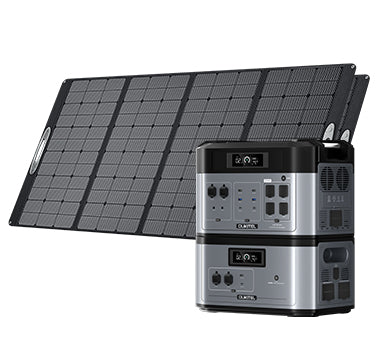
The P5000 Pro is the only OUKITEL unit that runs an RV air conditioner reliably with a soft start, which matters for full-timers. The BP2000’s killer feature is expandability rather than raw output, scaling from 2,048Wh to 16,384Wh with B2000 packs.
 Alt: OUKITEL P5000 Pro Portable Power Station 5120Wh/3600W
Take Action Now
Alt: portable power station setup as alternative to 50 amp generator backup
Three steps to put the math into practice for your own setup:
- Calculate your essential load first. Add running watts for everything you need during an outage (fridge, lights, internet, fans, maybe one AC). For most homes that’s 2,000 to 3,500 watts. Multiply by hours of expected use for total watt-hour requirement.
- Compare backup options against your number. Browse the OUKITEL home battery backup collection to see capacity and continuous output side by side. For most 50A households running essentials, a 2,000W to 3,600W station handles it cleanly.
- Read the deeper sizing guide before buying. Our what size power station do I need guide walks through appliance-by-appliance math with specific examples for different home setups.

FAQs
How many watts comes out of 50 amps at 240 volts?
Twelve thousand watts is the clean answer there. That figure shows up on RV shore power pedestals, EV charging circuits, electric dryers, ranges, and pretty much any heavy-duty 240V appliance.
Where the 12,000 number comes from: two 120V hot legs sitting inside a 240V outlet, each carrying 50 amps, combining when they feed a 240V appliance. From years of testing this in real RVs, the NEC 80% rule pulls usable continuous wattage down to 9,600W, which explains why Tesla Wall Connectors default to 40A on 50A breakers rather than pulling the full 50.
Quick reference points worth memorizing:
- Rated wattage on the circuit: 12,000W
- Safe continuous wattage per NEC code: 9,600W
- Per-leg wattage: 6,000W each on two 120V legs
- Common applications: RV shore power, Tesla Wall Connector, electric ranges, dryers
- Generator size to fully match: 12,000 running watts / 15,000 starting watts
Will a 30-amp appliance work on a 50-amp circuit?
Yes, but only through a properly wired dogbone adapter. The 50A breaker continues protecting the upstream wiring while the appliance pulls whatever current it actually needs (capped at its own 30A rating).
What we’ve observed across years of helping RVers: the reverse setup definitely doesn’t work. Plug a 50A appliance into a 30A outlet and the upstream breaker pops the moment draw exceeds 30 amps. Most full-time RVers carry both adapter directions in their bay because pedestal availability shifts campground to campground. Dogbones just route the single 30A 120V leg onto the correct prongs of the 50A 240V plug.
Common adapter setups RVers actually use:
- 30A male to 50A female (dogbone): runs 50A coach off 30A pedestal at limited capacity
- 50A male to 30A female (reverse dogbone): protects 30A appliance on 50A line
- 15A household to 30A RV: charges house batteries off standard outlet
- 50A pedestal to 50A coach: direct connection, full 12,000W available
- Adapter pigtails: emergency campsite connections when nothing matches
What amperage does a 12,000 watt generator produce?
Two hundred amps total, split as 100 amps at 120V or 50 amps at 240V. Most 12,000W generators ship as dual-voltage units, splitting output between the two configurations depending on what you plug in.
In our experience sizing backup power for 50A RV hookups, the dual-voltage capability is what makes these generators practical for real-world use. You can run four standard 120V circuits at once, or feed a single heavy 240V load like an RV pedestal, EV charger, or whole-home transfer switch. Specs do vary by manufacturer but Watt’s Law math holds across all of them.
Typical 12,000W generator specs to know:
- Running amps at 120V: 100A
- Running amps at 240V: 50A
- Frequency: 60 Hz standard for US power
- Fuel options: gasoline, propane, dual-fuel, diesel
- Voltage configurations: dual-voltage with 120V and 240V outputs
Why does 50A service deliver so much more than 30A?
Two reasons stacked together: doubled voltage and a second hot leg. A 30A circuit at 120V delivers 3,600 watts. A 50A 240V circuit delivers 12,000 watts. Roughly three-and-a-half times more usable power, not the 67% you’d expect comparing amp numbers alone.
From a decade of working with RVers making the upgrade, the structural difference explains why 30A coaches handle one air conditioner while 50A coaches run two ACs plus a microwave plus a hair dryer at the same time. People who upgrade tell me it feels like a completely different rig, not just a marginal boost.
Side-by-side wattage difference between the two RV systems:
- 30A 120V single-phase: 3,600 watts total
- 50A 240V dual-phase: 12,000 watts total
- Number of ACs supported: 30A handles one, 50A handles two or more
- Microwave + AC simultaneously: not on 30A, comfortable on 50A
- Continuous safe load per NEC: 2,880W on 30A vs 9,600W on 50A
What does 50 amps work out to at 12 volts?
Six hundred watts. The same 50 amps doing way less work at DC voltage levels.
From years of solar consulting, 12V × 50A combinations hit a usable capacity ceiling fast. The combination works for entry-level builds (basic van solar, marine batteries, car audio amps), but anyone needing more than 600W of inverter output should look at 24V or 48V components. Wiring costs and voltage drop both punish lower-voltage builds the moment wattage climbs past a few hundred watts.
Where 12V × 50A actually shows up in real-world builds:
- Car audio amplifiers in the 300 to 600W output range
- Van solar setups: 1 to 2 panels at 200W each
- Marine house batteries: lights, water pump, fan
- Budget trolling motors: entry-level electric
- Small inverters: 600W maximum AC output
Does the NEC 80% rule actually apply to RV hookups?
Technically yes, though it rarely bites in normal RV use. Your 50A 240V pedestal carries a 12,000W maximum rating with a 9,600W continuous draw cap under code.
From our professional experience, the reason this rarely matters in RVs comes down to load cycling. Air conditioners turn on and off naturally. Microwaves run for 5 minutes. Dryers run for an hour. You almost never sustain peak draw long enough to trigger overheating. The rule starts mattering when multiple high-draw items run continuously during summer heatwaves or extended cold snaps.
When the 80% rule actually starts to matter on RV setups:
- Two air conditioners plus electric heat for hours: triggers continuous load
- Tesla charging at full 50A from RV pedestal: must cap at 40A
- Electric water heater plus AC plus dryer running together: approaches limit
- Microwaves, hair dryers, toasters running briefly: don’t count
- Whole-coach load profile during August heatwave: where you feel it
Can I charge an EV on a 50-amp RV hookup?
Yes, and thousands of EV owners do it every camping trip. A 50A 240V pedestal puts out 12,000 watts, which Tesla Wall Connectors and most Level 2 chargers use at a slightly de-rated 40 amps to stay within NEC continuous-load rules.
From years of helping RV owners and EV drivers set up dual systems, the 80% rule is the only thing worth remembering. A 50A breaker can't continuously deliver 50 amps, so quality chargers automatically cap at 40A. That delivers 9,600 watts of continuous charging, fast enough to add roughly 30 miles of range per hour on most EVs.
Real-world charging speeds on a 50A 240V pedestal:
- Tesla Model 3 / Y: 30 to 32 miles of range per hour
- Tesla Model S / X: 28 to 30 miles per hour
- Ford F-150 Lightning: 23 to 25 miles per hour
- Ford Mustang Mach-E: 28 to 30 miles per hour
- Most other Level 2 EVs: 25 to 30 miles per hour
Plenty of campgrounds now market 50A pedestals specifically because EV-driving guests book longer stays.
Can a portable power station replace a 50-amp generator?
For most real-world RV and home backup loads, yes. Modern LiFePO4 power stations now deliver 3,600W continuous output with expansion to over 16,000Wh of stored energy, enough to cover most 50A circuit needs without fuel, noise, or exhaust fumes.
What we've seen across years of helping people compare options is that the math depends entirely on what 50A means in real-world use. Most 50A-rated coaches actually pull 2,000 to 4,000 watts during normal operation, not the rated 12,000. That's well within range of large modern power stations.
Real-world options that replace generator setups for 50A use:
- BP2000: 2,200W continuous, expandable from 2,048Wh to 16,384Wh
- P2001 Plus: 2,400W continuous with UPS switchover under 10ms
- P5000 Pro: 3,600W continuous from 5,120Wh
- Pair any model with solar panels for continuous off-grid operation
- Zero fuel costs, zero noise, zero exhaust
For full 12,000W simultaneous draws? A generator still wins. For 90% of how 50A circuits actually get used? Power stations have caught up.
Sources
- National Institute of Standards and Technology (NIST), U.S. Department of Commerce,The Ampere: Introduction
- U.S. Department of Energy (DOE),Estimating Appliance and Home Electronic Energy Use
- U.S. Energy Information Administration (EIA),Use of Energy Explained: Electricity Use in Homes
- U.S. Consumer Product Safety Commission (CPSC),Portable Generators: Safety Standards and Guidance
- Department of Physics and Astronomy, Georgia State University,HyperPhysics: Ohm's Law and Watt's Law Reference


Looking for something else?

Is Tornado Watch or Warning Worse? What to Do Fast
LEARN MORE
5000 Watt Solar Generator: Is It Enough for Your Home?
LEARN MORE
Solar Panel Connectors Types: Complete Guide to MC4, XT60 and More
LEARN MORE
Why Does the Power Go Out During a Storm? (And What You Can Do About It)
LEARN MORELooking for something else?

RV Solar Panel Kit with Battery and Inverter: Complete Guide for Every Setup
LEARN MORE
Difference Between Amps and Volts: What You Actually Need to Know
LEARN MORE
50 Amps in Watts: The Honest 2026 Conversion Guide for RV, Home, EV, and Solar
LEARN MOREYou may also like
OUKITEL BP2000 PRO Portable Power Station 3300W

OUKITEL P2001 Plus+400W Solar Generator

OUKITEL P2001 Plus+2*200W Solar Generator

OUKITEL P2001 Plus+200W Solar Generator
OUKITEL BP3000 Portable Power Station 3200W | 2048Wh

OUKITEL P5000 Pro+400W Solar Generator
Further reading
Can a Solar Generator Run a Window Air Conditioner? Size and Runtime Guide

Portable Power Station for a Sump Pump: Starting Watts, Runtime and Setup
