

 Flashlight
 Solar
Extension Cable
Solar
Extension Cable


Why Does the Power Go Out During a Storm? (And What You Can Do About It)
Why does the power go out during a storm? Because the electrical grid running to your house was designed for fair weather. Not for 70-mph winds ripping through tree canopies. Not for lightning bolts carrying a billion volts into a transformer full of cooling oil. And definitely not for ice that can make a power line weigh five times what it should.
I've sat through enough storm blackouts since 2015 to stop being surprised by them. What I've learned is that the gap between a 20-minute flicker and a 3-day nightmare comes down to what actually broke out there. A snapped branch on a neighborhood wire? You're probably fine by dinner. A flooded substation? Pack a bag.
This guide covers every reason your power disappears during storms, how long each type of damage takes to fix, and what you can do tonight to make the next outage a lot less miserable.
Why Does the Power Go Out During a Storm? The Short Answer
Storms physically damage the equipment that delivers electricity to your house. Wind throws trees into power lines. Lightning fries transformers. Flooding shorts out substation equipment that was never meant to sit in water. Ice loads wires until they snap like thread. Then the grid's automatic protection systems shut down whatever section got hit, because the alternative is fires and cascading failures across the whole network. That shutdown is your outage.
How the Electrical Grid Works
The Path From Power Plant to Your Outlet
Here's the chain. Power plants generate electricity. It travels through high-voltage transmission lines to substations, where the voltage gets stepped down. From there, distribution lines carry it through your neighborhood on those wooden poles you drive past every day. The whole thing flows in one direction and stays balanced. The moment something disrupts that balance, protection systems kill the power to that section. The DOE's grid modernization program has been tracking where these systems are being upgraded, and the short version is: slowly.
Three Places Where Storms Break Things
- Transmission lines — the big towers crossing the countryside. When one of these goes down, tens of thousands of homes lose power at once. Doesn't happen often. When it does, it's bad.
- Substations — the fenced facilities where voltage gets stepped down. Flood one of these and an entire section of your city goes dark. Could be days before it's back.
- Distribution lines — your street. The poles. The wires. The transformer on the corner. This is where 90% of storm outages happen. Trees fall on them constantly.
The Infrastructure Is Older Than You Think
Here's something that doesn't get talked about enough. Over 70% of U.S. transmission lines have been in service for more than 25 years. That equipment was engineered for weather patterns from the 1980s and 1990s. The storms hitting the grid today are frequently more intense than what those systems were designed to handle. Wooden poles rot. Transformer insulation degrades. Grid modernization is underway in some regions, but it's a process that takes decades. The system protecting your house right now is almost certainly older than your car.
Why Storms Knock Out Power (Cause by Cause)
Every storm type attacks the grid differently. Knowing which cause matches your weather tells you roughly how long you'll be sitting in the dark.
High Winds and Falling Trees
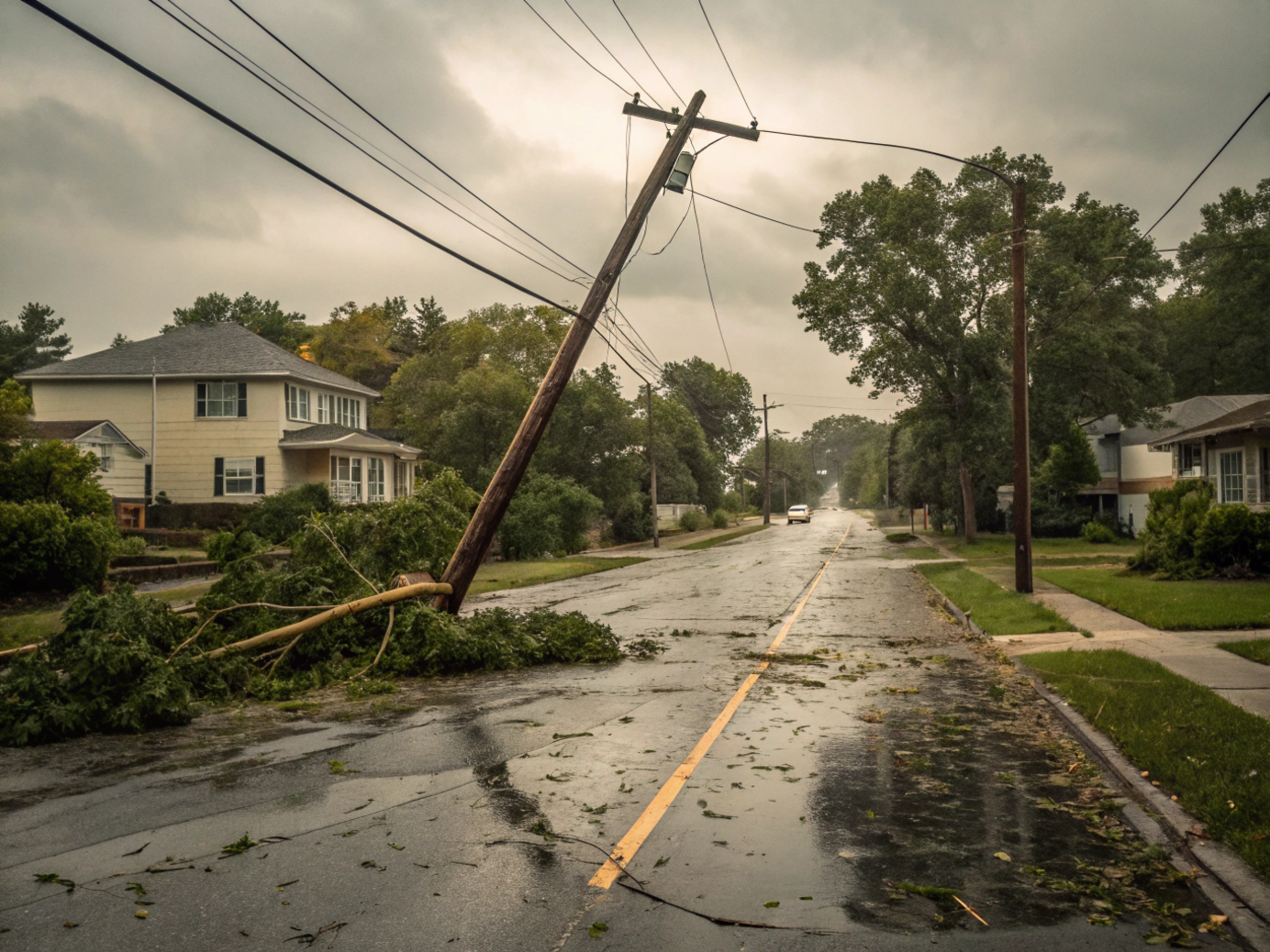
The number one cause of storm-related power outages in this country and it's not remotely close. Trees do most of the damage. Branches snap onto lines. Whole trees uproot and drag poles down with them. Wind can also swing overhead lines into each other. Two conductors touch, short circuit fires, and the automatic protection trips everything on that feeder.
Research published through utility studies shows that aggressive tree trimming reduces outages by up to 65%. But plenty of utilities don't trim on a schedule that actually prevents problems. If you look up at your street and see branches hanging over the wires, that's your next outage waiting to happen.
Underground lines are almost immune to all of this. No trees to fall on them. No wind to swing them. The tradeoff is cost. Burying distribution lines runs 5 to 10 times more than stringing them overhead. That math is why most of America still uses poles.
Lightning Strikes
A direct hit on a pole-mounted transformer vaporizes the cooling oil inside. I'm not exaggerating. The oil flash-boils. You get a bright blue explosion, a boom, and a fire 30 feet in the air. That transformer is destroyed. If the utility has a spare on a truck nearby, replacement takes a few hours. If they don't, you're waiting for one to be transported from a warehouse that might be two states away.
Lightning doesn't need to hit your block to take your power out either. A strike on a transformer three miles down the circuit trips protection systems that kill power across the entire feeder. Your lights go out from something you never even heard.
Heavy Rain and Flooding
Rain on its own doesn't usually knock power out. What rain does is create the conditions for everything else to go wrong. Substations sit at ground level. They're packed with transformers and switchgear. When floodwater reaches that equipment, utilities shut it all down preemptively. If they don't, the water does it for them, with a lot more damage.
Flooding leaves a nasty mess: salt, sediment, and debris coat every electrical surface. The equipment won't just dry out and work again. Every contact needs checking, corrosion testing, and sometimes the entire unit must be replaced if the contamination is too deep. Plus, flooding loosens the ground. I once saw a forty-year-old oak tree near my house crash down on a power line in just 25 mph wind because the soil had been soaked for a week. The root ball simply gave way.

Alt text: large uprooted tree fallen across overhead power lines blocking residential street after storm causing power outage
Ice Storms (The Worst-Case Scenario)
Nothing wrecks a power grid like ice does. I'd take a hurricane over an ice storm for grid damage any day, and I'm not joking. When freezing rain coats a power line, one inch of ice adds roughly 500% to the wire's weight. Lines that were designed to flex in wind just snap. The weight is too much. A quarter inch of accumulation starts taking down lines. Half an inch breaks large branches. A full inch across a service territory? Crews call that a mass casualty event for the grid.
Fixing ice damage is painfully slow. One to two weeks in the worst zones. Every single span of wire has to be walked and inspected before it gets power again. Utilities bring in crews from neighboring states through mutual aid agreements. Even with that help, the bottleneck is real. There are a finite number of trained linemen in this country. You can't manufacture more of them overnight.
Heat Waves (The Overlooked Cause)
Power outages aren't just about storms; intense heat is becoming a major culprit. When temperatures soar above 100 degrees, everyone blasts their AC simultaneously. This massive, sudden demand overloads neighborhood transformers, which are sized for average, not peak, usage. I saw it happen in 2023: a transformer on my corner popped during a heat wave—no wind, just too many AC units pulling power at once. These heat-related outages are increasing as summers get hotter and more homes add AC.
Protective Shutoffs (PSPS)
Not every outage is caused by damage. Sometimes the utility kills your power on purpose. In areas where dry brush and high winds combine into fire conditions, utilities use something called a Public Safety Power Shutoff. They de-energize lines in high-risk zones before a spark can start a wildfire. It's a trade: you lose power for a day, but your neighborhood doesn't burn down. PSPS events are common in California and increasingly used in other fire-prone states. Your utility's website will show active PSPS zones for your area.
Storm Outage Duration Guide
|
Storm Cause |
Typical Duration |
Why It Takes That Long |
|
Lightning (single transformer) |
2–8 hours |
Replacement parts usually stocked locally |
|
Wind (scattered trees on lines) |
6–24 hours |
Multiple repair points across the service area |
|
Flooding (substation damage) |
1–3 days |
Equipment must be cleaned, tested, or scrapped |
|
Widespread wind + ice damage |
3–7 days |
Hundreds of damage points, limited available crews |
|
Major hurricane or ice storm |
1–2 weeks |
Infrastructure rebuilt essentially from scratch |
According to EIA data, the national average for power interruptions in 2022 landed at about five and a half hours per customer. But national averages lie. If you live in a region that gets hit by severe storms regularly, your personal number is much worse. Some communities in the South and Midwest saw averages climb past 11 hours during the 2024-2025 storm seasons. The national number hides a lot of local pain.
Why Your Lights Flicker Before Going Out (The Recloser)
Ever notice how the lights blink a couple times before the power actually dies? For years I assumed that meant the grid was "struggling." Wrong. There's a device on the line called a recloser, and what it does is pretty clever. When something goes wrong on the circuit, the recloser shuts off power to that section for a fraction of a second and then reconnects. If whatever caused the fault was temporary, maybe lightning arced near a wire but didn't physically damage anything, the reconnection holds. Power restored. You barely noticed.
But if the problem is something physical, a branch actually lying across the wire, a pole cracked at the base, the recloser reconnects and immediately detects the same fault. So it tries again. And maybe one more time. After two or three failed attempts, it gives up and locks out. That's your full outage. It stays off until a truck rolls out and someone fixes the damage with their hands. Those flickers right before a blackout? The system was trying to save itself. When it stopped flickering, it admitted it couldn't.

Alt: utility restoration crew repairing ice-covered power lines from bucket truck after winter storm outage
Why Restoration Takes So Long
How Utilities Prioritize
They don't work in the order complaints came in. They work by how many people each fix restores:
1. Transmission lines first — a single repair here brings back power to tens of thousands of homes in one shot.
2. Substations second — each one feeds entire neighborhoods and commercial zones.
3. Main distribution feeders third — the trunk lines running through your part of town.
4. Individual street lines last — your specific block, your pole, your service drop.
If your house sits at the end of a cul-de-sac, you're at the bottom of that list. Not because anyone forgot about you. Because everything between the substation and your street has to be working first.
Assessment and Equipment Delays
Linemen drive every road and inspect every span of wire before re-energizing anything. They can't send power into a line until they've confirmed it's clear. One downed wire that's still energized when someone walks near it is a death sentence. That inspection process takes hours in a widespread event before a single repair even begins.
Equipment is the other bottleneck. Residential transformers get swapped in hours. Larger substation transformers need cranes, specialized crews, and parts that aren't sitting on any truck. And nobody works on live systems during active lightning. If the storm stretches across multiple days, restoration literally cannot start until conditions clear.
How to Protect Your Home Before and During a Storm
Surge Protection Is Your First Move
Lightning doesn't have to hit your house to destroy your electronics. A strike anywhere on the same circuit sends a voltage spike through every wire connected to it. Install two layers:
- Whole-home surge protector at your breaker panel (get an electrician for this one)
- Point-of-use protectors at your important devices (1,000+ joule rating minimum)
Those $10 power strips with "surge protection" stamped on the packaging? They offer almost nothing against a real lightning-induced surge.
Food Safety: What the FDA Actually Says
Close the fridge. Leave it closed. The FDA says a refrigerator keeps food safe for about 4 hours if you don't open the door. A full freezer holds for 48 hours. Half-full gets you about 24 hours. Every time that door opens during an outage, you're trading hours of safe food temperature for whatever you grabbed. Put a thermometer in your freezer right now so you can check whether food is still safe when power returns.
Carbon Monoxide: The Outage Killer Nobody Talks About
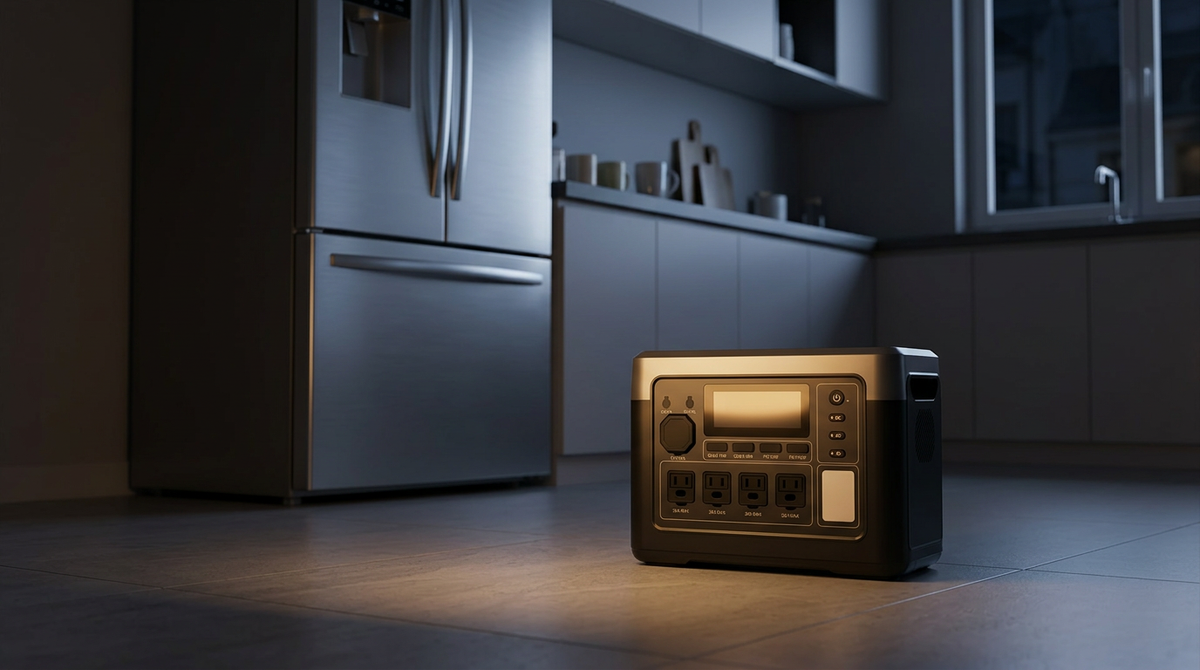
Every year during major storms, people die running gas generators inside their homes or in attached garages. Carbon monoxide has no smell. By the time you feel wrong, it's often too late. Running a generator in a garage with the door open is still not safe. The fumes accumulate. This is the single biggest practical advantage of a portable power station over a gas generator. Zero emissions. Run it right next to your fridge. No ventilation needed. No risk.
Your Immediate Action Checklist During an Outage
- Unplug sensitive electronics now. Power sometimes returns with a spike that your breakers won't fully absorb.
- Keep fridge and freezer doors shut. Every opening costs you hours of safe temperature.
- Report the outage to your utility. Reported outages get prioritized in the restoration queue.
- Check the utility outage map. Most publish live estimates by address.
- Connect only essentials to backup power: fridge, medical devices, lights, phone charging.
- Don't run everything at once. Stagger loads to stretch your runtime.
Backup Power: Portable Power Station vs Generator
Side-by-Side Comparison
|
Feature |
Gas Generator |
Portable Power Station |
|
Indoor use |
Never (CO poisoning risk) |
Yes, zero emissions |
|
Noise |
65–80 dB |
Silent |
|
Startup |
Pull-start, 30+ seconds |
Instant or <10ms EPS |
|
Maintenance |
Oil, carb, fuel stabilizer |
None |
|
Fuel during outage |
Gas stations may be down too |
Solar recharging available |
|
Runtime |
As long as fuel lasts |
Battery capacity, rechargeable |
|
10-year total cost |
$500 unit + $2,000+ fuel/maint |
$1,500–$2,600, nothing after |

Alt Text: gas generator with exhaust fumes versus clean OUKITEL P5000 Pro portable power station with solar panel for storm backup
For Short to Medium Outages (2–24 Hours)
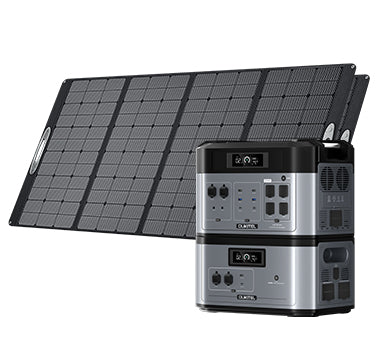
The OUKITEL BP2000 was built for exactly this window. 2,048Wh capacity, 2,200W output, and an EPS switchover under 10 milliseconds. I've plugged a router, fridge, and a couple of lamps into mine. When the grid dropped, nothing blinked. The devices had no idea anything happened. It takes MC4 solar input directly, so pairing it with 400W panels gives you recharging during longer events. And it expands up to 16,384Wh with B2000 expansion packs if your outages tend to stretch.
For Multi-Day Outages (24 Hours to a Week)
The OUKITEL P5000 Pro carries 5,120Wh with up to 1,000W solar input through its MPPT controller. I ran mine through a full week after a late-season storm in 2023. Two PV400 panels in the yard. Battery recharged to 80% by midday every single day. Seven days, no grid power, no fuel, no noise complaints from the neighbors. That's what indefinite off-grid capability actually looks like.

Alt text: Image of OUKITEL P5000 Pro Portable Power Station 5120Wh/3600W
Why LiFePO4 Matters for Storm Backup
Both stations use LiFePO4 battery chemistry. That matters here because LiFePO4 stays stable at high temperatures, doesn't vent gas, and handles 3,500 to 5,000+ full discharge cycles. Roughly 10 years if you used it every day. For storm-season use a handful of times per year, the battery longevity concerns people have with older lithium-ion chemistry simply don't apply.
Why Some Neighborhoods Lose Power Every Single Storm
If your street goes dark every time weather hits while the houses half a mile away keep their lights on, that's not bad luck. Three factors predict it.
Overhead vs Underground Wiring
A utility study in North Carolina found underground lines experience 50% fewer outages than overhead lines. The tradeoff: when underground lines do fail, repairs take 58% longer because crews have to dig. Neighborhoods built in the last 20 years with buried distribution rarely lose power from wind or ice. Older neighborhoods on wooden poles lose power every time a serious storm blows through.
Tree Maintenance
Your utility is supposed to trim vegetation away from lines on a regular schedule. Some do it well. Many don't. If you can look out your window and see branches touching or draping over the wires, call your utility and ask about their trimming timeline. That branch is your next outage.
Proximity to Critical Facilities
Homes sharing a distribution feeder with a hospital, fire station, or water treatment plant get restored faster. Not because the homes matter more. Because the critical facility on the same wire does, and fixing that wire fixes both.

Alt: overhead power lines on wooden poles versus underground utility neighborhood comparison showing storm vulnerability difference
FAQs
Why does my power go on and off during a storm?
That's a recloser doing its thing. Picture an automatic circuit breaker that's smarter than the one in your basement. It detects a problem on the line, kills power for a split second, then tries to bring it back. If the fault was something temporary, a brief arc from lightning hitting nearby, power returns so fast you barely notice. Maybe the clock on your microwave resets. If the problem is physical, like a branch actually sitting on the wire, the recloser gives it two or three more shots and then gives up. Locks out. Power stays off until a crew gets there. Those repeated flickers before a full outage? That's the system fighting to stay alive before admitting it lost.
What is the 30-minute thunder rule?
After you hear the last rumble of thunder, stay inside for another 30 minutes before going outside. Lightning doesn't stop the instant rain lets up. The electrical charge in the atmosphere hangs around longer than the visible storm. I saw someone in my neighborhood walk out to check their yard maybe five minutes after the rain stopped. A bolt hit a tree two blocks over. Close enough to feel it through the ground. The 30-minute window exists because that's roughly how long residual electrical activity needs to move far enough away that you're not a viable target.
Can I flush the toilet if the power is out?
Most homes, yes. Standard gravity-fed toilets work without any electricity. The tank holds enough water for at least one flush on its own. After that, you can manually refill the tank with a bucket of stored water and flush again. Where it gets complicated: if your house runs on a well pump, you have no water pressure without power running that pump. Same problem if you have a sewage ejector pump in the basement. No power means no pumping. For homes on municipal water with gravity-fed toilets, flushing works fine during an outage.
Why can't you shower during a thunderstorm?
Lightning travels through plumbing. Metal pipes conduct electricity. Water conducts electricity. If a bolt strikes your house or a nearby structure connected to the same water main, the charge can follow the pipes right to your showerhead. The CDC has documented cases of lightning injuries from indoor plumbing contact. This isn't theoretical. It happens. Your shower can wait 30 minutes until the storm clears. That's the same 30-minute thunder rule applied indoors.
Are portable power stations worth it for storm outages?
For most households dealing with outages that run a few hours to a few days, yes. A portable power station keeps your fridge cold, phones charged, medical devices running, and a couple rooms lit. No fumes. No noise. No carbon monoxide risk. Run it right in your living room. For outages that stretch past a day, pairing a station like the P5000 Pro with solar panels gives you a recharge source that doesn't depend on gas stations being open. I watched that advantage matter most during an outage where every gas station within 15 miles was also dark.
How can I tell how long my power will be out?
Pull up your utility's outage map online the moment your power drops. Nearly every major utility publishes real-time restoration estimates by address or zone now. Those estimates start rough and get more accurate as assessment crews physically reach your neighborhood and report back what they find. If the map shows your area with no estimate at all, that's usually bad news. It means crews haven't even gotten to your street yet, which signals widespread regional damage. I check the map every couple of hours during major events because the numbers update as repairs progress.
Does lightning always cause power outages?
Not every time. When lightning hits a power line, it sometimes triggers an automatic recloser that kills power for a fraction of a second and then restores it. If the fault clears, meaning no physical damage occurred, power snaps right back. That momentary flicker you notice during thunderstorms is usually a recloser doing exactly its job. When the strike actually damages something, a blown transformer or a melted wire, the recloser locks out and the outage stays until a repair crew arrives. The flicker is good news. It means the system tried and succeeded at healing itself.
Take Action Now
1. Check your surge protection today. Whole-home protector at the panel plus 1,000+ joule units at your important devices.
2. Put a thermometer in your freezer. When power returns after an outage, you'll need to know if your food stayed below 40°F.
3. Charge your backup power before storm season starts. Not during the storm. Before it. The people who prepare in April don't panic in July.
Sources
1. U.S. Energy Information Administration — Power Interruptions Report (2024)
2. U.S. Department of Energy — Grid Modernization and the Smart Grid (2024)
3. U.S. Food and Drug Administration — Food Safety During Power Outages (2024)
4. Federal Emergency Management Agency — Power Outages (2024)


Looking for something else?

OUKITEL Energy Storage Shines at the 139th Canton Fair, Global Customers Experience Product Strength On-Site
LEARN MORE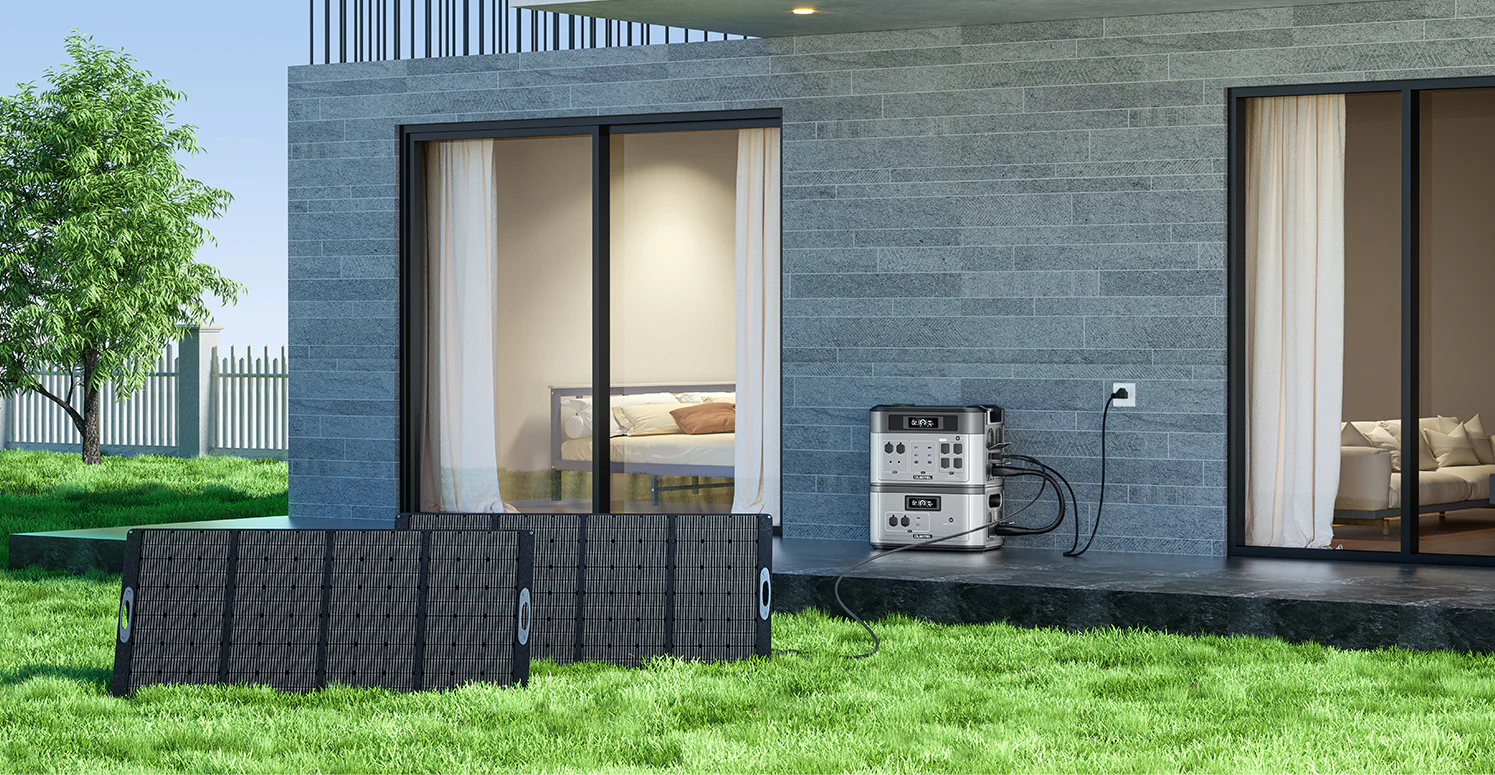
How Does a Solar Generator Work? A Comprehensive Guide to Clean, Renewable Power
LEARN MORE
How Long Does It Take to Fix the Power Outage by Situation
LEARN MORE
Is Tornado Watch or Warning Worse? What to Do Fast
LEARN MORELooking for something else?

5000 Watt Solar Generator: Is It Enough for Your Home?
LEARN MORE
Solar Panel Connectors Types: Complete Guide to MC4, XT60 and More
LEARN MORE
Why Does the Power Go Out During a Storm? (And What You Can Do About It)
LEARN MOREYou may also like

OUKITEL P2001 Plus+2*200W Solar Generator

OUKITEL P2001 Plus+200W Solar Generator

OUKITEL BP3000 Portable Power Station 3200W | 2048Wh

OUKITEL P5000 Pro+400W Solar Generator

OUKITEL BP2000+400W Solar Generator

OUKITEL P5000+2*400W Solar Generator
Further reading

Best Solar Generator for RV in 2026: How to Size and Choose One
Portable Power Station for CPAP: How to Size Runtime, Humidifier Load and Battery Backup