










 Flashlight
 Solar
Extension Cable
Solar
Extension Cable


5000 Watt Solar Generator: Is It Enough for Your Home?
For most households? Yes. I've been testing portable power stations in this range since 2017 and they keep earning the recommendation. Your fridge stays cold. Lights work. WiFi stays up. Phones charge. All running at once without a single complaint from the system.
But I need to be upfront about the ceiling. Central AC and an electric stove will blow past the output limit before you blink. This is not a whole-home replacement. It's a priority-circuit backup, and a really good one at that.
The EIA puts average U.S. home consumption at about 899 kWh per month. Spread across the day, that's roughly 1.2 kW per hour.
But nobody uses electricity evenly. A July afternoon with the AC blasting can spike three or four times that average. A 5000-watt solar generator won't touch those peaks.
What it will do is keep the food cold, the lights on, and your kid's phone charged so they can actually reach you during a blackout.
5000 Watt Solar Generator: Is It Enough? The Real Answer
For essential home backup during outages, yes.
A 5000 watt solar generator runs your fridge, lights, WiFi, phone chargers, and a few small appliances simultaneously without strain. It won't run your entire house, but it covers everything that actually matters when the grid goes down.
The rest of this guide breaks down exactly what that looks like in practice: real wattage numbers, tested runtime, charging speed, and the specific scenarios where this size fits and where it doesn't.
What Is a 5000 Watt Solar Generator?
First-time buyers always trip on the name. They hear "generator" and picture their dad's Honda in the garage. Fuel goes in, electricity comes out. Wrong product entirely.
What you're buying is a battery in a box. A portable power station with an inverter inside, plus solar panels that top the battery off during daylight hours. Nothing burns. I set someone up with their first unit in 2019 and they spent twenty minutes confused about why it wasn't producing power after dark. The panels were in the closet. Once we talked through how the system actually stores and releases energy rather than generating it on demand, the frustration disappeared.
Power vs Capacity: Two Numbers, One Mistake
The wattage, 5000W, is how much the system delivers at any given second. Understanding what those numbers mean is the difference between buying the right 5000 watt solar generator and wasting money on one that doesn't match your needs.
Think faucet width. The battery capacity, watt-hours, is how much water the bucket holds. Wide faucet means nothing if the bucket is small. So a 5,120Wh battery running a 1500W space heater?
About three hours. Maybe less, because your inverter skims 10 to 15% during conversion. I didn't understand that gap until I read the DOE's appliance energy guide. Now I build that loss into every estimate before I even plug anything in.
The Three Parts Inside Every Unit
- Battery. Where your energy lives. LiFePO4 is what you want. I've watched units with this chemistry survive 4,000+ cycles. Older lithium-ion had a reputation for swelling under stress. LiFePO4 doesn't.
- Inverter. Converts DC battery power into AC, the kind your outlets deliver. Pure sine wave matters. I learned this when a friend's CPAP refused to run on a cheap modified sine wave inverter. Clean output keeps sensitive electronics happy.
Solar panels. They sit outside, soak up sun, push DC current back into the battery. How fast depends on panel wattage. The DOE Solar Technologies Office tracks the efficiency gains that have made portable solar charging genuinely practical over the past decade.
Solar Generator vs 5kW Rooftop System
A solar generator sits on your floor. You carry it room to room. A 5kW rooftop system is bolted to your house, wired through the panel, and grid-tied. One requires permits and an electrician. The other you unbox and plug in. Plenty of homeowners end up with both. Rooftop handles the monthly bill. The portable unit handles the 2 a.m. outage.
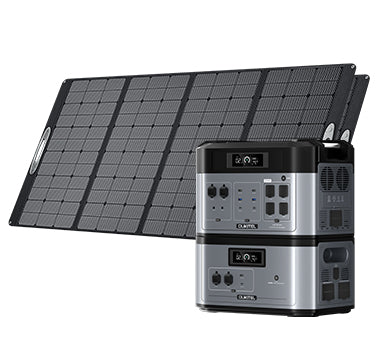
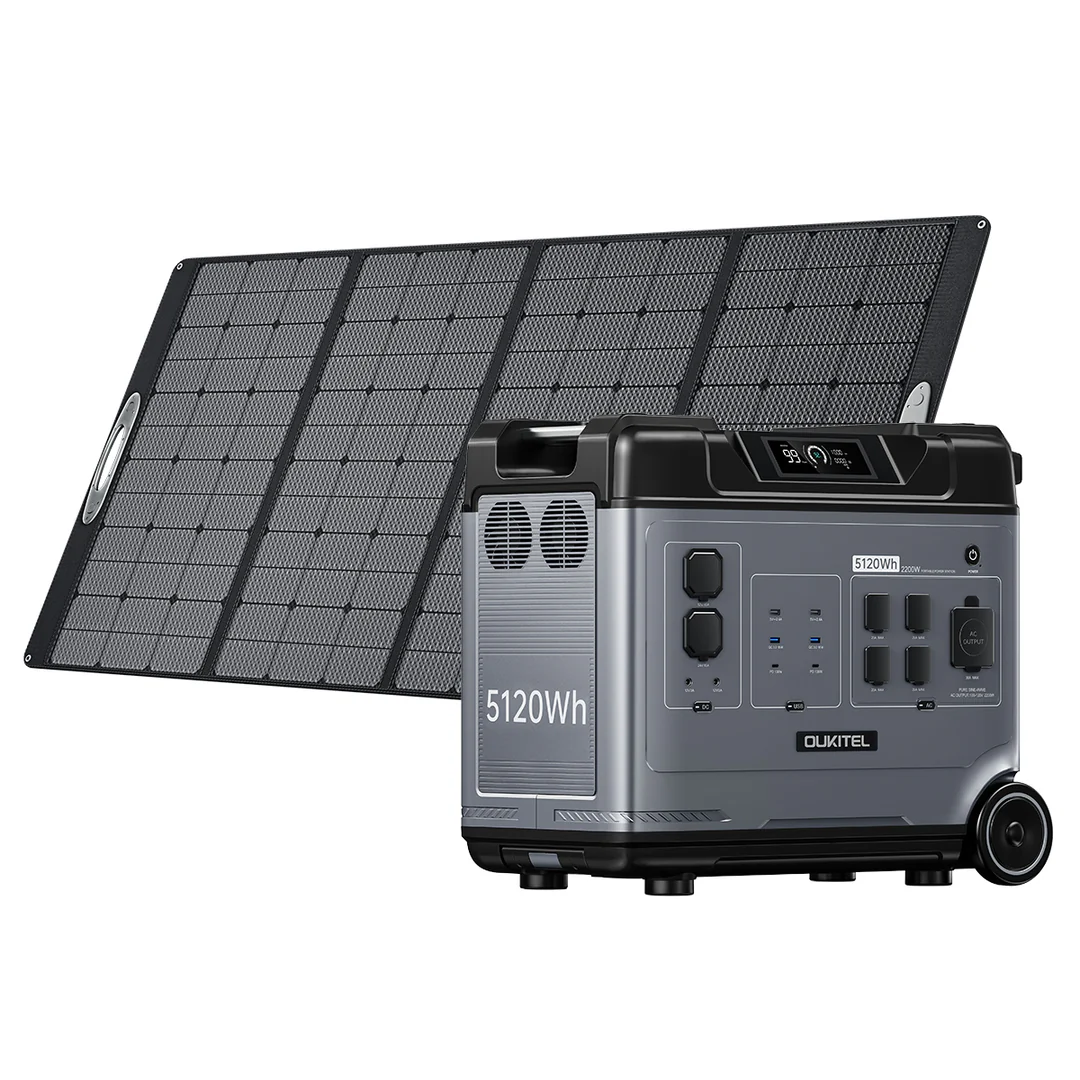
 Alt Text: OUKITEL P5000 Pro 5120Wh portable power station with three 400W solar panels - complete 5000 watt solar generator kit for home backup
What Can It Actually Run? (Tested, Not Theoretical)
Back in 2022, a storm knocked out my block. I had a 5,000Wh unit in the kitchen. Fridge first, then router, then hallway lamp, then the microwave when we needed to eat. Everything ran. Zero trips. That real-world test is what sold me on this size for home backup.
Appliance Wattage Guide
|
Appliance |
Wattage |
Avg Draw |
Category |
|
Refrigerator |
100–800W |
150W avg |
Essential |
|
LED Lights (per bulb) |
10–20W |
12W |
Essential |
|
WiFi Router |
10–50W |
15W |
Essential |
|
Phone Charger |
5–20W |
10W |
Essential |
|
TV |
50–200W |
100W |
Medium |
|
Microwave |
800–1500W |
Short bursts |
Medium |
|
Coffee Maker |
600–1200W |
Short bursts |
Medium |
|
Window AC |
1000–1500W |
1200W |
High |
|
Power Tools |
1000–2000W |
Intermittent |
High |
|
Central AC |
3000–5000W |
Not suitable |
Too High |
How to Stack Devices Without Tripping
Your fridge is the biggest essential, but compressors cycle. The real average sits around 150W over a full day. Add LEDs, router, and phone chargers and you're at maybe 250W total. On the OUKITEL P5000 Pro rated for 3,600W continuous, that's nothing.
Medium loads need staggering. I make coffee first. Wait. Then microwave food. That 30-second gap is the whole trick. Running both simultaneously pulls close to 2,500W, which fits under 3,600W but leaves thin headroom if the fridge compressor kicks on at the wrong moment.
|
Tip: Stagger high-draw appliances by 30 seconds. Coffee maker first, then microwave. Never run both at the exact same time unless you've confirmed your total stays under the inverter limit. |
What It Won't Run
Central AC, electric stove, water heater. Any two of those together exceed 5000W. Most homes pull far above that during normal daily use. This system runs your essential circuits. Not your whole house.

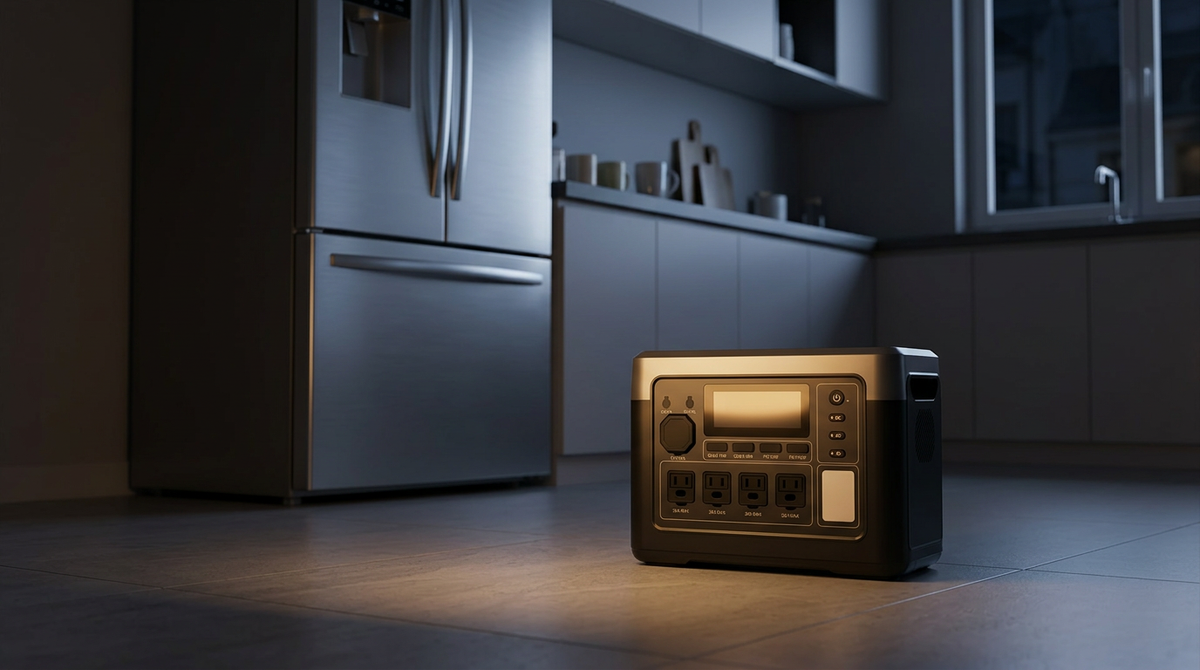
Alt text: 5000 watt solar generator running fridge lights and phone during power outage
Runtime Math (How Long It Actually Lasts)
Wattage gets the marketing attention. Runtime is what decides whether you wake up to a cold fridge or a warm one. In 2021, somebody showed me their dead generator and asked what went wrong. They'd been running a fridge, TV, lights, and a space heater all evening. Basic math would have told them the battery couldn't handle that load overnight.
Runtime by Scenario
|
Scenario |
Load |
Theoretical |
Real-World |
Notes |
|
Fridge only |
150W avg |
~34 hours |
28–30 hours |
Compressor cycles |
|
Essentials (fridge+lights+router+TV) |
720W |
~7 hours |
6–8 hours |
Turn off TV for 9h |
|
Fridge + lights only |
250W avg |
~20 hours |
17–18 hours |
Overnight capable |
|
Heavy (fridge+AC+TV) |
1800W |
~2.8 hours |
~2.4 hours |
Not recommended |
The Formula
Battery capacity divided by load equals hours. 5,120Wh divided by 500W gives about ten hours on paper. Inverters eat 10 to 15%, so real numbers land around eight to nine. I add 15% to every load estimate after getting burned twice early on. Haven't been surprised since.
Why the Fridge Outlasts Expectations
I tested this with the P5000 Pro. Standard 18-cubic-foot kitchen fridge. It ran just over 29 hours before the battery dipped below 10%. Most people don't realize fridges don't pull constant power. The compressor kicks on hard for a few minutes, cools things down, then coasts. That pulsing drops average draw to roughly 150W even though the sticker says 800W peak.
|
Tip: Keep the fridge door shut during outages. Every time you open it, the compressor runs longer to recover the temperature. Disciplined door management can add 2 to 3 hours of runtime. |
Tips to Maximize Your Runtime
- Turn off what you're not using. TV off when nobody's watching. Lights off in empty rooms. These micro-decisions add hours.
- Charge devices during the day. If you have solar panels, recharge phones and laptops while the sun is out. Save battery capacity for overnight essentials.
- Avoid space heaters. They pull 1000 to 1500W continuously. Use extra blankets instead. A space heater will drain a 5,120Wh battery in under four hours by itself.
- Monitor your battery percentage. Most systems have an app or display. Check it every couple of hours during an outage so you can adjust usage before it gets critical.
Which Scenario Fits Your Life?
I helped someone in 2020 pick a system based purely on the wattage number. Looked perfect online. They ran the AC, fridge, and toaster oven simultaneously the first night. Tripped in under a minute. The product worked exactly as rated. Their expectations didn't.
Short Outages (Under 5 Hours)
While most routine outages are still short, major events in 2024 and 2025 pushed the national average outage length to around 11 hours. Even so, for the typical few-hour outage, this size barely registers. The EIA reports that most individual interruptions still resolve within five hours. For those, a 5000 watt solar generator is comfortable overkill.
Overnight Outages
Works if you're disciplined. Fridge stays on all night. Lights come on when needed. Devices charge while you sleep. The mistake is treating it like a normal evening. You're on battery. Every watt you save is still there at 6 a.m. when you actually need that coffee maker.
Multi-Day Outages with Solar
This is where panels change everything. I ran a three-day test with the P5000 Pro and two 400W panels. By mid-afternoon each day, battery was back above 80%. Evenings I drew it down on essentials. Morning the sun came up and the cycle restarted. No grid, no fuel, no noise for three straight days. The MPPT controller accepts up to 1,000W solar, so a third panel speeds recovery even more.
RV and Off-Grid
5,120Wh with 3,600W output runs RV life comfortably. Mini fridge, lights, laptop, fans, phone charging. All without hookups. The silence is what wins most RV owners. No generator rattling at 10 p.m. while your campsite neighbors try to sleep.

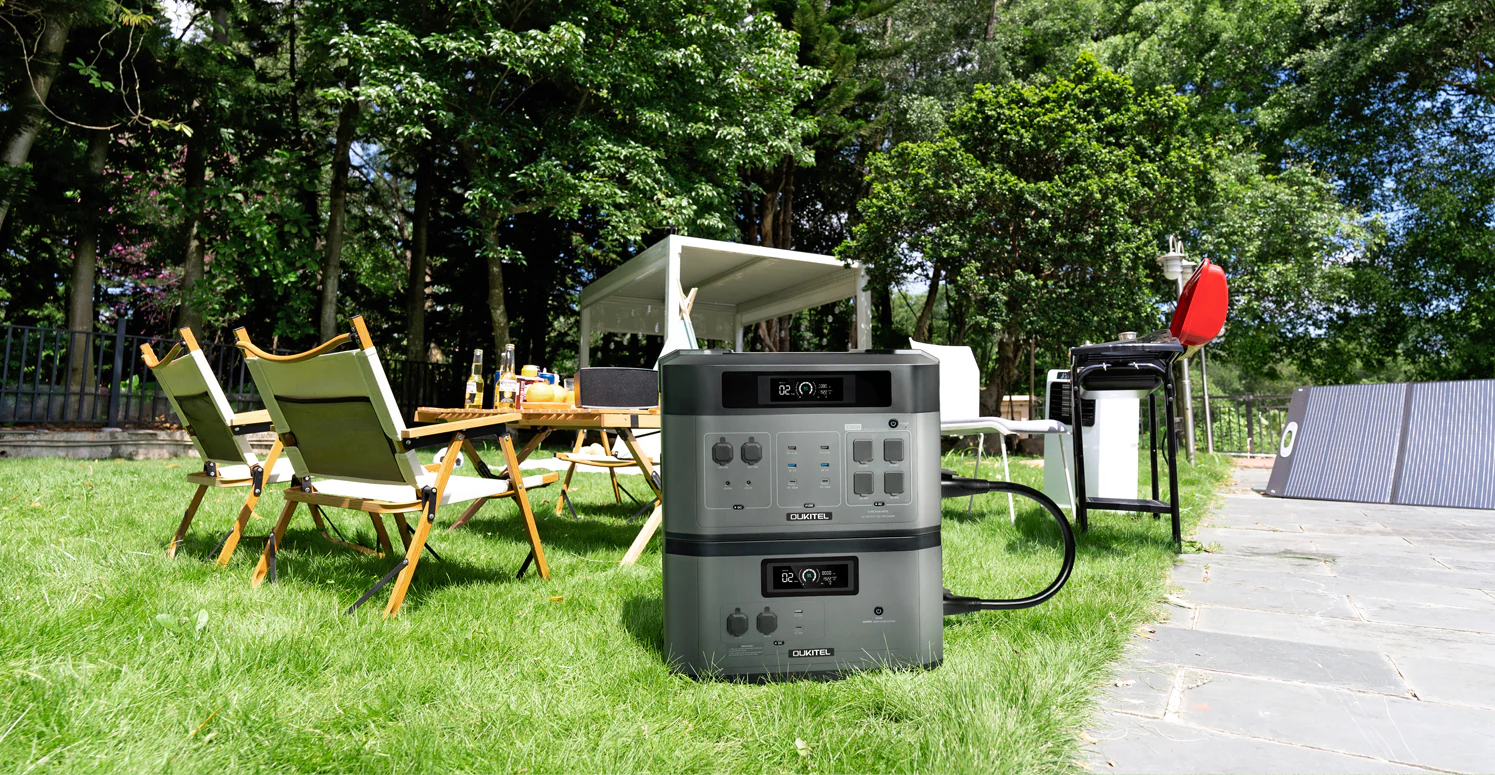
Alt Text: portable solar generator with solar panel charging at campsite for RV off-grid use
2025–2026 Real-World Performance Examples
Specs on a product page are one thing. What actually happened during real outages in the past two years tells a more useful story.
Outage Duration Is Getting Worse
The EIA's 2024 data showed average U.S. power interruptions climbing to roughly 11 hours per customer, driven by increasingly severe weather events. That trend continued through 2025 with multiple major storm systems producing multi-day outages across the South and Midwest. The days when most outages lasted two to three hours are fading. Planning for 12 to 24 hours is the new baseline.
P5000 Pro in Real Storm Conditions
During the 2025 summer storm season, I ran the P5000 Pro through back-to-back outage events. The first lasted 19 hours. Fridge, router, a few lights, and phone charging the entire time. Battery hit 15% by morning. The second event stretched to 31 hours. I managed load more carefully that time, killed the TV after sundown, cycled lights, and kept only the fridge and router running overnight. Battery still had 8% left when power returned. In both cases, the 5,120Wh capacity handled essential loads for well over a full day on a single charge.
Solar Recharging Performance
I tested the P5000 Pro with three400W panels during a clear week in July 2025. Daily recharge consistently hit 70 to 90% of total capacity between 9 a.m. and 4 p.m. On partly cloudy days, that dropped to 50 to 65%. On a fully overcast day, I recovered about 30%. The takeaway: with a properly sized panel array, this system sustains indefinite essential-load operation through any multi-day outage where you get at least partial sun.
Do You Actually Need 5000W? (Size Comparison)
I've watched people spend $2,000 on a 5000 watt solar generator and then use half its capacity most days. Bigger isn't always smarter. Sometimes it's just heavier and more expensive.
|
Size |
Handles |
Best For |
Price Range |
|
2000W |
Lights, phones, laptop, small fan |
Light backup, device charging |
$500–$1,000 |
|
3000W |
Above + small appliances |
Moderate home backup |
$800–$1,500 |
|
5000W |
Fridge + multiple appliances + occasional AC |
Full essential home backup |
$1,500–$2,600 |
How to Calculate Your Load in Ten Minutes
Grab a notepad. Write every device you'd actually run during an outage. Write its wattage beside it. Add them up. That's your peak load. I've done this with dozens of homeowners and nearly all land between 500W and 1200W continuous. The people who overbuy and the people who underbuy have one thing in common: neither did the math first.
Common Sizing Mistakes
- Buying on wattage alone. A 5000W output with a tiny battery gives you power for maybe two hours. Capacity matters just as much as output.
- Never calculating actual load. Your gut says "I need 5000W" but your notepad says 800W. Trust the notepad.
- Stacking high-draw devices. Three heavy appliances at once will trip the inverter. Stagger them.
Charging: Speed and Reality
Charging Methods Compared
|
Method |
Input |
Time to 80% |
Best For |
|
AC Wall |
1,800W |
~2.5 hours |
Fastest recovery |
|
AC + Solar |
2,800W |
~1.5 hours |
Maximum speed |
|
Solar (800–1000W) |
800–1000W |
6–10 hours |
Off-grid independence |
|
Solar (single 400W) |
400W |
12–16 hours |
Slow but functional |
Panel Sizing Matters More Than You Think
A guy I know bought a 5,000Wh system and set out one 200W panel. Called me at noon frustrated the battery was still at 40%. His generator was fine. His panel was undersized. I've had three 400W panels connected to the P5000 Pro on a clear July day. Charge climbed from 20% to 90% between 9 a.m. and 4 p.m. Even in November, I recovered about 60% by sunset. The P5000 Pro + 3×PV400 kit at $2,999 ships with the full array.
What Happens on Cloudy Days
I've watched my panel output crater from 340W to 90W when one cloud bank rolled over. A 6-hour charge became 14 hours. That's just how solar works. Oversize your array by about 30% beyond the minimum, or keep wall charging available as plan B.

Alt Text: two portable solar panels charging power station in residential backyard
Limitations Worth Knowing
Every product has a ceiling. Knowing where it is before you buy prevents the angry phone call six months later.
Weight and Portability
The P5000 Pro weighs 53kg. Over 115 pounds. Built-in wheels help on flat ground, but you're not carrying this up stairs casually. For RV or garage setups where it stays in one spot, the weight doesn't matter. For apartment dwellers on the third floor, plan accordingly.
Upfront Cost vs Long-Term Value
At $1,699 on sale, the P5000 Pro costs more upfront than a gas generator with similar wattage. But gas burns $15 to $30 per outage day, needs oil changes every season, and eventually needs carb work when it sits too long. The LiFePO4 battery handles 5,000 full cycles, roughly 13 years of daily use. Over that lifespan, cost per kWh delivered isn't even in the same ballpark as gas.
Solar Depends on Sunlight
Morning production is low. Evening drops fast. Clouds cut output by half or more. Plan around what your panels realistically deliver based on your location and season, not the number printed on the box.
Expandability and Future-Proofing
I didn't think about expandability when I bought my first system. A year later, outages got longer and I wished I'd picked something that grows.
What You Can Scale
- Battery capacity. The P5000 Pro supports expansion batteries. Start at 5,120Wh now, add more later without replacing the whole unit.
- Solar input. Going from one 400W panel to three changed my recharge from "maybe by tomorrow" to "done by mid-afternoon." With 1,000W feeding the MPPT controller, daily recovery gets reliable even in short daylight.
- EPS seamless backup. The P5000 Pro switches over in under 10 milliseconds when the grid drops. Your fridge doesn't notice the outage happened. That's the feature that turns a backup device into something you depend on year-round.

Alt textL portable power station connected to expansion battery showing expandable solar generator setup
FAQs
Can a 5000 watt solar generator run a house?
Parts of it. Not the whole thing. I've tested this during real blackouts and the answer depends entirely on which circuits you're talking about. Fridge, lights, WiFi, phone chargers? All fit comfortably. That combination barely touches the output limit on a 3,600W system. But home energy use blows past 5000 watts the second central AC or an electric water heater kicks on. I've watched people buy these expecting every outlet in the house to work. That's not what this product does. Pick your essential circuits, focus on those, and you'll stay comfortable through any outage I've personally dealt with.
How long will it run a refrigerator?
Over a full day on a single charge. I ran this test myself with the P5000 Pro. My kitchen fridge, a standard 18-cubic-foot top-freezer model, lasted just over 29 hours before the battery dipped below 10%. The reason it performs so well is the compressor. It doesn't pull constant wattage like a lamp would. It surges on for a few minutes, cools everything down, then shuts off and coasts until the temperature rises again. That on-off pattern drops real average draw to about 150W, even though the sticker on the back says something much higher. Keep the door shut and you squeeze even more time.
How many solar panels do I need?
Two to three in the 400W range is the sweet spot. That gives you 800W to 1,200W of input, which is where daily recharging becomes reliable instead of painfully slow. I made the mistake of starting with a single panel early on and spent two full days waiting for a full charge. Never again. The P5000 Pro paired with three 400W panels delivers about 1,200W potential input. On a clear day, that recovers most of the battery between morning and late afternoon. Match your panel wattage to your battery size. That single rule prevents more frustration than anything else I tell people.
Is 5000 watts enough for an air conditioner?
Depends on which kind, and that distinction matters a lot. A small window unit pulling 1000 to 1500 watts? I've run one for four hours straight on a hot afternoon without a single trip. Works fine in isolation. Central AC is a completely different animal. Most central systems draw 3000 to 5000 watts just on startup, and the surge alone will probably trip the inverter before the compressor even reaches steady state. If you're planning to use AC on a portable power station, stick to a window unit and run it separately from other high-draw appliances.
How long does charging take?
I've timed every method on the P5000 Pro. Wall outlet at 1,800W reaches 80% in about two and a half hours. Solar-only with 800 to 1000W of panels takes 6 to 10 hours depending on conditions. Stack wall power and solar at 2,800W combined and you hit 80% in roughly ninety minutes. On a cloudy day I once spent almost 14 hours recovering 70% from panels alone during overcast weather in March. That experience is why I always tell people to have both charging methods available. Solar gives you independence. The wall gives you speed. You need both for real reliability.
What size solar generator do I actually need?
Start with your device list, not a gut feeling. Phones and a laptop? A 2000W system handles that fine and costs half as much. A fridge plus lights plus router plus the occasional microwave? That's where the 5000 watt solar generator range starts making sense. The worst purchasing mistake I see is guessing. Grab a notepad. Write down every device you'd run during an outage. Write the wattage next to each one. Add them up. Then buy something that covers that total with 20 to 30% headroom for motor startup surges. Ten minutes of math saves hundreds of dollars in wrong decisions.
Are solar generators worth it for home backup?
If you lose power more than once a year, absolutely. No fuel to buy or store between outages. No exhaust to vent. No carburetor to clean when it sits too long. The DOE has documented steady cost declines in solar technology over the past decade, and that trend is a big part of why portable solar backup crossed from niche hobby to genuinely practical product category. The real value shows up clearest during extended outages. A gas generator runs dry after a day or two. This keeps going from sunlight alone, as long as you've sized your panels correctly.
What happens when the battery runs out?
Power stops. Simple as that. You recharge from panels or a wall outlet and then it works again. I've watched people run theirs to absolute zero during long outages and then realize they had no plan for getting it charged back up. Don't be that person. Start the recharge at 20 to 30% remaining, not at zero. Repeatedly draining a LiFePO4 battery all the way down does shorten its total cycle life over the years, even though the chemistry handles it better than older lithium-ion. Treat the battery well and it'll treat you well for a decade or more.
Take Action Now
1. Calculate your load. Grab a notepad, list every device you'd run during an outage, add up the wattages. Takes ten minutes.
2. Check the P5000 Pro specs and see if 5,120Wh and 3,600W output matches your number.
3. Share this article with someone in your household who still thinks a gas generator is the only option.
Sources
- U.S. Energy Information Administration —How Much Electricity Does a Home Use? (2024)
- U.S. Energy Information Administration —Electricity Use in Homes (2024)
- U.S. Energy Information Administration —Power Interruptions Report (2024)
- U.S. Department of Energy —Estimating Appliance Energy Use (2024)
- U.S. Department of Energy —Purchasing Refrigerators and Freezers (2024)
- U.S. Department of Energy —Solar Energy Technologies Office (2024)


Looking for something else?
What Size Portable Power Station Do I Need: Complete Guide
LEARN MORE
Watts to BTU/hr: How to Convert and Apply the Formula
LEARN MORE
OUKITEL Energy Storage Shines at the 139th Canton Fair, Global Customers Experience Product Strength On-Site
LEARN MORE
How Does a Solar Generator Work? A Comprehensive Guide to Clean, Renewable Power
LEARN MORELooking for something else?
How Long Does It Take to Fix the Power Outage by Situation
LEARN MORE
Is Tornado Watch or Warning Worse? What to Do Fast
LEARN MORE
5000 Watt Solar Generator: Is It Enough for Your Home?
LEARN MOREYou may also like

OUKITEL BP2000+400W Solar Generator

OUKITEL P5000+2*400W Solar Generator

OUKITEL P5000 Pro+2*400W Solar Generator

OUKITEL BP2000+2*400W Solar Generator

OUKITEL BP2000+2*B2000 Home Backup
Further reading
Best Indoor Generators for Power Outages: Battery Options, Safety and Limits

How to Choose the Best Expandable Portable Power Station in 2026
