








 Flashlight
 Solar
Extension Cable
Solar
Extension Cable


Best Indoor Generators for Power Outages: Battery Options, Safety and Limits
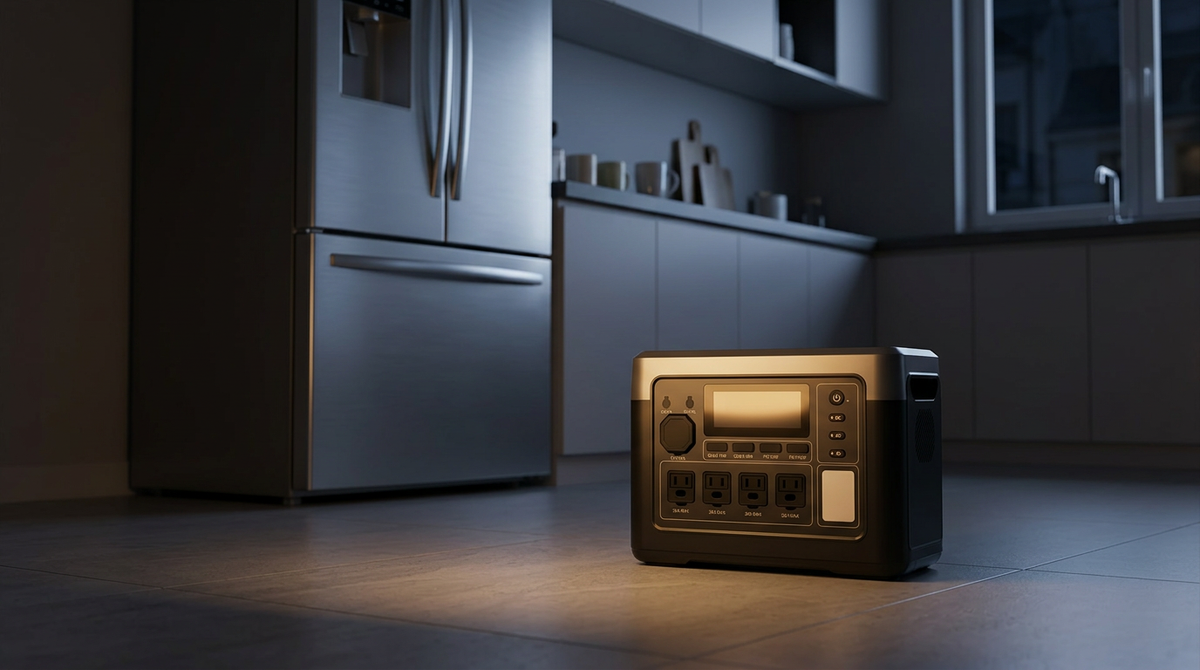
The best indoor generators for power outages are battery power stations sized to your essential loads. These units store electricity and release it through AC outlets, so nothing burns and no exhaust enters the room while they run. That is the whole reason a battery power station works for power outage backup indoors. Fuel-burning generators are a separate category and belong outdoors without exception.
Three numbers settle which indoor generator you need. Continuous output in watts sets what can run at once. Usable capacity in watt-hours sets how long it runs. Recharge input decides whether you get a second day.
What follows is the sizing math, the safety rules that actually apply indoors, the setup options from extension cord to transfer switch, and the limits worth knowing before you spend.
What Counts as an Indoor Generator for Power Outages?
An indoor generator for power outages is a portable power station. The retail name is shorthand for the same hardware: battery cells, an inverter, a charge controller, and outlets in one case. It does not generate anything. It stores energy you put in earlier and returns it on demand.
Battery Power Station vs Solar Generator
"Solar generator" almost always describes the same hardware bundled with panels. Panels change the input side only. They do not change output, capacity, or how the unit behaves indoors.
Panels earn their cost once the outage outlasts the battery. For a four-hour interruption, they sit in a closet. For a four-day one, they decide whether the refrigerator stays cold.
Gasoline, propane, diesel and natural gas units make electricity by burning fuel, and combustion produces carbon monoxide. That single fact puts them outdoors permanently.
|
Factor |
Battery power station |
Fuel-burning portable generator |
|
Indoor operation |
Generally suitable when the manual is followed |
Never, under any ventilation |
|
Energy source |
Stored electricity, finite per charge |
Fuel, refillable indefinitely |
|
Exhaust |
None during battery operation |
Carbon monoxide, invisible and odorless |
|
Noise |
Cooling fans only, load dependent |
Continuous engine noise |
|
Maintenance |
None routine beyond storage charge |
Oil, filters, fuel stabilizer, run-ups |
|
Cold weather |
Reduced capacity, charge limits below freezing |
Starting difficulty, fuel gelling in diesel |

[IMAGE: Alt: Indoor generator for power outages compared with an outdoor fuel-burning generator placed 20 feet from a house | 4:3 inline]
Which Indoor Generator Safety Rules Matter Most?
Combustion Units Stay Outside, Every Time
Portable generators sit at the top of U.S. Consumer Product Safety Commission data on non-fire carbon monoxide deaths, and the guidance is blunt. Never inside a home, garage, basement, crawlspace or shed, even with doors and windows open. Outdoors only, at least 20 feet from the house, exhaust directed away from doors, windows and vents.
Portable generators sold in the United States since May 2007 carry a mandated danger label stating that indoor use can kill within minutes. Opening a garage door does not change that. Neither does a fan.
Battery Units Still Need Care
No exhaust does mean no rules. Keep cooling vents clear on every side the manual specifies, keep the unit dry and off soft surfaces that block airflow, and keep it away from combustible material. Check the permitted charging, discharging and storage temperature ranges. Both ends of that range matter more than buyers expect.
Use only the cables, chargers, expansion batteries and solar equipment the manufacturer approves. Stop using a unit that swells, cracks, overheats or produces smoke or odor, and contact the manufacturer rather than opening the case.
Brand-level assurance is not documentation. What matters is certification covering the exact configuration you intend to run, which is not always the configuration that was tested.
Five details to confirm in the manual or spec sheet, not the product listing, before you order:
- Certification listed for the specific model and configuration, including any expansion batteries
- Battery-management protections written into the manual, not just the product page
- Whether expansion packs or transfer equipment change the tested configuration
- Grounding and GFCI instructions for the setup you plan to build
- Recall history for the model and for its accessories
How Do I Decide What Must Stay Powered?
Start with a list, not a wattage. Outage backup fails most often because somebody bought capacity before deciding what it was for.
Cover health, food, communication and the building itself. For most households that means a refrigerator, modem and router, phone and laptop charging, a few lights and any approved medical equipment. Sump pumps and furnace controls join the list depending on climate.
The refrigerator tops almost every list. FDA guidance puts a closed refrigerator at roughly four hours of safe temperature without power, and a full freezer at about 48 hours. Covering it converts a spoilage event into an inconvenience.
Medical device users should confirm power requirements with the device maker or care provider. FEMA outage guidance recommends planning refrigerated medication and power-dependent equipment ahead of time.
The Loads That Break the Math
Resistance heating is the usual culprit. Space heaters, water heaters, ranges, ovens, dryers and central air conditioning draw so heavily that they turn a multi-day battery into a multi-hour one. A 1,500W space heater consumes more in an hour than a refrigerator uses in a day.
That does not make them impossible. It makes them scheduled. Run them briefly and deliberately while watching the state of charge.
|
Essential load |
Running watts |
Startup surge |
Hours per day |
Daily energy |
|
Refrigerator (full size) |
120W |
700W to 1,200W |
24, cycling |
~1,000Wh |
|
Modem and router |
15W |
Negligible |
24 |
360Wh |
|
LED lighting, six fixtures |
54W |
Negligible |
6 |
~320Wh |
|
Laptop and phone charging |
80W |
Negligible |
5 |
400Wh |
|
CPAP, no heated humidifier |
45W |
Negligible |
8 |
360Wh |
|
Gas furnace blower (optional) |
500W |
~1,500W |
4 |
2,000Wh |
|
Sump pump (optional) |
900W |
~2,500W |
1 |
900Wh |
Add the daily energy column across the five core rows and the essentials total lands near 2,440Wh per day. Add the running watts column instead, and everything drawing power at once comes to about 314W. Output is rarely the constraint for essentials. Capacity is. Verify these typical ranges against your own appliance labels.
How Do I Size Output for an Indoor Generator?
Add the Continuous Watts First
Continuous AC output sets what can run simultaneously. Total the running watts of everything likely to overlap, then leave headroom rather than sizing to the exact figure. Demand moves during an outage as people cook, charge, and switch on lights.
Then Check the Surge Number
Motors and compressors spike briefly at startup, often three to seven times running wattage. A refrigerator drawing 120W steady can ask for 700W to 1,200W for a fraction of a second. A sump pump at 900W can spike past 2,500W.
Check the surge rating against the single largest startup, not the sum. Treat loosely described boost modes with caution, since they usually carry voltage, load, or duration restrictions printed in the manual rather than on the box.
Confirm Voltage Before Anything Else
Most household devices in the United States run on 120V. Well pumps, electric ranges, dryers, and most central HVAC systems need 240V. A high wattage rating does not imply 240V availability, and that assumption is the costliest mistake here.
Split-phase output is the feature that decides it. Across the OUKITEL range, the BP5000 Pro Max supplies 120V and 240V split-phase, rated 5,000W continuous with 9,000W surge and expandable to 19,456Wh. Everything else is 120V, which is adequate for essentials and wrong for a well pump.

[IMAGE: Alt: Sizing an indoor generator for power outages by adding continuous watts and checking surge wattage on appliance labels | 4:3 inline]
How Much Capacity and Runtime Do You Actually Need?
Watts describe draw at an instant. Watt-hours describe stored energy. A larger battery extends runtime and does nothing for output, which is why a 5,120Wh unit and a 2,048Wh unit can share an inverter rating.
Watts, Watt-Hours and the 85% Rule
Rated capacity is not usable capacity. Inverter conversion, standby draw, temperature, and protection limits each take a share, so plan at roughly 85% of the label.
Runtime = rated Wh x 0.85 / average load in watts
Work it through on a 2,048Wh unit. Usable energy comes to about 1,741Wh, so an essentials list at 2,440Wh per day does not quite fit. Add one 2,048Wh expansion pack and the same list runs past a day and a half.
Refrigerators, freezers and sump pumps switch on and off rather than running flat out. Label wattage is right for output and surge sizing and poor for runtime. Measure across several hours with a plug-in energy meter, then plan on the average. The gap between nameplate and measured refrigerator consumption is the most common undersizing error we see.
|
Outage profile |
Output needed |
Capacity needed |
What it covers |
OUKITEL fit |
|
Under 8 hours, electronics and lights |
1,000W to 1,800W |
1,000Wh to 1,500Wh |
Router, phones, laptops, LED lighting, short fridge stretches |
P1000 Plus |
|
12 to 24 hours, fridge plus essentials |
2,000W to 2,500W |
2,000Wh to 3,000Wh |
Full-size refrigerator, network, lighting, CPAP, charging |
BP2000 |
|
24 hours with a heavier load in the mix |
3,000W to 3,500W |
2,000Wh to 4,000Wh |
Essentials plus a microwave or space heater in short bursts |
BP2000 Pro |
|
Two to three days, multiple large loads |
3,600W and up |
5,000Wh and up |
Fridge, freezer, furnace blower, managed kitchen use |
P5000 Pro |
|
Multi-day, 240V circuits involved |
5,000W |
5,000Wh, expandable |
Split-phase loads through a transfer switch, larger circuit backup |
BP5000 Pro Max |
The 2,000Wh tier delivers roughly 17 hours against the essentials list calculated above, which is longer than most residential interruptions last. The BP2000 sits there at 2,048Wh and 2,200W continuous, expanding to 16,384Wh with seven B2000 packs. The BP2000 Pro holds the same 2,048Wh with 3,300W of output for households needing to start something bigger. Larger tiers exist for multi-day weather events, well water, and electric heating.
How Should You Compare Battery Chemistry and Protection?
Lithium iron phosphate, written LiFePO4 or LFP, is the standard chemistry in current home-backup power stations. It carries significantly lower thermal runaway risk than older lithium-ion formulations and lasts far more cycles. It is much more stable than the alternatives rather than risk-free, and that distinction matters when reading marketing claims.
A cycle count on its own means little. The number becomes a specification only once the test conditions travel with it.
Ask for all four:
- Rated cycle count, and capacity retained at that point, commonly 70% or 80% of original
- Ambient temperature the test was run at
- Charge and discharge rate used to establish it
- Whether the rating covers the base unit, the expansion packs, or both
For reference, the BP2000 and BP2000 Pro are rated at 3,500 or more cycles and the P5000 Pro at 5,000 cycles to 80% of original capacity. Published with conditions, figures like those are useful. Published bare, they are decoration.
What the Battery-Management System Should Cover
A battery-management system enforces limits the cells cannot enforce themselves. Documented protection against overcharge and over-discharge, overcurrent and short circuit, temperature cutoffs and cell balancing is the baseline. A proprietary name for the system is no substitute for that list.
Plan the end of life at the same time. EPA guidance on used lithium-ion batteries is to keep them out of household trash and curbside recycling bins, and to use a battery collection point or household hazardous waste facility instead.
Build the Recharge Plan Before the Outage
A battery unit is only as good as its refill path. Decide that path before the lights go out.
Wall Charging
Topping up ahead of a forecast storm is the first line of defense. Compare maximum AC input watts alongside full-charge time, since the two are not interchangeable across brands. The BP2000 reaches 80% in about 1.5 hours on 1,800W input, the BP2000 Pro in roughly 55 minutes at 2,200W.
Adjustable charge speed is worth having. Maximum-rate charging runs the fans harder and loads whichever household circuit it is plugged into.
Solar Input
Panels matter once the grid stays down. Check maximum solar input in watts, the voltage and current window the charge controller accepts, whether it uses MPPT, and the connector standard. The P5000 Pro accepts up to 1,000W of MPPT solar input, which turns a long outage from survivable into routine.
Set expectations on yield. A 400W panel in clear midday sun realistically delivers near 250W to 320W, and heavy cloud cuts that by two-thirds. Panels also need unobstructed outdoor sun, which is a planning problem in an apartment.
Two other inputs are worth knowing. A 12V vehicle accessory port will charge the unit, but at roughly 120W it needs the better part of a day to refill a 2,048Wh battery. For a long outage, the practical answer is a hybrid. Run a fuel generator outdoors at the required distance and bring an extension cord inside to charge the battery unit. Combustion stays outside.

[IMAGE: Alt: Recharging an indoor generator for power outages using a portable solar panel array positioned outdoors in direct sun | 16:9 inline]
Which Backup Setup Fits Your Home?
Direct plug-in is the simplest option and the right one for most short outages. Run the refrigerator, router, and lights straight off the unit with correctly rated cords, keeping combined draw under the inverter rating.

[IMAGE: Alt: Transfer switch and inlet box setup for an indoor generator for power outages backing up essential household circuits | 4:3 inline]
Back Up Selected Circuits
A transfer switch, inlet box, or compatible smart panel routes backup power to chosen household circuits, keeping hardwired equipment and wall outlets alive without cords through doorways. Switchover speed matters. The BP2000, BP2000 Pro, P5000 Pro, and BP5000 Pro Max all switch in under 10 milliseconds, quick enough that desktops and network hardware ride through it.
Compatibility depends on the unit, the panel, and local rules. A licensed electrician should evaluate and install anything that connects to the panel.
Whole-house backup describes a system, not a box. The two components that decide it are split-phase output, without which every 240V circuit in the panel stays dark regardless of battery size, and a professionally installed transfer switch that connects the unit to those circuits at all.
It also requires high continuous output, expandable capacity, correct neutral and grounding arrangements, and a load-management plan. Permits and electrical work add materially to the cost.
Never energize household wiring by plugging a power source into a wall outlet. That practice, known as backfeeding, can push voltage onto utility lines, destroy equipment, and injure utility workers or anyone else nearby.
What Are the Limits of an Indoor Battery Generator?
Everything above operates inside a boundary marketing copy tends to blur. Stored energy runs out.
Scale makes the point. The U.S. Energy Information Administration puts average household consumption near 10,500 kWh per year, roughly 28 to 30 kWh a day. A 2,048Wh power station holds about 7% of one average day of whole-home use. Essentials-only planning is not a compromise. It is the reason the arithmetic works.
The outage data points the same direction. EIA reported an average of 11 hours of electricity interruption per U.S. customer in 2024, with major weather events accounting for close to nine of those hours and routine interruptions holding near two. Most outages are short. The long tail does the damage, and capacity planning exists for the tail.
Four other limits matter. Expansion batteries increase runtime and not inverter output, so a taller stack runs the same loads for longer without starting anything larger.
Expansion packs use model-specific connectors, so units from one brand are not automatically compatible. Cost per stored watt-hour runs higher than a fuel generator’s cost per watt, and temperature extremes reduce both charging speed and available output.
One more, and it is the point we repeat most often to customers planning around medical equipment. A consumer power station should not be the only backup for life-support or other critical devices. Confirm requirements with the manufacturer and build a plan that does not rest on one device.
Final Indoor Generator Buying Checklist
- It is battery-powered and rated by the manufacturer for the indoor use you have planned.
- Continuous output covers every load running at the same time, and surge output clears the single largest startup.
- Required voltages, outlet types, and outlet counts are present, including 240V split-phase if any load needs it.
- Usable capacity, after derating to 85%, delivers the runtime you calculated.
- A recharge path can refill the unit before the next outage, and any solar plan matches its voltage, current, wattage and connector limits.
- Cycle rating, test conditions, certifications, EPS switchover time and warranty terms are disclosed in writing.
- Weight, fan noise, cable reach and floor space work in the room you will use, and any panel connection uses approved transfer equipment installed by a licensed electrician.

[IMAGE: Alt: Indoor generator for power outages buying checklist with expansion battery and transfer switch planning for home backup | 4:3 inline]
Ready to Size Your Indoor Backup System?
Sizing takes about twenty minutes once the loads are on paper.
- Our primer on what indoor generators actually cover runs through the same worksheet with the numbers filled in.
- Total the daily watt-hours, multiply the unit’s rated capacity by 0.85, then check the two figures against each other before you compare any brands. Types, sizes and cost trade-offs across the wider generator category are covered separately.
- Match the result to a unit. Start with the Home Battery Backup range, confirm split-phase support if any 240V load is on your list, and check current pricing on the product page.
FAQs
Is there a generator that can be used indoors?
Yes, if it runs on a battery. Portable power stations store electricity rather than burning fuel, so no combustion exhaust is produced indoors. Fuel-burning units are the opposite case. CPSC guidance keeps gasoline, propane, and diesel generators outdoors only, at least 20 feet from the house with exhaust pointed away.
Are indoor generators for power outages worth the money?
Indoor generators for power outages are worth it when the goal is quiet backup for a defined set of essentials. A 2,048Wh unit covers a refrigerator, router, lights, and phone charging for roughly a day. The case weakens quickly once heating or central cooling joins the list.
What size indoor generator do I need to run a refrigerator?
An inverter rated near 1,800W handles a full-size refrigerator, which draws 120W to 250W running and spikes to 700W or more at compressor startup. Capacity matters more than output here, since a fridge consumes roughly 1,000Wh to 2,000Wh over 24 hours of normal cycling rather than continuous running.
Can a portable indoor generator run a whole house?
Rarely without limits. Split-phase output is the gate, because well pumps, electric ranges, dryers, and most central HVAC need 240V that a 120V-only unit cannot supply. Even a 5,000W split-phase system usually needs a transfer switch installed by an electrician and scheduled use of the largest appliances.
How long do indoor battery generators last?
Two numbers answer that. Runtime is usable capacity divided by load, so a 2,048Wh unit runs about 17 hours against a 100W draw after derating to 85%. Service life is the cycle rating, commonly 3,500 to 5,000 cycles before capacity falls to 70% or 80% of original.
How long does it take to recharge an indoor generator with solar panels?
Longer than the panel rating suggests. A 400W array delivers closer to 250W to 320W in clear midday sun, so refilling a 2,048Wh unit realistically spans most of a sunny day. Cloud cover, panel angle, shading and season can easily push that into a second day.
Can you run an indoor battery generator overnight while people are sleeping?
Generally yes, because there is no combustion and therefore no carbon monoxide from the unit itself. Fan noise tracks load, so a station running a refrigerator and lights at roughly 200W is considerably quieter than the same unit charging at maximum input with the fans at full speed.
Do indoor battery generators work in cold weather?
They discharge fine in the cold but should not be charged below freezing, which is 32°F on most LiFePO4 units and triggers low-temperature charge protection that blocks input until the pack warms. Expect reduced available capacity and noticeably slower charging in an unheated garage.
Sources
- U.S. Consumer Product Safety Commission (CPSC), Carbon Monoxide Information Center
- Federal Emergency Management Agency (FEMA), Power Outages
- U.S. Energy Information Administration (EIA), Hurricanes in 2024 Led to the Most Hours Without Power in the United States in 10 Years (2025)
- U.S. Energy Information Administration (EIA), Electricity Use in Homes
- U.S. Food and Drug Administration (FDA), Food and Water Safety During Power Outages and Floods
- U.S. Environmental Protection Agency (EPA), Used Lithium-Ion Batteries


Looking for something else?

Portable Power Station for Freezer Backup: Runtime by Size and Temperature
LEARN MORE
Portable Power Station for a Sump Pump: Starting Watts, Runtime and Setup
LEARN MORE
Can a Solar Generator Run a Window Air Conditioner? Size and Runtime Guide
LEARN MORE
Hurricane, Wildfire and Winter Outage Power Checklist
LEARN MORELooking for something else?

OUKITEL Showcases Energy Storage Solutions at Intersolar South America 2026, Accelerating Expansion into Latin America
LEARN MORE
Portable Power Station for Starlink: Runtime, Solar and Off-Grid Setup
LEARN MORE
Portable Power Stations for Power Tools and Job Sites: Surge, Runtime and Safety
LEARN MOREYou may also like

OUKITEL BP2000+400W Solar Generator

OUKITEL P5000+2*400W Solar Generator

OUKITEL P5000 Pro+2*400W Solar Generator

OUKITEL BP2000+2*400W Solar Generator

OUKITEL BP2000+2*B2000 Home Backup
Further reading

OUKITEL P2001 Plus vs BLUETTI AC200L: Which 2kWh Station Is Better for You?

OUKITEL P2001 Plus vs EcoFlow DELTA 2 Max: 2048Wh Power Station Comparison
