








 Flashlight
 Solar
Extension Cable
Solar
Extension Cable


Hurricane, Wildfire and Winter Outage Power Checklist
A hurricane, wildfire, and winter outage power checklist works best in one specific order: list the loads that cannot lose power, convert them into watts and watt-hours, then check that total against the transfer rating on the equipment you actually own. Capacity is the last decision, not the first one.
That last check is the step most households skip. Major storms drove the longest outages in a decade during 2024, when interruptions tied to major events averaged nearly nine hours nationally against roughly four hours per year across the previous decade. One July storm left 2.6 million Texas customers without power, and restoration in the hardest-hit counties ran far past any national average. Preparation built on an average fails in exactly the events it was meant for.
Below you get the load arithmetic, the rating most spec sheets bury, a priority ranking to set before the grid drops, three hazard-specific adjustments, and a sequence for the first thirty minutes.
Outage Power Checklist at a Glance
- List every health, safety, refrigeration, communication, and water-system load.
- Record running watts, startup watts, and required hours.
- Convert the day into watt-hours, apply the usable-energy derate, and add reserve.
- Verify outlet voltage, continuous output, surge behavior, and transfer limits.
- Assign a protected watt-hour reserve to medical and safety equipment.
- Prepare two approved recharge routes and test the cord-and-plug setup.
- Stage 72 hours of non-electrical supplies and write down the cutoff decisions.
What Should a Hurricane, Wildfire and Winter Outage Power Checklist Cover First?
Start with what must keep working. A power station that comfortably charges phones and runs lights may be far too small for a household that also depends on refrigeration or powered medical equipment. Across the outage plans wereview, the genuinely critical list is shorter than people expect and the convenience list is much longer.
Separate Critical Loads From Convenience Loads
Write two lists, not one. Critical means powered medical equipment, phones, a weather radio, necessary lighting, refrigeration, and the modem and router that carry utility alerts. Convenience means televisions, entertainment devices, cooking appliances, and anything that heats with resistance elements.
Keeping the lists physically separate matters more than it sounds. It stops optional equipment from quietly consuming energy that safety or communication needs later in the outage.
Decide How Many Hours Each Load Actually Needs
Very few devices need electricity continuously. A phone needs perhaps an hour of charging per day. A refrigerator needs to hold temperature around the clock, but its compressor only runs part of each hour. Certain medical devices genuinely do need uninterrupted operation for eight hours or more.
Assign each critical load an honest number of hours for the outage you are planning against. Those hours become the basis for every capacity decision that follows.
How Do You Size a Power Station From Watts and Watt-Hours?
Two separate numbers decide whether a unit works for you. The first is whether it can supply enough power at any single moment. The second is whether its battery stores enough energy to hold those loads for the hours you need. A unit can pass one test and fail the other.
Record Running Watts and Starting Watts Separately
Check the documented electrical requirement for every essential appliance. Running watts describe normal operation. Refrigerators, freezers, pumps, and compressors briefly demand considerably more at the instant the motor starts, often several times the running figure.
Both numbers have to sit inside the manufacturer-rated limits. A battery can hold plenty of energy and still be the wrong choice if its output cannot start the appliance you bought it for.
Add Only the Loads That Run at the Same Time
Do not total every device in the house. Identify the critical loads likely to overlap. Medical equipment holding steady while a refrigerator compressor cycles on, a lamp burns, and a phone charges is a realistic simultaneous peak. That combined figure is what you compare against the continuous output rating.
Convert Hours Into Watt-Hours, Then Derate
The arithmetic is simple. Energy in watt-hours equals load in watts multiplied by operating hours. A 50W device running ten hours needs about 500Wh before any real-world losses.
Then apply a usable-energy derate. Inverter conversion losses, the unit's own electronics, battery age, and temperature all mean the full nameplate capacity never reaches your appliances. We plan against 0.85 of rated capacity as usable. A 2,048Wh unit gives roughly 1,741Wh in practice. Build the budget against that smaller number and headroom stops being optional.
Here is a worked 24-hour essentials budget for a typical household. Nearly every US home has a refrigerator, and about a third run a second refrigerator or freezer, so treat cold storage as the anchor load rather than an afterthought.
|
Critical load |
Running watts |
Startup demand |
Hours needed |
Energy needed |
|
Full-size refrigerator, averaged across its duty cycle |
100W |
600W to 900W |
24 |
2,400Wh |
|
Modem and Wi-Fi router |
15W |
none |
24 |
360Wh |
|
LED lighting, four fixtures |
40W |
none |
6 |
240Wh |
|
CPAP with the heated humidifier switched off |
40W |
none |
8 |
320Wh |
|
Phone and tablet charging |
30W |
none |
4 |
120Wh |
|
Totals |
225W together |
900W peak |
3,440Wh |

[IMAGE: Alt: Watt-hour load calculation worksheet with an energy meter for sizing outage backup power | 4:3]
Now divide by the derate. A 3,440Wh daily requirement needs roughly 4,050Wh of rated capacity to cover a full 24 hours. A single 2,048Wh unit covers about half a day of that list. Pairing it with one B2000 expansion battery reaches 4,096Wh and is only a mathematical minimum: after the 0.85 derate it provides about 3,482Wh against a 3,440Wh daily load, leaving almost no operational reserve. For a fuller walkthrough of the sizing method, our sizing guide for portable power stations works through more load combinations.
Why the Transfer Rating Decides What Actually Stays On
This is the number almost no outage checklist mentions, and in our experience it is the most common mismatch we see in finished plans. When a battery unit feeds appliances automatically the instant the grid drops, it is running in backup or EPS mode. That mode frequently carries a lower ceiling than the inverter continuous rating printed on the box.
The gap is not small. Compare the two columns on units we can verify against current published specifications.
|
Rated continuous AC output |
Automatic backup transfer ceiling |
What that means on an essentials circuit |
|
2,200W |
1,400W, switching in under 10ms |
Refrigerator, router and lighting pass through comfortably. A 1,500W kettle does not. |
|
3,200W |
2,200W, switching in under 10ms |
Room for a second motor load or a small microwave alongside cold storage. |
|
5,000W |
1,400W at 120V, 2,800W at 240V |
Use the 240V path only for equipment specifically rated for 240V, and confirm the applicable outlet and transfer limit. |
Read the third row carefully. A 5,000W inverter with a 1,400W automatic pass-through at 120V is not a defect. It is how transfer circuitry works, and it is why planning against the headline number leads to a surprise at 2 a.m. on the second night.
Two practical consequences follow. First, keep any automatic essentials circuit below the transfer ceiling, not merely below the inverter rating. Second, a load that exceeds that ceiling may be connected directly to a station outlet only when it is a freestanding cord-and-plug appliance, the outlet supports the load, and it remains completely isolated from household wiring. Panel-fed or hardwired loads require an approved transfer or interconnection system and qualified installation.
In our current range, the BP2000 pairs 2,200W continuous with a 1,400W transfer ceiling, the BP3000 raises continuous output to 3,200W, and the BP5000 Pro Max adds 120V and 240V split-phase output for households where a well pump means the difference between having running water and not.

[IMAGE: Alt: Portable power station transfer ceiling with essentials circuit powering refrigerator, router and lighting during an outage | 16:9]
How Do You Rank Loads Before the Outage Starts?
Electrical triage decided in advance beats improvisation in the dark. Sort every device into three tiers and allocate a share of the stored energy to each tier rather than a vague sense of importance.
|
Tier |
Loads |
Combined draw |
Share of day one |
|
1. Health and safety |
Powered medical equipment, CO and smoke alarms, one lighting circuit, one charged phone |
60W to 150W |
Device-specific Wh reserve; do not borrow from it |
|
2. Food and information |
Refrigerator or freezer, modem and router, weather radio and lantern charging |
100W to 250W |
Wh budget based on measured duty cycle and outage duration |
|
3. Comfort |
Fans, laptops, television, small kitchen electronics |
100W to 1,500W |
Fund only after Tiers 1 and 2; cut first |
One category deserves its own warning. Resistance heating appliances such as space heaters, electric kettles, and hair dryers draw enormous wattage and will empty a battery in under an hour. The inverter may technically support the load. That is not a reason to run it.

[IMAGE: Alt: Load priority tiers for an outage power checklist showing medical equipment, refrigeration and comfort loads ranked by watt-hour share | 16:9]
How Should the Checklist Change for Hurricane, Wildfire, or Winter Outages?
The electrical fundamentals never change. Operational priorities change completely depending on what took the power down.
|
Planning factor |
Hurricane |
Wildfire or planned shutoff |
Winter storm |
|
Duration to plan for |
Three to seven days, sometimes longer in rural areas |
One to three days, usually announced in advance |
One to six days |
|
Solar recharge outlook |
Poor for the first 24 to 48 hours under a cloud deck |
Reduced by smoke haze even on clear-looking days |
Shortest daylight of the year, plus snow on panels |
|
Dominant constraint |
Water intrusion and no way to recharge |
Mobility and evacuation timing |
Battery temperature and safe heating |
|
First change to make |
Waterproof the kit and add capacity margin |
Stage the unit by the door with documents |
Move the unit inside the heated envelope |
Hurricane: Plan for a Long Outage You Cannot Recharge
Hurricanes combine the two worst conditions: multi-day restoration and a cloud deck that suppresses solar for the first day or two. Charge everything to full while the grid is still up, store equipment in waterproof containers above likely flood level, and carry more capacity margin than the arithmetic strictly requires.
Food strategy tightens here too, because you are managing cold storage across days rather than hours. Our seasonal home preparation guide covers the structural side of storm readiness that sits alongside the power plan.
Wildfire or Planned Shutoff: Keep the System Ready to Leave
Public Safety Power Shutoffs are the one hazard that usually gives you notice, and the one where portability matters most. Register for utility alerts by address, fill vehicle fuel tanks, and confirm you know how to open an electric garage door by hand.
Stage equipment so it can leave with you. A compact unit such as the P1000 Plus at 1,024Wh and 1,800W output is small enough to lift into a vehicle alongside documents, medications, and pet supplies, which is the entire point during an evacuation. Smoke haze also cuts solar yield noticeably even when the sky looks workable, so do not count on recharging during the event itself.

Winter Storm: Watch the Temperature of the Battery Itself
Cold affects usable energy, but charging, discharging, and storage limits are separate specifications. A station may be allowed to discharge at a temperature where charging is blocked, and storage tolerance does not guarantee immediate output. Check the exact model's three limits, keep the battery from freezing conditions where practical, and never charge below the manufacturer's stated floor.
Store and operate the equipment only where the manufacturer allows, with the unit dry, accessible, and away from direct heat. Pair backup power with blankets and thermal layers rather than asking a battery to heat a room, because no portable station replaces whole-home heating. Spend stored energy on essential controls, circulation pumps, medical needs, and communication.
When Backup Power Stops Being the Decision
Equipment must never anchor anyone to a compromised building. Evacuation orders, rising water, approaching fire, dangerous indoor temperatures and structural damage all override any effort to keep the lights on. Leave, and take what is portable.
How Do You Recharge When the Grid Stays Down for Days?
Replenishment belongs in the calculation from the start. Treat it as a third column beside watts and watt-hours.
Charge From the Grid Before the Hazard Arrives
When a storm, winter warning, or shutoff notice is issued, bring the power station, every power bank, all phones, and all rechargeable lanterns to 100 percent while the grid is still there. Fast AC charging helps considerably in a short warning window. Units that accept up to 1,800W of AC input can reach 80 percent in roughly an hour and a half.
Treat Solar Output as a Variable, Not a Number
Panel ratings describe ideal conditions. Real output falls sharply under overcast skies, smoke, debris on the glass, low winter sun angles, and partial shade. A 400W panel rated at 23 percent cell efficiency can deliver well under half its nameplate figure on a bad day.
That does not make solar pointless. It makes solar a way to slow the drain rather than a daily replacement for stored capacity. Units accepting up to 1,000W of MPPT solar input let you stack panels so that a poor day still returns something meaningful. Our solar panel rangeuses standard MC4 connections, which keeps the field setup simple when conditions are already difficult.
Then keep a second route. Single points of failure turn an inconvenience into a crisis, so prepare at least one manufacturer-approved alternative such as a 12V vehicle charging adapter. A cloudy week should not end your plan.
What Should You Do in the First 30 Minutes?
A controlled opening sequence protects both people and stored watt-hours. Work through it in order.
- Confirm the scope. Check your breakers to rule out an internal fault, look at neighboring homes, then check the utility outage map or emergency channel.
- Leave the refrigerator and freezer closed. An unopened refrigerator holds a safe temperature for about four hours, a full freezer for roughly 48 hours, and a half-full freezer for about 24.
- Connect Tier 1 only. Bring up medical equipment, one lighting circuit, and one phone. Nothing else during the transition.
- Start tracking. Read the unit display for actual watt draw and remaining percentage, then compare it against your pre-event estimate and adjust.
- Report the outage and note the time. Restoration estimates and your own start time both feed the decisions you make on day two.
How Do You Protect Food, Medicine and Communications as Runtime Shrinks?
As charge falls, move energy toward health, food and information. Do not keep powering something merely because it was plugged in earlier. Stage coolers, frozen packs and a food thermometer in advance rather than assuming a battery maintains refrigeration indefinitely. A thermometer reading turns a guess into a decision. Our article on how long a refrigerator holds temperature goes deeper on the timing.
Powered medical equipment should have its own reserve, never a share of the general pool. Follow the device manufacturer's instructions and the guidance of the prescribing clinician or pharmacist. If equipment cannot be powered safely, contact medical or emergency services rather than improvising wiring or charging methods.
Keep more than one way to receive information. Charged phones, a power bank, a weather radio, a printed contact list, and access to local alerts give you redundancy when cellular networks overload.
Where Do Fuel Generators Fit, and Where Do They Not?
Fuel generators deliver substantial output for long periods. They also operate under entirely different safety rules, and the difference is not a matter of preference.
A battery power station produces no combustion exhaust, but that does not make every indoor setup acceptable. Follow the manufacturer's placement and ventilation guidance, keep the unit dry and clear of exits and heat sources, and stop using any pack that is damaged, swollen, unusually hot, or emitting odor. Gasoline and propane generators follow a different rule: they must operate outdoors, well away from openings.
Federal safety guidance is specific: operate portable generators outdoors only, at least 20 feet from the house, with exhaust directed away from windows, doors and vents. Never run one in a garage, basement, shed or enclosed porch, and opening a door or window does not make an enclosed space acceptable.
Install carbon monoxide alarms with battery backup on every level of the home and outside sleeping areas. Test them monthly. Never connect any generator to household wiring through improvised cords that can backfeed the electrical system. If backup power will supply circuits through your panel, use a professionally installed transfer or interconnection system.
What Belongs in the Non-Electrical Half of the Kit?
Backup electricity is one part of preparedness. Build a 72-hour baseline for everything else, then extend it when local restoration history says you should.
- Water: one gallon per person per day for drinking and sanitation, minimum three days, stored in food-grade containers and dated.
- Food: shelf-stable items your household already eats, so stock rotates into normal meals. Include a manual can opener.
- Communication: a battery or weather radio, a printed contact and utility list, and more than one charging method.
- Medical and hygiene: first aid supplies, prescriptions matched to your refill schedule, sanitation items, and anything specific to infants, older adults, pets or mobility needs.
- Access: emergency cash in small bills, protected copies of identification, insurance and prescriptions, and a spare vehicle key.
Lighting deserves its own line, because it is the item households most often discover has dead batteries. Keep one flashlight or headlamp per adult plus a lantern for room lighting. A magnetic base, like the one on our FL1 flashlight, sticks to a water heater or breaker panel and frees both hands for the actual work.
How Do You Store and Test the System Before Outage Season?
Equipment only helps if it can be found, connected, and operated when the grid fails. We have found that a practice outage exposes more problems than any amount of specification reading. Store the power station with its charging equipment, cables, adapters, lights, radio, and documentation in one accessible, dry place inside the specified storage range.
Run a controlled plug-in test before hurricane, wildfire, or winter season. Connect only the essential cord-and-plug loads that the power station and its manual support, then operate them for an hour while watching startup peaks, combined draw, temperature, and remaining energy. Do not open a service disconnect, backfeed a receptacle, or manipulate household panel wiring unless a qualified professional has installed and documented the approved transfer procedure. Review charge levels, spare batteries, food, water, medications, and documents quarterly.

[IMAGE: Alt: Practice outage test with an outage power checklist, portable power station powering essential household loads before storm season | 16:9]
The Seven-Step Outage Power Checklist
Run the same sequence before any major event. The hazard changes. The process does not.
- List critical electrical loads. Medical equipment, communication, essential lighting, refrigeration. Keep convenience devices on a separate list.
- Record running and starting watts for each one from documented specifications, not estimates.
- Assign honest operating hours. Separate what must run continuously from what can charge intermittently.
- Calculate watt-hours as watts multiplied by hours, then divide the total by 0.85 to get the rated capacity you actually need.
- Verify the transfer ceiling, not just the inverter rating, and keep your automatic essentials circuit underneath it.
- Confirm two recharge routes: grid charging before the event, and one approved method during it.
- Apply the hazard adjustment for hurricane, wildfire shutoff or winter storm from the matrix above.
Build Your Outage Power Plan Before the Next Warning
Three steps this week put you ahead of the next event.
- Write your load list tonight and total the watt-hours. Twenty minutes with the labels on your appliances gives you a real number instead of a guess.
- Check the transfer ceiling on whatever equipment you own or plan to buy, then compare it against your Tier 1 and Tier 2 totals.
- Close the gap. Browse our home battery backup range to match both capacity and transfer rating to the outage duration your area actually experiences, and check current pricing on the product page.
FAQs
What Should an Outage Power Checklist Include?
A useful checklist covers the decisions that must already be made before the lights go out:
- Critical devices ranked by consequence, not convenience.
- Running watts, starting watts, and required hours for each device.
- Rated watt-hours divided by a realistic usable-energy factor.
- The transfer or pass-through ceiling for the exact operating mode.
- At least two manufacturer-approved recharge routes.
- A 72-hour baseline for water, food, medication, lighting, and communication.
How Much Battery Capacity Do I Need for a Multi-Day Outage?
Add each device's watts multiplied by daily operating hours, then divide the total by about 0.85 and add reserve. Multiply that result by the number of days only when there is no reliable recharge. If solar, vehicle charging, or restored grid power can replace part of the daily use, size storage from the remaining daily deficit instead.
Can a Portable Power Station Run a Refrigerator?
Yes, if continuous output covers the refrigerator's running demand, surge output covers compressor startup, and the watt-hour budget covers the expected duty cycle. No, if the refrigerator must share an undersized transfer path with another motor load. Measure the exact appliance when possible because age, room temperature, door openings, and defrost cycles change the result.
Can Solar Panels Cover a Multi-Day Outage?
They can replace part or all of the daily use when weather, array size, orientation, and the station's MPPT limits support the required recovery. If smoke, clouds, snow, shade, or short winter days reduce production below consumption, solar only slows the battery drain. Keep a second approved recharge route and plan from the deficit, not the panel nameplate.
Can I Use a Battery Power Station Indoors in Winter?
Usually, if the manufacturer permits indoor operation and the unit is undamaged, dry, ventilated, clear of exits and heat sources, and used within its separate charging, discharging, and storage temperature limits. Do not charge a cold battery below its stated floor. This indoor guidance applies to battery stations, not gasoline or propane generators, which must remain outdoors away from openings.
What Should I Do When Grid Power Returns?
Restore the system deliberately rather than reconnecting everything at once:
- Check for storm, fire, water, and electrical damage before reconnecting.
- Move appliances back one at a time to limit simultaneous startup current.
- Judge refrigerated food by elapsed time and thermometer readings.
- Recharge batteries, restock supplies, and record actual watt-hour use.
- Update the checklist while the failures and workarounds are still fresh.
Sources
- U.S. Energy Information Administration (EIA), Hurricanes in 2024 led to the most hours without power in the United States in 10 years (2025)
- Federal Emergency Management Agency (FEMA), Power Outages (2025)
- U.S. Food and Drug Administration (FDA), Food and Water Safety During Power Outages and Floods (2024)
- U.S. Consumer Product Safety Commission (CPSC), Carbon Monoxide Information Center
- U.S. Consumer Product Safety Commission (CPSC), CPSC Warns of Generator, Carbon Monoxide and Fire Hazards Ahead of Hurricane Season (2026)
- U.S. Energy Information Administration (EIA), Electricity Use in Homes (2023)


Looking for something else?

Portable Power Station for Freezer Backup: Runtime by Size and Temperature
LEARN MORE
Portable Power Station for a Sump Pump: Starting Watts, Runtime and Setup
LEARN MORE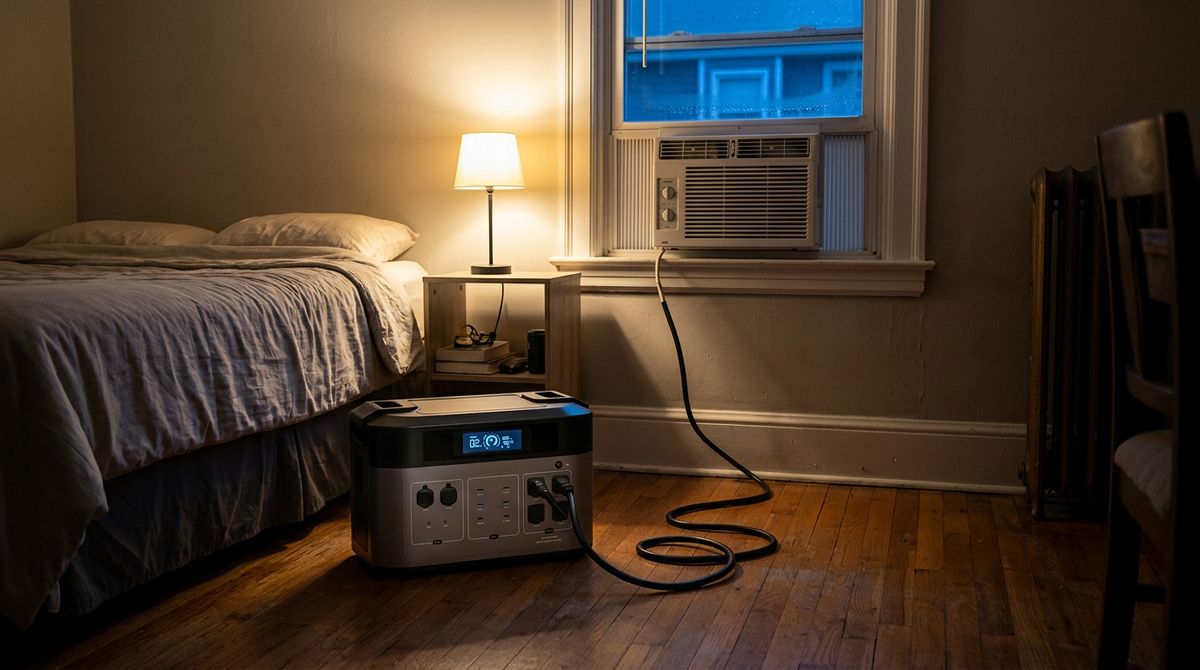
Can a Solar Generator Run a Window Air Conditioner? Size and Runtime Guide
LEARN MORE
Hurricane, Wildfire and Winter Outage Power Checklist
LEARN MORELooking for something else?

OUKITEL Showcases Energy Storage Solutions at Intersolar South America 2026, Accelerating Expansion into Latin America
LEARN MORE
Portable Power Station for Starlink: Runtime, Solar and Off-Grid Setup
LEARN MORE
Portable Power Stations for Power Tools and Job Sites: Surge, Runtime and Safety
LEARN MOREYou may also like
OUKITEL P5000 Portable Power Station 5120Wh | 2200W

OUKITEL P2001 Solar Generator

OUKITEL P1000 PLUS Portable Power Station 1800W | 1024Wh


OUKITEL BP2000 Portable Power Station 2200W | 2048Wh
OUKITEL P5000 Pro Portable Power Station 5120Wh | 3600W
Further reading

OUKITEL P2001 Plus vs BLUETTI AC200L: Which 2kWh Station Is Better for You?

OUKITEL P2001 Plus vs EcoFlow DELTA 2 Max: 2048Wh Power Station Comparison
