








 Flashlight
 Solar
Extension Cable
Solar
Extension Cable


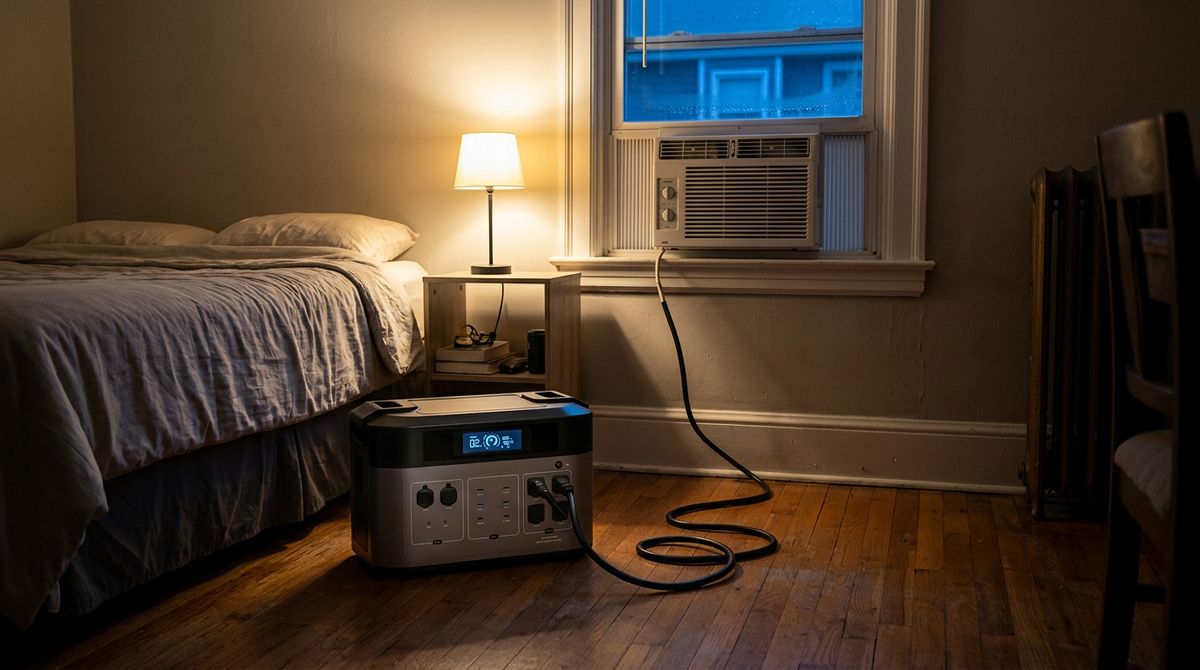
Can a Solar Generator Run a Window Air Conditioner? Size and Runtime Guide
A solar generator can run a window air conditioner when three separate numbers line up: continuous inverter output above the unit’s running watts, surge headroom above its compressor startup, and enough usable battery capacity to cover the hours you want cooling. Many 120 V window air conditioners can run from a 2,000 W-class power station, but BTU capacity alone does not confirm compatibility. Check the specific model's running watts or amps, compressor type, and LRA or measured startup inrush before selecting the inverter; then calculate usable battery capacity for the desired cooling time.
Inverter watts decide whether the air conditioner turns on at all. Watt-hours decide how long it stays on. Those are different specs on the same box, and a big number on one does not rescue a small number on the other.
What follows covers how to find your unit’s real draw, how much surge to plan for, how to calculate runtime without flattering yourself, what daytime solar actually replaces, and which station class fits each cooling plan.
Can a Solar Generator Run a Window Air Conditioner?
Yes for most 120V window units, provided the station meets all three requirements at once. A single-room window AC is the easiest cooling load to back up with a portable battery. It runs from a standard household outlet, draws a few hundred watts to a bit over a kilowatt, and cools one room instead of a whole house.
Central air is a different problem, and we cover why further down.
Start by placing your unit in a class. These ranges cover most residential window models sold in the United States, though efficiency varies enough that the nameplate still wins any argument.
|
Window AC size |
Typical running watts |
Typical startup peak |
Continuous output to plan for |
|
5,000 to 6,000 BTU |
450 to 600W |
900 to 1,500W |
1,000W |
|
8,000 to 10,000 BTU |
600 to 1,000W |
1,200 to 2,500W |
1,500W |
|
12,000 to 14,000 BTU |
900 to 1,500W |
1,800 to 3,500W |
2,000W |
|
Variable-speed, any size |
200 to 900W |
400 to 1,200W |
1,200W |
Startup peaks in that table assume a conventional single-speed compressor.
Three things can stop the setup from working even when the wattage looks fine:
- Voltage mismatch. Some larger room units need 240V, and a 120V station cannot supply it at any battery size.
- Outlet type. A 20A or 30A plug will not fit a standard 15A outlet on the station.
- Waveform. Compressor motors and control boards want pure sine wave output.
How Many Watts Does a Window Air Conditioner Actually Use?
Nameplate BTUs describe cooling capacity, not electricity. Two 8,000 BTU units built five years apart can pull very different wattage from the same outlet.
Sizing from BTUs alone is the most common error we see in customer questions about failed cooling backup plans. Air conditioning accounts for roughly 19% of household electricity use in the United States according to the EIA’s most recent residential survey, which is part of why it is also the load most likely to break a backup plan.
Why BTU Ratings Do Not Give You Watts
The conversion people reach for, dividing BTU/hr by 3.412, returns a thermal equivalent rather than electrical draw. Air conditioners move heat instead of generating it, so they consume far less power than their cooling output suggests.
The usable version brings efficiency into it. Divide the BTU rating by the unit’s CEER, which appears on the yellow EnergyGuide label and in ENERGY STAR listings.
- 8,000 BTU at CEER 12: about 667W
- The same 8,000 BTU at CEER 9: about 889W
- 12,000 BTU at CEER 15: about 800W
Same cooling capacity, a third more draw, purely from efficiency. Our watts to BTU/hr conversion guide works through both directions of that math.
The Volts Times Amps Trap
Multiplying label volts by label amps gives apparent power in volt-amps (VA), not real power in watts. Use measured real watts for runtime calculations. Use rated current, VA, and model-specific startup data when checking inverter compatibility; do not treat VA as merely a slightly conservative watt estimate.
Measure It Instead
A plug-in energy meter settles the question in an afternoon. Run the AC during genuinely hot weather rather than a mild evening, and record three things: the peak reading at compressor start, the steady running wattage, and total watt-hours accumulated across three hours.
That third number is the one most people skip. It matters more than the other two, because it captures the duty cycle.

[IMAGE: Alt: Plug-in energy meter measuring window air conditioner watts before solar generator sizing | 16:9]
What Startup Surge Really Costs You
A conventional compressor draws a hard spike when it kicks on. Locked rotor amperage, printed on many nameplates as LRA, describes that moment. Multiplying nameplate LRA by line voltage gives a conservative starting apparent-power figure in VA. Compare that model-specific startup requirement with the power station's documented surge magnitude and duration; do not infer compatibility from continuous watts alone.
Surge Size Versus Surge Duration
Surge ratings are not interchangeable between products. A station rated for 4,000W peak might hold that for a fraction of a second or for several seconds, and the specification sheet does not always say which. A compressor start needing 2,000W for half a second is a different demand from one needing 2,000W for three seconds.
We suggest planning against continuous output rather than the surge figure. If your unit runs at 800W and peaks near 2,000W, a station rated 2,200W continuous absorbs that peak inside its normal operating range instead of leaning on a brief overload allowance.
Batteries at a low state of charge start compressors less reliably, too. Test at 30% charge, not 100%.
Why Variable-Speed Units Change the Math
Variable-speed compressors ramp rather than slam on. ENERGY STAR notes that a conventional room air conditioner runs its compressor at full capacity or off, alternating frequently between the two, while variable-speed models continuously modulate motor speed to hold temperature.
The practical effect for anyone sizing a battery:
- Startup peaks drop sharply, often under 1.5 times running watts
- Steady draw falls once the room reaches temperature
- Owners of high-efficiency 12,000 BTU variable-speed units report holding a cool room near 200W
That last figure changes the entire runtime picture. A load like that behaves more like a chest freezer than a traditional air conditioner.
How Long Will a Solar Generator Run a Window AC?
Runtime comes from usable watt-hours divided by average load, not rated capacity divided by peak draw. Two adjustments separate a realistic estimate from an optimistic one.
The Usable-Energy Formula
Estimated runtime = rated capacity x 0.85 / average AC load
The 0.85 covers inverter conversion loss and the reserve the battery management system protects. It is a planning figure, not a guarantee. Aging cells, high ambient temperature and heavy simultaneous loads all push it lower.
|
Rated capacity |
Usable at 85% |
500W unit |
800W unit |
1,200W unit |
|
1,024Wh |
870Wh |
1.7 hrs |
1.1 hrs |
0.7 hrs |
|
2,048Wh |
1,741Wh |
3.5 hrs |
2.2 hrs |
1.5 hrs |
|
4,096Wh |
3,482Wh |
7.0 hrs |
4.4 hrs |
2.9 hrs |
|
5,120Wh |
4,352Wh |
8.7 hrs |
5.4 hrs |
3.6 hrs |
Those figures assume the compressor never stops.
Duty Cycle Changes Everything
It usually will stop. Once the room hits its setpoint, the compressor cycles off, and average consumption drops below running wattage. A unit pulling 800W while running but operating 60% of the time averages 480W.
On a 2,048Wh station that shifts runtime from about 2.2 hours to roughly 3.6 hours. Real gain, but conditional. During a genuine heat emergency, with a hot room and outdoor temperatures above 95F, the compressor may barely cycle at all. Size for the bad day.
How Much Solar Do You Need to Keep the AC Running?
Panels slow the drain. They rarely stop it. Sizing solar for air conditioning means comparing real production against real consumption hour by hour, not rated panel wattage against rated AC wattage.
Real Output Versus Rated Output
A 400W panel rating comes from laboratory test conditions. Field production in good midday sun typically lands between 250W and 320W, and the gap widens under haze, imperfect tilt, partial shade, or high panel temperature.
That last factor deserves attention here. Panel output falls as cell temperature climbs, which happens on exactly the days an air conditioner works hardest. Our guide on solar panel output on cloudy days covers the low-light end of the same problem.
The Deficit Math
Subtract production from consumption, and what remains is the net drain rate.
If an 800 W air conditioner receives 300 W of actual solar input, the battery supplies the remaining 500 W. With 1,741 Wh of usable AC energy, estimated runtime is about 3.5 hours before reserve, compared with about 2.2 hours without solar. Solar extends runtime in this example, but it does not make the setup self-sustaining.
For daytime cooling that comes close to self-sustaining, plan array wattage at two to three times the AC’s average draw.
Check the Input Limits
More panels cannot force more power into a station than its charge controller accepts. Before buying an array, confirm four things: maximum solar input in watts, the voltage window and current limit, connector type and polarity, and whether MPPT is built in.
Wiring panels in series raises voltage. Parallel raises current. Either can breach a limit the other would not.

[IMAGE: Alt: Solar panels charging a solar generator while a window air conditioner runs indoors | 16:9]
Which Solar Generator Size Fits Your Cooling Plan?
Match the station to the outage you are planning for, not to the largest air conditioner in the house.
The EIA reported that US electricity customers averaged about 11 hours without power during 2024, driven mostly by major storms, while interruptions outside those events routinely run near two hours. Those two numbers describe very different purchases.
|
Cooling plan |
What to prioritize |
OUKITEL match |
|
Short outage, one room, 1 to 2 hrs |
Surge headroom, fast recharge |
P1000 Plus, 1,024Wh with 1,800W continuous and 3,600W surge, 500W solar input |
|
Standard outage, 3 to 4 hrs |
Usable capacity plus room to grow |
BP2000, 2,048Wh and 2,200W, expandable to 16,384Wh with seven B2000 packs |
|
Stubborn compressor, high startup |
Continuous output above the peak |
BP2000 Pro, the same 2,048Wh battery at 3,300W continuous |
|
Overnight bedroom cooling |
Large fixed capacity, strong solar input |
P5000 Pro, 5,120Wh and 3,600W with 7,200W surge and 1,000W MPPT |
|
Multi-day heat event or 240V loads |
Split-phase output and expansion |
BP5000 Pro Max, 5,120Wh and 5,000W with 120V/240V output, expandable to 19,456Wh |
Expandability matters more than it looks on a spec sheet. Cooling is the household load people most consistently underestimate on a first purchase.
Being able to add battery capacity later instead of replacing the station is the difference between a plan that grows with you and one that gets abandoned in a closet. Pricing shifts with promotions across all of these, so check current pricing on the product pages.
For solar, the 400W portable solar panelcan be used with a station only when its connector or approved adapter, polarity, maximum open-circuit voltage, operating voltage, current, and total power remain within that station's published solar-input limits, and a solar extension cable helps when the only unshaded spot is nowhere near the window. If you are still deciding on capacity, our solar generator sizing guide covers the same math applied to whole-home loads.
Where Solar Generators Stop Working for Cooling
Honest limits matter here, because a station that cannot do the job is worse than having no plan at all.
Central air conditioning sits out of reach for most portable setups. Compressors on residential central systems typically need 240V, draw several thousand watts while running, and surge much higher than that. Backing one up calls for split-phase output, a large expandable battery bank, and a transfer switch installed by a licensed electrician.
Ductless mini-splits land in between. Many are efficient enough to run from a mid-size station, but most are hardwired rather than plug-in, so the connection itself needs professional work.
Portable floor units with a single exhaust hose are less efficient than window units of the same BTU rating, because they pull conditioned air out of the room while exhausting. Same cooling capacity on the label, more watts at the outlet.
Setup and Safety Checks Before the Heat Arrives
Test the whole setup before you need it. A successful trial on a mild evening tells you very little about a 98F afternoon with a hot room and a warm battery.
- Never plug a power station into a wall outlet to feed house circuits. Backfeeding energizes wiring unpredictably and endangers utility crews. Integration into home wiring requires approved transfer equipment and a licensed electrician.
- Use a heavy-gauge extension cord rated above the AC’s draw, or skip the cord entirely. No daisy-chained power strips, no loose adapters, no damaged cords.
- Keep the station’s vents clear and out of direct sun. Thermal throttling cuts output on precisely the days you need it.
- Protect the unit from rain, condensation drip, and standing water.
- If a fuel generator is also part of the plan, run it outdoors only, at least 20 feet from the house with exhaust pointed away. CPSC links more than 100 deaths a year to carbon monoxide from portable generators. Battery stations produce no exhaust, which is the practical reason they work for cooling a closed room.
One specification catches people out repeatedly: a station’s UPS or pass-through mode often carries a lower output ceiling than its standalone inverter rating. Check that number if you intend to run the air conditioner while the station charges.
FEMA’s extreme heat guidance is also worth reading alongside any sizing exercise. A single cooled room on battery power is a bridge through an outage, not a substitute for a cooling center during a multi-day heat wave.

[IMAGE: Alt: OUKITEL portable power station powering a window air conditioner | 16:9]
Common Sizing Mistakes
The same handful come up again and again:
- Sizing to running watts and ignoring startup entirely
- Treating rated watt-hours as usable watt-hours
- Reading a BTU number as though it were a wattage figure
- Confusing inverter watts with battery capacity
- Assuming panels deliver their rated output across the day
- Forgetting the fridge, fans, router and lights sharing the same inverter
- Testing on a mild day and calling the plan proven
Expansion batteries add runtime. They do not add inverter output. If the compressor will not start on the base unit, adding batteries will not fix it.
Size Your Own Setup in Three Steps
Ready to work out what your own window unit needs?
- Measure the air conditioner across three hot hours with a plug-in meter. Write down the startup peak, the steady running watts, and the total watt-hours.
- Multiply your target cooling hours by the average draw, then add 20% for conversion losses and any other appliances sharing the station.
- Match that total to a station whose continuous output clears your startup peak, then compare capacities and expansion options across the OUKITEL solar generator range.
FAQs
Can a solar generator run a window air conditioner overnight?
A solar generator runs a window air conditioner overnight only when the battery holds enough usable energy for the full stretch. A 5,120Wh station delivers roughly 4,350Wh usable, covering an 800W unit for about five hours of continuous compressor operation. Cycling in a well-insulated bedroom often carries that into morning.
What size solar generator do I need for an 8,000 BTU window AC?
Plan on at least 1,500W continuous output and 2,000Wh of battery. Most 8,000 BTU units draw 600W to 1,000W while running, with startup peaks approaching 2,000W on conventional compressors. Wattage decides whether the unit starts. Watt-hours decide how long it keeps running afterward.
How long will a 2,000Wh solar generator run a window AC?
Expect two to three and a half hours for most units. Apply a 0.85 factor for inverter losses and protected reserve, which leaves about 1,700Wh usable, then divide by average load. A 500W unit reaches close to 3.5 hours. An 800W unit lands nearer 2.2 hours.
Will a 2,000W solar generator start a window air conditioner?
Usually, for units up to roughly 12,000 BTU. Conventional compressors spike to two or three times running wattage for a moment, so a 900W unit can demand 2,700W at startup. Check the surge rating and the locked-rotor amperage on the nameplate before assuming the pairing works.
Can I run a window AC while the solar generator is charging?
Most stations support pass-through operation, charging and discharging simultaneously. Output ceilings frequently drop in UPS mode, sometimes to around 1,400W on 120V, so confirm the simultaneous limit first. Heat also builds faster during pass-through, and thermal protection can reduce output on hot afternoons.
Do I need a pure sine wave inverter for a window air conditioner?
Yes. Compressor motors and electronic control boards are built for the smooth waveform utility power supplies. Modified sine wave output can cause humming, extra heat and unreliable starting. Every current OUKITEL power station uses a pure sine wave inverter, so this rarely becomes the limiting factor.
Can a solar generator run central air conditioning?
Rarely. Residential central systems typically need 240V, draw several thousand watts continuously and surge far higher at startup. A split-phase unit such as the BP5000 Pro Max supplies both 120V and 240V at 5,000W continuous, but the connection still requires a transfer switch and a licensed electrician.
Does a soft start device help a solar generator run a window AC?
Yes, on conventional compressors. A soft starter ramps the motor rather than allowing full inrush, cutting startup demand by roughly half on many units. That can bring a stubborn air conditioner within reach of a smaller inverter. Confirm compatibility with the air conditioner manufacturer before fitting one.
How many solar panels does it take to run a window air conditioner?
Aim for two to three times the AC’s average draw in panel wattage if daytime operation should approach self-sustaining. An 800W unit therefore wants 1,600W to 2,400W of panels. Real production sits well below the rating, typically 250W to 320W from a 400W panel.

[IMAGE: Alt: OUKITEL P5000 Pro solar generator sized for overnight window air conditioner runtime | 16:9]
Sources
- U.S. Energy Information Administration (EIA), How much electricity is used for air conditioning in the United States? (2024)
- U.S. Energy Information Administration (EIA), Hurricanes in 2024 led to the most hours without power in the United States in 10 years (2025)
- U.S. Environmental Protection Agency (EPA), ENERGY STAR Room Air Conditioners
- U.S. Consumer Product Safety Commission (CPSC), Carbon Monoxide Information Center
- Federal Emergency Management Agency (FEMA), Extreme Heat


Looking for something else?
Best Solar Generator for Home Backup: 2026 Buyer's Guide
LEARN MORE
What Size Solar Generator Do You Need? 2026 Sizing Guide by Real Use Case
LEARN MORE
What Can a 1200 Watt Generator Run? 2026 Appliance Guide
LEARN MORE
Are Solar Generators Worth It in 2026? Honest Buyer Analysis
LEARN MORELooking for something else?

How Much Solar Do You Need for Your RV? 2026 Sizing Guide by Use Case
LEARN MORE
Can You Take a Solar Generator on a Plane? 2026 TSA + FAA Rules
LEARN MORE
OUKITEL 2026 Prime Day & Membership Guide: Rewards, Points, and Limited-Time Offers
LEARN MOREYou may also like


OUKITEL BP2000 Portable Power Station 2200W | 2048Wh

OUKITEL P5000 Pro Portable Power Station 5120Wh | 3600W

OUKITEL P5000 Solar Generator for Home with 400W Solar Panel

OUKITEL P800 Portable Power Station 800W | 512Wh

OUKITEL B2000 Expansion Battery | 2048Wh
Further reading

How Long Will a 2048Wh Battery Last? 30 Appliances + Formula

What Can a 3300W Power Station Run? Home Backup Load Planning
