










 Flashlight
 Solar
Extension Cable
Solar
Extension Cable


Can You Put Solar Panels on a Mobile Home? (Real-World Guide for 2026)
You can put solar panels on a mobile home, but the roof decides whether they go on top or sit on the ground next to it. That single answer rules out about half the rooftop installs I've quoted over the years.
A buyer in Arizona called me last March. He'd just paid $1,800 for eight rigid panels. Then his installer climbed onto the roof of his 1982 single-wide and shook his head. The roof joists couldn't hold it. Those panels sat in his shed for six months before he sold them at a loss.
That call made me write this guide.
Three paths work for almost every mobile home owner: rooftop install if the structure passes, ground-mounted system, or portable solar paired with a power station. I've installed all three. Below figures out which one fits yours. Home matters. Budget matters. So does how fast you need power working again.
Can You Put Solar Panels on a Mobile Home Roof?
Yes. With one caveat that costs people thousands when they skip it: get the structural check first. Every homeowner I've watched lose money on solar made the same mistake. They bought the panels. Then I checked the roof. Reverse the order.
The 1976 HUD Code Cutoff
Mark down June 15, 1976. Anything built before that sits outside any federal building code. Joist thickness, roof load rating, anchoring, entirely the manufacturer's call back then. Some held up beautifully. Plenty didn't. There's no way to know without checking yours specifically.
A user on r/solarenergy answered someone with a 1997 Illinois home with a clean line: “Generally you can't put solar on older manufactured homes, as the roof doesn't have enough dead load allowance to hold the weight.”
Solar installers in some states refuse the job entirely. Liability is the reason. Don't take it personally if your local company says no.
How to Know If Your Roof Can Handle It
Three checks. None of them are optional.
- Birthdate. Pre-1976 = ground mount or portable. Post-1976 = check the next two boxes.
- Roof age. A roof with under 10 years left needs replacement first. Removing and reinstalling panels later costs $500 to $1,500.
- Dead load rating. A structural engineer or qualified installer reads the manufacturer's spec sheet. Standard rigid panels weigh roughly 40 pounds each. Multiply that by your panel count.
Pay $200 to $400 for the inspection. It's cheaper than the Arizona buyer's mistake.
Lightweight and Flexible Panel Options
Flexible panels weigh 4 to 6 pounds each. Roughly one-tenth the weight of rigid panels. They glue or mount with low-profile brackets. Trade-off: they degrade faster in hot climates. Two Arizona summers can knock 15-20% off output.
Standard monocrystalline rigid panels run 22 to 24% efficiency in 2026. Flexible panels typically sit at 18 to 20%. If your roof can carry rigid, that's still the better long-term choice.

[IMAGE: Alt: mobile home roof solar panels rigid vs flexible weight comparison HUD 1976 | 16:9]
When Ground-Mounted Solar Beats Rooftop
For most mobile home owners I've worked with, ground-mounted solar ends up being the smarter call.
Mobile Home Park Restrictions
If your home is in a park, you have two layers of approval. The park owner. Then the utility. Both can stop the project.
A user on r/SolarDIY put it bluntly: “The short answer is that you cannot install a grid-tied system without significant coordination and cooperation from the park owner.”
Off-grid battery systems sidestep most of this. Same user community pointed out: “Installing solar panels on a mobile home also bypasses the need for permitting (the city does not care).”
Read your park agreement before spending a dollar on equipment. Get any approval in writing.
Why Ground Mounts Often Outproduce Roof Mounts
Ground mounts win on three things:
- Optimal angle. You set the tilt for your latitude. Roof angle is whatever it is.
- Optimal direction. True south, no tree shade, no AC vents in the way.
- Easy maintenance. Cleaning panels at chest height versus on a ladder.
The trade-off is cost. Posts, frames, and trenching add $1,500 to $4,000 to a system. Energy production usually offsets the upcharge inside three to four years.
Portable Solar Panels: The No-Drill Path
This is where most first-time mobile home solar buyers should start. No structural inspection. No park approval. No permits.
Who Portable Panels Are Best For
Renters. Park residents with strict HOAs. Homeowners testing solar before committing to a permanent system. Anyone who wants outage backup without a $15,000 install.
Portable panels pair with a power station instead of a charge controller plus battery plus inverter. One device replaces the whole electrical system. Setup runs 15 minutes.
A Real $425 Folding Panel Setup
A user on r/SolarDIY shared this exact starting point: “I bought this folding panel last year for $425. It's a LOT cheaper right now. Works GREAT!”
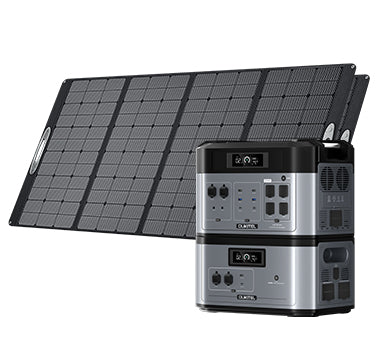
That's the entry-level reality. Pair a 200W to 400W foldable with a 1,000Wh power station. That combo carries a fridge, a few lights, phones, and a CPAP through a full overnight blackout. Whole kit lands under a grand. Look through foldable solar panels built for mobile setups to see what's stocked right now.

Alt: portable foldable solar panels mobile home park no drill setup power station
How Many Solar Panels Does a Mobile Home Need?
Forget square footage. Your kWh number decides this. The U.S. Energy Information Administration tracks the average American home at roughly 10,500 kWh per year. Daily? Around 30. Mobile homes usually sit below that. Push the AC hard and the number climbs fast.
Counting Your Daily Watt-Hours
Pull your last three electric bills. Find the kWh used per month. Divide by 30. That's your daily target.
Take a small mobile home with the basics live: fridge running, a few lights, phones plugged in, a fan moving air. That household clocks 8 to 12 kWh on a typical day. Add electric heat or AC and that number climbs fast. The DOE appliance energy guide lists most appliance wattages if you'd rather count from the device side.
Panel Count by Usage Tier
|
Daily Use |
System Size |
Panels (400W each) |
Best For |
|
5-8 kWh |
1.5-2 kW |
4-5 panels |
Backup essentials only |
|
8-15 kWh |
4-6 kW |
10-15 panels |
Average mobile home |
|
15-25 kWh |
6-8 kW |
15-20 panels |
Heavy AC use |
|
25 kWh+ |
8-12 kW |
20-30 panels |
Off-grid full-time |
Tack a 30% buffer on top of whatever number you land on. Clouds roll in. Batteries leak efficiency over time. I pad my own math the same way every single quote I run.
AC Changes the Math Fast
Air conditioning is usually the biggest single load on a mobile home. Run the numbers:
- 1-ton AC: roughly 900W to 1,000W
- 1.5-ton AC: 1,500W to 2,000W
- 2-ton AC: 1,800W to 2,500W with startup surge over 4,000W
A 1.5-ton unit running 6 hours a day eats 9 to 12 kWh on its own. That's the entire daily output of a 4 kW system. Plan AC capacity separately or your numbers will be off.
Battery Storage for Mobile Home Solar
Panels stop the second the sun drops. No storage means your lights die with it. Pretty simple physics, but a lot of buyers learn it the hard way the first time they wait for sundown to charge their phone.
Lead-Acid vs Lithium-Ion vs LiFePO4
|
Battery Type |
Cycle Life |
Usable Capacity |
Years (Daily Use) |
Cost per kWh |
|
Lead-acid (AGM) |
400-600 cycles |
50% |
2-3 years |
$200-300 |
|
Lithium-ion (NMC) |
1,000-1,500 cycles |
80% |
4-6 years |
$400-600 |
|
LiFePO4 |
3,000-3,500 cycles |
95-100% |
8-10 years |
$500-800 |
LiFePO4 crushes the others on cost per cycle. Not close. Run the numbers on a $700 LiFePO4 unit cycled every day for a decade and you land near $0.20 per kWh. Try that math on lead-acid? You're looking at $0.60 to $0.80 per kWh once you pay for two or three replacement batteries along the way.
Pairing a Power Station With Panels
A power station bundles the battery, charge controller, and inverter into one box. For mobile home owners, that simplification is worth real money. No wiring panel. No battery box. No separate inverter rack.
For backup essentials covering a fridge, lights, CPAP, and phones overnight, a battery backup sized for mobile home essentials like the OUKITEL BP2000 holds 2,048Wh and pushes 2,200W of continuous output. Expandable to 16,384Wh with seven battery packs as your needs grow.
For larger homes running AC, well pumps, or longer outages, the BP2000 Pro at 3,300W or the P5000 Pro at 5,120Wh cover heavier loads. The P5000 Pro also handles RV-style air conditioning with soft-start, which most stations choke on. Compare both inside the OUKITEL portable power lineup.

Alt: LiFePO4 battery storage mobile home solar power station BP2000
Mobile Home Solar Costs in 2026
Costs vary by setup. Here's the honest range.
Portable vs Roof vs Ground Mount
|
System Type |
Total Cost |
Install Time |
Best For |
|
Portable + power station |
$700-$2,500 |
15-30 minutes |
First-time buyers, renters |
|
Roof-mounted DIY |
$5,000-$10,000 |
1-2 weekends |
Newer homes, handy owners |
|
Roof-mounted pro install |
$12,000-$20,000 |
2-3 days |
Full home backup |
|
Ground-mounted full system |
$15,000-$25,000 |
3-5 days |
Off-grid, maximum production |
Someone over in r/SolarDIY threw out their actual number: “Installation around $3,500 from my local electrician.” Small grid-tied setup on a manufactured home. You'll see prices like that pop up when buyers skip the big national solar companies and hire whoever's good with electricity in their own town.
Federal Tax Credit and Financing
The federal Residential Clean Energy Credit covers 30% of qualifying solar costs for property installed through December 31, 2025. Mobile homes qualify if you own them and use them as your residence. Time matters here. If you're considering solar, the install needs to happen this year to lock in the 30% rate.
Financing is harder for manufactured homes than site-built homes. Some solar lenders won't underwrite the loan. Credit unions and HUD Title I loans are usually better starting points. Get pre-approved before shopping for systems.
What Mobile Home Owners Forget Before Going Solar
 Alt: Mobile home (road vehicle) standing on the road with solar panels on top
Three things that derail more projects than any panel spec.
Roof Age Trap
If your roof needs replacement in five years or less, replace it first. Removing solar panels for a reroof costs $500 to $1,500. Reinstalling them costs the same again. That's $1,000 to $3,000 in pure waste.
Look at flashing, soft spots, and the underside of the decking from the attic. If anything looks marginal, don't put panels on top.
Park Approval First
Read your park agreement. Get the park owner's written approval. Confirm with the utility. All three steps before buying equipment. I've watched two homeowners eat 20% restocking fees because they skipped this.
A user on r/SolarDIY summed up their successful park install: “It keeps track of what I use in the house, and what my solar array produced.” That kind of monitoring requires utility coordination, which requires approvals upstream.
Energy Efficiency Comes Before Solar
Cutting your usage by 20% is cheaper than adding 20% more panels. The U.S. Department of Energy lists the highest-impact upgrades for manufactured homes:
- Sealing air leaks around windows, doors, and ductwork
- Adding insulation to the underbelly
- Installing interior storm windows
- Servicing or replacing aging HVAC
Spend $500 on efficiency before $5,000 on solar. Your future system will be smaller and cheaper.
Take Action Now
 Alt: mobile home solar buying decision tree rooftop ground mount portable choice
Three steps that prevent the most expensive mistakes in mobile home solar.
1. Check your last three electric bills tonight. Calculate your daily kWh average. That single number tells you the system size you actually need. Most homeowners guess wrong until they see real numbers on paper.
2. Inspect your roof before shopping for panels. Confirm your home's build year (pre-1976 = ground mount only). Check roof age and dead load capacity. If anything looks marginal, switch to ground-mount or portable solar before buying equipment.
3. Start small with a portable system. Bottom line: If you're new to solar or live in a park with restrictions, start with a foldable solar panel from the OUKITEL solar collection paired with the BP2000 power station. If you own your land and want long-term backup, scale to a ground-mounted system with the BP2000 Pro or P5000 Pro for whole-home coverage.
FAQs
Can you put solar panels on a mobile home roof?
Yes, you can put solar panels on a mobile home roof if the home was built after the 1976 HUD code and the dead load rating supports the panel weight. Have a structural engineer or qualified solar installer verify the spec before buying anything.
In our experience, newer manufactured homes handle solar fine when the framing is in good condition. Older mobile homes are where problems show up because the joists weren't engineered for the dead load. Some installers refuse the job for liability reasons, which isn't a bad signal. It's the right call when the structure can't take the weight.
Three checks before you buy:
- Confirm home is post-June 1976 (HUD-coded build year)
- Verify roof age has 10+ years left before next replacement
- Get dead load rating from structural engineer ($200-$400 inspection)
Skip the inspection and you risk losing thousands. Don't.
What is the best type of solar panel for a mobile home?
Monocrystalline panels are the best overall choice for a mobile home because they produce the most power per square foot. Roof space is usually the limiting factor on manufactured homes, so efficiency matters more than panel count.
After helping a few hundred buyers choose panels, the right answer always depends on roof strength and goals, not the highest efficiency number on the box.
Panel types compared:
- Monocrystalline rigid hits 22-24% efficiency. Roughly 40 lbs per panel. Pick this if your roof can take the weight.
- Polycrystalline rigid runs cheaper at 15-18%, same weight class, but you'll need more square footage on the roof
- Thin-film flexible weighs 4-6 lbs each, about a tenth of rigid, and saves weak roofs
- Foldable portable is the no-install option. Pairs straight into a power station from the foldable solar panels collection
- Bifacial monocrystalline tops 24% but costs more and only works ground-mounted
Match the panel to the roof. Skip the brand hype.
How many solar panels do I need to power a mobile home?
Most mobile homes land in the 10 to 15 panel range at 400W each. Square footage doesn't decide this. Your daily kWh number does.
From years of testing residential setups, the biggest sizing mistake is guessing from square footage instead of kWh.
Panel count by usage:
- Backup essentials only (5-8 kWh/day): 4-5 panels
- Average mobile home (8-15 kWh/day): 10-15 panels
- Heavy AC users (15-25 kWh/day): 15-20 panels
- Off-grid full-time (25+ kWh/day): 20+ panels
- Always add 30% buffer for cloudy days and battery losses
Grab three recent electric bills. Find the daily kWh average. Start there.
Can I run my air conditioner on solar power?
Yes, you can run an air conditioner on solar power, but AC units use far more electricity than most mobile home owners expect. A 1-ton inverter AC pulls roughly 900W to 1,000W during operation, with surge spikes much higher.
I've worked with plenty of homeowners who could run lights and a fridge easily on a 4 kW system, then watched their numbers fall apart the moment the AC turned on. Inverter-style ACs are far easier on solar than older single-stage units.
Wattage by AC size:
- 1-ton AC: 900-1,000W running
- 1.5-ton AC: 1,500-2,000W running
- 2-ton AC: 1,800-2,500W running, 4,000W+ startup surge
- 6 hours of 1.5-ton AC = 9-12 kWh/day (a full small system's output)
Check the wattage label on your AC before sizing your system. That number tells you everything.
Do I need a battery to use solar panels on my mobile home?
No, you don't always need a battery, but battery storage makes mobile home solar far more practical. Without batteries, your system only powers devices while the sun is shining.
For mobile home owners off-grid or in parks where grid-tied isn't allowed, battery storage is essential. LiFePO4 batteries last 8 to 10 years at 3,000-3,500 cycles. Lead-acid lasts 2 to 3 years for the same usage, which is why I rarely recommend it anymore.
Battery options ranked by cost-per-cycle:
- LiFePO4: 3,000-3,500 cycles, $500-800/kWh, 8-10 years
- Lithium-ion (NMC): 1,000-1,500 cycles, $400-600/kWh, 4-6 years
- Lead-acid AGM: 400-600 cycles, $200-300/kWh, 2-3 years
- Power station with built-in LiFePO4 like the BP2000 sized for mobile home essentials: all-in-one box, no DIY wiring
Decide early if your goal is bill savings or outage backup. That answer changes everything.
How much does it cost to put solar panels on a mobile home?
Mobile home solar costs range from under $1,000 for a portable starter setup to $25,000 for a full ground-mounted system with battery backup. Most homeowners land between $5,000 and $15,000 depending on system size and install method.
The federal Residential Clean Energy Credit covers 30% of qualifying costs for systems installed through December 31, 2025. After that, the credit is gone unless Congress extends it. Plan accordingly.
Cost ranges by setup type:
- Portable solar + power station: $700-$2,500 (lowest risk entry)
- DIY rooftop install: $5,000-$10,000 (handy owners only)
- Pro rooftop install: $12,000-$20,000 (if roof passes inspection)
- Ground-mounted full system with batteries: $15,000-$25,000
- Federal tax credit: 30% off qualifying costs through 2025
Get two itemized installation quotes before signing anything.
Can I get solar panels on a mobile home in a park?
Yes, you can install solar panels in a mobile home park, but park approval is the biggest hurdle. Most parks have written rules about roof modifications, visible equipment, and utility connections.
I've seen grid-tied projects stall for months because the park owner, utility, and installer never coordinated. Off-grid battery systems sidestep most of the red tape because they don't connect to the park's electrical infrastructure.
What works in parks:
- Portable solar + power station: easiest, no permanent install
- Ground-mounted on your individual lot: if the park allows and lot is owned
- Off-grid battery systems: bypass utility coordination entirely
- Grid-tied systems: only with park owner + utility coordination
- Get all approvals in writing. Verbal doesn't hold up if management changes
Read your park agreement first. Get written approval second. Buy equipment third.
How long does a mobile home solar system last?
A well-built mobile home solar system lasts 20 to 25 years, with individual components aging at different rates. Solar panels carry 25-year performance warranties from quality manufacturers.
Panel output degrades roughly 0.5% per year for monocrystalline, so after 20 years you're still getting 90% of original output. Inverters are usually the first component to fail, which is why I always recommend a slightly oversized inverter to extend its working life.
Component lifespan by part:
- Solar panels: 25-year warranty, 30+ years actual life
- Inverters: 10-15 years (first to fail typically)
- LiFePO4 batteries: 8-10 years at daily cycling
- Lead-acid batteries: 2-3 years at daily cycling
- Charge controllers: 10-15 years
Plan as a 20-year investment with mid-life refreshes built into the budget.
Sources
- U.S. Department of Housing and Urban Development (HUD),Manufactured Housing and Standards: Construction and Safety Program
- U.S. Department of Energy (DOE),Solar Energy Technologies Office
- U.S. Department of Energy (DOE),Estimating Appliance and Home Electronic Energy Use
- U.S. Energy Information Administration (EIA),Electricity Use in Homes
- U.S. Internal Revenue Service (IRS),Residential Clean Energy Credit
- ENERGY STAR (U.S. EPA Program),Federal Tax Credits for Energy Efficiency


Looking for something else?

5000 Watt Solar Generator: Is It Enough for Your Home?
LEARN MORE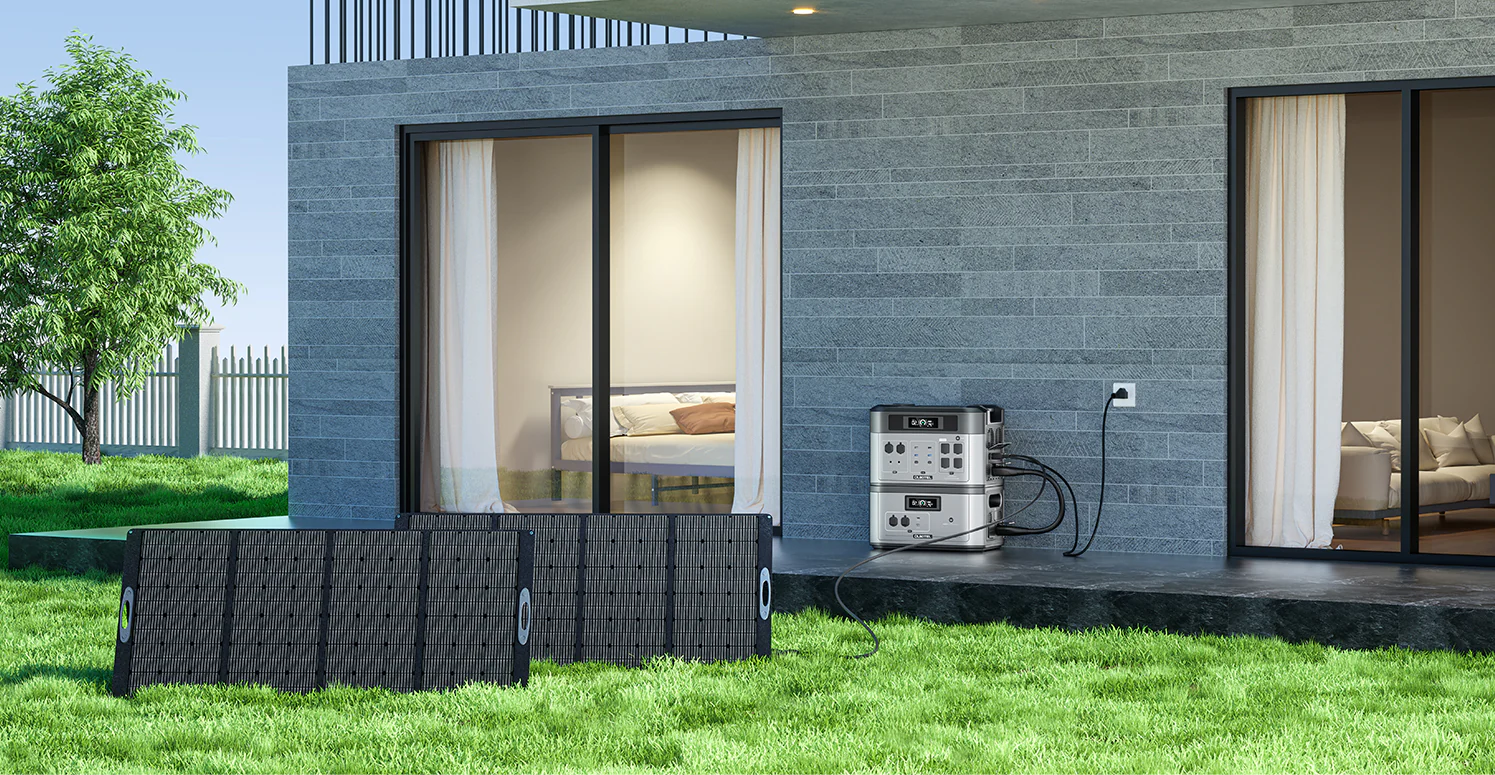
Solar Panel Connectors Types: Complete Guide to MC4, XT60 and More
LEARN MORE
Why Does the Power Go Out During a Storm? (And What You Can Do About It)
LEARN MORE
RV Solar Panel Kit with Battery and Inverter: Complete Guide for Every Setup
LEARN MORELooking for something else?

Difference Between Amps and Volts: What You Actually Need to Know
LEARN MORE
50 Amps in Watts: The Honest 2026 Conversion Guide for RV, Home, EV, and Solar
LEARN MORE
Can You Put Solar Panels on a Mobile Home? (Real-World Guide for 2026)
LEARN MOREYou may also like

OUKITEL P2001 Plus+400W Solar Generator
OUKITEL P2001 Plus+2*200W Solar Generator

OUKITEL P2001 Plus+200W Solar Generator

OUKITEL BP3000 Portable Power Station 3200W | 2048Wh

OUKITEL P5000 Pro+400W Solar Generator

OUKITEL BP2000+400W Solar Generator
Further reading

Hurricane, Wildfire and Winter Outage Power Checklist
Can a Solar Generator Run a Window Air Conditioner? Size and Runtime Guide
