

 Flashlight
 Solar
Extension Cable
Solar
Extension Cable


Do Portable Solar Panels Qualify for the 30% Credit?
Here is the thing about portable solar and the 30% federal tax credit. The IRS does not care if your panel folds up like a road map or weighs three pounds. They care about one thing only, and it has nothing to do with portability. They care about what you are using it for.
Take the same 200-watt portable panel. Charge your phone on a weekend camping trip with it, you get zero credit. Plug it into a power station that runs your fridge during a blackout, or use it to keep your off-grid cabin lit at night, and a 30% refund is waiting on your return. Same panel. Same hardware. Different purpose. Totally different tax outcome.
What follows: the qualification test the IRS actually applies in plain English, the three completely different rules covering panels alone vs. bundles vs. standalone batteries, the quiet use-case traps that get claims denied at audit time, and a walk-through of Form 5695 that most blog posts will not bother with. Plus the December 31, 2025 deadline that you cannot afford to miss if you are sitting on the fence.
Quick Answer at a Glance
Skim this first. Read the rest if any of it surprises you.
- Credit amount: 30% of qualifying costs, no dollar cap
- Deadline: Equipment must be placed in service by December 31, 2025
- What qualifies: Solar generator bundles + standalone batteries (3 kWh+) used to power a U.S. residence
- What doesn't: Solar panels alone, used equipment, anything powering an RV, van, boat, or campsite
- How to claim: IRS Form 5695 filed with your tax return for the year placed in service
- Refundable? No. Carries forward to future years if it exceeds your tax bill
The Short Answer: It Depends on One Thing
Portable solar gear absolutely can qualify for the Residential Clean Energy Credit, and you can get 30% of qualifying costs back. But here is where almost every article gets it wrong. "Portable" is not a yes-or-no qualifier on its own. It cuts both ways. What actually decides the credit is what you do with the equipment after you unbox it. Not whether it has a handle. Not whether it weighs ten pounds or sixty. Use matters. Hardware does not.
The IRS defines qualifying solar property as equipment that provides electricity for a residence. That's the whole legal standard in one sentence. Plug your solar panel into a power station that runs your home's fridge during a blackout? That counts. Use the same setup to run your CPAP at a campsite three weekends a year? It doesn't.
A residence is your house, apartment, mobile home, manufactured home, tiny home, off-grid cabin, or houseboat used as a dwelling. It's not your RV. It's not your van conversion. It's not your tent.
A user on r/solar pulled the right quote from IRS guidance: “The IRS issued guidance saying that solar property doesn't have to remain in use for any particular time to claim the tax credit.” Portable doesn't mean disqualified. Recreational use does.
Run Your Own Eligibility Check
Six questions. Run through them honestly. Six yes answers and you are in. Even one no and the credit does not apply, no matter what the brochure said when you bought the gear.
- Is the gear new? Used or refurbished kit never qualifies. Does not matter if the seller swears it was returned unopened from a buyer in Iowa.
- Is it going onto a U.S. dwelling? Vacation cabin in Mexico does not count. The credit is for stateside dwellings only, period.
- Does it actually provide electricity to a place people live? Houses, apartments, mobile homes, tiny homes, houseboats someone calls home, off-grid cabins, all qualify. RVs, vans, weekend boats, and campsites do not. The line is dwelling vs. not-dwelling.
- Is the system actually complete? A panel by itself, sitting in your garage waiting for a buyer? No credit. Pair that panel with a battery and inverter and run it as a solar generator bundle? That counts. Standalone batteries of 3 kWh or larger qualify on their own, no panel required.
- Will the system be up and running by December 31, 2025? Order date does nothing here. The day you flip it on and start using it for your residence, that is what the IRS watches.
- Are you the person actually living in that residence? Landlords trying to claim credits on rentals they do not occupy themselves get nowhere. Owner-occupants only.
Five yeses and one no? The credit is gone. Better to figure that out before writing the check than after.

Alt: portable solar tax credit eligibility decision tree IRS 6 questions
What the IRS Actually Says About Solar Equipment
The credit is officially called the Residential Clean Energy Credit. Before the Inflation Reduction Act, it was the Residential Energy Efficient Property Credit. Same idea, different name. Same 30% rate, but with a new deadline and broader scope.
The 3 Requirements Every Solar Purchase Must Meet
Three boxes need ticking. Miss any one and the IRS denies the credit.
- New property only. Used, refurbished, or previously owned equipment never qualifies, even when the seller marks it new in box.
- Connected to a U.S. dwelling. The system must be installed in connection with a residence located inside the United States.
- Used as a residence by the taxpayer. Vacation homes where you actually stay qualify. Rental properties don't.
What "Installed for Your Home" Really Means
The word "installed" trips up a lot of buyers. Reading it literally suggests bolted, wired, and permanent. The IRS rules don't require any of that. Installed means the equipment is connected to your residence and is providing electricity to it.
A solar generator sitting on your porch with a panel feeding it counts as installed if your home is using that power. The whole "permanent installation" interpretation comes from rooftop solar marketing, not from the tax code.
The 30% Math and the December 2025 Deadline
30% of qualifying expenses. No dollar ceiling on residential solar property. That is the headline. The math stacks up quickly:
- $1,000 system: $300 back
- $5,000 system: $1,500 back
- $15,000 system: $4,500 back
- $25,000 system: $7,500 back
Labor for onsite preparation and assembly counts toward your qualifying base. So does sales tax on the equipment. So do permit fees if your jurisdiction makes you pull one. The one thing that does not count is your own DIY labor. You cannot pay yourself for credit purposes, and the IRS has heard that one before.
The cutoff that matters most is the placed-in-service deadline. Equipment must be operational at your residence by December 31, 2025. After that date, the credit ends under current law unless Congress acts before then to extend it. Sitting on hardware in a closet does not start the clock.
Three Types of Portable Solar (Each Has Different Rules)
This is where confusion stacks up. "Portable solar" actually covers three purchase types and each has its own eligibility story.
|
Purchase Type |
Qualifies Alone? |
Conditions |
|
Solar panel only |
No |
Must be paired with battery + inverter system serving residence |
|
Solar generator bundle (panel + power station) |
Yes |
Must provide electricity to a U.S. residence |
|
Standalone battery storage (no panels) |
Yes |
Must have 3 kWh+ capacity and serve residence |
|
Used / refurbished equipment |
No |
Only new property qualifies |
|
Equipment for RV / van / camping |
No |
Recreational vehicles aren't dwellings under IRS rules |

Alt: three types portable solar tax credit panels bundles batteries comparison
Solar Panels Alone
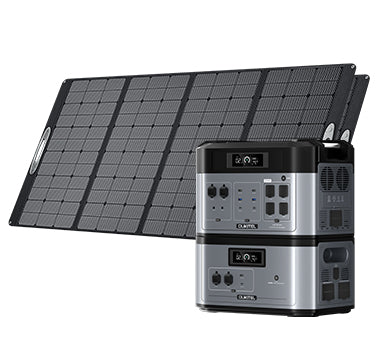
TheOUKITEL 200W Portable Solar Panel is an example — it's a fully functional panel, but it won't qualify for the 30% credit unless paired with a power station and used to power a U.S. residence. The same logic applies to every brand. The panel has to be part of a system that actually delivers electricity to your residence.
Buy three 400W panels and store them in your garage with no battery or inverter? No credit. Buy those same three panels plus a 5 kWh power station and use the whole setup to power your off-grid cabin? Credit applies to the full system cost including all three panels.

Alt text: OUKITEL 200W Portable Solar Panel
Solar Generator Bundles
A solar generator bundle is the most common qualifying portable purchase. Panel feeds power station. Power station provides electricity to your residence. Both pieces qualify as one system for the 30% credit.
The hinge stays the same: residential use. An EcoFlow Delta plus solar panel used to power a tiny home qualifies. The same bundle used for tailgating doesn't. Buyers who lost claims usually lost them at the use-case test, not at the equipment test.
For complete bundles with capacity for full-home backup, browse current LiFePO4 power stations. These qualify both as solar generator bundles when paired with panels and as standalone battery storage when used without.
Standalone Battery Storage (The 3 kWh Rule)
Battery storage qualifies on its own as a separate category. No solar panels required. But the battery must have a capacity of at least 3 kilowatt hours per ENERGY STAR battery storage rules.
Battery capacity reference at a glance:
- Under 3 kWh: Doesn't qualify as standalone storage
- 3-5 kWh: Qualifies, common small home backup range
- 5-10 kWh: Qualifies, typical whole-home essentials tier
- 10-20 kWh: Qualifies, multi-day or whole-home tier
- 20 kWh+: Qualifies, off-grid primary power range
Examples that clear the 3 kWh threshold easily: theOUKITEL BP2000 Pro at 2,200Wh paired with one expansion pack reaches 4,400Wh, and theOUKITEL P5000 Pro at 5,120Wh clears the rule on its own.
The Use Case That Kills Eligibility
The IRS standard is clear: equipment must serve a residence. Vehicles, RVs, campsites, and recreational setups don't qualify because they aren't dwellings under federal tax law.
What disqualifies a portable solar claim, at a glance:
- RVs and motorhomes, even if parked at your home address year-round
- Van conversions and skoolies, regardless of build quality or amenities
- Boats used recreationally, including liveaboards in some cases
- Campsites and primitive camping setups
- Equipment marketed primarily for camping when used that way
- Detached structures not used as dwellings (work sheds, hobby studios)
A user on r/solar asked the question that catches most people: “Does anyone know if 'Solar Generators' with panels like Bluetti AC200 or EB70 qualify for the US solar tax credit?” The answer isn't about the brand. It's about where the equipment lives and what it powers.
The Off-Grid Cabin Exception
Off-grid residential use is the exception that opens the door for many portable buyers. If you live in a cabin, tiny house, mobile home, or manufactured home that isn't connected to the utility grid, solar equipment powering that residence qualifies. The form factor doesn't matter.
The dwelling test is what counts. A primary residence with no grid connection that runs entirely on solar and battery is the strongest possible case for portable equipment qualifying. Many buyers in rural Alaska, mountain regions of the Rockies, and remote desert communities use exactly this setup.

Alt text: Portable solar panels set up on a sandy beach, collecting sunlight to generate power for outdoor devices and off-grid use.
How to Claim the Credit on Form 5695
The filing process is simpler than most buyers expect. You don't need a tax professional for a straightforward claim. You do need clean records and the right form.
When to File and What to Keep
You claim the credit on the tax return for the year you placed the equipment in service. Not the year you bought it. Bought a power station in November 2024 and didn't set it up until January 2025? You claim it on your 2025 return.
Documentation to keep for three years after filing:
- Purchase receipt or invoice showing item description, total cost, and date
- Manufacturer specifications confirming new condition and capacity (especially for the 3 kWh battery rule)
- Proof of placed-in-service date (photo with timestamp, utility bill showing connection, written log)
- Documentation of residential use (home address matching install location)
- Any installer invoices or permit fees that are part of qualifying expenses
You don't submit these with your return. You keep them in case the IRS asks.
Form 5695 Step by Step
Form 5695 is the form. Section 1 covers the Residential Clean Energy Credit.
- Line 1: Enter qualified solar electric property costs (panels, generator, inverter, install labor)
- Line 5b: Enter qualified battery storage costs if claiming a standalone battery
- Line 6a: Add the lines above for total qualified expenses
- Line 6b: Multiply by 0.30. This is your credit amount
- Lines 12-14: Apply credit against tax liability, calculate carryforward
The form auto-calculates the 30% rate. The result flows to Schedule 3 of your 1040 and reduces your tax owed dollar-for-dollar up to your tax liability.

Alt: IRS Form 5695 residential clean energy credit solar tax filing walkthrough
When Your Credit Beats Your Tax Bill
The credit is nonrefundable but carries forward. If your credit is $3,000 and your tax bill is $1,800, you reduce the bill to zero and carry the remaining $1,200 forward to next year's return. The carryforward continues until you use it or until the credit provision expires.
This matters for retirees and lower-income buyers. If your annual tax liability is small, a big solar credit takes multiple years to use up. Plan accordingly when timing large purchases.
Common Filing Mistakes That Lose the Credit
Most denied claims trace back to six mistakes, and the IRS sees them on repeat every tax season. Steer clear of these and your filing rarely runs into trouble.
- Wrong tax year. Credit attaches to the year placed in service, not the year purchased. A December 2024 purchase put in service in January 2025 goes on the 2025 return.
- Used equipment. Refurbished, returned, or previously owned solar property never qualifies. Even if the seller marks it "new in box," check the model history.
- Vehicle use claims. RV installs, van conversions, and boat installations all fail the dwelling test regardless of how legitimate the residential intent feels.
- Missing the 3 kWh battery threshold. Standalone batteries under 3 kWh don't qualify even if everything else checks out. The capacity rule is hard.
- Claiming DIY labor. Your own time installing the equipment isn't a qualifying expense. Hired labor is.
- No documentation of placed-in-service date. Without proof of when the system started serving your residence, the IRS can deny the year of claim.
Is the 30% Credit Still Available After 2025?
Short version: yes for property placed in service through December 31, 2025, no for anything after under current law.
The December 31, 2025 Cutoff
Per the IRS, the credit equals 30% of qualifying costs for property installed from 2022 through December 31, 2025. Property placed in service after December 31, 2025 is no longer eligible under current law.
This is a change from the original Inflation Reduction Act timeline. The IRA had set the credit at 30% through 2032 with a phase-down through 2034. Recent legislation accelerated the sunset to the end of 2025. If you're planning a 2025 purchase, the placed-in-service date matters more than the order date. Equipment ordered December 28 but set up January 3 won't qualify.
Buying in 2026 and Beyond
For buyers in 2026 and later, the federal credit doesn't currently apply. What still exists:
- State-level solar credits in California, New York, Massachusetts, Colorado, and others
- State sales tax exemptions on solar equipment in many states
- Local utility rebates offered by some power companies
- Net metering programs that pay you for excess solar production
- Future federal restoration is possible if Congress passes new legislation
Until federal restoration happens, 2026 purchases pay full sticker price without federal credit support. State programs continue independent of federal rules.
Take Action Now
Three steps that protect your claim before the deadline closes.
1. Confirm your equipment meets the three-part test. New property, installed in connection with a U.S. dwelling, used as your residence. If all three check, you're eligible. If any one fails, the credit doesn't apply regardless of brand or cost.
2. Calculate your placed-in-service date before December 31, 2025. This is the hard deadline for the 30% credit under current law. Equipment purchased earlier but not yet connected to your residence needs to be operational before year-end to qualify. Schedule the setup now, not in December.
3. Match the right system to your residential setup. Bottom line: If you need standalone battery backup that clears the 3 kWh threshold for credit eligibility, a battery system that meets the 3 kWh threshold like the OUKITEL BP2000 at 2,048Wh expandable to 16,384Wh hits the rule with one expansion pack. For complete solar generator bundles serving off-grid or backup setups, compare options inside the OUKITEL portable power lineup and verify the bundle qualifies under all three IRS conditions before you buy.
FAQs
Does portable battery qualify for solar tax credit?
Yes, with one big asterisk. The battery has to clear 3 kWh of capacity (per the Inflation Reduction Act rules), and it has to serve a U.S. residence as part of how you live there. Hit both marks and you can claim the 30% credit on the battery by itself, no panels required.
The 3 kWh threshold is the hard rule. A 2 kWh power bank doesn't qualify. A 3.6 kWh power station does, as long as it's used to power your home. The battery doesn't have to be permanently wired. It just needs to be connected to your residence and providing electricity when needed.
Standalone battery qualification rules:
- Capacity must be 3 kWh or higher
- Must be new (not refurbished or used)
- Must be installed in connection with a U.S. dwelling
- Must serve as electricity source for residence
- Equipment must be placed in service by December 31, 2025
For batteries that comfortably clear the 3 kWh rule with expansion, look at a battery system that meets the 3 kWh threshold like the OUKITEL BP2000, which starts at 2,048Wh and scales up.
Do portable solar panels qualify for tax credit if I use them off-grid?
Yes, and off-grid use is one of the cleanest qualifying paths for portable equipment. Cabins, tiny homes, mobile homes, and manufactured homes that run on solar as their main power source check every IRS box that matters. The credit covers panels, battery, inverter, and labor for the install.
The IRS doesn't require grid connection. It requires the property to be a dwelling used as a residence. If you live off-grid and your solar setup powers your home, the credit applies to the full system cost including panels, batteries, inverters, and installation labor.
Off-grid qualification specifics:
- Residence must be in the United States
- Must be used as a dwelling, not vehicle or recreational structure
- System must be the primary or supplemental power source
- All system components qualify, not just the panels
- Installation labor and onsite assembly costs count
Off-grid buyers are often surprised to learn their portable setup qualifies. It does.
Can I claim the solar tax credit for a Jackery, EcoFlow, or Bluetti?
Yes. Brand does not matter to the IRS, full stop. Jackery, EcoFlow, Bluetti, OUKITEL, anything else on the market, all of them qualify or fail to qualify based on how the gear gets used, not whose logo is on the side.
What does matter is whether you bought a complete bundle (panel plus power station) and whether you use it to power your residence. A Jackery solar generator used for home backup qualifies. The same product used only for road trips doesn't. Brand marketing language sometimes implies eligibility regardless of use, which causes confusion.
Brand-eligible setups:
- Complete solar generator bundle used for residential power
- Standalone power station of 3 kWh+ used to back up home circuits
- Solar panels integrated into off-grid cabin power system
- Combined bundle serving as off-grid primary power
- All-in-one units with built-in battery meeting capacity thresholds
The product on the receipt doesn't determine eligibility. The use case does.
What is the minimum battery size that qualifies for the tax credit?
Three kilowatt hours, or 3,000 watt hours. That is the floor for any standalone battery to qualify for the credit on its own, no panels attached. Anything smaller does not make the cut, even if it gets used for the same residential backup purpose.
Batteries below 3 kWh don't qualify as standalone storage even if they're used for residential backup. The 3 kWh floor was set to focus the credit on meaningful home backup capacity, not phone chargers or laptop batteries. Most decent portable power stations clear the threshold.
Battery capacity quick reference:
- Under 3 kWh: Does not qualify as standalone
- 3-5 kWh: Qualifies, common small home backup range
- 5-10 kWh: Qualifies, typical essentials tier
- 10-20 kWh: Qualifies, multi-day tier
- 20 kWh+: Qualifies, off-grid primary range
When a battery is paired with solar panels as a complete system, the 3 kWh rule doesn't apply because it's claimed under the solar property category, not standalone storage.
How does IRS verify that I used the equipment for my home?
The IRS verifies residential use through documentation reviews and occasional audits, not through any kind of pre-approval or inspection step. Most claims process automatically, and the agency only asks for proof when something on the return flags during review.
What flags claims includes mismatched addresses, very large credits relative to income, missing Form 5695 details, and claims for equipment sold by businesses focused on RV or recreational markets. Keep your documentation clean and the chance of an audit request stays low.
Documentation to retain:
- Purchase receipts showing item description, cost, and date
- Installation records or self-installation logs with photos
- Utility bills showing residence address matching install location
- Manufacturer specs confirming new condition and capacity
- Any correspondence with installers, electricians, or permit offices
Three years of records is the standard retention window for energy credit documentation.
Is the solar tax credit being canceled?
The 30% Residential Clean Energy Credit ends December 31, 2025 under the law as it stands today, unless Congress passes an extension before that date. Not a repeal in the political sense. A sunset that was originally scheduled for 2034 and got pulled forward by recent legislation.
The credit remains fully available for property placed in service through December 31, 2025. After that date, the federal credit is no longer available unless new legislation restores it. State-level credits in many states continue independently of federal rules.
Current status as of mid-2026:
- 30% federal credit active through December 31, 2025
- No federal credit available for property placed in service on or after January 1, 2026
- State credits continue in California, NY, MA, and others
- Congress can extend or restore the federal credit at any time
- Watch for legislative updates if planning a 2026+ purchase
The placed-in-service deadline is what matters most for current planning.
Do I need a licensed installer to claim the credit?
Nope. DIY installations qualify just fine, as long as the equipment itself meets the eligibility rules and the system genuinely provides electricity to your residence. The credit cares about the hardware and the use, not who installed it.
You can install your own panels, set up your own power station, and claim the full credit on the equipment costs. What you can't claim is your own labor. If you hire someone to help, their labor for onsite preparation, assembly, and installation does count toward qualifying expenses.
DIY vs. professional install:
- DIY equipment costs: Fully qualifying
- DIY your own labor: Not qualifying
- Hired installer labor: Qualifying as part of system cost
- Electrician for circuit work: Qualifying
- Permit fees: Qualifying if required by local jurisdiction
For portable solar generator bundles, DIY is the norm and the credit applies fully to the equipment purchase price.
Can I claim the credit on a purchase from last year?
You claim it on the return for the year you placed the equipment in service. Not the year you bought it. Bought a power station in November 2024 and finally got around to setting it up in January 2025? That is a 2025 credit, not a 2024 one.
The placed-in-service rule trips up year-end buyers most often. A December 2024 order that didn't get unboxed and connected until January is a 2025 credit, not a 2024 one. The IRS focuses on functional installation, not transaction date.
Year-of-claim rules:
- Purchase date doesn't determine claim year
- Placed-in-service date determines claim year
- Late-year purchases not installed until next year shift the credit year
- Equipment in storage for months still counts when first put into service
- Documentation of the placed-in-service date matters for audit defense
If you bought solar equipment in 2024 but haven't yet started using it for your home, you have until December 31, 2025 to place it in service and claim the 30% credit on your 2025 return.
Sources
- U.S. Internal Revenue Service (IRS),Residential Clean Energy Credit
- U.S. Internal Revenue Service (IRS),About Form 5695, Residential Energy Credits
- ENERGY STAR,Solar Energy Systems Tax Credit
- ENERGY STAR,Battery Storage Technology Tax Credit
- U.S. Internal Revenue Service (IRS),Home Energy Tax Credits


Looking for something else?

Solar Panel Connectors Types: Complete Guide to MC4, XT60 and More
LEARN MORE
Why Does the Power Go Out During a Storm? (And What You Can Do About It)
LEARN MORE
RV Solar Panel Kit with Battery and Inverter: Complete Guide for Every Setup
LEARN MORE
Difference Between Amps and Volts: What You Actually Need to Know
LEARN MORELooking for something else?

50 Amps in Watts: The Honest 2026 Conversion Guide for RV, Home, EV, and Solar
LEARN MORE
Can You Put Solar Panels on a Mobile Home? (Real-World Guide for 2026)
LEARN MORE
Do Portable Solar Panels Qualify for the 30% Credit?
LEARN MOREYou may also like

OUKITEL B2000 Expansion Battery | 2048Wh

OUKITEL BP5000 PRO MAX Portable Power Station 5000W | 5120Wh

OUKITEL C01 Car Jump Starter 1350A | 80Wh | PD60W

OUKITEL BP2000 PRO Portable Power Station 3300W

OUKITEL P2001 Plus+400W Solar Generator

OUKITEL P2001 Plus+2*200W Solar Generator
Further reading

OUKITEL Showcases Energy Storage Solutions at Intersolar South America 2026, Accelerating Expansion into Latin America

Hurricane, Wildfire and Winter Outage Power Checklist