








 Flashlight
 Solar
Extension Cable
Solar
Extension Cable


1500 Watt Generator: What Can It Power? 2026 Real-Appliance Guide
So 1500 watt generator, what can it power when the grid actually goes out? Plenty, turns out. Basically any household appliance pulling under 1,200W steady. Your fridge hums right along. Microwaves do their reheat thing in short bursts. Coffee makers brew without a hiccup. Power tools cut, drill, and sand on demand. CPAP runs the whole night.
Even a modest space heater on low settles in fine. Hard nos? Electric dryers, full-size ranges, central AC, anything 240V single-phase. Those expect different circuits, not a portable inverter feed. 1500W is your steady-state ceiling. Surge headroom typically runs 2,500-3,000W for half a second, catching motor startup spikes without drama.
Across years of fielding "will this run X?" calls, we've learned one thing: buyers should be checking wattage AND duration. Not wattage alone, ever. Wrap a 1500W inverter around a tiny battery, your fridge runs maybe an hour.
Wrap that same inverter around 2kWh of LiFePO4? Two full days. Below: appliance tables, surge-watt traps, runtime math pulled from real customer logs, and OUKITEL units sized for actual 1500W workloads.
What Does "1500 Watts" Actually Mean? Running vs Surge Watts

Alt: Running watts vs surge watts comparison for a 1500 watt generator powering home appliances
Two specs hide behind the same headline number. Mix them up, the generator trips on startup.
Running Watts (Continuous Output)
Steady ceiling. 1,500W means the inverter holds that load indefinitely without thermal cutoff. Run a 1,000W microwave, you've still got 500W headroom for anything else plugged in alongside it. Push past 1,500W continuous? Unit cuts out within seconds.
Surge Watts (Peak Output)
Brief overload margin for motor startup spikes. Quality 1500W inverters allow 2,500-3,000W surge for half a second or so. Fridge compressors, drills, table saws, AC pumps all need that headroom. Cheap inverters skip the surge spec entirely and trip on the first compressor kick. Pure sine wave matters too. Modified sine gear chokes on inductive loads even when wattage technically fits.
Watt-Hours (The Tank Behind the Pipe)
Wattage's the pipe. Watt-hours is the tank. Big difference. Stick a 1,500W inverter on a 500Wh battery, a 100W load runs 4 hours. Stick the same inverter on a 2,000Wh battery, that load runs 16 hours. The DOE publishes typical appliance ranges that make the math easy [1].
|
Spec |
What It Tells You |
1500W Class Example |
|
Running watts (W) |
Max continuous load |
1,500W microwave + nothing else |
|
Surge watts (W) |
Motor startup ceiling |
2,500-3,000W half-second |
|
Watt-hours (Wh) |
Battery capacity |
1,500-2,000Wh typical |
|
Inverter type |
Sine wave quality |
Pure sine for motors |
What Can a 1500 Watt Generator Run in Real-World Use?
Almost every common load buyers actually plug in. With one big catch though. Each one alone? Mostly fine. Two heavy loads at the same time? You'll trip the unit faster than you can step back from the breaker.
Nine out of ten residential loads land comfortably under 1,500W steady. The ones that don't? Pure resistive heat. Dryers. Full ranges. Peak-setting heaters. Plus anything wired 240V. Those simply expect a different breaker.
|
Appliance |
Continuous Draw |
Surge |
Runs on 1500W? |
|
Mini fridge |
50-100W |
200W |
Yes, all day |
|
Full-size fridge |
100-200W |
600-800W |
Yes, with surge margin |
|
CPAP (no humidifier) |
30-60W |
n/a |
Yes, all night |
|
Laptop + monitor |
60-150W |
n/a |
Yes, plus phones |
|
Coffee maker (drip) |
600-900W |
n/a |
Yes, solo |
|
Microwave (compact) |
700-1,100W |
1,400W |
Yes, short bursts |
|
Microwave (full-size) |
1,100-1,500W |
2,000W |
Borderline solo |
|
Toaster |
800-1,200W |
n/a |
Yes, solo |
|
Space heater (low) |
600-900W |
n/a |
Yes, watch the dial |
|
Power drill / circular saw |
600-1,200W |
2,000-2,500W |
Yes, surge OK |
|
32-inch TV |
50-80W |
n/a |
Yes, all night |
|
WiFi router + modem |
10-20W |
n/a |
Yes, indefinitely |
|
Sump pump (1/3 HP) |
500-800W |
1,500-2,000W |
Yes, surge OK |
|
Oxygen concentrator |
350-600W |
700W |
Yes, all night |
Tip from years of phone support: read the label inside the appliance door, not the cooking-power printed on the front panel. Input draw is what the inverter actually sees during runtime. Microwave labels especially mislead here, with cooking-power numbers consistently 30-40% below the actual electrical draw from the wall.
Filter most buyers miss. Read the surge column too. Not just the steady one. Motors? Fridges, AC, pumps, drills. They all spike 3-5x for a blink at startup. Pure sine wave inverters absorb it without drama. Modified sine wave gear chokes and trips.
What Won't Run on a 1500 Watt Generator?
The short list. Specific and unforgiving.
The Hard "No" List
Hairdryers on high. Electric clothes dryers, full-size. Ranges (the whole cooktop, not one burner). Tankless electric water heaters. Central air conditioners. Welders. Mini-split startup surge if oversized. Plus anything 240V single-phase. A 1500W generator outputs single-phase 120V, period. Split-phase appliances expect wiring it just doesn't supply, even with adapters.
Overload Combos That Trip Buyers
- Toaster plus microwave together: combined trips past the ceiling instantly
- Space heater on "high" setting: 1,500-2,000W solo trips it the moment you turn the dial
- Hair dryer at full: 1,400-1,800W and warming on cold mornings
- Coffee + space heater + fridge cycling: weekly overload scenario in winter
- Mini split AC startup: 1,800-2,500W spike trips it before cooling starts
Fix isn't a bigger battery. It's sequencing. Run heavy draws one at a time. Or step up to a 2,000W+ inverter class for headroom.
How Long Will a 1500 Watt Generator Run These Appliances?
Depends entirely on battery capacity behind the inverter. Formula's simple: battery Wh × 0.85 efficiency ÷ load W = runtime hours. It's basic electrical math, nothing exotic.
Real customer logs on 1500W class units with different battery sizes:
|
Load |
500Wh Battery |
1,024Wh Battery |
2,048Wh Battery |
|
100W fridge (cycling) |
~12 hr cooling |
~26 hr cooling |
~52 hr cooling |
|
50W CPAP overnight |
~8 hr |
~17 hr |
~35 hr |
|
75W laptop + monitor |
~5.5 hr |
~11.5 hr |
~23 hr |
|
800W microwave bursts |
~15 min cook |
~30 min cook |
~1 hr cook |
|
600W drip coffee maker |
~40 min brew |
~85 min brew |
~3 hr brew |
|
30W LED string lights |
~14 hr |
~29 hr |
~58 hr |
Real load mixes vary all day. Phones idle near zero between top-offs. Laptops sleep. Fridges cycle 30-40% of any given hour. Real example: a camper running fridge + lights + phone + occasional CPAP burns a 1kWh pack in 14-18 hours of mixed use. We've logged hundreds of trips ourselves to confirm.
Which OUKITEL Power Stations Match the 1500W Class?
Three units sit in the 1,500W performance envelope. Pure sine wave across the lineup. LiFePO4 chemistry rated 3,000+ cycles to 80%.
Daily-driver: OUKITEL P1000 Plus portable power station. 1,024Wh under the hood. 1,800W AC continuous, which covers the 1,500W class with built-in surge headroom. 3,600W ceiling on spike. Tops off to 80% on AC in under 40 minutes. Whisper-quiet 29dB under 500W loads. Check current pricing on the product page.

Alt: OUKITEL P1000 PLUS Portable Power Station 1800W/1024Wh
Workhorse: OUKITEL BP2000 portable power station. 2,048Wh base, stackable to 16kWh via B2000 expansion batteries. 2,200W AC continuous output. 4,400W surge swallows compressor and saw startup spikes whole. Recharges 0-80% on AC in 90 minutes flat. The default we steer most multi-day backup planners toward.
 Alt: OUKITEL BP2000 Portable Power Station 2200W/2048Wh
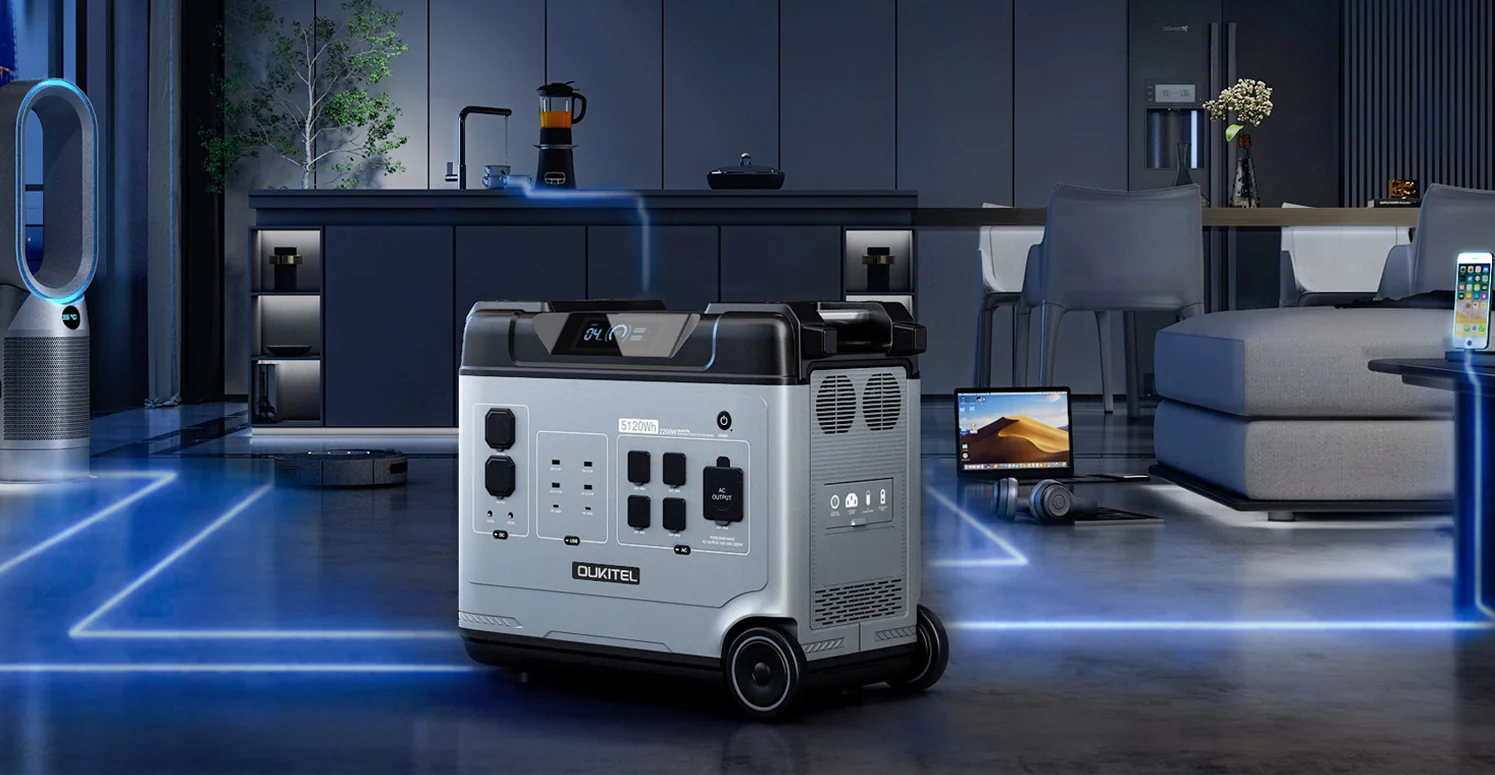
Extended-runtime: OUKITEL P5000 portable power station. 5,120Wh capacity. 2,200W AC. 1,800W lightning-fast AC input. Sub-10ms EPS switchover for partial-home backup duty.
Alt: OUKITEL P5000 Portable Power Station 5120Wh/2200W
|
Spec |
P1000 Plus |
BP2000 |
P5000 |
|
Capacity |
1,024 Wh |
2,048 Wh |
5,120 Wh |
|
AC continuous |
1,800 W |
2,200 W |
2,200 W |
|
AC surge |
3,600 W |
4,400 W |
4,400 W |
|
Fridge runtime (100W cycling) |
~26 hr |
~52 hr |
~125 hr |
|
AC charge (0-80%) |
39 min |
1.5 hr |
~2 hr |
|
Price |
Check current pricing |
Check current pricing |
Check current pricing |
The EPA publishes end-of-life recycling guidance for these chemistries [3], and LFP's stability record in residential backup has held up well across the brands we've tested over years of customer deployments.
Our Portable Power Station Calculator sizes any of these against your specific load list. The companion fridge sizing guide covers fridge-specific load math in more depth.
How Many Solar Panels Do You Need to Sustain a 1500W Load?
Marketing claims make it sound like one folding panel solves it. Field reality runs harsher.
A 100W panel in clear midday sun delivers 60-75W of usable charge after derate for angle and dust. A 200W panel rides 120-150W during the 4-hour midday peak. The DOE's Solar Energy Technologies Office publishes performance modeling that covers these derates clearly [4]. Sustaining a real 1,500W load all day from solar alone? Way more panel than most buyers expect.
- 200W panel: tops off phones, won't keep up with fridge-level loads
- 400W panel: covers fridge + lights + phones with comfortable margin
- 600W panel: handles fridge + CPAP + laptop + coffee maker mix
- 800W+ panel: comes close to sustaining steady 200-300W average loads
For storm-prone climates, FEMA flags battery backup as essential outage preparedness gear. Solar matters most when the grid stays out for days, not hours.
How to Match Your Load to the Right 1500W-Class Unit
Three-step shortcut we walk every new buyer through:
- Tally your continuous loads. Fridge 100W. Router 15W. Lights 30W. CPAP 50W. Roughly 200W steady. Multiply by 24 hours for your daily watt-hour budget.
- Pad capacity 30-50% above that budget. A 200Wh-per-day load rests easier on 2,000Wh than on 1,000Wh.
- Pin inverter rating to your biggest single load plus surge. A 1,200W microwave needs 1,500W rated minimum and 2,000W+ surge for safety.
For most 1500W class workloads (single-fridge backup, RV camping, weekend cabin), the OUKITEL P1000 Plus is our default. For multi-day grid-down or tool-heavy job sites, step up to the OUKITEL BP2000.
FAQs
What can I power with a 1500 watt generator?
Almost every common residential load. Just one heavy item at a time. Fridge 100-200W. CPAP overnight 30-60W. Laptop with monitor 60-150W. LED lights 5-30W. WiFi router 10-20W. 32-inch TV 50-80W. Coffee maker solo 600-900W. Microwave bursts 700-1,100W.
Where it gets tight? Stacking two heavy loads at the same time:
- Toaster plus microwave: combined trips it
- Space heater plus coffee maker brewing: same story
- Drill plus another power tool: kicks the breaker
Sequence beats stacking. Always. Buyers who plan loads around outage hours, not just nameplate watts, get noticeably more out of the same pack day after day.
What size generator do I need to run a TV?
Comically small one. A typical 32-inch LED TV draws 50-80W. A 55-inch smart TV draws 80-120W. A 65-inch QLED draws 120-180W under bright scenes. Any portable generator above 500W handles all three with massive headroom.
Realistic TV-only backup combos for a multi-day outage:
- 32-inch TV (60W avg) on 1,000Wh battery: ~14 hours streaming
- 55-inch TV (100W avg) on 1,000Wh battery: ~8.5 hours streaming
- 65-inch TV (150W avg) on 1,000Wh battery: ~5.5 hours streaming
- Bundle WiFi router (15W) for the streaming source
The TV is rarely the bottleneck. The battery duration is.
Can a 1500 watt generator run a refrigerator?
Yes, easily. A typical full-size residential fridge pulls 100-200W continuous with a 600-800W surge when the compressor kicks on. A 1,500W rated inverter handles that load with double the headroom for the surge spike. Pure sine wave inverters absorb the spike cleanly.
Three quick checks before plugging in any fridge:
- Inverter spec is pure sine wave, not modified sine
- Surge wattage rating is 1,500W minimum (most 1500W class units hit 2,500-3,000W)
- No other major load shares the inverter during compressor cycles
Older 1990s fridges with original compressors pull double-digit surge multiples, so test before relying.
What is the 20 20 20 rule for generators?
Maintenance shorthand from the gas generator world. Every 20 hours of runtime, do three checks. Oil level. Air filter. Overall condition. Skip any of those and lifespan drops fast. The rule was coined back when moving parts and combustion needed constant attention. The CPSC publishes current generator safety guidance for combustion units.
Modern lithium-battery solar generators sidestep most of this. No oil. No fuel. No moving parts beyond a fan. The maintenance checklist shrinks to:
- Cycle the battery to 100% then deep discharge once every 3 months
- Keep firmware updated via the app
- Store at 50-80% charge for long-term storage
- Wipe the cooling vents clean of dust
LFP chemistry handles 3,000+ cycles to 80% capacity with no service intervals required.
What should you not plug into a generator?
A few categories of gear cause real damage to either the appliance or the generator itself. Sensitive electronics on a modified sine wave inverter is the most common one. Anything with a precision-timed power supply (medical equipment, certain laser printers, some audio gear) needs pure sine wave or it fails fast.
Loads to keep entirely off a 1,500W inverter:
- Electric clothes dryers: 240V, way over wattage on top
- Full electric ranges: 240V split-phase wiring
- Central AC units: 240V, massive compressor surge
- Tankless electric water heaters: 240V, sustained 4,000W+ draw
- Anything plugged into a NEMA 14-30 or 14-50 outlet
Standard 120V kitchen appliances under 1,500W run fine.
What is the 80% rule for generators?
Plan continuous loads at 80% of rated capacity, not 100%. A 1,500W generator rated for short-term peak shouldn't sustain more than 1,200W continuous without thermal stress. This rule originally applied to gas generators where overheating shortens engine life dramatically.
For LiFePO4 solar generators the rule still helps for two reasons:
- Inverter MOSFETs run cooler with headroom (extends lifespan years)
- Surge events from cycling motors get absorbed without tripping protection
- Battery DC-to-AC efficiency peaks at 70-80% load, not 100%
Apply it as a sizing guide. If your steady load tops 1,200W, buy a 1,500W class unit. If steady load tops 1,600W, jump to a 2,000W class.
Will a 1500W generator power a window air conditioner?
Depends on the AC unit's tonnage entirely. A 5,000 BTU window pulls 450-650W steady, 1,200-1,500W surge on startup. Fits a 1,500W inverter with margin. An 8,000 BTU unit runs 700-900W steady, 2,000W surge, sits right at the edge. A 12,000 BTU unit? 1,200W+ steady, 3,000W surge. Exceeds most 1500W class units the moment the compressor kicks.
Quick reference by AC size on a 1,500W inverter:
- 5,000 BTU window unit: yes, comfortable headroom
- 8,000 BTU window unit: yes, borderline on startup
- 10,000 BTU window unit: no, surge trips it
- 12,000+ BTU window unit: needs 2,000W+ inverter class
Soft-start kits reduce surge by 60-70% on larger units.
How long will a 1500W generator run a refrigerator overnight?
All night and then some, with the right battery behind it. The exact runtime depends on what's stored under the inverter rating, not the inverter spec itself. The 1,500W number is the pipe. The watt-hours number is the tank that actually matters here.
Realistic overnight runtimes on a typical 100W cycling fridge by battery size:
- 500Wh battery: 12 hours (just barely overnight)
- 1,024Wh battery: 24-26 hours (full day with margin)
- 2,048Wh battery: 50-52 hours (two days grid-down)
- 5,120Wh battery: 125 hours (five days grid-down)
Pair with a 200W solar panel to bridge multi-day outages indefinitely as long as the sun shows up most afternoons.
Sources
- U.S. Department of Energy (DOE), Estimating Appliance and Home Electronic Energy Use (2024)
- U.S. Consumer Product Safety Commission (CPSC), Carbon Monoxide Information Center
- U.S. Environmental Protection Agency (EPA), Used Lithium-Ion Batteries (2024)
- U.S. Department of Energy (DOE), Planning a Home Solar Electric System
- Federal Emergency Management Agency (FEMA), Power Outages (2024)


Looking for something else?

Difference Between Amps and Volts: What You Actually Need to Know
LEARN MORE
50 Amps in Watts: The Honest 2026 Conversion Guide for RV, Home, EV, and Solar
LEARN MORE
Can You Put Solar Panels on a Mobile Home? (Real-World Guide for 2026)
LEARN MORE
Do Portable Solar Panels Qualify for the 30% Credit?
LEARN MORELooking for something else?

Are Solar Generators Any Good? Here's the Real Answer
LEARN MORE
How Long Does a Portable Power Station Last? (Real Numbers)
LEARN MORE
Oukitel Power Exhibits at Solar & Storage Live Philippines 2026: Carry the Sun, Power Your Freedom
LEARN MOREYou may also like
OUKITEL P2001 Portable Power Station 2000W | 2000Wh

OUKITEL P5000 Portable Power Station 5120Wh | 2200W
OUKITEL P2001 Solar Generator

OUKITEL P1000 PLUS Portable Power Station 1800W | 1024Wh


OUKITEL BP2000 Portable Power Station 2200W | 2048Wh
Further reading

OUKITEL Power Brings Full-Scenario Energy Storage Solutions to Intersolar Middle East 2026 in Dubai

Portable Power Stations for Power Tools and Job Sites: Surge, Runtime and Safety
