

 Oukitel Flashlight
 Oukitel Solar
Extension Cable
Oukitel Solar
Extension Cable


Solar Panel Connectors Types: Complete Guide to MC4, XT60 and More
Solar panel connectors types are the one thing nobody researches until they're standing in the garage holding two plugs that don't fit each other. I've been connecting panels to power stations and charge controllers since around 2016, and that moment of confusion is the single most common problem beginners hit.
Someone grabs a 400W panel, buys a portable power station, gets home excited, and stares at two completely different plug shapes. MC4 on the panel. XT60 on the station. No idea what either one is. That frustration is completely preventable if you spend five minutes understanding what each connector does and when you need it.
Solar Panel Connectors Types: Which One Do You Actually Need?
Quick answer before we go deep. If you're setting up a portable solar system, you almost certainly need MC4 on the panel side and XT60 on the station side, bridged by an adapter cable. For rooftop installations, MC4 handles everything end to end. For RV trickle charging, SAE might be all you need. The rest of this guide explains why, shows you every connector type in detail, and helps you match your exact setup.
What Are Solar Panel Connectors (And Why They Matter)
The Job Every Connector Does
Think of connectors as the handshake between your panel and whatever it's feeding power into. Could be another panel in a string. Could be a charge controller. Could be a portable power station sitting on your kitchen counter during a blackout. The connector carries DC electricity across that junction without losing power to resistance or heat, and does it reliably through years of sun, rain, and temperature swings.
What separates a good connector from a bad one is how stable that bond stays over time. Low resistance at the contact means less energy wasted as heat. A proper weatherproof seal keeps moisture from corroding the pins. I've pulled apart connectors on 8-year-old rooftop arrays and the contacts still looked clean because the gasket held. That's what proper engineering looks like at this level.
What Goes Wrong With the Wrong Connector
Two failure modes. The obvious one: plugs don't fit, nothing works, you're stuck ordering an adapter. The less obvious one is worse. The connection physically mates but the fit is loose or the materials aren't matched to spec. It works for a while. Then resistance builds at the junction. Heat follows.
I watched a DIY setup in 2021 where someone had cut MC4 connectors off a panel and twisted bare copper wire into a generic plug. Produced power for about a week before corrosion killed the entire string. The DOE's fire safety guide for solar systems documents how improper wiring and connector failures are a leading cause of PV system fires. A proper connector costs three to five dollars. A damaged charge controller or an insurance claim after a connection failure costs orders of magnitude more.
How Connectors Affect System Performance
This is the part most beginners skip because it sounds minor. It's not. Every connection point in your solar system introduces some amount of resistance. A clean, properly crimped MC4 connection adds negligible resistance. A corroded, loose, or mismatched connection can drop your system output by 5 to 15% or more. According to the DOE's cable management research, DC distribution problems account for 91% of serious field conditions in inspected PV systems. More than a quarter of those are related to cable and connector issues.
[IMAGE: Alt: all solar panel connectors types side by side - MC4 XT60 Anderson SAE DC barrel T4 on concrete surface | 4:3]
Every Solar Panel Connector Type Explained
MC4 Connectors (The Industry Standard)
MC4 is on virtually every solar panel sold today. The name comes from Multi-Contact (now Staubli), the Swiss company that developed it in 2004. The "4" refers to the 4mm contact pin diameter. MC4 connectors are IP67 or IP68 rated, UV resistant, and locked with a snap mechanism that needs a specialized tool to release. They handle up to 1,000V DC and 30A continuous on 10 AWG wire. MC4 connectors comply with NEC Article 690 and are UL certified. If you're buying solar panels for any setup, rooftop or portable, the panel side will almost certainly use MC4.
XT60 Connectors (Portable Power Station Standard)
XT60 looks nothing like MC4. It's a compact barrel-style connector that originated in the RC hobby world. The portable power station industry adopted it because it handles high current, 60A peak and 30A continuous, in a tiny package. Most stations, including the OUKITEL P5000 Pro, use XT60 for their solar input. The P5000 Pro accepts up to 1,000W at 12-120V and 15A through its XT60 port. One critical thing: XT60 is not weatherproof. It has no IP rating. It belongs on the station side, indoors or under cover. Not dangling outside in the rain.
Anderson Powerpole Connectors
Genderless and modular. Anderson Powerpoles click together in either orientation, which eliminates polarity confusion entirely. Rated up to 45A depending on contact size. You'll find them in van builds, ham radio setups, and off-grid DC distribution systems. Not typical on solar panels directly, but they show up wherever people build custom DC circuits. Reddit's overlanding and van conversion communities swear by them for rewiring flexibility.
SAE Connectors
The flat two-wire clips you see on motorcycles and RV trickle chargers. Rated for 7.5A to 10A, which limits them to small panels under 100W and trickle-charge applications only. Simple, cheap, and everywhere in the RV accessories aisle. One gotcha: SAE connectors on "solar-ready" RVs are sometimes wired with reversed polarity compared to standard solar equipment. Always verify with a multimeter before connecting.
DC Barrel Connectors (5.5mm and 8mm)
The round center-pin plugs you recognize from laptop chargers. Common solar sizes are 5.5mm x 2.5mm and 8mm. Some smaller portable stations use proprietary barrel connectors. The problems: sizes vary wildly by brand, current limits are low (typically 5-10A), and there's no locking mechanism. Fine for sub-100W portable applications. Beyond that, they become a bottleneck.
MC3 Connectors (Obsolete)
MC3 was the predecessor to MC4, developed by Multi-Contact in 1996. It relies on friction and suction rather than a positive lock. After the NEC began requiring locking mechanisms, MC4 took over and MC3 became non-compliant. If your panels are older than 10 years and still have MC3, it's time to upgrade.
T4 and Tyco SolarLok (Legacy)
T4 was developed by Canadian Solar's subsidiary Tlian as an MC4 alternative. IP68 rated with a wider operating temperature range. Canadian Solar published documentation confirming cross-compatibility with MC4. Tyco SolarLok by TE Connectivity uses a gender-neutral design with a plug-lock mechanism. Both are less common now but still appear on older commercial installations. T4 is the notable exception to the "don't mix brands" rule because it was specifically designed and tested for MC4 interoperability.
Full Connector Comparison
|
Connector |
Amps |
IP Rating |
Common Use |
Key Advantage |
Key Limitation |
|
MC4 |
30A |
IP67/68 |
Residential + commercial panels |
Industry standard, NEC compliant |
Needs crimping tool |
|
XT60 |
60A peak |
None |
Power station solar input |
High current, compact |
Not weatherproof |
|
Anderson |
45A |
None |
Van builds, off-grid DC |
Genderless, modular |
Uncommon on panels |
|
SAE |
10A |
None |
RV trickle charging |
Simple, cheap |
Low current, polarity issues |
|
DC Barrel |
5-10A |
None |
Small portable stations |
Simple plug-in |
Proprietary sizes, no lock |
|
MC3 |
30A |
IP67 |
Legacy pre-2010 panels |
Was the original standard |
Obsolete, NEC non-compliant |
|
T4 |
30A |
IP68 |
Canadian Solar panels |
MC4 compatible, highest IP |
Limited availability |
MC4 vs XT60: The Question Everyone Asks
This lands in my inbox more than any other connector question. And the answer is simple once you realize most portable solar setups use both connectors at the same time.
MC4 for the Panel Side
MC4 belongs anywhere weather exposure is a factor. Your panels live outdoors. MC4 is engineered for exactly that: UV-resistant housings, IP-rated seals, and a positive lock that won't vibrate loose. Every quality portable panel, including OUKITEL's 400W panels, uses MC4 on its output cables.
XT60 for the Station Side
XT60 belongs on the power station input. It handles high current in a compact form factor. You plug it in when charging, unplug when done. The OUKITEL BP2000 is the exception here because it accepts MC4 directly, no adapter needed. But most stations in the market use XT60.
How to Use Both Together

Alt Text: OUKITEL BP2000 portable power station unboxing showing included MC4 to XT60 solar adapter cable and accessories
Your panel has MC4. Your station has XT60. The bridge is an MC4-to-XT60 adapter cable. The P5000 Pro includes this cable in the box. MC4 end clicks onto the panel. XT60 end plugs into the station. Any third-party panel with standard MC4 output within 12-120V at 15A works through the same adapter.
Quick Decision Guide
|
If You Need To… |
Use This |
|
Connect panels to each other (series) |
MC4 male-to-female direct |
|
Connect panels to a charge controller |
MC4 |
|
Connect panels to a portable power station |
MC4-to-XT60 adapter cable |
|
Extend cable on the panel side (outdoor) |
MC4 extension cable |
|
Extend cable on the station side (indoor) |
XT60 extension cable (OUKITEL 5m, $60) |
|
Trickle charge a car or RV battery |
SAE |
|
Build a custom DC distribution for a van |
Anderson Powerpole |
|
Connect to the OUKITEL BP2000 |
MC4 direct (no adapter needed) |

Alt Text: OUKITEL BP2000 portable power station with expansion battery and solar panels connected via MC4 cables at RV campsite
OUKITEL Power Station Connector Compatibility
|
Product |
Solar Port |
Max Solar |
Panel Side |
Adapter? |
|
P5000 Pro |
XT60 |
1,000W / 12-120V |
MC4 via adapter |
MC4-to-XT60 included in box |
|
BP2000 |
MC4 direct |
1,000W / 12-120V |
MC4 |
None needed |
|
PV400 Panel |
MC4 output |
N/A |
MC4 |
MC4-to-XT60 for P5000 Pro |
Voltage and Amperage Matching
Before connecting any panel to any station, check two numbers on the panel's spec sheet: open-circuit voltage (Voc) and short-circuit current (Isc). Your panel's Voc must fall within the station's input range. For the P5000 Pro, that's 12 to 120V. A panel exceeding 120V Voc will damage the MPPT charge controller. No warning. Just damage. Always check the spec sheet before you plug in.
Series vs Parallel Wiring with MC4
Series: Join positive of panel 1 to negative of panel 2 using MC4. Voltage adds up. Current stays the same. Two OUKITEL PV400 panels in series gives roughly 96V, well within the 120V limit. Three would push to about 144V. Over the limit. Damage guaranteed.
Parallel: Connect all positives together and all negatives together using MC4 branch combiners. Current adds up. Voltage stays the same. Use parallel when you want to stay at lower voltage but increase total charging current.

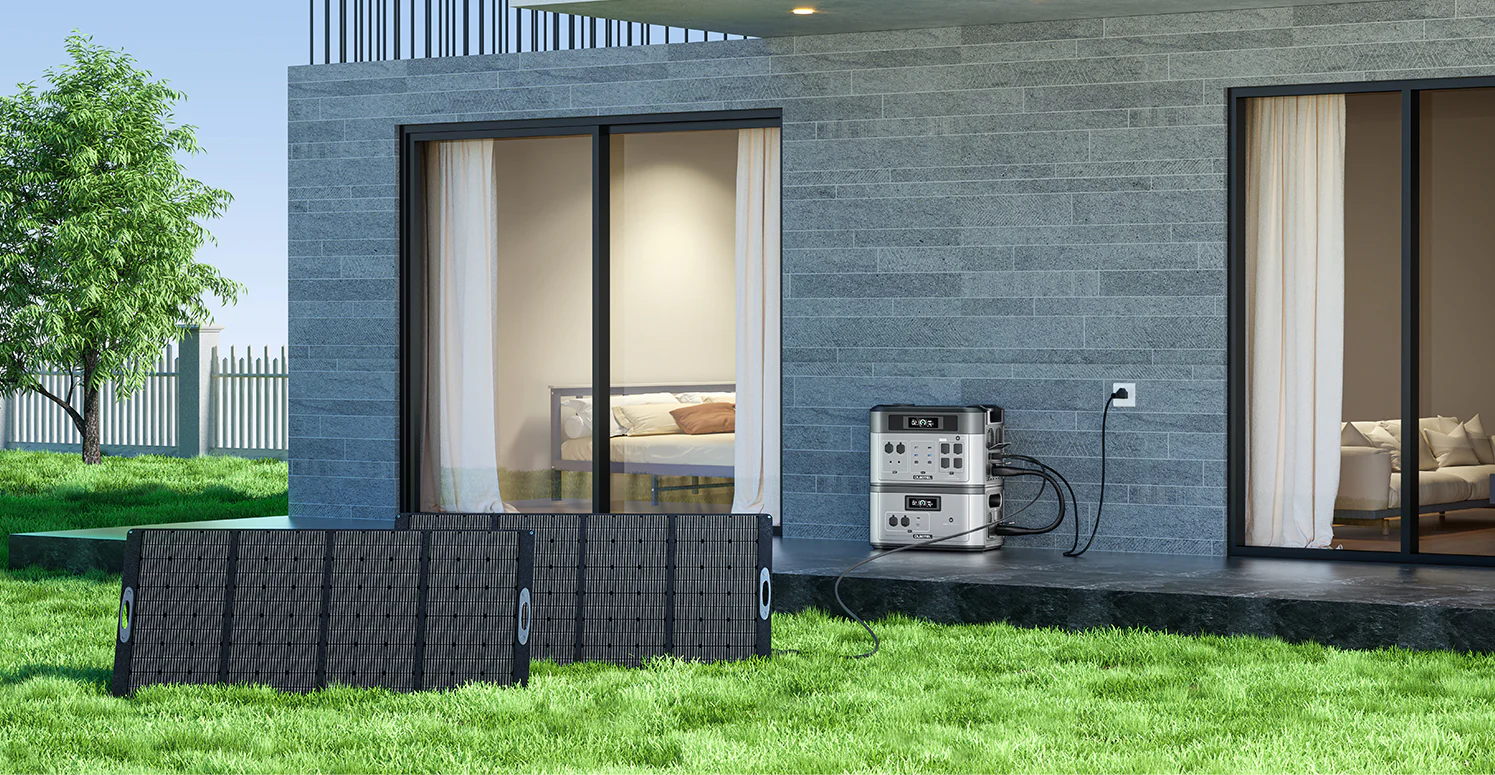
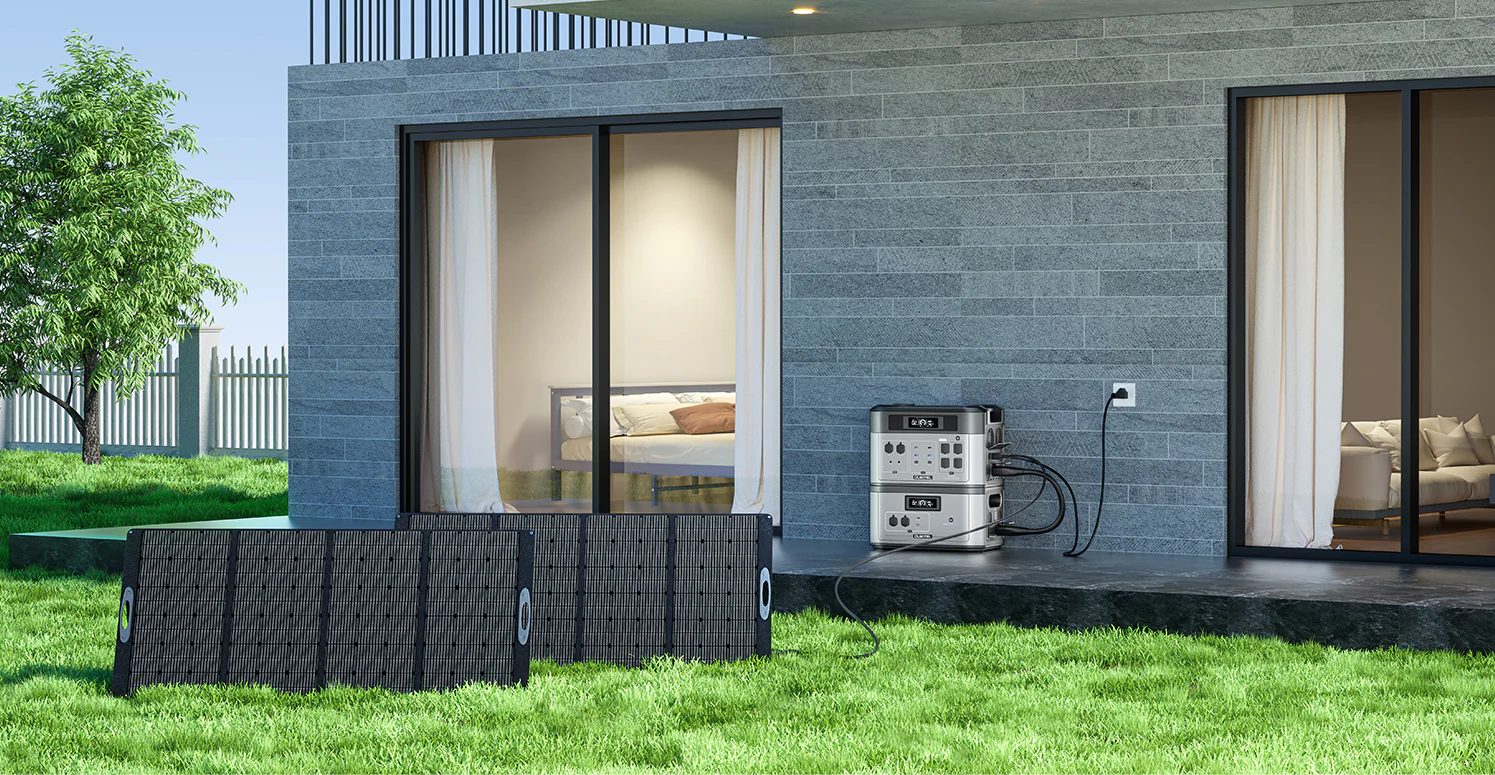
Alt text: OUKITEL home backup system with solar panels connected via MC4 connectors to stacked portable power stations and transfer switch
How to Connect Solar Panels to a Power Station
Step-by-Step Process
1. Check your panel's connector. MC4 connectors are cylindrical, about one inch long, with a notched locking collar. Male has a pin inside. Female has a socket.
2. Check your power station's input port. XT60 on the P5000 Pro. MC4 direct on the BP2000. Other brands may use proprietary barrel connectors.
3. Match or adapt. Same connector on both ends? Connect directly. Different? Use the appropriate adapter cable. Never force a connection that doesn't click naturally.
4. Verify polarity. MC4 is physically keyed, but always double-check custom cables with a multimeter before first connection. Reversed polarity causes immediate damage.
5. Secure your cables. Route panel cables to avoid sharp edges, standing water, and foot traffic. Use UV-rated cable ties or stainless steel clips for permanent installs.
Wire Gauge Guide
|
Wire Gauge |
Max Amps |
Best For |
|
14 AWG |
15A |
Small panels under 200W, short runs under 10 ft |
|
12 AWG |
20A |
Mid-range panels 200-400W, moderate runs |
|
10 AWG |
30A |
Standard for most portable setups (recommended) |
|
8 AWG |
40A |
High-current arrays, parallel strings, long runs |
For most portable setups up to 400W, 10 AWG is what I recommend. Longer runs need thicker wire to offset voltage drop. The DOE's solar codes and standards page references NEC Article 690 for wire sizing in PV systems. When in doubt, go one gauge heavier. The cost difference is a few dollars. The safety difference is significant.

Alt Text: OUKITEL BP2000 power station with expansion battery showing XT60 and MC4 solar panel connector ports and cable connections
Common Mistakes That Cost Money or Cause Danger
Mixing MC4 Brands
Someone buys genuine Staubli MC4 for their panel, then grabs a generic from a different manufacturer for the extension cable. They mate physically. But resistance can spike at the junction over time, the connection runs hot, and housing material starts cracking after a couple of seasons outdoors. I've seen this on three separate installs. Use one brand throughout your system.
Ignoring Polarity on Custom Cables
MC4 is physically keyed to prevent reverse polarity. Male to female only. But people still get it wrong when building custom extensions or swapping connectors between panels from different brands. Reversed polarity fed into a power station fries the MPPT controller instantly. Multimeter. Every single time. Before first connection.
Using Undersized Wire
I watched someone run 14 AWG for a 400W panel because it was sitting in the garage. At the current that panel produces, that wire gets dangerously hot. For a PV400 panel at 400W, 10 AWG is the correct choice. Thicker wire costs a couple extra dollars per run. An overheated wire costs your equipment or worse.
Forcing Connections That Don't Fit
A Reddit user described jamming an incompatible connector into a port and wrapping the whole thing in electrical tape. A forced connection breaks any weatherproof seal the connector had. Water gets in. Corrosion builds. Resistance climbs. If it doesn't click cleanly and lock with a solid snap, it's the wrong connector.
Wrapping MC4 in Electrical Tape
This one surprises people. Tape traps moisture against the connector housing and actually accelerates corrosion instead of preventing it. A properly mated, locked MC4 connection seals itself through its internal rubber gasket. Adding tape makes it worse, not better. If the connection doesn't feel sealed when locked, inspect the gasket and replace the connector.
Weatherproofing, Maintenance, and When to Replace
IP Ratings Explained
- IP67: Full dust protection plus temporary water immersion up to 1 meter for 30 minutes. The minimum for any outdoor solar connector.
- IP68: Full dust protection plus extended immersion beyond 1 meter. The premium rating.
- No IP rating: XT60, Anderson, SAE, and barrel connectors. Keep these under cover. Not optional.
Inspection Schedule
Check outdoor connectors every one to two years. What to look for:
- Cracked or discolored housing (UV degradation)
- Green corrosion on metal contacts
- Connectors that release without the disconnect tool (worn lock)
- Heat marks or melting around the junction point
- Loose fit that wiggles when touched
If your panels still have MC3 connectors from a pre-2010 installation, replace them with MC4. MC3 no longer meets NEC requirements in most jurisdictions and the friction-only hold degrades with age.
FAQs
Are all MC4 connectors the same?
No, and this trips up more people than you'd think. Staubli makes the original MC4. Dozens of other companies produce versions that look identical and mate physically. But not all of them carry the same UL listing or cross-compatibility certification. I've seen generic MC4 connectors that fit perfectly at first, but developed high resistance at the junction after a year outdoors. The safest approach is sticking with one brand for your entire array. If you're mixing, confirm both are independently UL-listed and rated for the same current and voltage. A few extra dollars on genuine connectors beats replacing a fried charge controller.
Can I connect MC4 panels to an XT60 power station?
Yes, and this is exactly how most portable solar setups work in practice. Your panel outputs MC4. Your station accepts XT60. An MC4-to-XT60 adapter cable bridges the gap. The OUKITEL P5000 Pro ships with this adapter included in the box. I've connected panels from three different brands to OUKITEL stations through these cables with zero issues. Just verify your panel's Voc and Isc fall within the station's input range before plugging in. For the P5000 Pro, that's 12 to 120V at up to 15A.
What gauge wire should I use for solar panels?
10 AWG handles up to 30A and covers the vast majority of portable setups in the 200W to 400W range. For cable runs longer than 20 feet, step up to 8 AWG to reduce voltage drop from resistance. Smaller panels under 200W on short runs can manage with 12 AWG. I've seen people grab 14 AWG for a 400W panel because it was sitting in the toolbox. Don't do that. At the current a 400W panel produces, undersized wire overheats fast. The cost difference between 14 and 10 AWG is a couple of dollars per run. The safety gap is enormous.
Are XT60 connectors waterproof?
No. This is one of the most common misconceptions I run into. XT60 has zero IP rating. It's designed for the power station input side, which should be in a covered or indoor location. The panel side uses MC4 specifically because MC4 is rated IP67 or IP68 for full outdoor exposure. If you're temporarily running an XT60 extension outdoors, keep the connection point off the ground and shielded from direct rain. Long-term outdoor exposure corrodes XT60 contacts and creates resistance problems that waste power and generate heat at the junction.
Can I mix different connector brands safely?
Physically, most MC4-compatible connectors from different brands will mate without issue. But "physically fits" doesn't mean "safe and code-compliant." Mixed-brand connections often lack UL certification as a pair, which can fail electrical inspections and void your panel warranty. The exception is T4, which Canadian Solar specifically designed and tested for MC4 cross-compatibility. For everything else, match your brands throughout the system. The small savings of buying generic extensions isn't worth the risk of a degraded connection after a year of weather.
How many panels can I wire in series with MC4?
The limit comes from your charge controller or power station's maximum input voltage, not the MC4 connector itself. MC4 handles up to 1,000V DC without issue. The P5000 Pro accepts up to 120V Voc. Each PV400 panel has a Voc around 48V. Two in series gives roughly 96V, safe and within range. Three hits about 144V, which exceeds the 120V limit and will damage the MPPT controller. Always multiply Voc by the number of series panels and check against your station's maximum input voltage before connecting.
What if my panel and station have completely different connectors?
Buy the right adapter cable. Never cut, splice, or force a mismatched connection. MC4-to-XT60 adapters are the most common and run $10 to $15. MC4-to-Anderson and MC4-to-SAE adapters also exist for specific setups. If you can't find the exact adapter you need, check whether an MC4-to-bare-wire cable paired with the correct station-side plug solves the problem. Worst case, a solar electrician can build a custom adapter for $20 to $30 in parts and labor. That's cheaper than replacing a device you damaged by forcing the wrong connector.
Do I need special tools for MC4 connectors?
Yes. MC4 requires a dedicated crimping tool to attach the contact pin to the wire, plus an assembly wrench to lock the connector housing. A poorly crimped pin sits loose inside, creates resistance under load, and overheats over time. You also need a wire stripper for about half an inch of insulation removal. A basic toolkit runs $15 to $30 online. Professional-grade crimpers cost $60 and up. For a one-time install, the basic set handles the job. If you plan on doing this regularly, the better tool is worth it. The quality difference in the crimp is noticeable.
Take Action Now
1. Check your panel's connector type. Flip it over, look at the cable ends. MC4 is cylindrical with a locking collar. Flat clips? SAE. Round barrel? DC connector. Yellow compact plug? XT60.
2. Check your power station's solar input port. Match it to the product spec sheet. Don't assume.
3. Order the right adapter if needed. The P5000 Pro includes MC4-to-XT60 in the box. The BP2000 takes MC4 directly. For other stations, search "MC4 to [your port type]" and buy from a reputable brand.

Alt: MC4 crimping tools wire stripper and 10 AWG solar cable on workbench flat lay
Sources
- U.S. Department of Energy —Fire Safety with Solar Systems (2024)
- U.S. Department of Energy —Solar PV Cable Management Best Practices (2024)
- U.S. Department of Energy —Solar Codes and Standards (2024)
- International Electrotechnical Commission —IEC 62852: Connectors for DC PV Systems (2024)
- National Fire Protection Association —NEC Article 690: Solar Photovoltaic Systems (2024)
- Staubli (Multi-Contact) —MC4 Connector Product Line (2024)
- Canadian Solar —T4 Connector Technical Documentation (2024)
- OUKITEL Power —P5000 Pro +BP2000 Product Pages


Looking for something else?
How Easy Is a Portable Power Station to Use? A Beginner’s Guide
LEARN MORE
Cold-Weather Power: Best Portable Power Stations for Winter Camping
LEARN MORE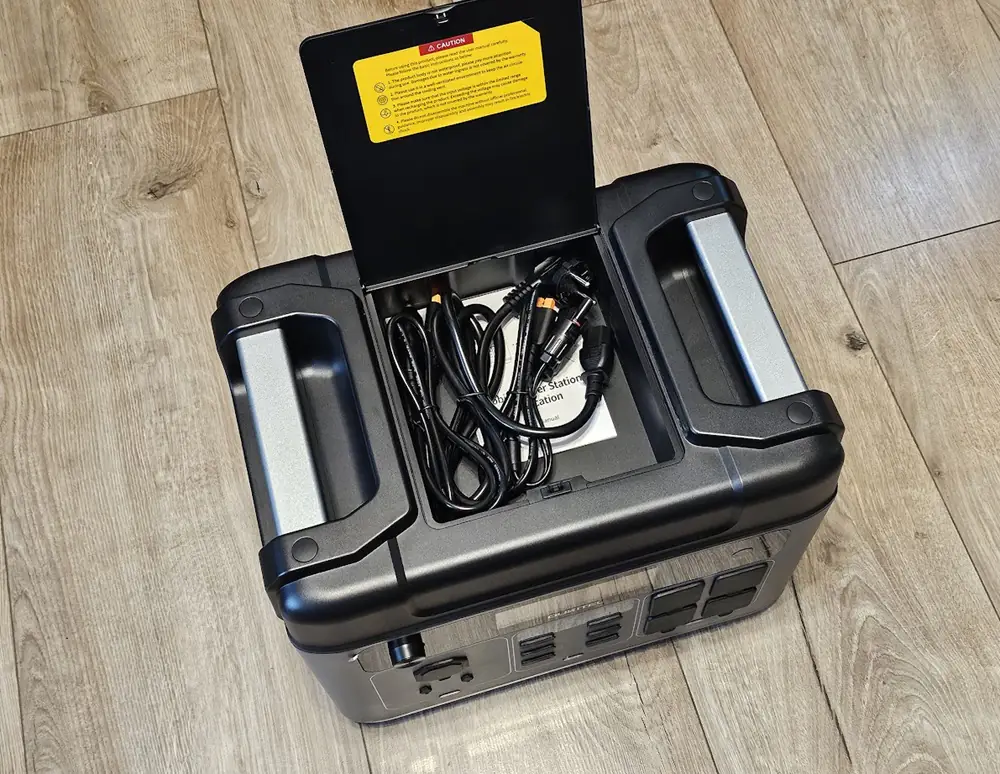
What is a Portable Power Station & How It’s Used
LEARN MORE
5 Must-Have Portable Power Solutions for a Stress-Free Christmas
LEARN MORELooking for something else?
Power Station Calculator: How to Estimate Output & Recharge Time
LEARN MORE
Solar Panel Voltage: Understanding Output and Regulation
LEARN MORE
How Do Solar Panels Work: From Sunlight to Home Energy
LEARN MOREYou may also like

OUKITEL P5000 Portable Power Station 5120Wh/2200W

OUKITEL P2001 Solar Generator

OUKITEL P1000 PLUS Portable Power Station 1800W/1024Wh

OUKITEL BP2000 Portable Power Station 2200W/2048Wh

OUKITEL P5000 Solar Generator for Home with 400W Solar Panel
Further reading
Best Solar Generator for Home Backup: 2026 Buyer's Guide
How Long Do Portable Power Stations Last? 2026 Lifespan and Runtime Guide