

 Flashlight
 Solar
Extension Cable
Solar
Extension Cable


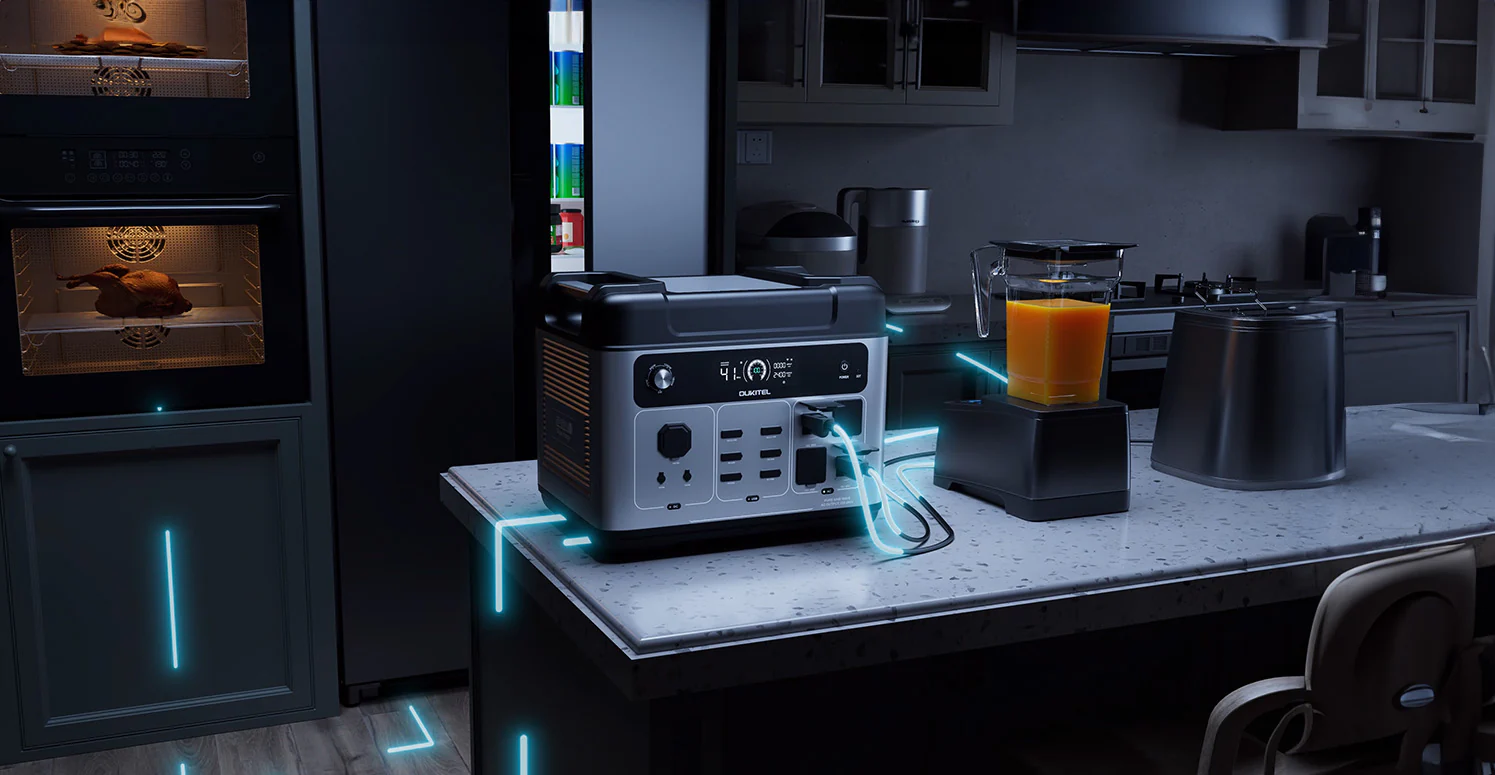
Black Friday Portable Power Station Deals: Mistakes to Avoid Before You Buy
The best Black Friday portable power station deals can save you hundreds—or cost you more than you bargained for if you rush the buy. This guide walks you through the 13 most common mistakes shoppers make (and how to avoid them), plus the simple math you need to verify runtime and value. We’ll keep brand mentions light, focus on specs that matter, and point you to a couple of good reference pages so you can compare apples to apples.
The One-Page Cheat Sheet
- Capacity (Wh/kWh) decides how long you can run things.
- Inverter output (W, surge W) decides what you can run at once.
- Recharge speed (AC input watts; solar window volts/amps) decides how quickly you’re back in action.
- Noise & cooling determine if you can actually live with the unit.
- LiFePO₄ + 3-year warranty are the new baseline for quality and life.
- Bundles: do the $/Wh math—some panel kits are steals; some aren’t.
- Don’t overbuy watts, underbuy watt-hours. Most people do it the wrong way around.
Confusing Watts with Watt-hours

- Watts (W) = power at an instant (what the inverter can deliver).
- Watt-hours (Wh) = energy in the tank (how long it lasts).
A “2,400 W” inverter sounds mighty, but if the battery is only 600 Wh, you’ll drain it in minutes under heavy load. For most buyers hunting portable power station Black Friday deals, Wh matters more than W—after you’ve passed the threshold of what you need to run.
Rule of thumb: First size Wh for runtime, then check that W covers your simultaneous loads + surge.
Ignoring the simple runtime math
You don’t need an app to estimate runtime. Use:
Estimated runtime (hours) ≈ (Battery Wh × 0.90) ÷ Load Watts
- The 0.90 factor accounts for inverter and conversion losses.
- If you’re running only USB-C PD/12 V DC, you can use 0.93–0.95.
Examples
- 1,024 Wh → 100 W (router+lights): (1024×0.90)/100 ≈ 9.2 h
- 2,048 Wh → 300 W (fridge duty-cycle avg): (2048×0.90)/300 ≈ 6.1 h
- 5,120 Wh → 500 W essentials: (5120×0.90)/500 ≈ 9.2 h
If a product page’s “days of power” math doesn’t make sense with the formula above, keep scrolling.
Buying “max watts” and starving runtime
The classic “spec flex” trap: a giant 2–3 kW inverter paired to a small battery. If you don’t plan to run a space heater or a table saw, you probably don’t need 3 kW. What you do need is enough Wh to last through the outage, the night, or the weekend.
List the devices you’ll run, estimate daily Wh, and buy Wh with 20–30% headroom. Then ensure inverter W and surge comfortably cover your highest simultaneous draw.
Overlooking surge for motor loads

Fridges, well pumps, and power tools have starting surges typically 2–3× running watts. A 250 W fridge can spike to 600–900 W for a second or two.
Ensure your inverter’s surge rating (brief peak) is above the starting need. For home-backup use, a surge of ≈2× the continuous rating is a good sanity check.
Assuming all batteries last the same
Battery chemistry matters. LiFePO₄ (LFP) is the modern standard for longevity and stability.
- LFP cycles: commonly 3,000–5,000+ to ~80% remaining
- NMC/NCA cycles: often 500–1,500+ to ~80%
For year-round resilience and frequent cycling, choose LiFePO₄. Scan the listing for cycle counts and a 3-year warranty on the station.
Ignoring recharge speed (AC input watts)
Fast discharge is only half the story—fast recharge matters in the real world. Can you get back to 80% in ~40–60 minutes for ~1kWh units? ~~1 -- 1.5 h for ~2kWh? Look for AC input wattage (e.g., 1,000–1,800 W fast charge) and whether you can adjust input to be gentler on the pack when speed isn’t urgent.
Prefer stations that specify 0–80% time and max AC input (W). Adjustable charge rate is a big plus when you want to reduce heat and extend battery life.
Buying a solar bundle that doesn’t fit the input window
Many shoppers grab “panel + station” bundles only to discover the station’s solar input voltage/amp window doesn’t match the panel’s output. Or the “400 W” panel is really two 200 W sheets but the controller only accepts 300–500 W.
Check the station’s MPPT spec (e.g., “12–60 V / 15 A, max 500 W”). Make sure the panel’s Vmp and Imp fit, and that the total watts aren’t choked by the controller. For everyday use, 200–400 W panels pair well with ~1–2 kWh stations.
Underestimating noise & thermal behavior
Anything with an inverter and fans makes noise under load—especially during fast charge. Advertised “<50 dB” under moderate load is comfortable indoors; “<30 dB at light loads” is excellent for bedrooms or tents.
Look for noise figures, “eco” fan modes, and clear ventilation. If the product page doesn’t mention noise at all, assume it’s average at best.
Skipping EPS/“UPS-like” details for home backup
Many modern stations offer EPS/UPS-like switchover—keeping PCs, routers, and small appliances alive when the grid blips. What matters is transfer time. If a brand touts “<10 ms EPS”, you’re generally fine for typical electronics. Ultra-sensitive equipment may still prefer online UPS.
If you want a portable power station Black Friday buys for outage resilience, verify EPS/“UPS-like” <10 ms on AC outputs and understand it’s not a data-center UPS.
Forgetting DC and USB-C PD efficiency
Running everything on AC wastes energy. A lot of modern loads—laptops, tablets, phones, many DC fridges—can run on USB-C PD or 12 V DC, which avoids inverter losses and fan spin.
Prioritize PD 100 W ports and solid 12 V rails. You’ll get a longer runtime at the same Wh.
Trusting “compare-to” prices without doing $/Wh math
Two similar stations may differ massively in $ per Wh. That’s your equalizer across brands and promos.
Compute $/Wh: sale price ÷ battery Wh. For example, $749 ÷ 2,048 Wh ≈ $0.37/Wh (a strong figure for LFP + fast-charge + EPS in 2025). If a smaller station posts a higher $/Wh, the “deal” might just be clever packaging.
Overlooking size, weight & wheels
A 5 kWh single-box is life-changing in an outage—and a back-breaker to move without wheels and a telescopic handle. Likewise, a “portable” 1 kWh station that’s 15 kg isn’t portable for everyone.
Check net weight and mobility features. For the ~2 kWh class, ≈20–23 kg is typical; for ~1 kWh, ≈10–13 kg is reasonable; for ~5 kWh, wheels are essential.
Neglecting warranty terms & support
Some deep discount listings hide short warranties or complicated claims. That’s a false economy.
Aim for a 3-year warranty on the station, straightforward RMA, and documented service email/hours. Bonus points for manuals, app updates, and spare-part availability.
How to sanity-check a deal in 90 seconds
- Capacity: Is the Wh enough for your day? Add 20–30% headroom.
- Inverter: Does W + surge cover your simultaneous loads?
- Recharge: AC input W and 0–80% time meet your needs?
- Solar fit: Panel volts/amps fall inside the MPPT window?
- Noise: Any numbers? (<50 dB under load, <30 dB light load = great.)
- Chemistry & life: LiFePO₄, cycles quoted, 3-year warranty.
- $/Wh math: Sale price ÷ Wh. Compare across carts.
- Bundle logic: Is the panel/trolley bundle actually cheaper than separate?
- Returns & support: 30-day return, visible support email/hours.
Quick reference: a well-specced ~2kWh/2.4kW class (for comparison)
Use this as a feature benchmark while you browse portable power station Black Friday listings:
- Capacity: ~2,048 Wh
- Inverter: ~2,400 W pure sine (surge ~4,800 W)
- AC input: up to ~1,800 W (≈ 0–80% ~1 hour)
- Adjustable AC input (e.g., 400/800/1200/1800 W) for battery care
- Solar input: ~500 W, clear voltage/amp window
- EPS/“UPS-like” <10 ms
- Noise: <50 dB under load
- App control: Bluetooth/Wi-Fi
- Chemistry: LiFePO₄, 3,500+ cycles
- Warranty: 1+2 years (with registration)
See the P2001 Plus PDP to reality-check specs against your shortlist: /collections/portable-power-station/products/oukitel-p2001-plus-portable-power-station
Frequently Asked Questions
What’s a “good” Black Friday price for portable power stations?
There’s no single number—use $/Wh. In 2025, strong LFP deals with fast charge and EPS often land in the $0.35–$0.55/Wh range depending on size and bundle. Under that for a reputable spec stack is excellent.
Is it smarter to buy a bundle on Black Friday?
Often, yes—if the panel matches the station’s solar window and the bundle math beats buying separately. Watch for real solar wattage (not just “400 W” marketing), cable types (MC4 vs proprietary), and storage cases.
Do I really need 2–3 kW output?
Only if your simultaneous loads demand it (microwave, toaster, power tools). Most buyers are happier with a balanced 1.5–2.4 kW inverter and more Wh for longer runtime.
Will fast charging ruin the battery?
Occasional fast charging is fine. Chronic max-rate charging in high heat accelerates wear. Adjustable AC input lets you trade speed for longevity when you’re not in a rush.
How loud are stations in real life?
It varies by load and charge speed. Look for <50 dB under moderate load and <30 dB at light loads. If a page lists no noise data, assume average fan noise.
A simple game plan for “best Black Friday portable power station deals”
- Pick your Wh tier (≈600 Wh / ≈1 kWh / ≈2 kWh / ≈5 kWh).
- Use the 90-second checklist; eliminate poor fits.
- Compute $/Wh, confirm EPS, PD 100 W, noise claims.
- If going solar, match the MPPT window.
- Check for a return window and a true 3-year warranty.
- Apply stackable coupons (newsletter/spin-to-win) at checkout.
- Buy once—right size, right features, real value.
Handy internal links for shoppers (add these near CTA)
- Compare models/sizes: /collections/portable-power-station
-
Benchmark ~2kWh/2.4kW features: /collections/portable-power-station/products/oukitel-p2001-plus-portable-power-station
Final word
The best black friday portable power station to buy is the one that fits your real-world loads, recharges fast on your schedule, and won’t drive you nuts with fan noise. Avoid spec traps (too many watts, not enough watt-hours), verify surge for motor loads, match panels to the MPPT window, and let $/Wh + LiFePO₄ + EPS + noise guide you. You’ll spend less up front—and be happier every time the lights flicker.


Looking for something else?
mAh to kWh: How to Convert and Understand Battery Capacity
LEARN MORE
How Many mA in an Amp: Understanding Electrical Conversion
LEARN MORE
Solar Array Roof: How to Mount on Pitched and Non-Pitched Roofs
LEARN MORE
Power Tool Battery Standardization: Benefits and Guidelines
LEARN MORELooking for something else?
What Size Portable Power Station Do I Need: Complete Guide
LEARN MORE
Watts to BTU/hr: How to Convert and Apply the Formula
LEARN MORE
OUKITEL Energy Storage Shines at the 139th Canton Fair, Global Customers Experience Product Strength On-Site
LEARN MOREYou may also like

OUKITEL BP2000 PRO Portable Power Station 3300W

OUKITEL BP5000 PRO MAX Portable Power Station 5000W | 5120Wh

OUKITEL P2001 Plus+400W Solar Generator

OUKITEL P2001 Plus+2*200W Solar Generator

OUKITEL P2001 Plus+200W Solar Generator

OUKITEL BP3000 Portable Power Station 3200W | 2048Wh
Further reading
Portable Power Station for Van Life: 1-7 Day System Sizing Guide
Portable Power Station for Apartment Blackouts: Indoor Backup Guide