








 Flashlight
 Solar
Extension Cable
Solar
Extension Cable


What Size Generator for 400 Amp Service: 2026 Sizing Guide
For 400 amp service, plan 20 to 30 kW for essentials. Or 48 to 60 kW with smart load shedding for automatic whole-home backup. The 96 kW theoretical max almost never matches real life. Why? Your home doesn't pull 400 amps at once. Sizing for that ceiling burns cash you'll never see back, sometimes $15,000 worth.
Here's the part nobody mentions. That 400 amp service in your panel? Almost certainly two 200 amp panels stitched together by a meter cabinet. One fact. Changes the whole generator math. We'll get there.
This guide is the 2026 rebuild of the article that's been ranking here for two years. Updated numbers. Honest install costs. And a section on pairing a generator with a battery for the silent gaps generators leave wide open.
What Size Generator Do You Actually Need for 400 Amp Service?
Three tiers cover most homes. Pick yours by what you actually want running, not the panel rating stamped on the meter.

Alt: what size generator for 400 amp service comparison - 20 kW 60 kW 100 kW units side by side
The Three Generator Sizing Tiers for 400A Service
|
Tier |
Generator Size |
Best For |
Installed Cost (2026) |
|
Essentials |
20 to 30 kW |
Critical loads only: fridge, lights, well pump, HVAC blower, internet |
$7,000 to $13,000 |
|
Smart Full-Home |
48 to 60 kW |
Most luxury or all-electric homes with managed load priority |
$18,000 to $30,000 |
|
No-Compromise |
80 to 100+ kW |
Multiple HVACs, EVs, electric heat, no load shedding needed |
$30,000 to $60,000+ |
Why 96 kW Is Misleading on 400 Amp Service
96 kW looks tempting on paper. It isn't useful. The U.S. Department of Energy puts average American home draw at 1.2 to 4 kW continuously, with peaks closer to 8 to 12 kW when AC and electric range are running together. Even all-electric luxury builds rarely hold past 30 to 40 kW for any length of time.
In our experience, 100 kW buyers regret it. Bigger fuel bills every storm. Louder operation. And a January service contract that costs more than the smaller unit's annual fuel.
What Each Generator Size Actually Covers
What each size actually covers, in plain English:
- 20 kW: fridge, well pump, 15 LED fixtures, internet, one HVAC zone
- Step up to 30 kW and you add a second AC plus a slow EV charge
- 48 kW carries most homes once smart shedding drops electric heat and EVs
- Comfortable margin at 60 kW for two HVAC compressors plus an electric water heater
- 100 kW only earns its price tag if you refuse to shed any load, ever
Pick the smallest size your real peak draw plus 20% will fit inside. Bigger isn't safer here. Undersized generators die early. Oversized ones drain bank accounts.
Why Your 400 Amp Service Is Probably Two 200 Amp Panels
This catches almost everyone. Modern 400 amp residential service is rarely one big panel. It's a meter cabinet with a splitter feeding two separate 200 amp main breaker panels. Twin units. Side by side. Standard build now.
Reddit's r/Generator and r/AskElectricians say the same thing across dozens of threads, year after year. One homeowner described it perfectly after his electrician walked the project: 400A main disconnect, meter cabinet, splitter, two 200A panels, and automatic transfer. The electrician charged him for 20 minutes of explanation. He should have charged for 5.
What Dual 200A Panels Mean for Your Generator
So why does it matter for your generator?
- True 400A ATS units (the Generac model is 21.8 inches wide) cost $2,500 to $5,000 more than two stock 200A switches
- Skip the second panel entirely. Back up only the essentials side. Saves $5,000+ in equipment alone
- One 60 kW unit feeding both 200A panels through a smart load center beats a 100 kW unit on a single 400A ATS, every time
- Each panel becomes its own load-shed zone. Simpler logic, simpler troubleshooting at 2 AM in a storm
- Wire sizes drop too. Smaller copper for two 200A runs than for one 400A run
I've seen this catch first-time buyers more often than any other 400A topic. The fix is easy. Day one, ask the electrician which layout you have. The answer locks half your equipment list and most of your budget.
The Neutral Switching Gotcha on 400A Hookups
There's also a wiring gotcha some installers still miss. Certain interlock setups switch only the hot legs, leaving the neutral floating. Sounds like minutiae. The real-world result is backfeed risk, even when the generator is supposedly off. If your installer hasn't wired three or more 400A jobs, walk away. Same labor cost. Different outcome.
How Do You Calculate Generator Size for 400 Amp Service?
The math is straightforward. Generator size in kilowatts equals amps times volts, divided by 1,000. For 400 amps at 240 volts: 400 multiplied by 240, divided by 1,000, gets you 96 kW theoretical max.
That's the ceiling. Not the size you actually buy. You size to peak load plus a buffer.
Step-by-Step Generator Sizing Calculation
Step by step:
- List every appliance you want running during an outage.
- Pull running watts for each one (the DOE appliance energy guide is free and accurate).
- Mark the items with motors: fridge, AC, well pump, freezer.
- Add 2 to 4x starting watts for the biggest motor only. One motor starts at a time.
- Sum running watts plus that single largest surge.
- Multiply by 1.2 for a 20% safety buffer.
- Round up to the next standard generator size.
Worked Example: 24 kW for a 4,000 Sq Ft Home
Working example. Real 4,000 sq ft home, smart shedding active:
|
Load |
Running Watts |
Starting Watts |
|
Central AC (3-ton) |
3,500 |
10,000 |
|
Refrigerator |
600 |
1,800 |
|
Well pump (1 hp) |
1,000 |
3,000 |
|
LED lights (15 fixtures) |
150 |
150 |
|
Microwave |
1,000 |
1,000 |
|
Electric range (one burner) |
2,000 |
2,000 |
|
Internet, router, laptop |
200 |
200 |
|
Total running + largest surge |
8,450 |
+ 10,000 |
Total demand at peak: 18,450 W. Add the 20% buffer: 22,140 W. Round up: 24 kW.
That's exactly what one Reddit installer used on a 4,000 sq ft home with two compressors load-shed. Not 96 kW. Not 60 kW. The math beats the assumption. Every time.
Standby vs Portable: Which Generator Fits a 400 Amp Service?
Standby wins for almost every 400 amp home. Portables can support, but they shouldn't lead the plan.
Standby generators sit on a permanent pad outside, run on natural gas or propane, and switch on through an ATS within 10 to 15 seconds of an outage. Hardwired. Auto-start whether you're home or not. Portables are gas-fueled, manually started, plugged in through an inlet, and the biggest residential portables top out around 12,500 watts. Different tool. Different job entirely.

Alt: standby generator vs portable generator comparison for 400 amp service
Standby vs Portable: Side-by-Side Comparison
|
Factor |
Standby Generator |
Portable Generator |
|
Power range |
14 to 150+ kW |
3 to 12.5 kW |
|
Fits 400A whole-home |
Yes, with right ATS |
No, essentials only |
|
Auto-start |
Yes (10-15 sec switch) |
No (manual) |
|
Fuel |
Natural gas, propane, diesel |
Gasoline, sometimes propane |
|
Installed cost |
$7K to $30K+ |
$800 to $3,000 |
|
Refuel during outage |
Not needed |
Every 6 to 10 hours |
|
Safe location |
Outdoor only (CO risk) |
Outdoor only, 20+ ft from home |
Why CPSC Safety Rules Favor Standby for 400A
CPSC reports portable generators kill dozens of Americans every year through carbon monoxide. Twenty feet from any window or door, on the side facing away from the house. That rule isn't optional. On 400 amp service, where you're trying to run for days and not hours, it's another vote for standby.
Reddit's installers say the same thing. One described a 26 kW Kohler install on a new build: never wakes up to a dead house, never refuels in a storm, never trips over an extension cord at 3 AM. That's the actual value of the auto-transfer. Not the brochure copy. The 3 AM part.
How Much Does a 400 Amp Service Generator Cost in 2026?
Installed totals run from $7,000 on the low end to $50,000+ for full-coverage no-compromise builds. The generator unit itself? Usually 50 to 60% of the total. ATS, gas line, concrete pad, permits, electrical labor, and the inspection fees swallow the rest.
Budget the install, not the unit. A $5,000 generator on Amazon turns into a $12,000 project once you add a licensed electrician, a permit, a 400 amp transfer switch, and the pad pour. What I tell homeowners: ask for a turnkey number. If the quote leaves a line item blank, find another installer.
2026 Installed Cost Ranges by Generator Tier
2026 installed cost ranges by tier:
- Essentials at 20 to 30 kW: $4,000 to $8,000 unit + $3,000 to $5,000 install = $7,000 to $13,000 total
- Smart full-home at 48 to 60 kW: $12,000 to $20,000 unit + $6,000 to $10,000 install = $18,000 to $30,000 total
- No-compromise at 80 to 100 kW: $25,000 to $40,000 unit + $5,000 to $10,000 install = $30,000 to $50,000+ total
- Single 400A ATS instead of dual 200A switches: tack on $2,500 to $5,000
- Gas line trench plus a meter upgrade if those aren't already in place: another $1,500 to $4,000
Skip the bargain installers. Pattern repeats every season. People who shave $2,000 off the install spend $8,000 fixing it later.
Project Timeline and Storm Season Lead Times
Timelinesmatter too. Quote to work ATS usually runs 6 to 12 weeks. Permits, utility coordination for the gas tap, and the electrician's calendar all stack up. Order before storm season starts. Lead times stretch past 16 weeks the moment a hurricane warning gets issued anywhere along the coast.
Can a Portable Power Station Replace Part of Your Generator Setup?
A portable power station can't replace a 400 amp generator. It fills two real gaps the generator leaves wide open. Silent backup-to-backup during refuel, ATS testing, or scheduled maintenance. And the entire backup setup for renters who can't install permanent equipment.
Power stations are not 400 amp solutions. Anyone selling them as one is stretching it. What they're genuinely good at: running the fridge, a CPAP, internet, a few lights, and phone charging silently and instantly. Through the 10 to 15 second switch window your standby ATS takes on startup. Or the hours your portable generator sits off for refueling, oil checks, or quiet hours after 10 PM.
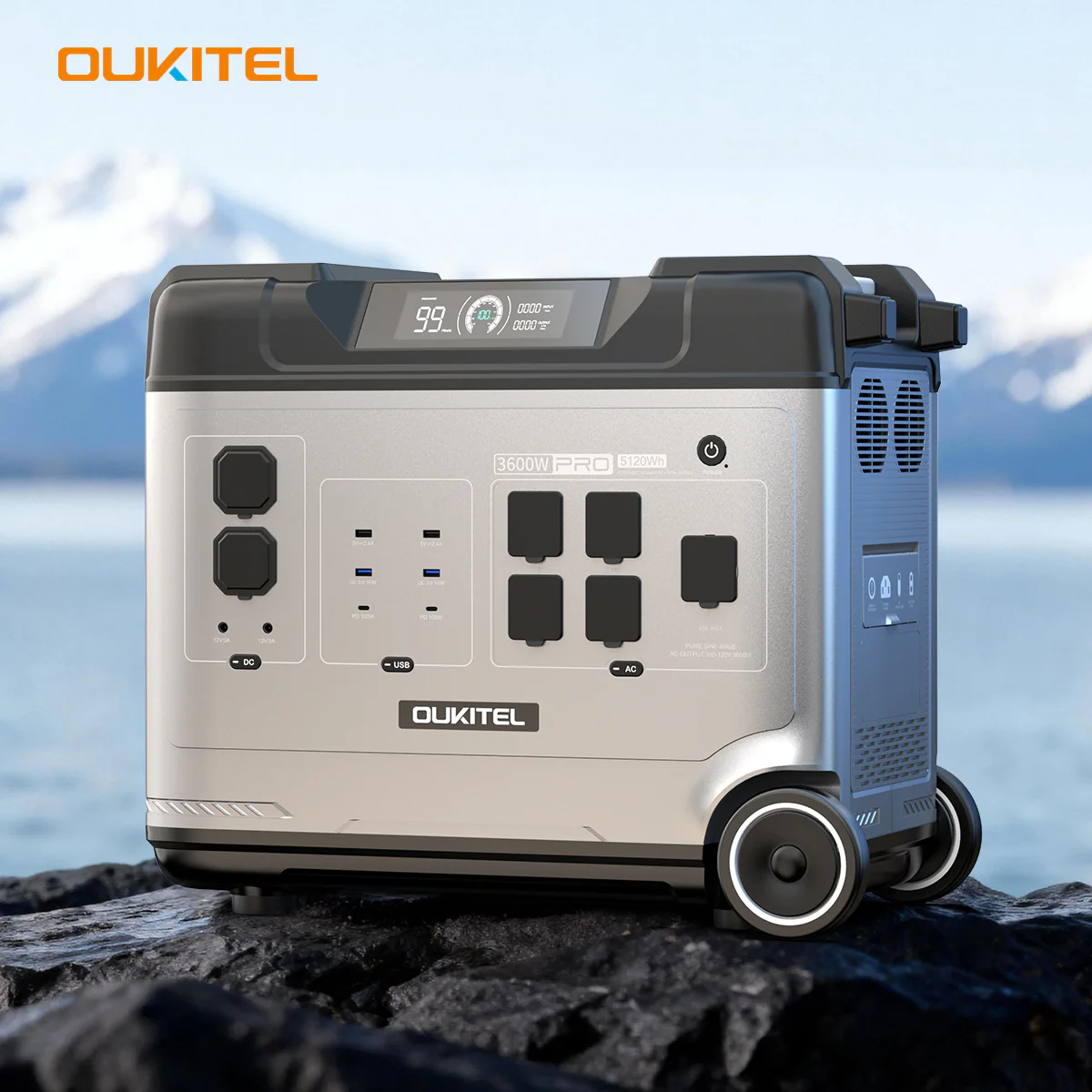
The OUKITEL P5000 Pro at 5,120 Wh and 3,600 W continuously handles a typical critical-load list (fridge, CPAP, router, a few lights) for roughly 18 to 30 hours, depending on draw. The BP2000 at 2,048 Wh expands up to 16,384 Wh with B2000 packs. Better fit if you'd rather start small and grow the system over time.

Alt Text: OUKITEL P5000 Pro Portable Power Station 5120Wh/3600W
Where a Power Station Fits in Your 400A Backup Plan
Where a power station genuinely earns its place in a 400A backup plan:
- Fridge plus freezer plus CPAP plus router for 12 to 24 hours during portable generator off-hours
- Silent indoor operation overnight, when neighbors would rather not hear the standby
- Backup-to-backup if the standby flunks its monthly ATS test during an actual outage
- MC4 solar input means it runs forever in daylight, no fuel deliveries needed
- Whole-house circuit transfer is not on this list. Don't try.
Power Station Backup for Renters and Condo Owners
Renters and condo owners with 400A service (yes, that exists in some buildings, especially older luxury units in Manhattan and downtown Chicago) can't install a standby. Two expandable BP2000 units paired with solar panels handle essentials for multi-day outages. No structural modifications. Move out, take the system with you.

Alt: homeowner planning what size generator for 400 amp service with electrician
Your Next Steps
- Confirm your panel setup. Have a licensed electrician verify whether your 400A service runs through one panel or two 200A panels. This single answer changes 50% of the equipment list.
- Build your real load list. Write down every appliance you want running during an outage with running watts and starting watts. Add 20%. That number, not 96 kW, is your generator size.
- Plan the silent backup layer. For critical loads that need to keep running during refuel, ATS test, or generator service, pair your generator with a P5000 Pro or expandable BP2000. Your CPAP, fridge, and internet won't notice the gap.
Need help sizing the portable side of your backup plan? Our home backup generators guide and portable power station sizing guide walk through real-world load scenarios.
FAQs
Will a 7 kW generator run a house with 400 amp service?
A 7 kW generator won't run a full house on 400 amp service. It can power essentials in a small home. A 7 kW unit handles a fridge, a few lights, internet, and a couple of small appliances at the same time. Central AC? Out. Electric water heater? Out. Large electric range? Definitely out.
What 7 kW realistically covers:
- Refrigerator at 600 W running, plus 5 LED fixtures pulling 50 W
- Internet router and modem combo at 40 W
- Microwave running on and off at 1,000 W
- One small space heater or box fan, 500 to 1,500 W
- Phone and laptop charging, around 100 W combined
Anything labeled whole-home plus 400 amp service starts at 20 kW. Period.
How many amps does a 20,000 watt generator produce?
A 20,000 watt (20 kW) generator produces 83.3 amps at 240 volts. That's 20,000 divided by 240. Enough for critical loads on a 400 amp service, well below full panel capacity but plenty for the loads families actually run during outages.
Why this matters: 20 kW is the most common essentials tier sold today. Paired with a smart load center managing priorities, it covers around 90% of the loads a real family uses during an outage.
Output by voltage:
- 240V single-phase delivers 83.3 amps continuous
- 120V single-phase delivers 166.6 amps continuous
- 208V three-phase: 55.5 amps continuous (commercial setups)
- 480V three-phase: 24 amps continuous (industrial setups)
- Surge capacity typically lands at 25,000 W, or 104 amps at 240V
A 20 kW unit gives you 83.3 amps. Roughly 21% of a 400 amp service capacity. Smart load shedding handles the rest.
Do I need a 400 amp automatic transfer switch?
Only if your service runs through a single 400 amp panel. Most modern 400 amp installs split into two 200 amp panels, and two standard 200A transfer switches handle them for less money.
One Reddit electrician summed it up well: 2x 200 amp service panels are cheaper and easier than going larger. That advice held in 2023. Still holds in 2026. Probably will in 2030.
ATS choices by panel layout:
- Single 400A panel: Generac 400A ATS or Kohler equivalent runs $2,500 to $5,000
- Dual 200A panels: two 200A ATS units, $1,500 to $3,000 combined
- Whole-home backup: ATS rated to generator output, not service rating
- Essentials-only: smaller ATS sized to a critical-load subpanel
- Smart load center: priority logic instead of fixed ATS sizing
Nail down your panel layout first. Wrong ATS choice can add $3,000 to a project.
What size wire do I need for a generator on 400 amp service?
For a 400 amp service feeder from a generator or main disconnect, the typical spec is 600 kcmil copper or 750 kcmil aluminum, sized per NEC ampacity tables. Local code and conduit run length set the final number.
Wire alone for a 400A run runs $1,500 to $4,000, depending on distance from the pad to the panel. Don't shave this. Undersized wire causes voltage drop and heat at full load. Both kill generators early.
Common requirements:
- 400A service feeder: 600 kcmil copper or 750 kcmil aluminum
- Generator-to-ATS run: matched to generator output rating, not service size
- Grounding electrode conductor: 2/0 copper for 400A
- Equipment grounding: 1/0 copper minimum
- Always pull a permit. Always let a licensed electrician size it
Wire sizing is one place where DIY is genuinely dangerous. Pay an electrician.
How many kVA is needed for 400 amp service?
A 400 amp service at 240 volts has a theoretical 96 kVA capacity. Practical generator sizing typically lands between 25 and 75 kVA, depending on your real load. kVA and kW look similar but they aren't identical. kVA accounts for power factor, usually 0.8 on backup generators.
Residential homeowners can essentially treat kW and kVA as interchangeable for sizing decisions. Most home loads run at 0.9 to 1.0 power factor anyway. Commercial and motor-heavy installs need the kVA distinction.
Quick conversion at 240V:
- 20 kW = 25 kVA = 83 amps
- 30 kW = 37.5 kVA = 125 amps
- 48 kW = 60 kVA = 200 amps
- 60 kW = 75 kVA = 250 amps
- 96 kW = 120 kVA = 400 amps (the theoretical max)
If a manufacturer quotes only kVA, divide by 1.25 for usable kW. The 0.8 power factor is industry standard for backup gear.
Is one 60 kW generator better than two 30 kW units?
For most 400 amp homes, one 60 kW unit wins. Simpler install, single ATS, easier maintenance long term. Two 30 kW units only earn their cost on mission-critical setups: medical homes, off-grid properties, places where any single failure isn't acceptable.
After helping dozens of homeowners weigh this, the redundancy argument loses to cost and simplicity nearly every time.
What a single 60 kW gets you:
- One fuel connection, one pad, one annual service contract
- Simpler controls and a single ATS or transfer system
- Lower installed total, typically 25 to 30% less than two 30 kW units
- Quieter overall when oversized for typical home loads
- Better starting performance when AC compressors kick on
Dual 30 kW only earns its keep when you genuinely cannot afford to lose all power if one unit fails.
How much does a generator for 400 amp service cost?
Expect $15,000 to $40,000 fully installed for a quality standby generator sized for 400 amp service. The generator itself runs $5,000 to $20,000 depending on size and fuel type, while installation, transfer switch, fuel hookup, and concrete pad work add another $10,000 to $20,000 on top.
From years of helping homeowners price out 400 amp backup systems, we've seen the total installed cost split roughly 50/50 between equipment and labor. The generator size matters less than people expect, most of the cost lives in the install. A 22 kW essentials-tier setup runs roughly the same labor as a 48 kW whole-home unit.
Breakdown of a typical 400 amp install:
- 22 kW essentials generator: $5,000 to $8,000 unit + $8,000 to $12,000 install
- 48 kW whole-home generator: $12,000 to $20,000 unit + $10,000 to $15,000 install
- 400 amp service-rated ATS: $1,500 to $3,500
- Concrete pad and gas line: $1,500 to $4,000
- Permits, inspection, electrical work: $2,000 to $5,000
Going dual 30 kW units instead of a single 60 kW typically adds 25 to 30% to total project cost.
Can a battery backup system replace a 400 amp generator?
Not fully, but it covers 60-80% of what most families actually use during an outage. The math depends on which loads matter to you. Modern LiFePO4 battery systems handle essentials silently, but a 400 amp panel's full simultaneous draw still needs a generator.
In our experience helping homeowners design layered backup, the smart play isn't either/or. It's both. Battery handles the silent, indoor-safe 0-to-12-hour window. Generator handles multi-day events and heavy 240V loads (electric range, dryer, central AC) that batteries can't sustain affordably.
Realistic battery backup options for 400 amp homes:
- P5000 Pro: 3,600W continuous from 5,120Wh, runs essentials for 12 to 24 hours
- BP2000 expanded: 2,200W continuous, up to 16,384Wh with B2000 packs
- Multiple P5000 Pro units networked for higher capacity
- Pair any system with solar panels for indefinite off-grid operation
- Zero fuel, zero noise, fully indoor-safe operation
Full replacement with battery alone is technically possible at 80,000+ Wh, but rarely pencils out cheaper than layering both.
Sources
- U.S. Department of Energy (DOE),Estimating Appliance and Home Electronic Energy Use
- U.S. Consumer Product Safety Commission (CPSC),Portable Generators: Safety Standards and Guidance
- U.S. Energy Information Administration (EIA),Power Interruptions and Average Outage Duration (2023)
- Federal Emergency Management Agency (FEMA),Power Outages Preparedness Guide
- ENERGY STAR (U.S. EPA Program),Energy Efficient Home Improvements


Looking for something else?

Difference Between Amps and Volts: What You Actually Need to Know
LEARN MORE
50 Amps in Watts: The Honest 2026 Conversion Guide for RV, Home, EV, and Solar
LEARN MORE
Can You Put Solar Panels on a Mobile Home? (Real-World Guide for 2026)
LEARN MORE
Do Portable Solar Panels Qualify for the 30% Credit?
LEARN MORELooking for something else?

Are Solar Generators Any Good? Here's the Real Answer
LEARN MORE
How Long Does a Portable Power Station Last? (Real Numbers)
LEARN MORE
Oukitel Power Exhibits at Solar & Storage Live Philippines 2026: Carry the Sun, Power Your Freedom
LEARN MOREYou may also like

OUKITEL BP2000 PRO Portable Power Station 3300W

OUKITEL P2001 Plus+400W Solar Generator

OUKITEL P2001 Plus+2*200W Solar Generator

OUKITEL P2001 Plus+200W Solar Generator

OUKITEL BP3000 Portable Power Station 3200W | 2048Wh
OUKITEL P5000 Pro+400W Solar Generator
Further reading

OUKITEL Power Brings Full-Scenario Energy Storage Solutions to Intersolar Middle East 2026 in Dubai

Portable Power Stations for Power Tools and Job Sites: Surge, Runtime and Safety
