








 Flashlight
 Solar
Extension Cable
Solar
Extension Cable


OUKITEL vs BLUETTI: Expandability, Runtime and Price Compared
OUKITEL vs BLUETTI comes down to three numbers that spec sheets tend to bury: how far storage expands after the first purchase, how much of the rated capacity actually reaches your appliances, and what the complete working system costs once cables and panels are in the cart.
This is a framework, not a head-to-head of two units. Lineups refresh every few months. A comparison built on two model numbers expires almost immediately, and the buyer is left holding a chart that no longer describes anything on sale.
The checks below apply to any brand. OUKITEL figures appear as worked examples because we can verify them against our own product pages. Run the same questions against whatever else is on your shortlist.
What Separates OUKITEL vs BLUETTI on Expandability, Runtime and Price?
The separation happens on three axes, and on each one the headline number is not the number that decides the purchase. Expandability is limited by the inverter, not the battery. Runtime is limited by usable energy, not rated energy. Price is set by the complete system, not the base unit.
Most comparison content stops at the headline figure. That is where the mistakes start.
|
Axis
|
What the spec sheet shows
|
What actually decides it
|
|
Expandability
|
Maximum combined watt-hours across the base unit plus every supported pack
|
Whether continuous AC output rises with capacity. It does not. The inverter is a separate ceiling.
|
|
Runtime
|
Rated watt-hours of the installed battery
|
Usable watt-hours after conversion losses, divided by real average draw rather than nameplate draw
|
|
Price
|
Base unit list price
|
Complete system cost: packs, hubs, cables, panels, shipping, tax, and regional warranty eligibility
|
Work down that third column and most shortlists shorten on their own.
How Does Battery Expandability Actually Work?
A large battery and an expandable battery system are different products. The first delivers the capacity installed at the factory. The second accepts additional compatible storage later, on terms the manufacturer sets.
Expansion Adds Watt-Hours, Not Watts
This is the misunderstanding that costs buyers the most money. Adding an expansion battery increases stored energy. It does not increase the inverter's continuous AC rating.
The OUKITEL BP2000 shows the shape of it clearly. Base capacity is 2,048Wh. Connect seven B2000 expansion packs in parallel, and combined storage reaches 16,384Wh, an eight-fold increase. Continuous AC output stays at 2,200W the entire way up. A 3,000W load that trips the inverter at 2,048Wh still trips it at 16,384Wh.
Capacity buys duration. Inverter rating buys the ability to start and hold the appliance at all. Confusing them is why people buy expansion packs that solve nothing.
The Maximum Capacity Figure Hides a Shopping List
Headline maximums describe a fully built system, not a box. Separate what ships in the listed package from what has to be bought later to reach the advertised ceiling.
-
Count the packs. Seven expansion batteries at 2,048Wh each is seven separate purchases, not an upgrade path you complete in one order.
-
Cables and hubs are often sold separately. Confirm which connection hardware ships in the box before assuming the quoted maximum is reachable.
-
Weight compounds. Storage that sits fine beside a refrigerator becomes something you cannot lift into a vehicle.
-
More stored energy takes longer to refill unless charging capability scales with it. Check the input rating, not just the output.
-
Ventilation clearances apply to every unit in the stack, not only the base station.
Ecosystem Commitment Is a Real Cost
Proprietary expansion batteries simplify integration and tie your future purchases to one supported component family. That trade is fine as long as you make it deliberately.
Check that compatible packs and replacement cables are actually stocked in your region before you commit. If expansion is central to the plan, price the first upgrade now. Availability and pricing on the B2000 expansion battery are worth confirming at the same time you buy the base unit, not two years later when you need it.
Never infer compatibility from a matching connector. A plug that fits is not a documented pairing.

Here is how the expandable side of the OUKITEL line is structured. Note the last column.
|
Model
|
Base capacity
|
Max expanded
|
Packs supported
|
Continuous AC output
|
|
P1000 Plus
|
1,024Wh
|
Not expandable
|
None
|
1,800W
|
|
BP2000
|
2,048Wh
|
16,384Wh
|
Up to 7
|
2,200W at every configuration
|
|
BP2000 Pro
|
2,048Wh
|
16,384Wh
|
Up to 7
|
3,300W at every configuration
|
|
P5000 Pro
|
5,120Wh
|
Not expandable
|
None
|
3,600W
|
|
BP5000 Pro Max
|
5,120Wh
|
19,456Wh
|
Up to 7
|
5,000W at every configuration
|
Capacity moves eight-fold. Output never moves at all. That column is the whole lesson.
How Do You Estimate Runtime Instead of Trusting Rated Watt-Hours?
Rated watt-hours describe what the cells hold. They do not describe what reaches your appliance. Inverter conversion, cooling fans, the display, and battery management overhead all draw power before anything useful happens.
Start With Usable Watt-Hours
A working derate for AC loads on a modern LiFePO4 station is 0.85. Multiply rated capacity by that figure, then divide by average draw.
For a 2,048Wh unit: 2,048 multiplied by 0.85 gives roughly 1,741Wh usable. Every runtime number below uses that same factor. Applying it consistently is more important than arguing about whether the true figure is 0.84 or 0.88.
We keep a full worked version of this in the portable power station calculator guide, including solar recharge math and inverter sizing.
Use Average Draw, Not Nameplate Draw
Refrigerators, freezers, and sump pumps cycle. A fridge with a 150W compressor does not pull 150W for twenty-four hours. It pulls it for a fraction of each hour, and the average across a day lands far lower.
Size the inverter for the peak. Size the battery for the average. Two different numbers, two different jobs.
|
Load
|
Average draw
|
Usable energy
|
Estimated runtime
|
|
Full-size refrigerator, cycling
|
60W
|
1,741Wh
|
About 29 hours
|
|
Chest freezer, cycling
|
45W
|
1,741Wh
|
About 38 hours
|
|
CPAP without humidifier
|
40W
|
1,741Wh
|
About 43 hours
|
|
Router, modem and phone charging
|
25W
|
1,741Wh
|
About 70 hours
|
|
1,500W space heater, continuous
|
1,500W
|
1,741Wh
|
Just over 1 hour
|
That last row is worth sitting with. The same battery that carries a fridge for more than a day carries a resistive heater for barely an hour. Heat is where energy budgets go to die.
Build a conservative margin on top. Cold weather reduces available capacity, cells lose capacity with age, and outages do not schedule themselves around your estimate.

Why the EPS Rating Matters More Than the Inverter Rating
This is the specification almost no comparison article checks, and it decides whether your backup plan works.
A station's continuous AC rating describes what it can run off the battery when you plug things in deliberately. Its EPS rating describes what it can carry through a grid failure without interrupting. Those are different numbers. The second one is usually lower, sometimes by a wide margin.
The Gap Is Larger Than Most Buyers Expect
Across the OUKITEL line, the EPS ceiling sits below the inverter rating on every expandable model. We publish both figures. The comparison below is worth running against any brand you are considering.
|
Model
|
Capacity
|
Continuous AC
|
EPS ceiling on 120V
|
Gap
|
Expandable
|
|
P1000 Plus
|
1,024Wh
|
1,800W
|
1,800W
|
None
|
No
|
|
BP2000
|
2,048Wh
|
2,200W
|
1,400W
|
800W
|
To 16,384Wh
|
|
BP2000 Pro
|
2,048Wh
|
3,300W
|
2,000W
|
1,300W
|
To 16,384Wh
|
|
P5000 Pro
|
5,120Wh
|
3,600W
|
1,400W
|
2,200W
|
No
|
|
BP5000 Pro Max
|
5,120Wh
|
5,000W
|
1,400W, or 2,800W on the 240V outlet
|
Varies by outlet
|
To 19,456Wh
|
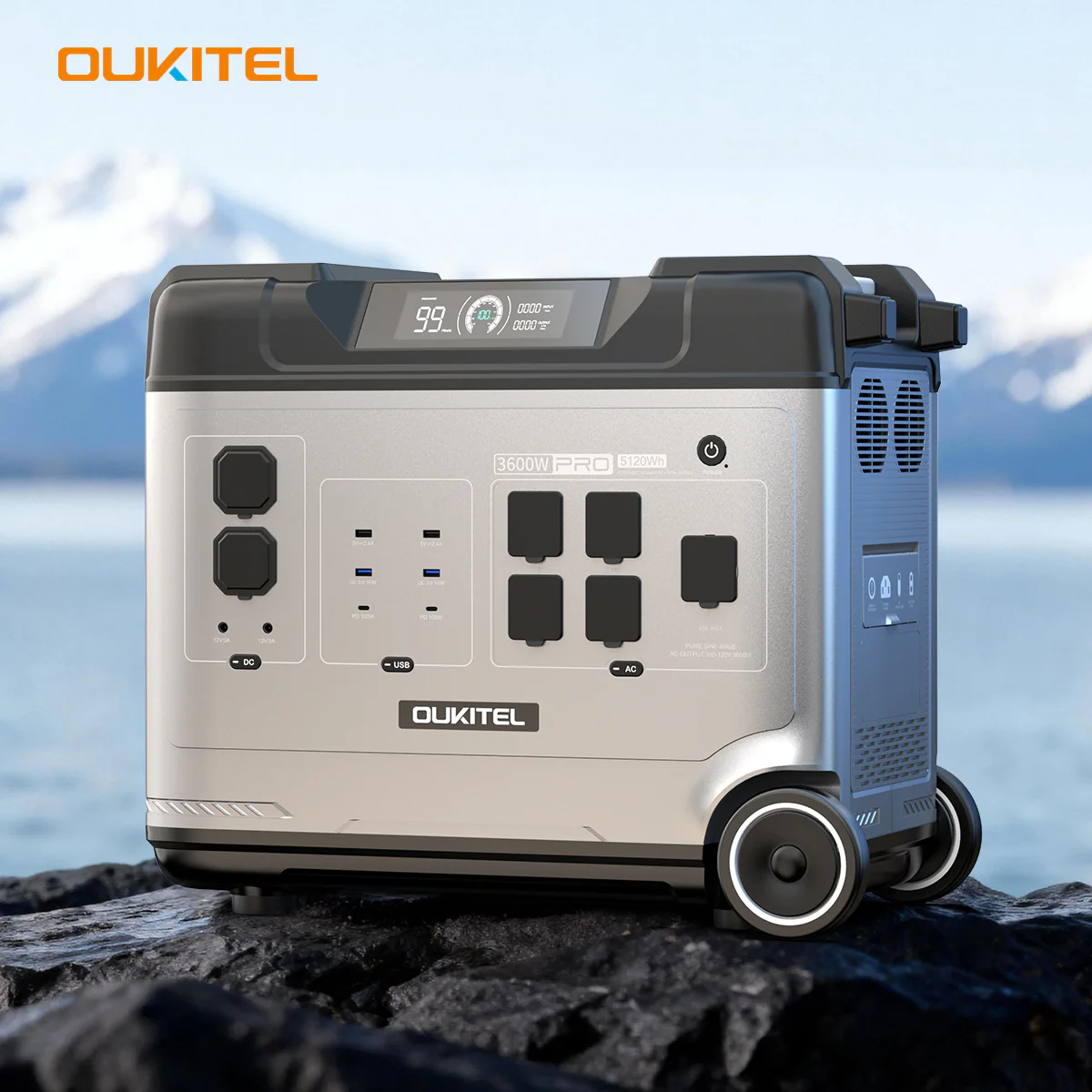
Read the P5000 Pro row again. It carries a 3,600W inverter and a 1,400W EPS ceiling on 120V. That unit will happily run a 3,000W load you plug in by hand, and will flag an overload if you ask it to carry that same load through a blackout. Both facts are documented on the P5000 Pro product page. Neither one is a defect. They are simply two different modes with two different limits.
The practical consequence: if seamless backup is the reason you are buying, the EPS number is your real output rating. Size against that.
Regional Voltage Standard Changes the Ceiling
The same hardware can carry different EPS limits depending on which market it is configured for. On the P5000 Pro, the EPS ceiling is 1,400W under US and Japanese standards and 2,000W under Chinese, UK, European, and Korean standards.
A review written for one market therefore does not describe the unit you will receive in another. Check the manual for your region rather than the review for someone else's.
The BP5000 Pro Max handles this differently again. Its 120V outlets carry 1,400W in EPS mode while the 240V outlet carries 2,800W. If a 240V circuit is in your plan, that split matters more than the 5,000W headline.
Pass-Through Is Not the Same as Backup
Pass-through charging means the station powers your devices while it is itself receiving energy. It does not by itself guarantee uninterrupted operation when the grid drops.
-
Transfer time matters, and so does what the unit will actually carry during the transfer.
-
Extension cords between the station and the load can interfere with switchover behavior. Test the exact arrangement you plan to rely on.
-
Sensitive electronics may not tolerate even a brief interruption, so verify against the documented rating rather than a marketing phrase.
-
Never assume medical equipment suitability. Require written confirmation for anything in that category.

How Should You Compare Price on OUKITEL vs BLUETTI?
Compare complete systems, dated and itemized, or you are not comparing anything. A base unit price is an ingredient, not a total.
Price the Working System, Not the Box
Build both quotes to the same boundary. Same target capacity, same target output, same accessories, same market, same day.
-
Expansion batteries needed to reach your capacity target
-
Connection cables and any hub required to link them
-
Solar panels and extension cabling, if solar is part of the plan
-
Shipping on a heavy battery, plus taxes and duties for your market
-
Whether a pictured accessory is included or staged for the photograph
A discounted overseas listing is not equivalent to a locally supported package with warranty eligibility. Record the country, the seller, and the date next to each quote.
We do not publish fixed prices in guides like this because they move. Check current pricing on the product page for whatever configuration you settle on.
Cost Per Usable Watt-Hour Beats Cost Per Rated Watt-Hour
Divide the complete system price by usable watt-hours rather than rated watt-hours. Rated capacity flatters every unit equally, which makes it useless for separating them.
A 2,048Wh package priced against 1,741Wh of usable energy tells you something closer to the truth. Apply the identical derate to both sides of the comparison so the numbers stay honest.
What the Cost Metric Cannot Tell You
Cost per watt-hour is one input among several. It says nothing about inverter output, EPS ceiling, recharge speed, portability, cycle life, or whether anyone will answer the phone in your country.
A cheaper watt-hour is worthless if the station cannot start your appliance or refill before the next outage. Cheap energy you cannot deploy is not cheap.
Which Configuration Fits Your Situation?
Match the system to where it will live and what has to stay on. Not to a spec-sheet ranking.
Home Backup for Essential Loads
Build around the circuits that cannot go dark, not every outlet in the house. A refrigerator, a router, and lighting is a very different budget from cooking and electric heat. For most households running one to two days of essentials, an expandable 2,000Wh-class unit covers the load with room to add packs later. The BP2000 sits in that class, alongside the rest of the home battery backup range.
Outages are not evenly distributed. The EIA notes that customers in the hardest-hit states have seen interruption totals stretch into the tens of hours after major storm events, which is the scenario worth sizing against rather than the national average. Our home backup buyer guide walks through the load-by-load version of this.
Higher Output Without Jumping Tiers
When 2,200W is not enough but a full 5,000Wh system is more than the situation calls for, the BP2000 Pro sits in between at 3,300W continuous on the same 2,048Wh base and the same seven-pack expansion path. A space heater plus a fridge is the archetypal case.
Large Loads and 240V Circuits
Well pumps, ranges, and some workshop equipment need 240V. Most portable stations cannot supply it at all, which rules them out before any other spec matters. Split-phase output is the qualifying feature here, and it is worth checking the EPS behavior on the 240V outlet separately from the 120V outlets.
Camping, RV and Mobile Work
Measure the storage space before choosing capacity, including clearance for plugs and cables, then confirm you can lift the assembled system. For lighter duty, the P1000 Plus runs at 1,800W continuous with a matching 1,800W EPS ceiling, weighs about 12kg, and reaches 80 percent in 39 minutes on AC. Fan noise near a sleeping area is worth checking too.
Outdoor marketing does not establish weatherproofing. Follow the published temperature, moisture, and transport limits.

What Should You Verify Before You Buy?
-
Run this list against every unit still on the shortlist. If a listing cannot answer one of these, that is information too.
-
Continuous AC output against your largest simultaneous load, with startup surge checked separately for anything with a motor.
-
EPS ceiling for your region's voltage standard, since this is your real output limit during an outage.
-
Documented expansion path: which pack family, how many units, what cables, and what the combined capacity actually reaches.
-
Usable energy against measured average draw, using the same derate on every unit you compare.
-
Recharge window from AC and from realistic solar, not from a peak rating measured in laboratory conditions.
-
Complete system price for your market, dated, with warranty eligibility and authorized-seller requirements confirmed in writing.
If a critical specification is missing from the listing, do not infer it. Ask the manufacturer or the authorized seller and keep the reply with your purchase records.

Start With Your Load Sheet
Three steps turn this framework into a purchase decision.
-
Write down every load that cannot lose power, with its running watts and its startup surge. Add the running watts of anything that will be on at the same time.
-
Multiply your target capacity by 0.85 and divide by your average draw. If the result does not clear your worst-case outage, you need more capacity, more solar, or fewer loads on the list.
-
Check the EPS ceiling against that same simultaneous load, then browse the expandable models on oukitelpower.com and confirm current pricing on the product page for the configuration you land on.
FAQs
How do I compare OUKITEL and BLUETTI runtime fairly?
Compare usable watt-hours against measured average draw, not rated capacity against nameplate wattage. Multiply rated capacity by 0.85 to approximate usable energy, then divide by the average load. A 2,048Wh unit yields roughly 1,741Wh usable, which carries a cycling refrigerator drawing 60W for about 29 hours.
Does adding an expansion battery increase power output?
No. Expansion batteries increase stored energy only. The inverter's continuous AC rating is a separate ceiling that does not move at all. A BP2000 expanded from 2,048Wh to 16,384Wh across seven packs still delivers 2,200W continuous, so a load that overloads the base unit will overload the full stack too.
What is an EPS rating and why is it lower than the inverter rating?
EPS is the maximum load the station will carry through a grid failure without interrupting, which is usually lower than what it delivers in normal operation. The P5000 Pro carries a 3,600W inverter and a 1,400W EPS ceiling on 120V. Size backup plans against the EPS figure.
Which brand offers better battery expandability?
Neither brand wins categorically, because expandability is a per-product-family question rather than a brand-level one. Check the documented pack family, the supported quantity and the combined maximum for the exact model. OUKITEL's expandable line supports up to seven packs, reaching 16,384Wh or 19,456Wh depending on the base unit.
Are OUKITEL power stations good for home backup?
They suit home backup when the verified output, EPS ceiling and expansion path match your load sheet. Judge the individual model rather than the brand reputation. The BP2000 covers most essential-load households at 2,048Wh expandable to 16,384Wh across seven packs, with a 1,400W EPS ceiling worth sizing against.
Is the cheaper power station the better value?
Only if it meets the same requirements at a lower complete-system cost. Price the packs, cables, panels, shipping and tax together, then divide by usable watt-hours rather than rated ones. A 2,048Wh package works out against 1,741Wh usable. Base prices often converge once both configurations are fully specified.
How much capacity do I need for a multi-day outage?
Size against your worst historical outage, not the national average. EIA reliability data shows customers in storm-affected states experiencing tens of hours without power in a single year. Two thousand watt-hours covers roughly a day of essentials; multi-day coverage generally needs 5,000Wh or paired solar.
Does the EPS rating change between regions?
Yes, on some models it does. The P5000 Pro allows up to 1,400W in EPS mode under US and Japanese standards and up to 2,000W under Chinese, UK, European, and Korean standards. Check the manual written for your market rather than a review from another one.
Can a portable power station run a 240V appliance?
Only if it supports split-phase output, which most portable units do not offer at any capacity. The BP5000 Pro Max supplies both 120V and 240V from a 5,120Wh base with 5,000W continuous output. Its EPS behavior differs by outlet: 1,400W on the 120V outlets, 2,800W on the 240V outlet.
How long should a portable power station last before replacement?
LiFePO4 cells in this category are typically rated in the thousands of full cycles to 80 percent of original capacity, which translates to roughly a decade of regular use. The BP2000 is rated at over 3,500 cycles. Cycle count matters more than calendar age for daily-use setups.


Looking for something else?

Do Portable Solar Panels Qualify for the 30% Credit?
LEARN MORE
Are Solar Generators Any Good? Here's the Real Answer
LEARN MORE
How Long Does a Portable Power Station Last? (Real Numbers)
LEARN MORE
Oukitel Power Exhibits at Solar & Storage Live Philippines 2026: Carry the Sun, Power Your Freedom
LEARN MORELooking for something else?
What Size Generator for 400 Amp Service: 2026 Sizing Guide
LEARN MORE
Battery Backup for Power Outage: Sizing & Real Runtime
LEARN MORE
Solar Panels for Charging a Car Battery: An Honest Guide
LEARN MOREYou may also like

OUKITEL P5000 Solar Generator for Home with 400W Solar Panel
$1,499.00
$2,999.00

OUKITEL P800 Portable Power Station 800W | 512Wh
$249.00
$399.00

OUKITEL B2000 Expansion Battery | 2048Wh
$699.00
$999.00

OUKITEL BP5000 PRO MAX Portable Power Station 5000W | 5120Wh
$1,999.00
$2,999.00

OUKITEL C01 Car Jump Starter 1350A | 80Wh | PD60W
$139.00
$299.00

OUKITEL BP2000 PRO Portable Power Station 3300W
$849.00
$1,599.00
Further reading

OUKITEL vs Jackery: Home Backup, Camping and Value Compared
OUKITEL vs Jackery is settled by three numbers rather than by brand reputation: the wattage your loads pull, the watt-hours needed to cover the outage or the trip, and the watts you can push back ...
OUKITEL vs BLUETTI: Expandability, Runtime and Price Compared
OUKITEL vs BLUETTI comes down to three numbers that spec sheets tend to bury: how far storage expands after the first purchase, how much of the rated capacity actually reaches your appliances, and...

OUKITEL vs EcoFlow: Which Portable Power Brand Fits Your Needs in 2026?
The OUKITEL vs EcoFlow choice comes down to six checks: continuous output, backup transfer rating, usable energy, recharge speed, expansion path, and warranty eligibility where you live. Run those...