










 Flashlight
 Solar
Extension Cable
Solar
Extension Cable


Best Portable Power Station Under $1,000 in 2026: Buying Guide
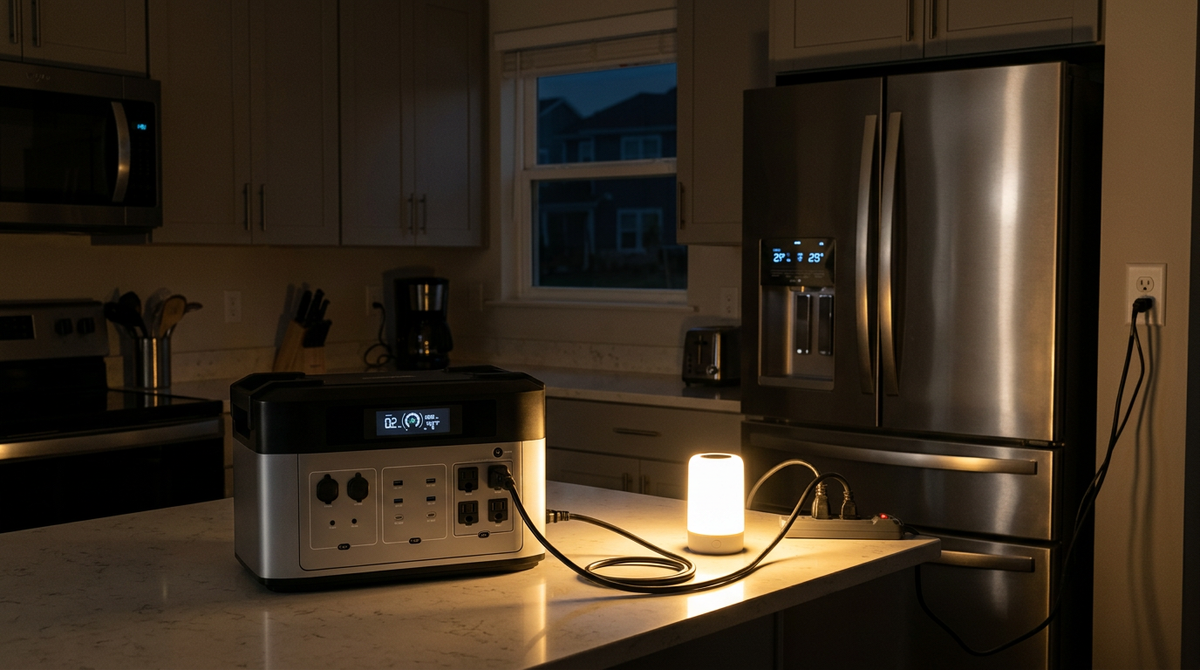
The right portable power station under $1,000 for 2026 comes down to load, not the number printed on the box. For most people that lands somewhere between 1,000Wh and 2,000Wh, with 1,800W of clean output or better. Get that match right, and it carries a fridge through a blackout. Charges a weekend's worth of devices. Stays light enough that you can load it into the car yourself.
A thousand dollars now buys real capability. A few years ago, this budget covered little more than phone charging and a camp light. Today, it can keep refrigerators, CPAP machines, routers, and a laptop or two running, in many cases for most of a day. The market expanded quickly over that period, which pushed prices down but also made the choice harder to reason about.
This guide is here to make that pick easier. Most roundups give you a ranked list of models and stop. They skip the part that decides everything. The real question is not which brand wins. It is what your setup needs because that sets the capacity, output, weight, and price.
What Can You Get From the Best Portable Power Stations Under $1,000 in 2026?
A budget under $1,000 covers a lot in 2026. You can get a small 300Wh unit or an expandable 2,000Wh system that comes close to home backup. The trade is always the same: how easy it is to carry versus how long it runs. There are three rough size bands. Picking your band is most of the job.
Units under roughly 300Wh function as personal energy hubs. Phones, tablets, cameras, and LED lights all stay powered through a short outage or a day trip. These units are cheap and light. Their scope is narrow, though, and a high-wattage appliance simply will not start on one. That is the point. Big appliances were never the job.
The middle band sits around 500Wh to 1,000Wh. Most people should look here. This is the jump from charging gadgets to actually running things. A full fridge. A CPAP at night. A router and a laptop across a workday. Output climbs too, usually past 1,800W, enough for real appliances instead of just small batteries topping up.
Above it comes the 1,000Wh to 2,000Wh tier, which leans toward emergency backup. Longer fridge runtime. More things running at once.
A lot of these units expand, so the base size is a floor, not a limit. The cost is weight. More watt-hours always mean more pounds.
Features that once carried a premium now ship as standard across the band. Expect LiFePO4 chemistry, a pure sine wave inverter, solar input, USB-C fast charging, and a UPS mode on most units worth buying. There is no reason to pay extra for capabilities that are now baseline.
 Here is how portable power station capacity tiers under $1,000 compare at a glance, including their typical output, the devices and situations they support, and the trade-offs that come with each size:
|
Capacity band |
Typical output |
Runs well |
Trade-off |
|
Under 300Wh |
300W to 600W |
Phones, laptops, lights, router |
Won’t start big appliances |
|
500Wh to 1,000Wh |
1,000W to 1,800W |
Fridge, CPAP, laptop, small appliances |
The value sweet spot for most |
|
1,000Wh to 2,000Wh |
1,800W to 2,400W |
Longer outages, RV loads, multiple devices |
Heavier, less portable |
That 1,000Wh class is where OUKITEL's P1000 Plus lands. It holds 1,024Wh of LiFePO4 capacity and puts out 1,800W, which runs most home devices during a blackout or a camping trip. It weighs about 26 pounds. One person can carry it fine.
How Do I Choose the Best Portable Power Station Under $1,000?
Begin with what you need the unit to do, and read spec sheets afterward. A list of impressive numbers means little until you know the load you are trying to cover, so the sizing decision always starts from your own devices.
The right portable power station under $1,000 comes from matching your budget to the capacity tier that fits your actual use case, whether that means camping, home backup, or remote work.
Match the Unit to How You’ll Actually Use It
 [IMAGE: Alt: Portable power station under $1,000 at a campsite charging a phone, camera, and 12V fridge | 4:3]
Use case determines everything else. Three buyers can reach three different correct answers.
Camping puts carrying first. You move the unit from the car to the site, sometimes farther. Phones, cameras, lights, a laptop, a 12V fridge on longer trips. A lighter unit you bring beats a heavier one you leave home, so weight really counts here.
Home backup cares more about run time and staying on. During an outage, most homes only need a few things running: the fridge, a router, lights, phones, and gear like a CPAP. A bigger battery makes a long outage easier. But a mid-band unit still covers plenty of homes, so bigger is not always better.
Remote work has a short list. A laptop, a monitor, the router, maybe a lamp. Quick recharge, quiet running, and a fast switch to battery matter more here than a huge battery, because you just want to keep working. A unit that flips to battery in under 10 milliseconds keeps a desktop from restarting when the power blinks.
The priciest mistake we see, across hundreds of buyer questions, is going too big. People grab the largest battery on the shelf, then carry the extra weight and pay for power they never use. Match the load. Add a small buffer. Stop.
Read Watt-Hours as Runtime, Not Bragging Rights
Battery size is measured in watt-hours. It tells you how long the unit lasts, not what it can run. The rough math is simple:
Battery capacity (Wh) × 0.85 ÷ device wattage (W) = approximate runtime in hours
For example, a 1,000Wh power station running a 100W device would provide roughly 8.5 hours of runtime (1,000 × 0.85 ÷ 100 = 8.5). Treat this as a planning estimate, not a guaranteed runtime, because real-world results vary with temperature, battery age, and changing power demands.
The 0.85 covers the power lost turning the battery into wall power, which is real. You never get the full rated number. Cold, an old battery, and the load itself all shift it, too.
Try a real load. Take a 60W mini fridge on a 1,024Wh unit: 1,024 × 0.85 ÷ 60 gives you around 14 hours of steady draw. But fridges cycle on and off rather than running flat out. Real coverage usually stretches past that. Drop a 15W CPAP on the same battery, and you clear a full night with room left over.
One habit saves a lot of grief. Whatever your math says, add 20%. Cold weather trims the run time. So does an aging cell, or a second device you did not plan for. That buffer is what keeps the unit alive at 3 a.m., right when you need it.
Check Output Wattage Before You Plug Anything In
Capacity is how long it runs. Output is what will even turn on. This is the spec people skip most, and it is the one that leaves them with a coffee maker that will not start.
Watts are the power a device pulls right now. A big battery with a weak inverter still cannot start a hungry appliance, because the inverter limits how much power leaves the unit at once. Two numbers matter here:
- Continuous output: the wattage the unit sustains indefinitely
- Surge output: the brief spike it tolerates when a motor kicks on
Lower-output units handle light loads fine: phones, tablets, LED lights, a Wi-Fi router. Units rated 1,800W and up can run fridges, power tools, and small kitchen appliances.
Motors are where units trip up. A fridge compressor or a power tool pulls a big spike at startup, sometimes two to three times its running watts. If the surge rating is too low, the unit shuts off the second the compressor starts, even when the running load is well within range. The P1000 Plus does 1,800W steady and 3,600W surge, which handles that startup kick with room left.
Choose LiFePO4 for Anything You’ll Keep More Than a Year
 Battery chemistry sets long-term value more than size does. Almost every unit worth buying now uses lithium iron phosphate, or LiFePO4, and there are good reasons for the switch.
LiFePO4 brings a few concrete advantages:
- Far longer cycle life, often several thousand charge cycles
- Better thermal stability, which matters for indoor use
- Stronger safety margins under stress
- Steadier performance as the battery ages
If you plan to keep the unit for years, how long it lasts can matter more than a bit more capacity. A cell rated for 4,000 cycles that still holds 80% after ten years beats a cheap one that fades in three. The OUKITEL units in this budget, like the P1000 Plus and the expandable BP2000, use LiFePO4 rated at 3,500 to 4,000 cycles for that reason.
For more on why the chemistry matters, our LiFePO4 vs lithium-ion battery guide breaks it down.
Factor In Charging Speed and Recharge Options
A power station is only as useful as your ability to refill it, so recharge speed and available methods deserve close attention, especially for outage prep. Most modern units support several inputs:
- Wall outlet, the fastest on most units
- Solar panels, for off-grid or extended outages
- Vehicle charging, slow but handy in transit
Fast wall charging pays off when a storm is coming, and you need a full battery in an hour. The P1000 Plus hits 80% in about 39 minutes on a 1,200W input, which is quick for the class. That speed is the gap between ready and scrambling.
Solar adds independence, but expectations need to be set. Recharge time depends on panel wattage, sun conditions, and the unit's solar input cap, which is often the real bottleneck.
A large battery paired with a small panel and a low input limit charges slowly, regardless of how many panels you chain together. Match your panel wattage to the unit's stated input ceiling.
Weigh Features by Whether You’ll Use Them
Modern units add a long list of features, and not all of them justify their cost. Focus on the ones that improve reliability and daily use:
- UPS or EPS mode, for gear that cannot lose power mid-task
- Expandable battery support, if your needs might grow
- Multiple output ports, so you can charge several devices at once
- USB-C PD, for modern laptops and phones
- A clear display of battery level and live power draw
- App monitoring, for remote status and control
Features do not beat the basics. The right capacity, output, and chemistry win over a long list of extras every time. Buy the things you will use, not the ones that look good in a listing.
How Do I Match Power Station Size to My Needs?
This is the core of the decision, so it warrants its own framework. Brand names can be set aside entirely. Categorize your essential electronics, find the tier that covers them, and let the capacity follow from that.
These capacity tiers are designed for portable power stations under $1,000, where the goal is balancing portability, runtime, and essential power needs rather than building a whole-home energy system.
Small Capacity, Under 300Wh: Electronics and Short Emergencies
These are handy little hubs. They keep low-draw devices and a few lights running through short outages or day trips.
- Best for: Charging phones, tablets, and cameras; running LED lights and a Wi-Fi router to stay connected
- Upside: Very light, easy to stash in a closet or backpack, lowest entry price
- Limits: Short runtime and thin appliance support. High-wattage tools and kitchen gear will not power on
Medium Capacity, 500Wh to 1,000Wh: The Balance Most Buyers Want
This tier is the sweet spot for most people. It takes you from charging personal gear to running small home basics.
- Best for: Running a full-size fridge, charging laptops repeatedly, powering a CPAP, covering varied camping gear, and riding out longer outages
- Why it wins: The cleanest balance of portability and runtime. You gain versatile output, multiple AC outlets, and high-speed USB-C without giving up the ability to carry the unit yourself
For example, the OUKITEL P1000 Plus fits within this capacity tier, with a 1,024Wh capacity, 1,800W continuous output, and a roughly 26-pound weight. This combination supports common backup needs such as running a fridge, powering a CPAP overnight, and keeping work devices charged. For working out your own number before you buy, our portable power station sizing guide walks through the math device by device.
Higher Capacity, 1,000Wh to 2,000Wh: Extended Backup
Bigger systems make sense once you care less about convenience and more about riding out a real outage or living off-grid.
- Best for: Managing multi-day outages, powering RV loads, running heavier appliances, and anchoring an expandable backup system
- Trade-offs: Higher upfront cost, real weight, less portability. Some units in this tier need wheels or two people
Being able to expand changes the math here. The OUKITEL BP2000 starts at 2,048Wh and grows to 16,384Wh with extra B2000 packs, so you buy the base now and add to it as your needs or budget allow. That path often beats buying one big fixed unit up front.
Can a Portable Power Station Replace a Gas Generator?
 For many homes in 2026, a sub-$1,000 portable power station can replace a gas generator for essential loads, such as keeping a fridge, router, lights, and small devices running during an outage.
It is not a full replacement for whole-home backup or multi-day heavy usage, where larger systems or fuel-powered generators may still be needed. A battery unit is not a straight swap for a gas engine, and treating it like one leads to disappointment. For clean, quiet, instant backup, though, it is often the better pick.
Where Battery Power Wins
Battery units perform best in exactly the areas where gas generators struggle:
- Quiet: Near silent, no engine roar
- No fuel: Nothing flammable to store, no gas or propane cans in the garage
- Indoor-safe: Zero emissions, so they work indoors when used correctly, unlike gas units, which the CPSC warns must never run inside or in a garage because of carbon monoxide risk
- Low upkeep: Plug-and-play solar, virtually no mechanical maintenance
Where Battery Power Has Limits
The limits are real:
- Finite capacity: When the stored watt-hours run out, the unit is done until recharged
- Recharge time: Refilling needs a wall outlet, a carport, or sun, and none is instan
- Sustained heavy loads: Not built to run large continuous loads for days on end
In practice, battery systems are the better choice for clean, quiet backup in an apartment or suburban home, and for running essentials through the kind of outage most people face. Fuel generators still suit high-demand construction sites or multi-week outages where fuel is available, but the grid is down. Our portable power station vs generator guide covers the trade-offs in depth.
What Are the Most Common Mistakes Buying Under $1,000?
The budget band is where buyer's remorse tends to appear, because it is easy to chase the wrong spec. Five mistakes account for most of it.
Buying More Capacity Than You Need
The large number is tempting, but capacity scales cost and weight quickly, and unused watt-hours are money and pounds sitting idle in a closet. Calculate your real load first, size to it, add a buffer, and stop reaching for a tier you will never fully use.
Focusing Only on Battery Size
A large reservoir is useless if the outlet is narrow. Buyers check watt-hours, overlook continuous output, then wonder why the coffee maker will not start. A large battery with a weak inverter is little more than a large phone charger. Match output to your highest-draw device, not only capacity, but also to your runtime.
Ignoring Solar Charging Limits
Assuming a budget unit charges quickly in the sun is a common error. Real solar speed depends on panel wattage, sunlight, the unit's input cap, and battery size working together. A low-input ceiling charges slowly regardless of how many panels you connect. Check the solar input limit before building out an array.
Forgetting Weight and Storage
Portable is a relative term, not a guarantee of light weight. Read the dimensions and weight before buying, and consider whether the unit will fit your vehicle, your storage, and your carry distance. A 40-pound unit is portable in theory, but a chore in practice if you move it often.
Assuming It Can Run Everything
Set expectations early to avoid overloads, because these units are not the grid. High-draw heating appliances, including space heaters, hair dryers, and hot plates, consume enormous power and will overwhelm or rapidly drain a sub-$1,000 unit. Identify which appliances are out of scope before you plug them in.
Final Buying Checklist
Choosing the right unit comes down to matching the system to your real needs. Before you buy, work through this list:
- Required wattage: Confirm the unit handles your devices, including startup surges from motors and compressors
- Desired runtime: Estimate how long you need backup, then size capacity to it without piling on weight
- Battery chemistry: Favor LiFePO4 for longer lifespan and better long-term performance
- Recharge options: Check for wall, vehicle, and solar charging that fit your situation
- Solar compatibility: Match solar input capacity to your intended panel setup
- Port selection: Confirm you have the AC, USB-C, and DC outputs your devices need
- Weight and portability: More runtime means more weight, so balance the two honestly
- Expandability: If your needs may grow, consider a system that adds battery capacity
The best portable power station under $1,000 is not the one with the largest battery or the highest wattage. It is the one that matches your load, your setting, and your backup plan. Get that right, and the brand on the front matters far less.
FAQs
What is the Best Portable Power Station Under $1,000?
There is no single winner. The best portable power station under $1,000 is the one matched to your load: capacity sized to your runtime, output sized to your highest-draw device, and LiFePO4 chemistry for longevity. For most buyers, that means 1,000Wh to 2,000Wh with at least 1,800W, such as the P1000 Plus or the expandable BP2000.
How Much Power Can a $1,000 Portable Power Station Provide?
Enough for the essentials, not the whole home. A sub-$1,000 unit will charge electronics, run lights and a router, and power a fridge or a laptop. On a typical 1,000Wh unit, expect about 14 hours for a 60W mini fridge and a full night for a 15W CPAP. Central air and electric heating are out of scope.
Are Portable Power Stations Worth Buying for Home Backup?
Yes, for essential devices during an outage. They keep a fridge, router, lights, phones, and gear like a CPAP running, with quiet operation and solar recharging that a gas generator cannot match. The EIA reports U.S. customers averaged well over eight hours without power in 2024, so even a mid-band unit covers the outage most homes face. Just plan around essentials, not high-draw HVAC.
How Many Watt-Hours Do I Need for a Power Station?
It depends on your devices and how long you run them. The math is simple: battery capacity (Wh) × 0.85 ÷ device wattage (W) gives approximate runtime. As rough guides, weekend camping with a fridge needs about 1,000Wh, an extended outage 1,500Wh to 2,000Wh. When in doubt, size one step larger than your calculation suggests.
Is LiFePO4 Better Than Lithium-Ion for Portable Power Stations?
For most buyers, yes. LiFePO4 lasts far longer, often several thousand charge cycles versus several hundred, with better thermal stability and steadier output as it ages. Lithium-ion packs more energy into less weight, but LiFePO4 usually wins on long-term value. The only real trade is slightly more weight per watt-hour.
Can a Portable Power Station Run a Refrigerator During a Power Outage?
Yes, if the numbers line up. Check the fridge's running wattage and its startup surge, which can hit two to three times the running watts when the compressor kicks on. A fridge might run at 150W but surge past 800W. A unit like the 1,800W-continuous, 3,600W-surge P1000 Plus handles that kick and holds the fridge for hours.
Can You Charge a Portable Power Station With Solar Panels?
Yes, most modern units do. Recharge time depends on panel wattage, sunlight, and the unit's solar input cap, which is usually the real limit, so a small panel on a big battery charges slowly. The P1000 Plus accepts up to 500W of solar and the BP2000 up to 1,000W, so match your panels to that maximum.
What Is UPS Mode on a Portable Power Station?
UPS mode switches the unit to battery power the instant the grid fails, so connected devices never lose power. Many units label it EPS and rate the switchover in milliseconds. It matters most for routers, desktops, mid-task, and medical devices. Units under 10 milliseconds, including the P1000 Plus and BP2000, keep a desktop or CPAP running through the cut.
Ready to Pick the Right Unit?
 Work the framework in three steps:
1. List your loads and add the wattages. Write down every device you need during an outage or trip, note each one's watts, and total the ones you would run at the same time. That total sets your minimum output.
2. Size capacity to your runtime, then add 20%. Use capacity (Wh) × 0.85 ÷ load to estimate hours, and build in a buffer for cold, aging cells, and surprise loads. For most buyers, the answer is a 1,000Wh to 2,000Wh LiFePO4 unit.
3. Match a unit and a recharge plan. For balanced everyday use, the OUKITEL P1000 Plus is an example of a portable power station in the under-$1,000 range, with 1,024Wh capacity and 1,800W output for loads such as a fridge, CPAP, and everyday devices. For outage prep with room to grow, the expandable BP2000 provides a higher-capacity option that can scale with additional batteries. Check the latest pricing, specifications, and availability on each product page before buying, and pair with matched solar panels if you plan to go off-grid.
Sources
- U.S. Energy Information Administration (EIA), Hurricanes in 2024 led to the most hours without power in the United States in 10 years (2025)
- U.S. Energy Information Administration, Electricity Use in Homes (2023)
- U.S. Consumer Product Safety Commission (CPSC), Carbon Monoxide Information Center
- Federal Emergency Management Agency (FEMA), Power Outages Preparedness
- U.S. Food and Drug Administration (FDA), Food and Water Safety During Power Outages and Floods


Looking for something else?

Difference Between Amps and Volts: What You Actually Need to Know
LEARN MORE
50 Amps in Watts: The Honest 2026 Conversion Guide for RV, Home, EV, and Solar
LEARN MORE
Can You Put Solar Panels on a Mobile Home? (Real-World Guide for 2026)
LEARN MORE
Do Portable Solar Panels Qualify for the 30% Credit?
LEARN MORELooking for something else?

Are Solar Generators Any Good? Here's the Real Answer
LEARN MORE
How Long Does a Portable Power Station Last? (Real Numbers)
LEARN MORE
Oukitel Power Exhibits at Solar & Storage Live Philippines 2026: Carry the Sun, Power Your Freedom
LEARN MOREYou may also like

OUKITEL B2000 Expansion Battery | 2048Wh
OUKITEL BP5000 PRO MAX Portable Power Station 5000W | 5120Wh

OUKITEL C01 Car Jump Starter 1350A | 80Wh | PD60W

OUKITEL BP2000 PRO Portable Power Station 3300W

OUKITEL P2001 Plus+400W Solar Generator

OUKITEL P2001 Plus+2*200W Solar Generator
Further reading

OUKITEL Power Brings Full-Scenario Energy Storage Solutions to Intersolar Middle East 2026 in Dubai

Portable Power Stations for Power Tools and Job Sites: Surge, Runtime and Safety
