








 Flashlight
 Solar
Extension Cable
Solar
Extension Cable


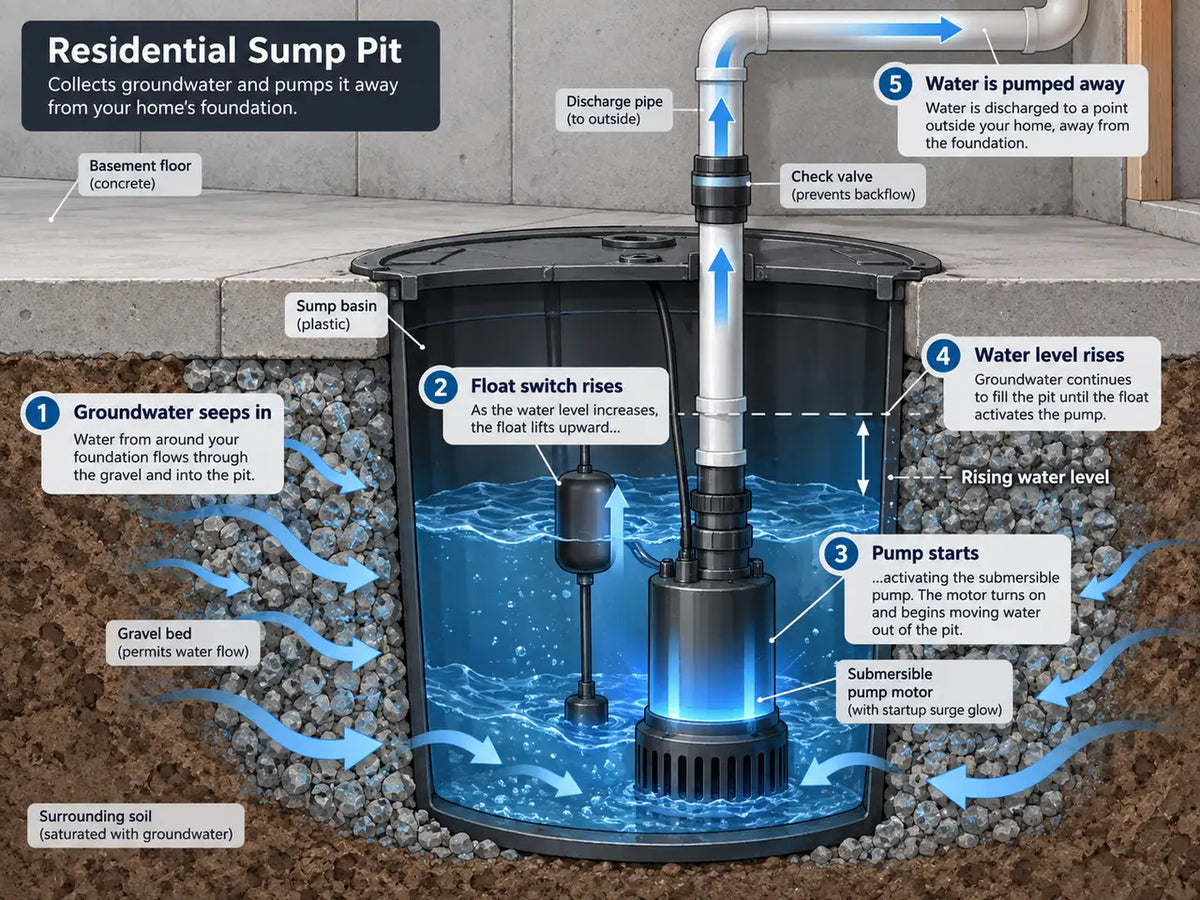
Portable Power Station for a Sump Pump: Starting Watts, Runtime and Setup
Whether a portable power station for a sump pump will actually protect your basement depends on more than the size of its battery. It has to get the motor turning every time the water climbs back up the pit, for as long as the power stays out. People tend to shop by battery size, since that is the big number on the box, but we have watched a 2,000Wh unit with a weak inverter shut itself off the first time a pump tried to start, and a smaller station with a stronger inverter start that same pump all night.
Quick answer: With a regular 1/3 or 1/2 HP pump, our floor is 1,800W continuous and 3,600W surge from a pure sine wave inverter, sitting on 1,000Wh to 2,000Wh of LiFePO4. Whatever you buy, plug your actual pump into it on a dry afternoon. Finding out it trips during a storm is the expensive way to learn.
What Size Portable Power Station Does a Sump Pump Need?
Starting a pump motor is a bit like pushing a stalled car. The first shove takes far more effort than keeping it rolling, and in watts that first shove is usually about double the running figure. Honda's numbers are a decent place to begin. Their lists 750 running and 1,500 starting watts for a 1/3 HP sump pump, and 1,000 and 2,100 for a 1/2 HP one.
|
Pump size
|
Running watts
|
Starting watts
|
Station to look for
|
|
1/4 HP
|
500 to 600W
|
1,000 to 1,800W
|
1,200W continuous, 2,400W surge
|
|
1/3 HP
|
About 750W
|
About 1,500W
|
1,500W continuous, 3,000W surge
|
|
1/2 HP
|
About 1,000W
|
About 2,100W
|
1,800W continuous, 3,600W surge
|
|
3/4 HP
|
1,200 to 1,500W
|
3,000 to 4,500W
|
3,000W continuous, 6,000W surge
|
|
1 HP
|
About 2,300W
|
About 4,500W
|
3,600W continuous, 7,200W surge
|
Honda's guide is where the 1/3, 1/2 and 1 HP numbers come from, and the 1/4 and 3/4 HP rows are the ranges we tend to plan around. The sticker on your own pump beats all of them: 120V and 7A, for example, means roughly 840W while it runs.
When we pick a surge rating, we add roughly half again on top of the starting watts. Old pumps are stubborn. A station that only just cleared the surge on day one may start tripping a few years in, and it tends to pick a stormy night to do it.
How Long Does a Battery Last When the Pump Keeps Cycling?
Your pump spends most of an outage doing nothing. It wakes up, drains the pit in a minute or two and goes quiet again, which means the number you care about is how many of those minutes add up in an hour. For the estimate, we take the battery's rated capacity, knock off 15% for inverter losses (that is the 0.85), and divide by what the pump draws on average. The table uses an 800W pump as the example.
|
Station capacity
|
Usable energy
|
Light rain (6 min/hr)
|
Steady rain (15 min/hr)
|
Heavy storm (30 min/hr)
|
|
1,024Wh
|
About 870Wh
|
About 10.9 hours
|
About 4.4 hours
|
About 2.2 hours
|
|
2,048Wh
|
About 1,741Wh
|
About 21.8 hours
|
About 8.7 hours
|
About 4.4 hours
|
|
5,120Wh
|
About 4,352Wh
|
About 54 hours
|
About 21.8 hours
|
About 10.9 hours
|
Of the three columns, the heavy storm one is the one we would plan around. Outages and fast water have a habit of showing up on the same night, and that is when your pump runs the most. Our power station runtime calculator guide uses the same method if you want to check a fridge or router while you are at it.
Which Specs Matter Most for Sump Pump Backup?

-
Pure sine wave output. Run a pump on the choppier modified sine wave from a cheap inverter and the motor hums louder and gets noticeably warmer.
-
How long the surge lasts. Two stations can both say 3,600W peak while one holds it for milliseconds and the other for a couple of seconds. Your pump needs the couple of seconds.
-
UPS or EPS switchover. The pump stays plugged into the station, which passes wall power through and jumps to battery when the grid drops.
-
AC that stays on. Lots of stations turn their AC outlets off when nothing has drawn power for a while. That is handy when camping and a real problem here, because your pump might not need power for three hours and then suddenly need it right away.
-
LiFePO4 cells. This chemistry is good for thousands of cycles, and it carries significantly lower thermal runaway risk than the NMC packs older stations used.
-
Which OUKITEL Power Station Fits Your Sump Pump?
We picked three current OUKITEL portable power stations that cover the pump sizes most people actually have. They share the basics: LiFePO4 cells, pure sine wave output, and a switchover to battery in under 10ms, which is quick enough that a pump halfway through a cycle just keeps running.
|
Model
|
Capacity
|
AC output / surge
|
Best fit
|
Runtime at 15 min/hr
|
|
P1000 Plus
|
1,024Wh
|
1,800W / 3,600W
|
1/4 to 1/2 HP, short outages
|
About 4.4 hours
|
|
P2001 Pro
|
2,048Wh
|
3,200W / 6,400W
|
1/3 to 3/4 HP, overnight
|
About 8.7 hours
|
|
P5000 Pro
|
5,120Wh
|
3,600W / 7,200W
|
Up to 1 HP, multi day
|
About 21.8 hours
|
OUKITEL P1000 Plus: Compact Pick for Small Pumps
The OUKITEL P1000 Plus is the small one of the group, but its 3,600W surge is enough for most 1/3 HP pumps and a good share of 1/2 HP ones, with 1,800W continuous and 1,024Wh behind it. It also charges fast, about 0.85 hours on a 1,200W wall input. With no expansion port, we would treat it as backup for outages that last hours rather than days.
OUKITEL P2001 Pro: The Right Size for Most Basements

The OUKITEL P2001 Pro has 3,200W of continuous output and 6,400W of surge, which is enough to start a 3/4 HP pump. Its 2,048Wh battery fills back up in about 1.5 hours from the wall, and it takes up to 1,000W of solar, so you can top it off during the day if the outage drags on. In most of the basements our team has helped set up, around 2,000Wh is the point where an overnight storm stops feeling like a gamble.
OUKITEL P5000 Pro: Multi Day Outages and Larger Pumps

If you are worried about outages that last more than a day, or you have a bigger pump, the OUKITEL P5000 Pro is the one to look at. It stores 5,120Wh, puts out 3,600W with 7,200W surge, and is rated for 5,000 cycles to 80%. You will also find it in our home battery backup range bundled with 400W solar panels.
How to Set Up a Portable Power Station With a Sump Pump

-
Measure the pump first. A cheap plug in power meter between the pump and the outlet will show you what it really pulls while it is moving water.
-
Plug the pump straight into the station. If there is a piggyback float switch, leave it wired the way it is now. If you need an extension cord, use a grounded one rated for what the pump draws.
-
Turn off anything that shuts the AC off. Dig through the settings or the app for sleep, timeout or energy saving options.
-
Get the station off the floor. Put it on a solid shelf well above any water line you have ever seen down there, with a little breathing room around the vents.
-
Do a pulled plug test. Pull the station's wall plug, pour a bucket into the pit, and watch the pump go through five cycles on battery. Do it again later when the battery is down near half.
-
Charge it full before a storm. If you keep a charge limit of 80% for battery health, which is a reasonable habit, raise it to 100% as soon as heavy rain shows up in the forecast.
-
Safety warning: Keep gas generators out of the basement and out of the garage, even with the garage door open. The CDC wants generators outside and more than 20 feet from any window, door or vent. Please also skip the male to male cord trick for feeding a wall outlet. The CPSC warns it backfeeds the house wiring and can cause electrocution or fire. A battery station has no exhaust, so it can live indoors next to the pit.
A power station can only power the pump you already have, so a jammed float or a burned out motor is still a problem. If your basement would flood within an hour without the pump, add a second battery powered pump too. FEMA's flood preparation guide is worth a read, and it points out that standard homeowner insurance does not cover flood damage.
Conclusion
Backing up a sump pump with a battery comes down to two things. First, the inverter has to start your pump every time the float lifts, not just most times. Second, the battery has to outlast the wettest hours of the outage, so size it from the heavy storm column and pull the plug on a dry day before you rely on it.
Build Your Sump Pump Backup in Three Steps
-
Check your pump's nameplate, or use a meter, to find its running and starting watts.
-
Choose a station whose surge rating is at least 1.5 times that starting number, with enough Wh for your heavy storm duty cycle.
-
Test everything, pulled plug included, before the next big storm rolls in.
FAQs
What size portable generator do I need to run a sump pump?
Somewhere around 2,000W to 3,000W covers most 1/3 HP and 1/2 HP pumps. The figure to check first is surge, because running watts are rarely the problem. Honda's chart has a 1/2 HP pump needing 2,100 watts to start, and a generator that tops out at 2,000W can bog down before that motor ever reaches speed.
Rough sizing by pump:
-
1/3 HP: about 1,500W starting, so 3,000W of surge gives you headroom
-
1/2 HP: about 2,100W starting, look for 3,600W of surge
-
3/4 HP: 3,000W to 4,500W starting, look for 6,000W of surge
How long will a portable power station run a sump pump?
How long a portable power station runs a sump pump comes down to the usable energy in the battery and how many minutes each hour your pump actually spends running. Take the rated Wh, multiply it by 0.85, and divide by the pump's average draw.
An 800W pump on a 2,048Wh station:
-
6 minutes per hour: about 21.8 hours
-
15 minutes per hour: about 8.7 hours
-
30 minutes per hour: about 4.4 hours
Time a few cycles during a real downpour and keep about 20% in reserve.
Can a Jackery power a sump pump?
The bigger Jackery models can, the small ones cannot, and the same goes for every brand. What decides it is a pure sine wave inverter whose surge rating comfortably clears your pump's starting watts. A 300W camping unit will not even get the motor turning, while a 2,000W class station with around 4,000W of surge handles most 1/3 HP pumps.
Before you buy, check for:
-
Surge of at least 1.5 times your starting watts
-
UPS or EPS switchover, with the AC set to stay on
-
At least 1,000Wh for a short outage
We compare capacity and expansion model by model in our OUKITEL vs Jackery comparison.
How can I run my sump pump without electricity?
There are four realistic options: a portable power station, a battery backup pump, a portable generator or a standby generator. Each one covers a slightly different risk.
How they stack up:
-
Power station: runs the pump you already have, indoors, with no fumes
-
Battery backup pump: a second pump with its own float, handy if the main pump dies
-
Portable generator: lasts as long as your gas does, but lives outdoors
-
Standby generator: the whole house, automatically, for the biggest install bill
In a basement that fills fast, we like a power station plus a backup pump, so a single failure does not end with water on the floor.
Will a 1000 watt generator run a sump pump?
Not reliably. A 1,000W unit can keep a small pump spinning once it is up and running, but a 1/3 HP or 1/2 HP motor wants 1,500W to 2,100W for the first second or two, and that is more than the generator has.
Where 1,000W comes up short:
-
1/4 HP: might work, as long as the starting watts stay under 1,000W
-
1/3 HP: needs about 1,500W to start, which is too much
-
1/2 HP: needs about 2,100W to start, well past the limit
An 1,800W unit, by comparison, handles most 1/3 HP pumps but gets tight with a 1/2 HP, which needs at least 2,100W of surge.
Can I plug my sump pump into a generator?
Yes, and it is a common setup. Run a grounded, outdoor rated cord from a generator that is big enough straight to the pump's plug. The generator stays outside and the cord comes in to the pump.
A few rules to keep it safe:
-
Keep the generator more than 20 feet from windows, doors and vents
-
Never use a male to male cord to feed power into a wall outlet
-
Pick a cord gauge that fits the pump's amps and the length of the run
-
Put battery powered CO alarms on every floor, as the CPSC advises
A battery power station skips the exhaust problem altogether and can sit right beside the pump.


Looking for something else?

How to Choose the Best 5000Wh Portable Power Station in 2026
LEARN MORE
How to Choose the Best Expandable Portable Power Station in 2026
LEARN MORE
Best Indoor Generators for Power Outages: Battery Options, Safety and Limits
LEARN MORE
Portable Power Station for CPAP: How to Size Runtime, Humidifier Load and Battery Backup
LEARN MORELooking for something else?

Best Solar Generator for RV in 2026: How to Size and Choose One
LEARN MORE
Portable Power Station for Freezer Backup: Runtime by Size and Temperature
LEARN MORE
Portable Power Station for a Sump Pump: Starting Watts, Runtime and Setup
LEARN MOREYou may also like

OUKITEL BP5000 PRO MAX Portable Power Station 5000W | 5120Wh
$1,999.00
$2,999.00

OUKITEL BP2000 PRO Portable Power Station 3300W
$879.00
$1,599.00

OUKITEL C01 Car Jump Starter 1350A | 80Wh | PD60W
$169.00
$299.00

OUKITEL BP3000 Portable Power Station 3200W | 2048Wh
$959.00
$1,599.00

OUKITEL P2001 Plus+400W Solar Generator
$1,248.00
$1,598.00

OUKITEL P2001 Plus+2*200W Solar Generator
$749.00
$999.00
Further reading

OUKITEL Power Showcases Full-Scenario Energy Storage Solutions at the 140th Canton Fair
October 15–19, 2026 — Guangzhou, China. The 140th China Import and Export Fair (Canton Fair) is underway at the China Import and Export Fair Complex in Guangzhou. OUKITEL is showcasing its latest ...

Hurricane, Wildfire and Winter Outage Power Checklist
Hurricane, Wildfire and Winter Outage Power Checklist
We'd build an emergency power station checklist for hurricane, wildfire and winter outages around your house first and the battery second. Sta...

Portable Power Stations for Power Tools and Job Sites: Surge, Runtime and Safety
A portable power station for power tools has to get three numbers right before it earns a spot on the truck: continuous AC output, surge output for the motor start, and battery capacity. Get one w...