








 Flashlight
 Solar
Extension Cable
Solar
Extension Cable


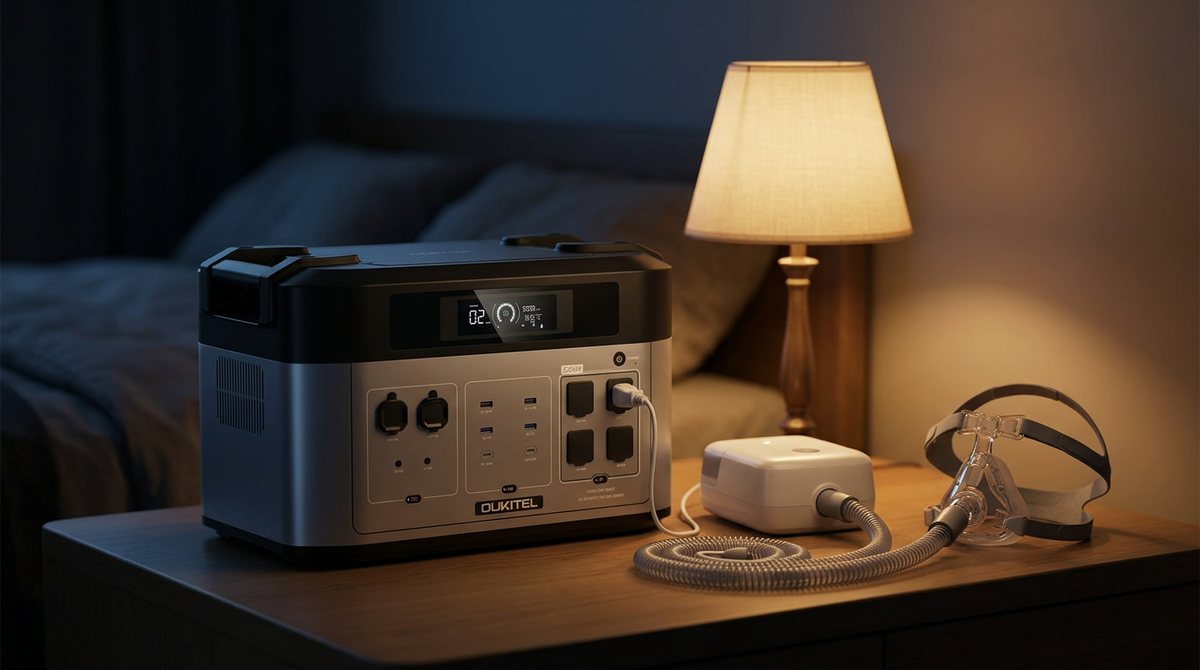
Portable Power Station for CPAP: How to Size Runtime, Humidifier Load and Battery Backup
A portable power station for CPAP has to cover real overnight energy use, not the rating on its power supply. Runtime, humidifier load, and safe bedside setup are what decide whether it does.Measured draw reported by CPAP users ranges from roughly 10W with heating off to 100W or more with a heated humidifier and heated hose active. Across eight hours, that is a spread of about 80Wh to 800Wh.
That spread is why fixed nights-per-charge claims break down. Two people with the same machine can land four times apart depending on humidity setting, tube temperature, room conditions, and whether the machine runs from AC or an approved DC connection.
Below: how to measure your real draw, convert it into usable battery capacity, and check the output behaviour that decides whether the machine runs all night.
Can a Portable Power Station Run a CPAP Machine?
Yes, provided output type, continuous rating, and usable capacity all match the complete sleep setup. Getting the machine to switch on proves very little. What matters is whether it stays running for the full sleep period with your comfort settings enabled.
The FDA classifies CPAP as a respiratory medical device prescribed with specific pressure settings. Power planning sits around that prescription, never replacing it.
Work through these in order. Each one can disqualify a unit on its own, so a station that clears three and fails the fourth is still the wrong station. Settle all four before you start comparing capacity or price.
1. Does It Deliver the Output Your Machine Accepts?
Decide first whether you are running AC or an approved DC connection, because that choice changes every number after it. AC needs standard outlet voltage and frequency with pure sine wave output. DC needs matching voltage, polarity, connector style, and current rating.
Confirm both against the CPAP manual and the power supply label. Any unit that cannot supply the power your machine accepts is out, whatever else it offers.
2. Can It Carry Every Load at Once?
Add blower, humidifier, and heated hose together, then compare that total against the station's continuous rating rather than its surge rating. Surge covers a two-second motor start, not eight hours of steady heating. Most CPAP setups sit well under the continuous rating of anything in this class, so this gate rarely fails. Check it anyway. It is the cheapest of the four to check.
3. Does It Hold Enough Usable Energy for Your Target Nights?
This is the gate that decides the purchase. Take measured draw multiplied by hours, multiplied by nights, then derate for the connection path and add a reserve. Compare that figure against rated capacity, never against advertised runtime. A unit that clears every other gate and misses this one by twenty percent will still run short before morning.
4. Will the CPAP Manufacturer Confirm the Connection?
Ask before buying, in writing, naming your exact CPAP model and the exact adapter. Manufacturer acceptance is the one gate you cannot settle yourself from a spec sheet, and it is the one most buyers skip. Where the answer is unclear, or the manufacturer will not commit, treat that as a fail and use the AC path instead.
Why a Connector That Fits Is Not Proof of Compatibility
Physical fit says nothing about voltage, polarity, available current, connector wiring or waveform quality. A third-party cable can be dimensionally correct and electrically wrong, producing unreliable operation, alarms partway through the night, or damage. Where specifications are ambiguous, ask the manufacturer in writing first.
How Much Power Does a CPAP Actually Use?
Less than the label says, in most cases. Published figures across retailer pages and user forums range from about 10W to over 100W for what is described as the same category of machine. That is the difference between a 300Wh battery lasting three nights and lasting three hours.
Watts, Watt-Hours and Why the Label Misleads
Watts describe rate. Watt-hours describe quantity. A 300W rating is a ceiling on load. A 300Wh rating is how much energy the battery holds before losses apply. Sizing from the inverter rating is the most common error here, because it is the number printed largest on the box. Our capacity and inverter walkthrough covers the arithmetic.
The adapter label compounds this. It states maximum rated output under worst-case demand, not what your machine draws while you sleep. Measured draw of 10W against a 65W label is a common forum report. Size off the label and you buy several times more battery than the job needs.
Measure the Whole Sleep Setup
Since neither the inverter rating nor the adapter label tells you what your machine actually draws, the only reliable number is one you take yourself. Put a plug-in energy meter between the wall outlet and the CPAP power supply and leave it for a full night.
Read the accumulated watt-hour total in the morning, not an instantaneous watt figure, because draw shifts as pressure and heating demand change. Repeat on a cold night and a mild one. Measure everything that shares the station:
- CPAP blower at your prescribed pressure
- Heated humidifier at the setting you actually use
- Heated or climate-controlled tubing, if fitted
- The CPAP power supply itself, which has its own conversion loss
- Any phone, lamp, or monitor running overnight on the same unit
How Do You Calculate CPAP Runtime Before You Buy?
Work from measured energy, apply a conversion derate, then add a reserve.
Energy Per Night, Minus Conversion Losses
Average watts multiplied by hours of sleep gives watt-hours per night. A setup averaging 40W across eight hours costs 320Wh. AC operation adds losses, since the station converts battery DC to AC and the CPAP supply converts it back.
A 15% derate is reasonable where usable capacity is not published, because each conversion stage costs a few percent and the station's own electronics draw a small idle load all night. Quality sine wave inverters typically run 85 to 90% efficient under light loads, which is where a CPAP sits. An approved DC connection skips the inverter and loses less.
|
Connection Path |
Planning Derate |
Usable from 1,024Wh |
Usable from 2,048Wh |
|
AC outlet, inverter active |
0.85 |
About 870Wh |
About 1,741Wh |
|
Approved DC connection |
0.90 to 0.95 |
About 920 to 970Wh |
About 1,843 to 1,946Wh |
|
AC with devices sharing |
0.85 minus shared load |
Varies with what else is plugged in |
Varies with what else is plugged in |
Rated watt-hours multiplied by the derate, divided by average load, gives estimated hours. These are planning estimates. Where a manufacturer publishes usable energy, use that figure instead.
Add a Reserve
Twenty percent is a sensible default, and it is not padding. It absorbs a longer night than usual, capacity loss as the pack ages, cold-weather performance, a humidifier working harder than in testing, and the low-battery cutoff. No single figure suits every combination of machine, battery, and climate.
Test It Overnight at Home
Run a supervised overnight test before the setup matters. Same prescribed pressure, same comfort settings, same hose, same adapter. Record starting charge, operating time, and remaining capacity. Across customer setups we have reviewed, that first test is where people find an eco mode they did not know was enabled, or an adapter that alarms at 4 am.
How Much Do the Humidifier and Heated Hose Change Runtime?

[IMAGE: Alt: CPAP humidifier chamber and heated hose connected to a portable power station for CPAP overnight runtime testing | 16:9]
Enough to change your capacity tier. The blower is a steady, modest load. The heating elements are neither, which is why two users with identical machines report wildly different results.
Two Heating Elements, Measured Separately
A heated humidifier spends energy warming water and holding a target humidity. How much depends on room temperature, ambient humidity, airflow, the setting, and the machine's control logic. Switching it on does not add a fixed number of watts. It adds a variable load that climbs in cold, dry rooms, which is the condition you meet camping in shoulder season.
Climate-controlled tubing is a second, separate load holding tube temperature and limiting condensation. It is not part of the humidifier figure. Cold pushes it harder, so a heated hose costing little in a warm bedroom can cost a great deal in a tent at 4 degrees Celsius.
Ways to Reduce Draw Without Touching Therapy
Comfort settings and therapy settings are different things. The first is adjustable within the manual's guidance. The second is not.
- Lower the humidity level or tube temperature where the manual permits and comfort allows
- Switch to a manufacturer-approved non-heated hose where one is compatible
- Empty the water chamber when running the humidifier off, so the machine is not heating an empty tank
- Check whether your machine has a travel or airplane mode that disables heating features
- Where a passover humidifier exists for your model, it adds humidity without a heating element
Never change prescribed pressure to save battery. Comfort-feature adjustments should follow the CPAP manual and, where there is doubt, guidance from your clinician or equipment provider.
What Size Portable Power Station for CPAP Do You Need?
Size against nights rather than hours, and size twice: once for heating off, once for heating on. The table works from two illustrative figures, 300Wh with heating off and 550Wh with humidifier and heated hose active, then applies the 0.85 derate and a 20% reserve.
|
Target |
Heating Off, Rated Wh Needed |
Heating On, Rated Wh Needed |
Tier That Fits |
|
1 night |
About 420Wh |
About 780Wh |
Compact class |
|
2 nights |
About 850Wh |
About 1,550Wh |
1,000Wh class covers heating off |
|
3 nights |
About 1,270Wh |
About 2,330Wh |
2,000Wh class |
|
5 nights |
About 2,120Wh |
About 3,880Wh |
2,000Wh expandable, or 5,000Wh class |
Read that as a floor, not a target. It assumes the CPAP is the only load. Capacity also scales with weight, so a unit that solves runtime and then never leaves the garage has not solved anything.
Where the OUKITEL Range Lands
The P1000 Plus power station holds 1,024Wh with 1,800W continuous output and runs at 29 dB under a 500W load. For something sitting on a bedside table all night, that noise figure matters more than headline capacity.
It weighs about 26.5 lb, reaches 80% in roughly 39 minutes, and switches over in under 10 ms. On a measured 300Wh night with heating off, that is a planning estimate of just under three nights.
Theexpandable BP2000steps up to 2,048Wh and 2,200W continuous, scaling to 16,384Wh across seven B2000 packs. That headroom is why it suits humidifier-on users, who often find real consumption well above their estimate. Same sub-10 ms switchover, 3,500 or more cycles, 0 to 80% in about 1.5 hours.
The largest of the three, theP5000 Pro, carries 5,120Wh with 3,600W continuous and 7,200W surge, rated at 5,000 cycles, with up to 1,000W of MPPT solar input. That is the tier for extended outages where the CPAP shares the battery with a refrigerator. Our capacity guide covershow to size for mixed loads. Check current pricing on each product page.
Compatibility and Output Quality Checks
Capacity gets the attention. Output behaviour is what fails at 3 am. For AC operation, the station should deliver pure sine wave output at standard outlet voltage and frequency, since modified sine wave can cause audible noise, erratic behaviour, or added stress on sensitive electronics. Confirm continuous wattage covers blower, humidifier, and heated hose together.
Approved DC Connection
A DC connection bypasses the inverter entirely, removing a conversion stage and stretching runtime. The catch is that DC adapters are not interchangeable. Voltage, polarity, connector style, and current rating all have to match, and the adapter should be one the CPAP manufacturer approves. The largest efficiency gain available here, and the easiest way to damage a machine on guesswork.
Low-Load Auto Shutoff Is the Failure Nobody Plans For
Many power stations include an energy-saving mode that cuts output when draw stays below a threshold. A CPAP running at 20W to 40W can sit under it. The station does what it was designed to do, and the machine stops.
This is the one failure mode that reliably catches people out, because nothing about it looks like a fault. The battery still shows charge in the morning. The station is still switched on. The machine simply stopped at some point in the night.
Find that setting in the manual before the first night and disable it, or confirm the threshold sits below your measured draw. Then verify it with a full overnight run, not a twenty-minute check.
Supporting Features Worth Checking
With the shutoff behaviour settled, these are the features that separate a workable bedside unit from an anxious one:
- Battery percentage and estimated runtime shown on the display
- A low-battery alert loud enough to wake you, or an app alert on your phone
- Fan noise low enough for a bedside surface. Anything audible over the CPAP is a problem
- A battery management system with over-current, over-temperature and short-circuit protection
- Disclosed chemistry, a published cycle rating and warranty terms. LiFePO4 carries significantly lower thermal runaway risk than older cell types
UPS, EPS and Pass-Through Charging
A UPS or EPS function keeps the CPAP running from grid power and switches to battery when the grid drops. Sub-10 ms switchover is short enough that most equipment does not notice. Whether your machine rides through without restarting is a separate question.
Simulate it: on a test night, with the CPAP running, pull the wall plug and watch. Pass-through charging is different again, letting the station power the CPAP while itself charging. Supported limits vary by model, and some units behave differently in EPS mode than in normal discharge.
How Do You Set Up a Power Station Safely at the Bedside?

[IMAGE: Alt: Safe bedside setup of a portable power station for CPAP showing clear ventilation and separation from the water chamber | 16:9]
Charge it, test it, place it clear of the water chamber, and never rely on a single power path. FEMA's outage guidance is direct: anyone using power-dependent medical devices should have an alternate plan and should discuss it with their medical provider before an outage, not during one.
Before the First Night
- Confirm compatibility with both manufacturers, then charge the station fully.
- Disable any low-load or eco shutoff mode.
- Connect the exact adapters, hose, and accessories you intend to use.
- Run one supervised overnight test at home.
- Record remaining capacity in the morning and compare it against your calculation.
Bedside Placement
Put the station on a firm, dry, level surface with ventilation clear. Keep it away from the humidifier water chamber, from condensation, and from bedding or heat sources. Route cables so they cannot be pulled loose by someone turning over, and so nobody trips on them in the dark. A disconnection at 2 am is a quieter failure than an electrical one, and more likely.
Why Combustion Stays Outside, and Why You Keep a Second Plan
Battery power stations produce no combustion exhaust in normal operation, so they are generally considered suitable indoors where a fuel generator is not.
The gap is not marginal. CPSC records more than 200 accidental non-fire carbon monoxide deaths a year in the United States from consumer products, more than 100 of them linked to portable generators. A fuel generator belongs outdoors, at least 20 feet from the building, with exhaust away from windows and vents. Never in a bedroom, garage, tent, or camper.
One battery is still one point of failure. A second plan might be a smaller backup battery, a vehicle you can charge from, a nearby location with power, or an arrangement with your equipment provider.
NHLBI guidance is that CPAP should be used every time you sleep, including while travelling, which makes the backup plan part of the therapy plan. Discuss specifics with your clinician, particularly if interrupted therapy carries risk for you.
How Will You Recharge It?

[IMAGE: Alt: Solar panel recharging a portable power station for CPAP at a campsite between overnight uses | 16:9]
Recharging has to replace the previous night's watt-hours before the next sleep period. Charge speed matters less than whether the window fits your day.
Wall charging is fastest. Vehicle charging suits road trips and long outages, though rates sit well below a wall outlet. Follow both manufacturers' instructions on engine operation and cables.
For solar, check input voltage range, current limit, connector type and MPPT support before buying panels. A panel's rated wattage is a laboratory number, and real output falls with cloud, shade, sun angle, temperature and daylight hours.
A 300Wh night needs roughly 350Wh back into the battery after losses, which a 200W array in decent conditions might return in three to five hours of usable sun. In persistent overcast, plan two days to recover one night. Check pairing on the solar panels collection.
Matching the Setup to Your Situation
|
Situation |
What Matters Most |
Sizing Note |
|
Home outage backup |
Battery backup that stays charged, fast transfer time, simple controls, alerts you can hear |
EIA reports US customers averaged about 11 hours of interruptions in 2024, with some states far higher. Size for two nights, not one |
|
RV and car camping |
Multi-night capacity, approved DC output, vehicle or solar recharge between nights |
Weight is less critical. Recharge planning is more critical |
|
Tent camping |
Low weight, quiet fan, weather protection, cable management, cold-weather margin |
Cold cuts usable capacity and raises heating load at the same time |
|
Air travel |
Watt-hour rating against aviation limits |
Usually a hard stop. See below |

[IMAGE: Alt: Portable power station for CPAP capacity sizing compression showing compact, mid and large battery units | 4:3]
Portable power station for CPAP capacity sizing comparison showing compact, mid and large battery units
Air Travel Is a Watt-Hour Problem
FAA rules set thresholds by watt-hours, and they rule out this entire product class. Up to 100Wh is permitted in carry-on baggage, 101Wh to 160Wh needs airline approval, and anything above 160Wh is forbidden on passenger aircraft. A 512Wh station is more than three times over the ceiling. Plan on a dedicated small CPAP battery or mains power at the destination.
Your Next Three Steps

[IMAGE: Alt: Portable power station for CPAP use cases across home outage, RV travel and tent camping | 16:9]
- Measure. Put a plug-in energy meter on your CPAP for two full nights, one warm and one cold, with your normal comfort settings. Record watt-hours per night, not watts.
- Calculate. Multiply your worst night by your target number of nights, divide by 0.85 for the AC path, then add 20%. That figure is your minimum rated capacity.
- Match and test. Choose a unit that clears that figure with quiet operation and a defeatable eco mode, then run one supervised overnight test at home before relying on it. Compare the P1000 Plus, BP2000 and P5000 Pro against the number you calculated.
Bring us your number. Send our team the watt-hours you measured, your target nights, and whether heating stays on, and we will tell you which tier clears it. Ordering before you have measured is how people end up one tier short.
FAQs
Can a portable power station run a CPAP machine?
Yes, if output type, continuous rating, and usable capacity match the complete sleep setup. Compatibility is four separate requirements rather than one, and the requirement most people miss is written confirmation from the CPAP manufacturer that the connection method suits their specific model before the first night.
What size portable power station for CPAP do I need?
What size portable power station for CPAP you need comes from measured nightly watt-hours multiplied by target nights, divided by 0.85 for AC operation, plus about 20% reserve. A 300Wh night across three nights lands near 1,270Wh of rated capacity, and the same three nights with heating active can exceed 2,300Wh.
How many nights will a 1,000Wh power station run a CPAP?
Between one and three nights for most setups, depending on whether heating features are running. After the AC derate, roughly 870Wh of a 1,024Wh unit reaches the machine, which covers just under three nights at a measured 300Wh, or under two with humidifier and heated hose active.
Does turning off the humidifier really extend battery life?
Yes, usually substantially, because heating water accounts for most of the variable energy in a CPAP setup. Some users report roughly doubling runtime by emptying the water chamber and switching to a non-heated hose, though humidity level is a comfort setting and prescribed pressure is not.
Is a DC connection better than AC for running a CPAP?
Usually yes on efficiency, because a DC connection bypasses the station's inverter and removes one conversion stage. That path typically loses 5 to 10% against roughly 15% on AC, though the adapter must match voltage, polarity, connector style, current rating and be approved by the CPAP manufacturer.
Can I take a portable power station on a plane for my CPAP?
Almost certainly not. FAA limits allow up to 100Wh in carry-on baggage, require airline approval between 101Wh and 160Wh, and forbid anything above 160Wh on passenger aircraft, which puts even a compact 512Wh station more than three times over the ceiling and a 1,024Wh unit six times over.
Will a power station keep a CPAP running through a blackout without interruption?
It can, though that depends on the station's transfer time and on how your specific machine responds to it. Better units switch to battery in under 10 milliseconds, but the only way to confirm your machine rides through is to pull the wall plug on a test night.
Do I need a pure sine wave inverter for a CPAP?
For AC operation, treat it as a requirement. Pure sine wave reproduces the waveform a CPAP power supply was designed around, while modified sine wave can cause audible noise or erratic behaviour, and a machine that runs on it for an hour may not run reliably for eight.
Sources
- U.S. Food and Drug Administration (FDA), Respiratory Devices (2023)
- National Heart, Lung, and Blood Institute (NHLBI), CPAP
- Federal Emergency Management Agency (FEMA), Power Outages
- U.S. Consumer Product Safety Commission (CPSC), Carbon Monoxide Information Center
- Federal Aviation Administration (FAA), Airline Passengers and Batteries
- U.S. Energy Information Administration (EIA), Hurricanes in 2024 Led to the Most Hours Without Power in the United States in 10 Years (2025)


Looking for something else?
Best Solar Generator for Home Backup: 2026 Buyer's Guide
LEARN MORE
What Size Solar Generator Do You Need? 2026 Sizing Guide by Real Use Case
LEARN MORE
What Can a 1200 Watt Generator Run? 2026 Appliance Guide
LEARN MORE
Are Solar Generators Worth It in 2026? Honest Buyer Analysis
LEARN MORELooking for something else?

How Much Solar Do You Need for Your RV? 2026 Sizing Guide by Use Case
LEARN MORE
Can You Take a Solar Generator on a Plane? 2026 TSA + FAA Rules
LEARN MORE
OUKITEL 2026 Prime Day & Membership Guide: Rewards, Points, and Limited-Time Offers
LEARN MOREYou may also like

OUKITEL P5000 Pro+400W Solar Generator

OUKITEL BP2000+400W Solar Generator

OUKITEL P5000+2*400W Solar Generator

OUKITEL P5000 Pro+2*400W Solar Generator

OUKITEL BP2000+2*400W Solar Generator

OUKITEL BP2000+2*B2000 Home Backup
Further reading

How Long Will a 2048Wh Battery Last? 30 Appliances + Formula

What Can a 3300W Power Station Run? Home Backup Load Planning
