








 Flashlight
 Solar
Extension Cable
Solar
Extension Cable


OUKITEL vs Jackery: Home Backup, Camping and Value Compared
OUKITEL vs Jackery is settled by three numbers rather than by brand reputation: the wattage your loads pull, the watt-hours needed to cover the outage or the trip, and the watts you can push back into the battery each day. Get those three right and the shortlist writes itself.
For home backup, the deciding spec is usually not the headline inverter rating. It is the transfer rating, meaning the load the unit will actually carry the instant grid power drops. On the same product, those two figures are often far apart.
Camping is decided by weight and recharge access. Value is decided by the cost of the complete working system, panels and cables included. What follows is the comparison method, applied to OUKITEL's current lineup.
How Should You Compare OUKITEL vs Jackery Fairly?
Put both options on equal terms before judging either. A comparison between a 1,000Wh camping unit and a 5,000Wh home backup unit tells you about product classes, not about brands.
Record the same six items for every candidate, from the manufacturer documentation for the version sold in your country:
-
Rated battery capacity in watt-hours, and whether expansion batteries are supported.
-
Continuous AC output, plus the surge figure and how long the surge is held.
-
Backup transfer rating and switchover time, which may differ from continuous output.
-
Maximum AC input, maximum solar input, and the accepted solar voltage window.
-
Weight, dimensions, and whether the unit has wheels or only a handle.
-
Complete purchase cost, warranty length, and who honors the claim.
|
Comparison axis
|
What to record
|
Why it decides the purchase
|
Common mistake
|
|
Energy
|
Rated Wh and expansion ceiling
|
Sets how long you run before recharging
|
Reading Wh as a measure of power
|
|
Power
|
Continuous W, surge W, surge duration
|
Sets which appliances start and stay running
|
Quoting peak watts as if continuous
|
|
Backup
|
Transfer rating and switchover time
|
Sets what stays on during the cutover
|
Assuming full inverter output in backup mode
|
|
Recharge
|
AC input W, solar input W, voltage range
|
Sets how fast the battery refills
|
Buying capacity without matching input
|

Compare Within the Same Capacity and Power Class
A larger battery running longer proves nothing about the brand that built it. A lighter unit being easier to carry proves nothing either. Both results are properties of the product class.
Generation matters too. Manufacturers revise inverters, cell chemistry, and charge controllers between releases while keeping a similar model name. Check the release version and the battery chemistry on each specific unit rather than assuming consistency across a catalog.
Confirm the Regional Version and What Is in the Box
Outlet type, mains voltage, included cables, and warranty eligibility all vary by region. A specification sheet written for one market does not describe the unit shipped to another.
Separate bare stations from bundles as well. A standalone unit and a solar generator kit at similar prices are not comparable purchases, because one includes panels and the other does not.
What Size Battery and Output Do You Actually Need?
List every device you intend to run, its running wattage, its startup wattage, and the hours it needs to operate. That list produces a minimum specification. Price and features get considered afterward.
Watts and Watt-Hours Measure Different Things
Watts describe demand and output capability. Watt-hours describe stored energy. A unit rated for high output can drive demanding appliances within its limit, but that rating says nothing about duration.
The BP2000 illustrates the split. It carries 2,048Wh of LiFePO4 storage behind a 2,200W continuous inverter, and it accepts up to seven B2000 expansion packs for a ceiling of 16,384Wh. Adding those packs extends runtime. It does not raise the 2,200W output ceiling, so an appliance that overloads the inverter still overloads it at 16,384Wh.
Running Load and Startup Surge Are Separate Checks
Add the running wattage of everything that will operate at the same time. Then check startup demand separately for anything with a motor or compressor: refrigerators, sump pumps, well pumps, and air conditioners all draw a brief multiple of their running figure when they kick on.
Continuous output has to cover the sustained load. Surge capability has to cover the startup spike for as long as the appliance takes to reach speed. A published peak wattage with no stated duration is not a compatibility guarantee.
Runtime Math That Holds Up
Rated capacity is not delivered capacity. Inverter conversion, standby draw, and temperature all take a share. A derate of 0.85 is a reasonable planning figure for a well-built LiFePO4 unit.
Runtime in hours = rated Wh x 0.85 divided by average load in watts.
Applied to 2,048Wh, that gives roughly 1,740Wh reaching your appliances.
|
Appliance
|
Average draw
|
Runtime on 2,048Wh at 0.85
|
|
CPAP without humidifier
|
40W
|
About 43 hours
|
|
Chest freezer
|
60W
|
About 29 hours
|
|
Lights, router, phone charging
|
80W
|
About 21 hours
|
|
Full-size refrigerator
|
100W
|
About 17 hours
|
|
Window air conditioner
|
500W
|
About 3.5 hours
|
|
1,500W space heater
|
1,500W
|
About 70 minutes
|
Cycling appliances need measured figures, not nameplate figures. A refrigerator labeled 150W does not draw 150W continuously, because the compressor runs in cycles. Meter it across a full day and use that average.
Leave headroom on top of the result. The EIA reported that U.S. electricity customers averaged 11 hours without power in 2024, close to double the previous decade's annual average, with major storm events responsible for 80% of those hours. Sizing to the median outage leaves nothing for the outage that actually hurts.
Why the Backup Transfer Rating Matters More Than the Inverter Rating
This is the specification most comparison articles skip entirely, and it is the one that decides whether your backup plan works.
A power station in backup mode does not always deliver its full inverter rating. Many units route grid pass-through and battery cutover through a subset of their outlets at a lower wattage ceiling. The inverter number on the box describes standalone operation. The transfer number describes what survives the moment the lights go out.
Two examples from OUKITEL's own published specifications show the size of the gap:
-
The BP2000 Pro delivers 3,300W of continuous AC output. Its EPS function is rated at 2,000W with a switchover under 10ms.
-
The BP5000 Pro Max delivers 5,000W continuous with 120V/240V split-phase output. In UPS mode on a 120V input, protection applies to the two 120V AC1 outlets at up to 1,400W. On a 240V input, it applies to the 240V AC3 outlet at up to 2,800W.
Neither figure is a flaw. Both are normal engineering. The problem is planning a backup system around 5,000W and then discovering that the circuit carrying your furnace controller was never inside the protected group.
|
Model
|
Capacity
|
AC continuous
|
Backup behavior
|
Where it fits
|
|
P1000 Plus
|
1,024Wh
|
1,800W
|
EPS switchover under 10ms
|
Tent camping, desk gear, short outages
|
|
BP2000
|
2,048Wh, expandable to 16,384Wh
|
2,200W
|
EPS switchover under 10ms
|
Fridge and essentials, 6 to 24 hour outages
|
|
BP2000 Pro
|
2,048Wh, expandable to 16,384Wh
|
3,300W
|
2,000W EPS, under 10ms
|
Heavier 120V loads on one circuit
|
|
P5000 Pro
|
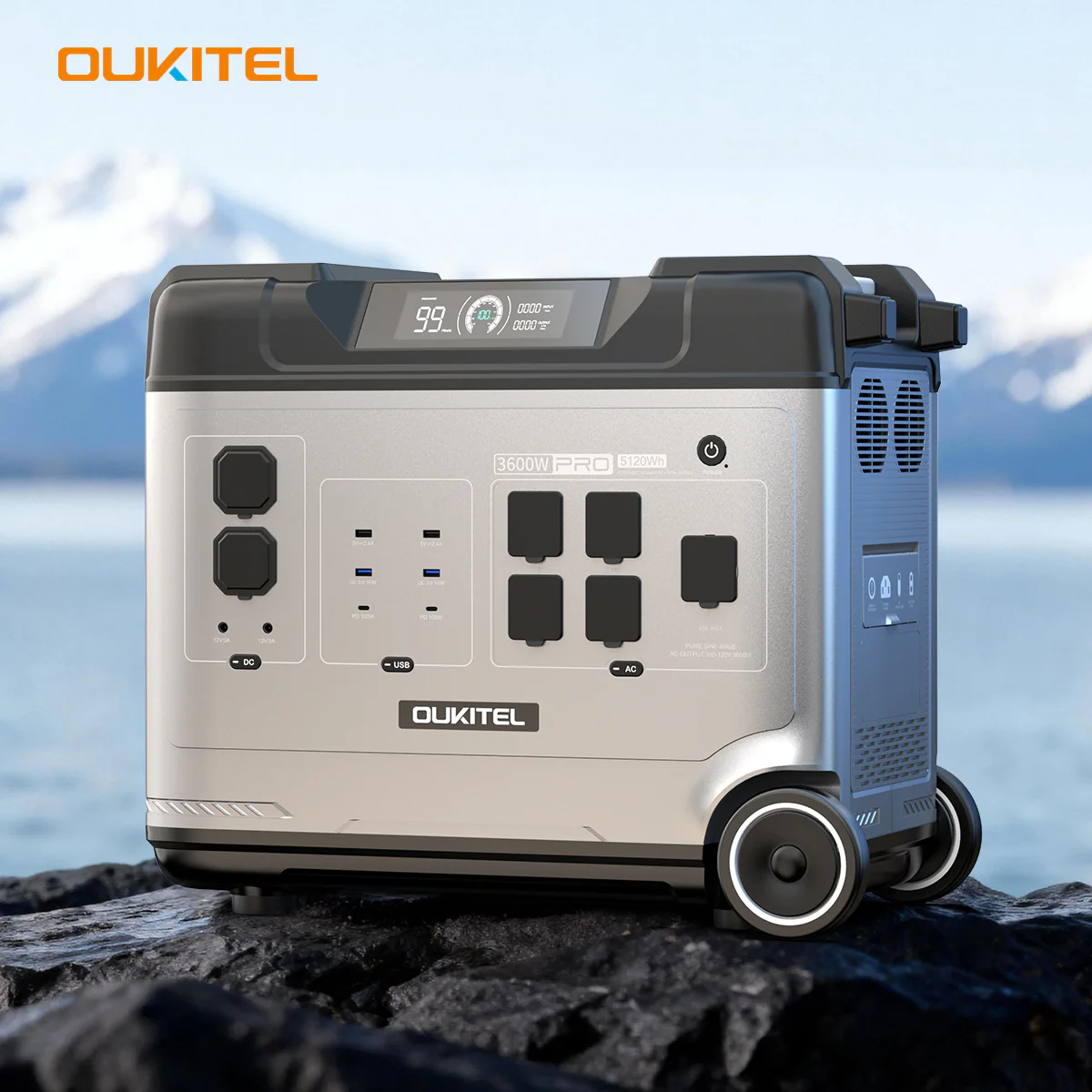
5,120Wh
|
3,600W
|
EPS switchover under 10ms
|
Multi-day outages, RV full-timers
|
|
BP5000 Pro Max
|
5,120Wh
|
5,000W, 120V/240V split phase
|
UPS 5 to 8ms, 1,400W on 120V AC1, 2,800W on 240V AC3
|
240V appliances, multi-circuit backup
|

Split-phase output deserves a note of its own. A well pump, an electric range, or a central air handler runs on 240V. A 120V-only station cannot power those loads regardless of its watt-hour capacity. Among OUKITEL units, the BP5000 Pro Max is the one that produces 240V.
Any connection to household circuits, whether through a transfer switch or an interlock, is licensed electrician territory. Plugging appliances directly into the unit is not.
How Fast Can You Put Energy Back In?
Capacity only helps until the stored energy is gone. After that, the question is recharge rate, and undersized recharge is the single most common complaint in owner forums.
The arithmetic is unforgiving. A 4,000Wh system paired with a 200W panel collects roughly 800Wh to 1,200Wh on a clear day, once you account for angle, temperature, and real sun hours. Refilling from empty takes three to four days of good weather. The panel is topping the system up, not recharging it.
A workable ratio for off-grid use is solar input equal to at least a quarter of your rated capacity. Check three things on the recharge side:
-
AC input. Compare identical ranges. A 0 to 80% figure and a 0 to 100% figure are not the same measurement. The BP2000 accepts up to 1,800W of AC input and reaches 80% in about 90 minutes. The BP2000 Pro reaches 80% in 55 minutes at 2,200W input.
-
Solar input has a voltage window, not just a wattage ceiling. Panel open-circuit voltage rises as temperature falls, and a cold morning can push a series string past the controller limit. Confirm Voc at your lowest expected temperature before wiring anything.
-
Matching connectors prove nothing. MC4 plugs fit almost everything; electrical compatibility is a separate question decided by voltage, current, and polarity.
-
Vehicle charging is slow by design. A standard 12V socket puts back a small fraction of a large battery over a long drive. Faster DC charging needs supported equipment and correct installation.
OUKITEL's 400W portable solar panels can be paired to reach the 1,000W MPPT input ceiling on the BP2000 and the P5000 Pro. Two panels on a 5,120Wh unit is a genuine recharge plan. One panel on the same unit is a trickle.

Which OUKITEL Setup Fits Home Backup, Camping or RV Use?
|
Use case
|
Minimum capacity
|
Minimum continuous output
|
Recharge plan
|
|
Short outage, essentials only
|
1,000Wh
|
1,800W
|
AC top-up between outages
|
|
Multi-day outage, fridge plus heat
|
2,000Wh expandable
|
2,200W to 3,300W
|
800W solar or fast AC
|
|
240V appliances or circuit backup
|
5,000Wh
|
5,000W split phase
|
1,000W solar plus AC
|
|
Weekend camping
|
500Wh to 1,000Wh
|
1,000W
|
200W to 400W solar
|
Home Backup and Essential Appliances
Start from the appliance list, not the unit. Refrigerator, a lamp or two, phone charging, router, and whatever medical equipment is in the house. That group typically lands between 200W and 400W running, which the BP2000 covers comfortably for most of a day.
Add heat or cooling and the picture changes fast. A space heater alone will empty 2,048Wh in a little over an hour. FEMA's outage guidance is worth reading alongside your sizing math, and the FDA's four-hour refrigerator rule tells you how quickly food becomes the priority. Our guide to choosing a battery generator for home backup walks through the appliance list in more detail.
Camping and Frequent Transport
Weight is the constraint that people underestimate. The P1000 Plus weighs about 26 lb at 1,024Wh and 1,800W, which one person moves between a car and a campsite without much thought. A 5,120Wh unit weighs over 110 lb and needs wheels and a hard surface.
Count the whole kit, not the station. Panels, cables, and a case add weight and bulk that campers routinely forget when comparing two units on paper. Fan noise matters at a quiet campsite too. Our breakdown of power station sizing for camping covers the trip-length math.

RV Travel and Longer Off-Grid Stays
Off-grid time is decided by daily replenishment, not by battery size. Work out your daily consumption in watt-hours, then confirm your solar array can collect that amount in the hours of usable sun your location provides in your worst month.
Check output connections against your actual RV setup. A TT-30 receptacle on the unit is convenient, but the socket does not raise the inverter ceiling behind it. Air conditioning remains the hard case: most RV rooftop units need a soft start to fall within a portable inverter's surge window.
How Do You Compare Total Value Instead of Sticker Price?
Neither a lower price nor a bigger discount establishes better value. Compare what each complete setup delivers against your requirement list, then look at the terms behind the sale.
Price the Complete Working System
Add panels, adapters, extension cables, expansion batteries, shipping, and tax. Record the date and the seller for each quote, since promotions move constantly. Compare configurations that meet the same requirement, not a bare station against a full kit.
Expandable systems change the arithmetic. Buying a BP2000 with expansion capacity lets you add storage later without replacing the inverter you already paid for. A fixed-capacity unit that turns out to be too small has to be sold and replaced. For OUKITEL configurations, check current pricing on the product page, since bundles and promotions change.
Cost per Watt-Hour Has Limits
Divide price by rated capacity for a rough sense of where a unit sits. It is a useful first filter and a poor final answer.
That figure ignores usable energy after derate, continuous output, transfer rating, recharge speed, cycle life, and weight. A cheaper battery is bad value if it cannot start your refrigerator. Cycle life belongs in the calculation as well: at 3,500 cycles to 80% capacity, a LiFePO4 unit cycled daily has a very different cost per year than one rated for a third of that.
Read the Warranty Terms, Not the Headline Number
A longer stated warranty period does not automatically mean broader coverage. The FTC administers the federal law governing written warranties on consumer products, and it requires the terms to be available for review before you buy. Read them.
Check regional eligibility, authorized-seller requirements, registration deadlines, exclusions, and the return window. Establish who pays return shipping and whether a valid claim results in repair, replacement, or refund. Contact support with a compatibility question before ordering. A slow or evasive answer before the sale is useful information.

A Short Pre-Order Checklist
Confirm all six before you order:
-
Continuous output covers your running load, and surge covers startup.
-
Usable energy after derate covers your required hours.
-
Transfer rating covers the loads that must not drop.
-
Recharge input matches capacity, with a real solar or AC plan.
-
Weight and dimensions suit how you will actually move it.
-
Warranty terms, seller authorization, and return window are documented.
If two candidates clear all six, choose on the differences that affect your routine. Paying for capacity you never use is waste. Cutting a capability you need to save money is worse.
Start Your Shortlist Today
-
Write your load list. Every appliance, its running watts, its startup watts, and the hours it must run. Total the watt-hours and multiply by 1.2 for headroom.
-
Identify your must-not-drop loads. Check those against the transfer rating, not the inverter rating, and confirm which outlets carry them.
-
Match a unit and a recharge plan together. Browse the OUKITEL portable power station range and pair the unit with enough solar input to refill it in the time you have.
FAQs
Is OUKITEL or Jackery Better for Home Backup?
Whichever unit covers your essential loads for your required outage duration is the better choice, and that depends on the specific model rather than the brand. Check transfer rating alongside inverter rating. The BP2000 Pro, for example, delivers 3,300W continuously but rates its EPS function at 2,000W.
Is OUKITEL or Jackery Better for Camping?
Camping favors whichever unit balances your energy needs against what you are willing to carry. Compare weight, dimensions, fan noise, and usable capacity for units in the same class. The P1000 Plus weighs about 26 lb at 1,024Wh, which is near the practical limit for carrying any distance.
Is OUKITEL a Trusted Brand?
OUKITEL is an established electronics manufacturer with a dedicated power station line, though brand history does not verify any individual unit. Check the documentation for the model you are considering, along with warranty terms and seller authorization. Every current OUKITEL station uses LiFePO4 cells rated for 3,500 or more cycles.
Is There a Better Brand Than Jackery?
Several manufacturers build competitive units, and no brand wins across every capacity class. Compare candidates with similar capacity and output, then judge them on transfer rating, recharge speed, complete system cost, and support terms. Expandability is worth weighting heavily, since it determines whether a system can grow later.
Does a Higher Inverter Rating Mean Better Backup?
No. Inverter rating describes standalone output, while transfer rating describes what the unit carries the instant grid power fails. Those figures differ on most products. The BP5000 Pro Max delivers 5,000W continuous, but its UPS protection on a 120V input applies to two outlets at up to 1,400W.
Can OUKITEL and Jackery Power Stations Use Third-Party Solar Panels?
Third-party panels work where the station's documentation permits the connection. Verify open-circuit voltage, current, total wattage, connector type, and polarity before buying anything. Include cold-weather voltage rise in that check. A panel's Voc climbs as temperature drops, and a series string that reads 55V in summer can exceed a 60V controller ceiling on a freezing morning.
Can a Portable Power Station Run a Refrigerator During an Outage?
Yes, provided the unit's continuous output covers the running load and its surge covers compressor startup. Runtime then depends on measured consumption rather than the nameplate figure, since the compressor cycles rather than running constantly. A refrigerator averaging 100W runs roughly 17 hours on 2,048Wh after a 0.85 usable-capacity derate.
How Long Will a 2,000Wh Power Station Run Essential Appliances?
A 2,048Wh unit delivers about 1,740Wh to your appliances after conversion and standby losses. Lights, a router, and phone charging at a combined 80W run for roughly 21 hours. Add a refrigerator and the same battery covers a typical overnight outage with margin left over.
Is Cost per Watt-Hour a Reliable Way to Compare Value?
It is a useful first filter and an unreliable final answer. The figure ignores usable capacity after derate, continuous output, transfer rating, recharge speed, and cycle life. A unit rated for 3,500 cycles and one rated for 1,000 have very different costs per year at identical prices.


Looking for something else?

Do Portable Solar Panels Qualify for the 30% Credit?
LEARN MORE
Are Solar Generators Any Good? Here's the Real Answer
LEARN MORE
How Long Does a Portable Power Station Last? (Real Numbers)
LEARN MORE
Oukitel Power Exhibits at Solar & Storage Live Philippines 2026: Carry the Sun, Power Your Freedom
LEARN MORELooking for something else?
What Size Generator for 400 Amp Service: 2026 Sizing Guide
LEARN MORE
Battery Backup for Power Outage: Sizing & Real Runtime
LEARN MORE
Solar Panels for Charging a Car Battery: An Honest Guide
LEARN MOREYou may also like
OUKITEL BP3000 Portable Power Station 3200W | 2048Wh
$859.00
$1,599.00

OUKITEL P2001 Plus+2*200W Solar Generator
$729.00
$999.00

OUKITEL P2001 Plus+200W Solar Generator
$958.00
$1,298.00

OUKITEL P5000 Pro+400W Solar Generator
$2,028.00
$2,798.00

OUKITEL BP2000+400W Solar Generator
$1,269.00
$1,799.00

OUKITEL P5000+2*400W Solar Generator
$2,098.00
$3,599.00
Further reading
OUKITEL vs Jackery: Home Backup, Camping and Value Compared
OUKITEL vs Jackery is settled by three numbers rather than by brand reputation: the wattage your loads pull, the watt-hours needed to cover the outage or the trip, and the watts you can push back ...

OUKITEL vs BLUETTI: Expandability, Runtime and Price Compared
OUKITEL vs BLUETTI comes down to three numbers that spec sheets tend to bury: how far storage expands after the first purchase, how much of the rated capacity actually reaches your appliances, and...

OUKITEL vs EcoFlow: Which Portable Power Brand Fits Your Needs in 2026?
The OUKITEL vs EcoFlow choice comes down to six checks: continuous output, backup transfer rating, usable energy, recharge speed, expansion path, and warranty eligibility where you live. Run those...