








 Flashlight
 Solar
Extension Cable
Solar
Extension Cable


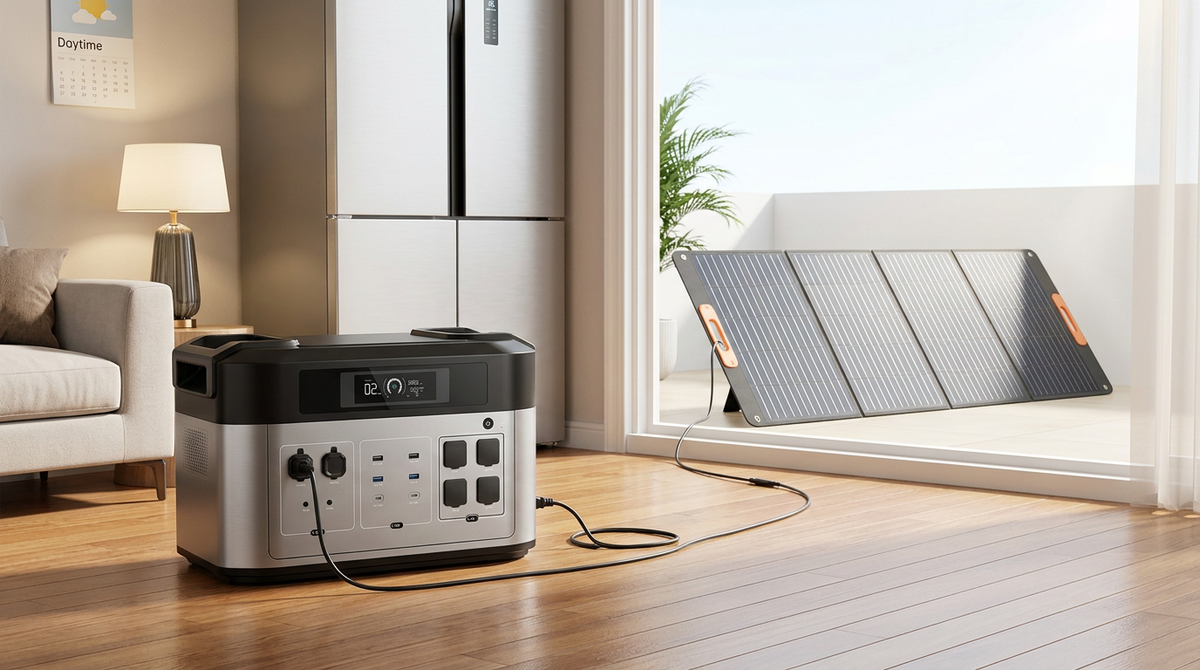
Best Portable Power Stations Under $2,000 in 2026: A Buyer's Decision Guide
The best portable power station under $2,000 is the one matched to your load list, not the one with the biggest battery on the box. That sounds obvious. Most first-time buyers still overspend by a full capacity tier, or worse, buy a unit that cannot start their fridge.
This guide skips the leaderboard. When choosing the best portable power station under $2,000, the right decision comes down to five factors that decide whether a station fits your life: how much energy you need, what you need to run, how it recharges, how heavy it is, and how far it can grow.
Why the price ceiling matters. Below $2,000, a unit stops being a phone charger. It starts being a real backup. And it does that without crossing into permanent home-battery cost, wiring, and a permit.
Portable power stations in the under-$2,000 tier typically offer capacities from about 1,000Wh to 2,500Wh, with enough output and storage to run essential loads like a refrigerator, a few lights, a router, and a laptop at the same time. Outages are getting longer, too. U.S. electricity customers averagedroughly 11 hours without power in 2024, nearly double the prior decade. Storms drove most of it. A unit sized for a two-hour blip is the wrong unit for a two-day one.
What Makes a Portable Power Station Worth Buying Under $2,000?
A station in this range earns its keep across multiple scenarios. It can cover essential loads during a home power outage, provide reliable energy for camping trips, support RV travel, and bring portable power to remote worksites. It covers what you need when the grid is down while still fitting how you use power the rest of the time. The category sits between two extremes. Below it are pocket batteries and sub-500Wh units.
Fine for phones and a fan, useless for a refrigerator. Above it sit whole-home battery walls that need an electrician and a permit. The under-$2,000 tier is the practical middle: enough inverter to run motors, enough capacity to matter, light enough that one person can still move it.
The Sweet Spot Between Portability and Power
Every extra watt-hour is extra weight. LiFePO4 cells are dense, so a bigger battery is a heavier box. That tension is the whole game in this price range. Where you land depends on whether the unit lives in a closet or rides in a truck.
In practice, the good units share a feature set that cheaper gear skips. Pure sine wave output. LiFePO4 chemistry. MPPT solar input. Fast AC charging. What varies is the tuning.
- Capacity: usually 1,000Wh to 2,500Wh, the band that clears a day of essentials.
- Continuous output between 1,800W and 3,300W, which determines what you can switch on at once.
- Charging speed, with the better units hitting 80% in about 1.5 hours on AC alone.
- Solar input from 400W to 1,000W, the difference between a slow trickle and a real daytime refill.
- Expandability, the one spec that lets a unit grow later instead of forcing a full replacement.
What You Can Realistically Power
A well-sized unit in this range runs the loads most households actually care about during an outage. Not the whole house. The essentials. Here is the honest list of what a 1,000Wh to 2,500Wh station handles comfortably:
- Refrigerator: a standard fridge cycles at roughly 100W to 200W average, so a 2,000Wh unit holds it for 12 to 24-plus hours.
- Internet and phones: a modem and router pull a handful of watts. Days of uptime, easily.
- CPAP machines run 30W to 60W, or triple that with a heated humidifier. A full night is no problem.
- Lights and small kitchen gear: LED lamps, a blender, a coffee maker in short bursts.
- Power tools on a job site, within the inverter's surge limit.
What it will not do: central air, an electric furnace, or an electric range running together. Those are whole-home battery jobs. Force them onto a portable unit, and you trip the inverter fast. Then a perfectly good machine feels like a lemon, through no fault of its own. Match the tool to the task. This class delivers when you do.
How Do I Choose the Best Portable Power Station Under $2,000?

[IMAGE: Alt: Portable power station display showing battery percentage and watt output while powering essential home devices | 4:3 inline]
Choosing well means working on five questions in order. Not chasing the biggest number. Capacity first, then output, then chemistry, then charging, then portability. Skip the order, and you end up with a unit that is somehow too big and still cannot start your fridge. We see it constantly. For a deeper walkthrough on matching a unit to specific appliances, see how to size a portable power station for your specific loads.
Start With Battery Capacity (Wh)
Think of watt-hours as the fuel tank. Battery capacity sets how long the unit runs, not what it can run. A higher Wh number means longer runtime, but only relative to your actual draw. Here is the catch that almost every spec sheet buries: you do not get the full rated capacity. Inverter losses, heat, and battery efficiency skim roughly 15% off the top. So the working formula is:
Usable runtime (hours) = Battery capacity (Wh) x 0.85 / device load (W)
For example, a 1,000Wh power station running a constant 100W device would provide an estimated runtime of about 8.5 hours: 1,000Wh x 0.85 ÷ 100W = 8.5 hours. A 2,048Wh unit powering the same device would provide roughly 17 hours. These figures are estimates for planning purposes, not guaranteed runtimes, because real-world results vary based on temperature, battery condition, inverter efficiency, and how much power the device actually draws.
The EIA's energy use information helps explain household electricity consumption patterns and how different appliances contribute to overall home energy use. The EIA's energy use information helps explain household electricity consumption patterns and how different appliances contribute to overall home energy use.
Bigger is not automatically better. A larger battery costs more, weighs more, and recharges more slowly. If your real need is phones, a laptop, and lights, a 1,000Wh unit may serve you better than a 2,500Wh one you resent carrying.
What's the Difference Between Continuous Output and Surge Wattage?
Continuous output is when a unit runs steadily. Surge is the short burst it delivers when a motor kicks on. These are two separate buying questions, and conflating them is the second-most-common mistake we see. Capacity told you how long. Wattage tells you what. Motors change the math.
Motors are the catch. A fridge, a pump, a power tool. Each one pulls a startup spike, often two to three times its running draw. So a unit with plenty of continuous power can still choke the moment a compressor kicks on. The surge ceiling is what gives out first.
- Running watts: add up everything you will run at the same time. That is your continuous floor.
- Startup surge: motors, compressors, and pumps need headroom, often 2x to 3x their running figure for a second or two.
- Headroom: leave a 20% margin so you are not riding the inverter's limit.
- Pure sine wave output matters here too. Sensitive electronics and motor-driven gear both want clean power.
As one example from the under-$2,000 class, the OUKITEL BP2000 delivers 2,200W of continuous output with a 4,000W surge rating. That level of surge headroom helps it handle startup demands from appliances like refrigerators while other essential loads are running. For buyers who need more continuous output, the BP2000 Pro is another example in this category, offering 3,300W of continuous output for higher-demand setups.
Does Battery Chemistry and Lifespan Really Matter?
Yes. It decides whether your unit lasts five years or fifteen. Nearly every quality station under $2,000 now ships with LiFePO4 (lithium iron phosphate) cells.
The number to read is the cycle life. A pack rated for 3,500-plus cycles to 80% takes a full charge and drain every day for about a decade. Older chemistries tap out at 500 to 1,000. That gap is the whole story. Across hundreds of setups we have reviewed, chemistry predicts buyer regret better than any other spec.
- Cycle life: look for 3,000-plus cycles to 80%. LiFePO4 clears this easily; older lithium-ion rarely does.
- Thermal behavior: LiFePO4 runs cooler under load, with significantly lower thermal runaway risk than NMC lithium-ion.
- The cold-weather caveat: LiFePO4 portable power stations under $2,000 should not be charged below freezing. Most units block charging around 32F to protect the cells. If you store or use a unit in a cold environment, move it indoors or warm it above freezing before charging.
- Indoor use: generally considered safe indoors, which is the whole point of a battery over a fuel generator.
That freezing-point note trips people up. Campers and RV users should remember that cold storage is not the same as cold charging. Discharging in low temperatures is generally fine, but charging is the sensitive part.
Evaluate Your Charging Options
A backup unit is only as good as your ability to refill it. Three recharge paths matter, and the best units offer all three. AC is fastest for prep: plug in before a storm, and a good unit hits 80% in around 90 minutes. Solar is what turns a one-day battery into open-ended coverage.
- AC wall charging: the fastest top-up. Best for pre-outage prep and quick turnarounds between trips.
- Solar via MPPT: the controller that squeezes usable power from panels even on overcast days. Higher input caps mean faster refills.
- Car charging: handy in transit, but slow. Treat it as a trickle, not a fast fill.
- Dual charging: some units accept AC and solar together to cut recharge time roughly in half.
Check solar input caps against your panels. A unit that accepts up to 1,000W of solar, paired with OUKITEL solar panels, refills fast enough to run essentials indefinitely as long as the sun shows up. No sense buying 800W of panels for a unit that caps at 400W input.
Which Ports and Connections Do You Actually Need?
Ports decide daily usability more than any headline spec. A unit can hold a massive battery and still be useless if it lacks the plugs your gear needs. So skip the generic 'lots of ports' pitch. Look at what each type serves. Count what you plug in at once.
- AC outlets: pure sine wave, for anything from a laptop to a fridge. Count how many you need running together.
- USB-C Power Delivery: prioritize 100W ports. One cable then charges a modern laptop, no brick.
- USB-A: for older phones, e-readers, and small accessories.
- 12V DC and DC5521: the car socket and barrel ports run a 12V fridge directly, skipping inverter losses.
- TT-30R RV outlet: a 30A RV plug lets you connect a shore-power cord straight to the station.
The 12V point is the one people miss. A DC-native device like a portable fridge, running straight off a 12V port, skips converting DC to AC and back. That conversion wastes energy every time. For RV and van users, the savings add up over a long boondock.
Think About Weight and Portability
Weight and capacity move together, so decide how you will carry the unit before you decide how big it is. A machine you can roll out of a garage during a blackout may be miserable to lift over rocks into a campsite. 'Portable' means different things to different buyers.
The right weight class depends on how you plan to use the unit: compact models prioritize travel and quick mobility, mid-size units balance home backup with camping needs, and wheeled stations are built for heavier home backup setups where portability means easy relocation rather than carrying.
Weight classes for portable power stations under $2,000
|
Weight class |
Typical range |
Best for |
|
Compact |
Under 25 lbs |
Road trips, light mobile work, trunk emergency kit |
|
Mid-size |
30 to 55 lbs |
Camping, van life, single-person carry to a truck bed |
|
Wheeled |
60 to 90+ lbs |
Home backup, rolled across flat floors with luggage handles |
For reference, a 2,048Wh unit typically lands in the mid-size band, around 52 lbs, with a handheld design that one person can move. That is the tier most home-backup-plus-occasional-camping buyers want. Heavy enough to matter, light enough to relocate.
Best Uses for Portable Power Stations Under $2,000
A mid-tier station is a versatile asset, filling several roles depending on where and how you draw power. Pinning down your primary use case is what tells you the exact capacity and output to buy. Four scenarios cover most buyers.
Emergency Home Backup During Power Outages

[IMAGE: Alt: LiFePO4 portable power station running a refrigerator and LED lights indoors during a power outage | 16:9 inline]
This is the number-one reason people buy in this tier. It is also where a battery beats a fuel generator outright. A power station sits safely in your kitchen and runs the essentials silently. A gas generator cannot. CPSC reports that portable generators cause an average of about 100 carbon monoxide deaths a year, because CO from a generator can kill in minutes indoors. A LiFePO4 station produces no exhaust.
- Refrigerator: a 2,000Wh unit holds a standard fridge 12 to 24-plus hours, well past the FDA's 4-hour safe-food window.
- Internet: a modem and router draw little, so your network stays up for days.
- Lighting: a few LED lamps keep the home safe and livable after dark.
- Medical devices: a CPAP or oxygen concentrator runs overnight without interruption.
- Small appliances: a blender, coffee maker, or microwave in short bursts.
Long outages reward discipline. Power is finite. So you triage. Unplug what you are not using. Skip the heavy heat, space heaters, and hair dryers, unless you truly need them. Keep an eye on the real-time draw on the display. Switchover speed matters here too. A unit that flips to battery in under 10 milliseconds keeps a desktop or a sump pump running without a reboot. For the full comparison against fuel units, see our full guide to home backup generators.
Camping and Off-Grid Adventures

[IMAGE: Alt: Portable power station at a campsite charging a 12V cooler and camp lights with a solar panel in sunlight | 4:3 inline]
Camping is where these earn their keep quietly. A power station brings the comforts of a gas model minus the noise and fumes. It runs near-silent. You keep the peace at the campsite, and you leave the smelly fuel cans at home.
- Quiet operation: no engine, no hum. You hear the campsite, not the generator.
- No fuel storage: nothing to spill, nothing to degrade, nothing flammable in the trunk.
- Solar recharge: panels create a self-sustaining loop, harvesting by day what you spend by night.
- Real electronics away from outlets: a 12V cooler, camp lights, drone and camera batteries, a projector.
The honest sizing note: the right camping unit is usually smaller than buyers assume. A 1,024Wh unit holds a 12V camping fridge for an estimated 17 hours on steady draw, closer to 28 once compressor cycling is factored in. That covers a normal weekend. Bump to 2,048Wh and runtime roughly doubles.
RV and Mobile Power Needs

[IMAGE: Alt: Portable power station with a TT-30R RV outlet connected to a camper van shore power cord while boondocking | 16:9 inline]
Van lifers and RV owners use these units to complement or replace built-in electrical systems. Flexibility is everything on the road. Four things deserve close attention.
- Higher capacity: running a living space means water pumps, vent fans, and electronics over long stretches.
- 12V compatibility: DC-native gear runs straight off the 12V ports, dodging conversion losses.
- Solar input: high-wattage input maximizes a roof array for fast refills while boondocking.
- Expandability: units that take add-on packs grow with your rig instead of forcing a new purchase.
That TT-30R outlet is the RV-specific feature to confirm. It lets a shore-power cord plug directly into the station, so your rig's existing wiring just works. Not every unit in this tier has one. Check before you buy.
Worksites and Outdoor Projects
Power stations have quietly replaced small gas generators on job sites. They bring power to a fence line or a remote corner without hundreds of feet of extension cord and without the exhaust. They handle circular saws, drills, and miter saws, plus temporary lighting and a charging hub for tool batteries. The one thing to verify: high-demand tools that need a big surge to spin up must fall inside both the continuous and surge limits. A drill is easy. A large compressor is where you check the surge spec twice.
Key Features That Separate Good Power Stations From Average Ones
On paper, most units look alike. Engineering quality, internal components, and software do not. Cheaper units deliver raw capacity and little else. The features below are what a premium unit under $2,000 adds, and they are worth understanding before you spend.
Expandable Battery Capacity

[IMAGE: Alt: Expandable portable power station connected to a stacked expansion battery pack for extended home backup | 4:3 inline]
This is the single most valuable feature in a modern station, and the one most competitor roundups underweight. A unit with expansion ports lets you chain external battery packs to the main station, doubling or tripling total capacity without paying for that weight upfront.
It is a hedge against your own changing needs. Buy a 2,048Wh unit for weekend camping today, decide next year to prep for multi-day blackouts, and you add a pack instead of replacing the whole system.
The BP2000, for instance, starts at 2,048Wh and expands to 16,384Wh with up to seven B2000 packs. Depending on the devices you run, power consumption habits, and recharge options, that expanded capacity can support extended backup needs that may range from roughly one to six days for a typical household setup. That headroom is why we treat expandability as a key decision factor, not a footnote.
UPS and EPS Functionality
A UPS or EPS feature lets the station sit between your wall outlet and your electronics. Power passes through cleanly until the grid drops; then the unit flips to its battery automatically. The speed of that flip is what matters.
Premium units switch in under 10 to 20 milliseconds. Fast enough that sensitive gear never notices. It protects:
- Routers and modems: your network stays online through the switch, no dropped work calls.
- Computers and NAS drives: no sudden data corruption or lost unsaved work.
- Critical electronics: medical monitors and home security keep running.
Useful, but keep it in perspective. UPS capability is a strong bonus, not the sole reason to buy. Core inverter quality and battery health still come first.
Smart Controls and Displays
A station is only as useful as your ability to read it. Better units drop the vague battery bars. In their place, accurate LCD or TFT displays show real numbers:
- Exact battery percentage, not a five-bar guess.
- Live runtime estimates based on your current draw.
- Input and output monitoring, watts coming in from solar or AC versus watts going out.
App control via Bluetooth or WiFi adds real convenience. At midnight during a blackout, checking status, toggling ports, or adjusting charge speed from your phone is genuine peace of mind. Not essential. Nice.
Solar Compatibility
True off-grid independence rides on how well a unit works with solar. Good solar support is more than a port. It needs an MPPT charge controller actively optimizing efficiency, plus a solar input cap high enough to matter.
Check the maximum solar wattage and voltage tolerance.
A higher input ceiling lets you connect more panels at once, which cuts recharge time and pulls meaningful power even on overcast days. That last part matters more than the spec sheet suggests. Winter sun is short and dim, so a unit that accepts high solar wattage still banks usable energy in a narrow, clear window.
Common Mistakes When Buying a Portable Power Station Under $2,000
This is a long-term purchase, and choosing the wrong unit can mean paying for features you do not need or ending up with a system that does not match your actual power needs. These mistakes are especially common among buyers looking for portable power stations under $2,000, where capacity, output, and portability all involve tradeoffs.
Most buyers fixate on big battery numbers and miss the factors that decide daily usability. Here are the five that trip people up most.
- Buying more capacity than you need: oversized units cost more, weigh more, and store harder. If you mostly charge phones and a laptop, a huge battery is money spent on capacity you will not use.
- Ignoring startup surge: checking only running watts is a classic error. A unit that looks strong on continuous power can still fail to start a fridge if its surge ceiling is low.
- Focusing only on battery size: capacity is half the story. A big battery still disappoints with weak output, slow charging, or too few ports. Read the whole spec sheet.
- Forgetting solar planning: a small panel takes forever to refill a large battery, especially in weak light. Match panel wattage to the unit's input cap and your daily use.
- Ignoring portability: a powerful unit is useless if it is too heavy to move when you need it. Decide where it lives and how often it travels first.
How Do I Match a Portable Power Station to My Power Needs?
Match the unit to how you will actually use it, not to a price or a headline number. Three buyer profiles cover most people. Find yours, then buy it.
Matching capacity tier to use case
|
Your situation |
Prioritize |
Capacity tier |
|
Basic electronics, short outages |
Low weight, USB ports, fast charging, and easy storage |
~1,000Wh |
|
Fridge and essential appliances |
Higher Wh, strong inverter output, solar compatibility |
~2,000Wh |
|
Extended backup and RV use |
Expandable battery, large solar input, high output |
2,000Wh+ expandable |
For basic electronics and short outages, a lighter 1,000Wh-class unit handles phones, a laptop, a router, and LED lights with room to spare. For fridge-and-essentials backup, step up to a 2,000Wh-class unit with a strong inverter and solar support. For extended backup or RV life, expandability and high solar input win because they let the system grow and stay charged when the grid is not an option.
Final Verdict: Finding the Best Portable Power Station Under $2,000
There is no single best unit for everyone because camping, home backup, and RV travel pull in different directions. The right answer is the one matched to your loads and your recharge reality.
Choose compact if portability and device charging lead. Choose a mid-capacity unit if you need a fridge, lights, and essentials through an outage.
And if outages are frequent, or your needs might grow, an expandable system buys flexibility that a fixed-capacity unit never will. That is the point we return to most. The OUKITEL BP2000 and BP2000 Pro both start at a usable 2,048Wh and scale to 16,384Wh, so the decision does not lock you in.
When you compare options, weigh battery chemistry, usable capacity, inverter output, charging flexibility, and portability over marketing numbers. The best portable power station under $2,000 is not the largest or most powerful. It is the one that fits your real energy needs, your environment, your recharge options, and your expectations for reliable backup. Buy that one.
Ready to Choose Your Portable Power Station?
Sizing a unit does not have to be guesswork. Work these three steps, and you will land on the right capacity tier with confidence.
- List your loads. Write down every device you need running at once, note its running watts, and add the surge for anything with a motor or compressor.
- Do the runtime math. Before comparing portable power stations under $2,000, multiply your target capacity by 0.85, divide by your total load, and confirm the estimated runtime covers your worst realistic outage. Once you know your capacity and output needs, explore the home battery backup range to compare which unit fits your setup. Explore the home battery backup range to see which unit fits.
- Plan your recharge. Pick AC-only for prep, or add matched solar panels for open-ended off-grid coverage, and check the unit's solar input cap before buying panels.
FAQs
What Is the Best Portable Power Station for the Money?
The best value is the unit whose specs match your loads. Not the lowest price, not the biggest battery. Value is personal. Someone charging phones and a laptop gets the most from a lighter unit, because they never pay for weight they will not use.
Someone backing up a fridge gets more from a 2,000Wh-class unit that expands.
The real value shows up in cost-per-watt-hour over a LiFePO4 unit's decade-long life. Before buying, check three things: LiFePO4 chemistry with 3,000-plus cycles, usable capacity that clears your worst realistic outage after the 0.85 efficiency factor, and an inverter rated above your largest single load plus its surge.
Who Makes the Best 2000-Watt Power Station?
Several do. The winner depends on which features you weigh most, and a camper and a home-backup buyer want different things from the same wattage. In this class, the deciding factors are surge headroom, cycle life, and whether the unit expands.
A 2,000W-class unit with a 4,000W surge starts a fridge comfortably. One with a lower surge may not, even at the same continuous rating. The OUKITEL BP2000 sits here at 2,200W continuous, 4,000W surge, and expands to 16,384Wh, which is the mix we point most 2,000W shoppers toward.
Which Brand of Portable Power Station Is Best?
It depends on the category. The best brand tracks the features you value, so look past reputation to the specifics that affect ownership. Warranty, battery quality, software, accessories, and support vary more than the marketing does.
A dependable brand shows strong build quality, consistent battery performance, and real support across the product's life. We have found that support quality separates brands more than spec sheets do. A unit is only useful if help arrives when something goes wrong, so read owner reviews for how a brand handles problems, not just how it performs on day one.
Is It Worth Buying a Portable Power Station?
For most people, yes. If you face outages, camp, travel by RV, or want quiet off-grid power, it earns its place. It produces no exhaust and runs silently, which makes it usable indoors where a fuel generator is dangerous.
The worth-it test is how often you would use it. Somewhere with frequent storms, or a few camping trips a year, and it pays for itself in food saved and comfort kept. Use it once a year, and a power bank may cover your needs for far less. It will not run central HVAC continuously, and that is fine, because that was never its job.
How Long Will a Portable Power Station Run a Refrigerator?
Roughly 12 to 24-plus hours on a 2,000Wh unit, depending on the fridge and how often you open the door. The range is wide because fridges cycle their compressors instead of drawing full power constantly.
A fridge rated at 150W often averages 60W to 100W once cycling is factored in, since it runs at max wattage only about a third of the time. Apply the formula, 2,048Wh times 0.85 divided by an 80W average, and you land near 21 hours of real coverage. That clears the FDA's 4-hour safe-food window many times over. Keeping the door closed stretches it further.
Can a Portable Power Station Charge From Solar Panels?
Yes, and directly. Most quality units under $2,000 accept solar through an MPPT controller, rated between 400W and 1,000W depending on the model. Solar is what turns a one-day battery into a multi-day, open-ended system.
We have seen this during long outages: the households that came through comfortably had panels paired with the battery from day one. The sun comes up, panels charge the battery, the battery powers essentials overnight, repeat. The trick is matching panel wattage to the unit's input cap. There is no point in spending on 800W of panels for a unit that tops out at 400W.
Is LiFePO4 Better Than Regular Lithium-Ion for a Power Station?
For a power station, yes, for nearly every buyer. It lasts far longer, runs cooler, and carries significantly lower thermal runaway risk than older NMC lithium-ion. Cycle life is the headline. A LiFePO4 pack rated for 3,500-plus cycles can run daily for roughly a decade, while older lithium-ion often fades after 500 to 1,000.
That is why every modern quality station ships with it. The tradeoffs are weight, since LiFePO4 is denser, and a charging floor around freezing. Discharging in the cold is fine. Most buyers accept both readily for the safety and the longevity.
What Size Portable Power Station Do I Need for Home Backup?
2,000 Wh for essentials. A unit that size with a 2,200W-plus inverter covers a fridge, lights, a router, phones, and a CPAP through a one-day outage. Add a window AC and the math changes: now you want 5,000Wh and a bigger inverter, which usually means an expandable system. Size by what stays on, not by your home's total draw.
Most buyers who ask for whole-home backup actually want essentials plus a couple of comfort loads once we map it out. A 2,048Wh unit clears a typical essentials list with margin, and an expandable one lets you add packs as your needs grow. Pair it with panels, and runtime stops being a hard ceiling.
Sources
- U.S. Energy Information Administration (EIA), Hurricanes in 2024 led to the most hours without power in the United States in 10 years (2025)
- U.S. Food and Drug Administration (FDA), Food and Water Safety During Power Outages and Floods
- U.S. Energy Information Administration (EIA),Use of energy explained: Energy use in homes
- U.S. Consumer Product Safety Commission (CPSC), CPSC Issues Safety Tips to Help Families Prevent Carbon Monoxide Poisoning and Fires (2025)
- Federal Emergency Management Agency (FEMA), Power Outages


Looking for something else?

Difference Between Amps and Volts: What You Actually Need to Know
LEARN MORE
50 Amps in Watts: The Honest 2026 Conversion Guide for RV, Home, EV, and Solar
LEARN MORE
Can You Put Solar Panels on a Mobile Home? (Real-World Guide for 2026)
LEARN MORE
Do Portable Solar Panels Qualify for the 30% Credit?
LEARN MORELooking for something else?

Are Solar Generators Any Good? Here's the Real Answer
LEARN MORE
How Long Does a Portable Power Station Last? (Real Numbers)
LEARN MORE
Oukitel Power Exhibits at Solar & Storage Live Philippines 2026: Carry the Sun, Power Your Freedom
LEARN MOREYou may also like
OUKITEL B2000 Expansion Battery | 2048Wh

OUKITEL BP5000 PRO MAX Portable Power Station 5000W | 5120Wh

OUKITEL C01 Car Jump Starter 1350A | 80Wh | PD60W

OUKITEL BP2000 PRO Portable Power Station 3300W

OUKITEL P2001 Plus+400W Solar Generator

OUKITEL P2001 Plus+2*200W Solar Generator
Further reading

OUKITEL Power Brings Full-Scenario Energy Storage Solutions to Intersolar Middle East 2026 in Dubai

Portable Power Stations for Power Tools and Job Sites: Surge, Runtime and Safety
