








 Flashlight
 Solar
Extension Cable
Solar
Extension Cable


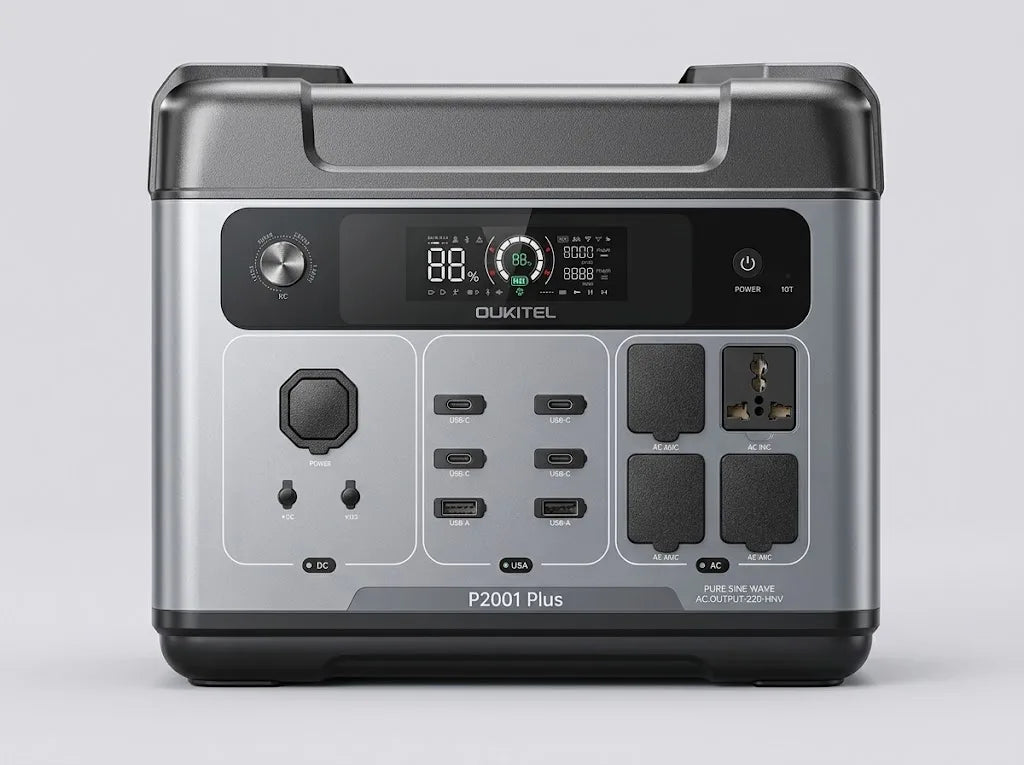
OUKITEL P2001 Plus vs EcoFlow DELTA 2 Max: 2048Wh Power Station Comparison
The P2001 Plus vs EcoFlow DELTA 2 Max decision comes down to one question: do you need a single 2kWh battery, or a system that can grow past it? Both units store 2,048Wh in LiFePO4 cells and run 2,400W of continuous AC load. On the headline numbers, they tie.
The differences sit underneath. The OUKITEL P2001 Plus costs less, lists a UPS switchover under 10 ms, and gives you a physical knob for AC charging speed. The DELTA 2 Max accepts two extra batteries for up to 6,144Wh, takes 1,000W of solar input, and runs on a more developed app.
This guide compares both units on battery life, appliance output, charging, backup switching, ports, weight and cost per Wh. All specs come from each brand's official US store as of September 2026.
Quick verdict
Pick the P2001 Plus if 2,048Wh covers your outage or trip, you want the lower price, and you run desktop PCs or network gear on UPS.
Pick the DELTA 2 Max if you plan to add storage later, want 1,000W of solar input, or rely on app scheduling.
Either works for weekend RV trips, camping and short outages. Both hold 2,400W continuous and 4,800W surge.
P2001 Plus vs EcoFlow DELTA 2 Max: Specs Side by Side
Five of the specs below are identical. The rest decide the purchase, and most of them split along one line: OUKITEL leads on price, cycle life and switchover speed, EcoFlow leads on expansion, solar and outlet count.
|
Spec
|
OUKITEL P2001 Plus
|
EcoFlow DELTA 2 Max
|
Edge
|
|
Battery capacity
|
2,048Wh
|
2,048Wh
|
Tie
|
|
Chemistry
|
LiFePO4
|
LiFePO4
|
Tie
|
|
Cycle life
|
3,500+ cycles to 80%
|
3,000 cycles to 80%
|
OUKITEL
|
|
Continuous AC output
|
2,400W pure sine wave
|
2,400W
|
Tie
|
|
Surge output
|
4,800W
|
4,800W
|
Tie
|
|
Resistive boost mode
|
Not offered
|
X-Boost up to 3,400W
|
EcoFlow
|
|
Max AC charging
|
1,800W, 4 step knob
|
1,800W
|
Tie
|
|
Max solar input
|
500W (12 to 60V, 15A)
|
1,000W (2 x 500W, 11 to 60V)
|
EcoFlow
|
|
Expansion
|
None, fixed at 2,048Wh
|
Up to 6,144Wh
|
EcoFlow
|
|
UPS switchover
|
Under 10 ms (EPS 1,400W)
|
30 ms rated
|
OUKITEL
|
|
AC outlets
|
4
|
6
|
EcoFlow
|
|
Weight
|
48.5 lb (22 kg)
|
50 lb (23 kg)
|
OUKITEL
|
|
Dimensions
|
15.7 x 11.3 x 12.6 in
|
19.6 x 9.5 x 12 in
|
Depends on space
|
|
Warranty
|
1 year + 2 with subscription
|
5 years
|
EcoFlow
|
|
Listed price (Sept 2026)
|
$729
|
$1,029
|
OUKITEL
|
Spec note
Some reviews list the P2001 Plus with 1,000W of solar input. OUKITEL's US product page lists 500W maximum, and this article follows the US page. Check the listing for your region before planning a large solar array.
How Much Usable Energy Does Each Battery Deliver?

Both batteries are rated at 2,048Wh. Usable AC energy is lower because the inverter loses some power converting DC to AC. We plan with a 0.85 factor, which puts usable output near 1,740Wh for either unit.
Independent testing supports that range. StorageReview measured about 1,800Wh of AC output from the DELTA 2 Max under a 350W load, roughly 88% of its rating.
Cycle Life: 3,500 vs 3,000
OUKITEL rates the P2001 Plus for 3,500+ cycles to 80% capacity. EcoFlow rates the DELTA 2 Max for 3,000. At one full cycle per day, that works out to about 9.6 years versus 8.2 years.
Reaching 80% is not failure. A 2,048Wh pack at 80% still holds about 1,640Wh. Most home backup owners cycle far less than once a day, so either battery should last many years in that role.
Expansion: Fixed 2kWh vs Up to 6kWh
This is the largest functional gap. The P2001 Plus has no expansion port, so 2,048Wh is the ceiling. The DELTA 2 Max has two expansion ports and accepts up to two DELTA 2 Max Smart Extra Batteries.
Expansion adds hours, not watts. The inverter stays at 2,400W however many batteries sit behind it. Our OUKITEL vs EcoFlow brand comparison covers that distinction in more depth.
-
DELTA 2 Max alone: 2,048Wh, about 1,740Wh usable
-
With one extra battery: 4,096Wh total
-
With two extra batteries: 6,144Wh total, about 5,220Wh usable
-
Want OUKITEL with room to grow? Look at the expandable home battery backup systems rather than the P2001 Plus.
What Appliances Can the P2001 Plus and DELTA 2 Max Run?
Both inverters hold 2,400W continuously and 4,800W for short startup surges. That covers a full size refrigerator, a microwave, a coffee maker, most power tools and a complete home office.
The limit is the total. Every AC outlet shares the same 2,400W, so a 1,200W microwave and a 1,500W space heater cannot run at the same time. Large heating and cooling loads are also the ones that drain a battery fastest. EIA data ranks air conditioning, space heating and water heating as the three largest uses of electricity in US homes.
Runtime at Common Loads
Runtime equals capacity x 0.85 divided by load in watts. The figures below apply to either unit at its base 2,048Wh. Check the nameplate or use a plug in meter for your own devices.
|
Load
|
Typical Draw
|
Estimated Runtime
|
|
Wi-Fi router and modem
|
20W
|
About 87 hours
|
|
Laptop charging
|
60W
|
About 29 hours
|
|
Full size refrigerator
|
60 to 80W average (150W+ while running)
|
About 22 to 29 hours
|
|
Desktop PC and monitor
|
200W
|
About 8.7 hours
|
|
Outage essentials: fridge, router, lights, phones, TV
|
300W
|
About 5.8 hours
|
|
Microwave
|
1,000W
|
About 1.7 hours of run time
|
With two extra batteries, the DELTA 2 Max stretches that 300W essentials load to about 17 hours. For context, the FDA notes that an unopened refrigerator keeps food cold for about 4 hours without power.

Our refrigerator and freezer sizing guide shows how to size for longer outages.
What EcoFlow X-Boost Does and Does Not Do
X-Boost lets the DELTA 2 Max run some resistive devices rated up to 3,400W, such as kettles and hair dryers, by lowering the voltage. The device runs at reduced power, so a 3,000W heater produces less heat. It does not help motor loads, and it does not raise the 2,400W continuous rating. The P2001 Plus has no equivalent mode.
Which Charges Faster: Wall, Solar or Car?
On wall power, it is a draw. Both accept 1,800W, and OUKITEL lists 0 to 80% in about one hour for the P2001 Plus. On solar, EcoFlow leads clearly with twice the input.
|
Charging Method
|
OUKITEL P2001 Plus
|
EcoFlow DELTA 2 Max
|
|
AC wall
|
1,800W max, knob: 400 / 800 / 1,200 / 1,800W
|
1,800W max, adjustable in app
|
|
Solar
|
500W max, 12 to 60V, 15A, XT60
|
1,000W max over two 500W inputs, 11 to 60V, 15A
|
|
AC + solar combined
|
2,300W max
|
Not listed on the product page
|
|
Theoretical full solar recharge
|
About 4.1 hours at 500W
|
About 2 hours at 1,000W
|
|
Car
|
12V, 10A (about 120W)
|
12V or 24V, 8A
|
Car charging is a top up, not a full recharge. At about 120W, refilling 2,048Wh from a car socket would take roughly 17 hours of driving.
The P2001 Plus Charging Knob
The four step knob sets AC input at the unit itself: 400W, 800W, 1,200W or 1,800W. Lower settings keep the station from tripping a shared 15A household circuit or overloading a small inverter generator. On the DELTA 2 Max, charge speed is adjusted in the EcoFlow app.
Solar Output in Real Conditions
Rated input is a ceiling, not a promise. Panel angle, heat, shade and season all cut real output, and the DOE's solar planning guidance starts with site conditions for that reason. In our experience, portable panels often deliver 60 to 80% of their rating on a clear day.
If you plan to recharge mostly from the sun, the DELTA 2 Max's 1,000W input is a real advantage. For lighter solar use, the P2001 Plus + 400W solar generator kit pairs the station with a matched folding panel.

Which Has the Better UPS for PCs and Home Offices?

The P2001 Plus lists a switchover under 10 ms. EcoFlow rates the DELTA 2 Max at 30 ms, according to StorageReview. Many desktop power supplies are designed to ride through only about 16 ms of lost power, so the shorter gap leaves more margin.
Field testing points the same way. In Root-Nation's side by side test, a device on an extension cord dropped power during the switch on a BLUETTI AC200L but stayed on with the P2001 Plus.
Check the EPS load limit
OUKITEL lists EPS power of 1,400W next to the under 10 ms switchover. Keep the devices you want protected under that figure. A PC, monitor, router and NAS usually total well under 500W.
Test your setup before you depend on it:
-
Plug critical devices straight into the station, not through a surge strip with extra protection circuits.
-
Unplug the station from the wall to simulate an outage.
-
Confirm the PC, router and any storage drives stay on.
-
Repeat under your normal working load.
Ports, Controls and App: Which Is Easier to Live With?
|
Output
|
OUKITEL P2001 Plus
|
EcoFlow DELTA 2 Max
|
|
AC outlets
|
4
|
6
|
|
USB-C
|
4 (100W, 45W, 2 x 20W)
|
2 (100W each)
|
|
USB-A
|
2 (18W each)
|
4 (2 x 12W, 2 x 18W)
|
|
12V car outlet
|
1
|
1 (126W max)
|
|
12V DC barrel ports
|
2 (per Root-Nation)
|
Not listed
|
|
App connection
|
Wi-Fi and Bluetooth
|
Wi-Fi and Bluetooth
|
The DELTA 2 Max wins on AC outlets, which matters when you run several plug in appliances without a power strip. The P2001 Plus has twice the USB-C ports and two DC barrel outputs, useful for routers and security cameras.
Physical Controls vs App Depth
The P2001 Plus keeps key controls on the chassis: AC, DC and USB buttons plus the charging knob. Its app handles monitoring, output toggles and charge speed. Root-Nation described it as basic but sufficient for daily use.
EcoFlow's app goes further, with charge limits, scheduling and remote monitoring across its wider product family. Buyers who manage power from a phone will value it. Buyers who want to turn a knob and walk away may not.
Noise
OUKITEL rates the P2001 Plus under 50 dB. Root-Nation's review found its fans run continuously while charging or powering AC loads, and noted a firmware update that reduces noise. Place it where fan sound will not bother you, such as a kitchen or utility room.
Size, Weight and Build Quality
Neither unit is light. The P2001 Plus weighs 48.5 lb and the DELTA 2 Max weighs 50 lb. Both are easy to roll or carry a short distance and tiring to carry up stairs.
-
P2001 Plus: 15.7 x 11.3 x 12.6 in. Shorter and deeper, two aluminum handles, a top compartment for cables, IP54 dust and splash rating.
-
DELTA 2 Max: 19.6 x 9.5 x 12 in. Longer and narrower, which suits a slim shelf or RV storage bay.
IP54 means protection from dust and light splashes, not rain or submersion. Keep either unit dry and ventilated. OUKITEL lists an operating range of 32°F to 104°F for the P2001 Plus.
P2001 Plus vs EcoFlow DELTA 2 Max for Home Backup, RV and Off Grid Use

Match the unit to the job. Root-Nation's apartment testing found critical household loads averaged 200 to 400W, which a single 2,048Wh battery covers for roughly 4 to 9 hours.
|
Use Case
|
Better Fit
|
Why
|
|
Short outages, under 12 hours
|
P2001 Plus
|
Same capacity at a lower price
|
|
Multi day outages
|
DELTA 2 Max
|
Expands to 6,144Wh
|
|
Home office UPS
|
P2001 Plus
|
Under 10 ms vs 30 ms switchover; keep loads under 1,400W
|
|
Weekend RV or camping
|
Either
|
2kWh covers lights, a 12V or AC fridge, fans and devices
|
|
Solar first off grid
|
DELTA 2 Max
|
1,000W solar input across two ports
|
|
Kettle or hair dryer in outages
|
DELTA 2 Max
|
X-Boost adds headroom for resistive loads
|
Indoor use
Battery power stations produce no exhaust, so both can run indoors. A portable gas generator can produce as much carbon monoxide as hundreds of cars, according to the CPSC, and must stay outside.
Price and Long Term Value
At the time of writing, each brand's official US store lists the P2001 Plus at $729 and the DELTA 2 Max at $1,029. Sale prices move often, so compare the same configuration on the same day.
|
Metric
|
OUKITEL P2001 Plus
|
EcoFlow DELTA 2 Max
|
|
Listed price (Sept 2026)
|
$729
|
$1,029
|
|
Cost per rated Wh
|
About $0.36
|
About $0.50
|
|
Rated lifetime energy (cycles x 2.048kWh)
|
About 7,170kWh
|
About 6,140kWh
|
|
Cost per kWh of rated cycle life
|
About $0.10
|
About $0.17
|
|
Warranty
|
1 year + 2 with subscription
|
5 years
|
On pure cost per Wh and per cycle, the P2001 Plus wins by a wide margin. EcoFlow's 5 year warranty is the stronger term, which matters more if you plan to cycle the battery daily.
Expansion changes the math. Reaching 6kWh with EcoFlow means buying two extra batteries on top of the base unit. If you know you need that much storage, price the full system rather than the base station.
Which One Should You Buy?
Choose the OUKITEL P2001 Plus If
-
One 2,048Wh battery covers your longest expected outage or trip
-
You want the lower upfront price and lower cost per cycle
-
You protect PCs, routers or NAS drives and value the under 10 ms switchover
-
You prefer a physical charging knob over app settings
-
You charge many USB-C devices at once
See the full specs and current bundles on the OUKITEL P2001 Plus product page, or compare it with larger models in the OUKITEL portable power station lineup.
Choose the EcoFlow DELTA 2 Max If
-
You expect to need more than 2kWh within a few years
-
Solar is your main charging source and you can use 1,000W of input
-
You want six AC outlets or X-Boost for resistive appliances
-
App scheduling and a 5 year warranty justify the higher price
Final Verdict
The P2001 Plus and the DELTA 2 Max are equals on the numbers most buyers check first: 2,048Wh of LiFePO4 storage, 2,400W continuous output and 4,800W surge. The choice turns on what surrounds that core.
The P2001 Plus is the value pick. It costs about $300 less at current listings, rates 500 more cycles, switches to battery in under 10 ms and puts charging control on a physical knob. The DELTA 2 Max is the growth pick, with expansion to 6,144Wh, 1,000W solar input and a longer warranty.
If one battery fits your needs, the P2001 Plus delivers the same core power for less. For more options across capacities, browse the full range at OUKITEL Power.
Next Steps Before You Buy
-
List your loads. Write down the watts of each device you need during an outage and add them up. Keep the total under 2,400W, or under 1,400W for UPS protected devices on the P2001 Plus.
-
Size for your worst case. Multiply the total watts by the hours you need. If the result is under about 1,740Wh, one 2,048Wh unit is enough. If it is higher, plan for expansion or a larger station.
-
Compare current prices on matching configurations. Price the base units side by side, then add solar panels or extra batteries only if your plan needs them.
FAQs
Is the OUKITEL P2001 Plus Better Than the EcoFlow DELTA 2 Max?
The P2001 Plus vs EcoFlow DELTA 2 Max answer depends on storage: the P2001 Plus is better if 2,048Wh is enough, the DELTA 2 Max if you need more later. Both run 2,400W continuously.
Where each unit leads:
-
P2001 Plus: lower price, 3,500+ cycles, under 10 ms switchover
-
P2001 Plus: physical charging knob, four USB-C ports
-
DELTA 2 Max: expands to 6,144Wh
-
DELTA 2 Max: 1,000W solar, six AC outlets, 5 year warranty
If one battery covers your longest outage, choose OUKITEL.
Is the EcoFlow DELTA 2 Max Good?
Yes. It is a well reviewed 2kWh LiFePO4 station, and StorageReview measured about 1,800Wh of usable AC output. Its main strength is expansion.
Strengths and tradeoffs:
-
2,048Wh base, 2,400W continuous, 4,800W surge
-
Two expansion ports, up to 6,144Wh
-
1,000W solar across two inputs
-
30 ms switchover, slower than the P2001 Plus
-
Higher listed price than the P2001 Plus
It is worth the premium only if you will actually add batteries.
Which Is Better, the EcoFlow DELTA 2 Max or the BLUETTI AC200L?
The AC200L offers more peak power; the DELTA 2 Max offers more outlets and two solar inputs. Both expand past 2kWh. Our OUKITEL vs BLUETTI guide covers how expansion and inverter size interact.
Key differences, per Root-Nation's testing:
-
Surge: 7,200W vs 4,800W
-
AC charging: 2,400W vs 1,800W
-
Max expansion: about 7.5kWh vs 6,144Wh
-
UPS switchover: 20 ms vs 30 ms
Compare current prices in your market before deciding.
Which Is Better, Jackery, EcoFlow, or BLUETTI?
No brand wins every category. Compare specific models in the same capacity class, since each brand sells units from about 300Wh to multiple kWh.
Line up these figures for any two models:
-
Measured usable AC output
-
Continuous and surge watts
-
Solar and AC charging input
-
UPS switchover time and EPS load limit
-
Expansion ceiling and warranty length
If cost per Wh matters, add OUKITEL: the P2001 Plus matches the DELTA 2 Max on capacity and output for less.
Is EcoFlow a Chinese Company?
Yes. EcoFlow was founded in 2017 and is headquartered in Shenzhen, China. OUKITEL and BLUETTI are also Shenzhen based.
Country of origin matters less than these points:
-
Safety listings required in your region
-
Warranty length and local claim handling
-
Spare cables and chargers
-
Return policy (OUKITEL offers 30 day money back on its official store)
A clear warranty process is worth more than the flag on the box.
What Are the Key Differences Between the DELTA 3 Max and DELTA 2 Max?
Both hold 2,048Wh and 2,400W. Retailer listings show the DELTA 3 Max trading solar input and outlets for faster switching and less weight.
-
Solar input: 500W vs 1,000W
-
AC outlets: 4 vs 6
-
UPS switchover: under 10 ms vs 30 ms
-
Surge: 3,600W vs 4,800W
-
Weight: about 44.7 lb vs 50 lb
DELTA 3 Max expansion support varies by listing, so confirm on EcoFlow's page. For solar and expansion, the DELTA 2 Max is the stronger pick.
Can a 2,048Wh Power Station Run a Refrigerator?
Yes. A 2,048Wh station runs a full size refrigerator for roughly 22 to 29 hours. The same check applies to a BLUETTI AC200MAX: compare startup surge and daily energy use with its specs.
Sizing checklist:
-
Running watts under 2,400W
-
Startup surge under 4,800W
-
Daily use often 1.4 to 1.9kWh
-
Usable battery energy about 1,740Wh
Our refrigerator and freezer sizing guide walks through the math.
How Long Does the P2001 Plus Battery Last?
Per charge, it lasts from under 2 hours at 1,000W to several days at 20W. OUKITEL rates it for 3,500+ cycles to 80% capacity, about 10 years of typical use.
Care points:
-
Store between 14°F and 104°F, partly charged
-
Operate between 32°F and 104°F
-
Check the charge every few months in storage
-
Recycle at end of life, not in household trash, per EPA guidance


Looking for something else?
What Will a 6000 Watt Generator Run? 2026 Whole-Home Guide
LEARN MORE
What Can 1,000 Watts Power? 2026 Guide to Real Appliances & RuntimeWhat Can 1,000 Watts Power? A 2026 Guide to Real Appliances and Runtime
LEARN MORE
Best Portable Power Station for Camping: A No-Nonsense 2026 Buyer's Guide
LEARN MORE
1500 Watt Generator: What Can It Power? 2026 Real-Appliance Guide
LEARN MORELooking for something else?
How Long Do Portable Power Stations Last? 2026 Lifespan and Runtime Guide
LEARN MORE
Best Solar Generator for Home Backup: 2026 Buyer's Guide
LEARN MORE
What Size Solar Generator Do You Need? 2026 Sizing Guide by Real Use Case
LEARN MOREYou may also like

OUKITEL BP2000+400W Solar Generator
$1,269.00
$1,799.00

OUKITEL P5000+2*400W Solar Generator
$2,098.00
$3,599.00
OUKITEL P5000 Pro+2*400W Solar Generator
$2,398.00
$3,398.00

OUKITEL BP2000+2*400W Solar Generator
$1,869.00
$2,399.00

OUKITEL BP2000+2*B2000 Home Backup
$2,099.00
$2,799.00
Further reading

OUKITEL BP5000 Pro Max vs EcoFlow DELTA Pro 3 vs Anker SOLIX F3800
Picking between the OUKITEL BP5000 Pro Max vs EcoFlow DELTA Pro 3 vs Anker SOLIX F3800 comes down to one priority. Stored energy, solar recovery, or raw output. The OUKITEL BP5000 Pro Max carries ...

OUKITEL P5000 Pro vs Jackery HomePower 3600 Plus: 3.6kW-Class Home Backup
The OUKITEL P5000 Pro vs Jackery HomePower 3600 Plus choice comes down to one trade: more battery in the box, or less weight with room to grow. Both run 3,600W continuous and 7,200W surge on LiFeP...

OUKITEL BP2000 Pro vs Jackery Explorer 2000 Plus: Expandable Home Backup Compared
BP2000 Pro vs Jackery Explorer 2000 Plus. On the spec sheet, these two look close at first. Each holds roughly 2kWh on LiFePO4 cells and runs at 120V.
The gaps are elsewhere. Output, for one. The ...