

 Flashlight
 Solar
Extension Cable
Solar
Extension Cable


Best Black Friday Portable Power Station Deals 2025: Top 5 Picks by Capacity
Shopping the best Black Friday portable power station deals in 2025 doesn’t have to be chaotic. The trick is to filter by what you actually need—capacity (Wh/kWh) and inverter output (W)—and then pounce when you see a well-specced model at a real discount or in a bundle (solar panel, trolley, extended warranty).
This guide ranks top picks by capacity, gives you fast runtime math, and shows you how to shop deals on portable power station models with confidence, from compact weekend units to whole-home backup beasts.
Quick note on lingo
- Wh/kWh (capacity): how long it runs things
- W (inverter): what it can power at once
- DC vs AC: DC/USB is more efficient; AC adds inverter losses (~5–15%)
Which size should you buy on Black Friday?
- Under 600Wh (day trips & lights): cheapest portable power station deals; get USB-C PD and quiet fans.
- ~1kWh / 1–1.2kWh (weekend & emergency): the value sweet spot of Black Friday portable power station deals; look for fast AC charging to 80% in ~40 minutes.
- ~2kWh (home backup + RV): best cost-per-Wh; you’ll see shop deals on portable solar power station bundles here (panels + station).
- ~5kWh single-box (serious backup): fewer listings but huge impact; if you spot a bundle price, consider locking it in.
- Expandable stacks (2–16kWh): modular flexibility; great if you want to start small and scale.
How we ranked the top 5 (capacity-first)
- Real capacity / inverter balance for the category
- Recharge speed (AC fast charge, solar input, car input)
- Noise & thermal behavior (sub-50 dB under moderate loads is comfy, <30 dB at light loads is excellent)
- Battery chemistry (LiFePO₄ for longevity)
- Backup features (EPS/“UPS-like” switchover under 10 ms)
- Bundle value (panels, trolleys, warranty)
- Actual price delta vs typical non-sale price
Quick runtime math (copy this)
When you compare portable power station Black Friday deals, runtime matters more than slogans. Use:
Estimated runtime (hours) ≈ (Battery Wh × 0.90) ÷ Load Watts
- Use 0.90 to account for losses; it keeps your plan realistic.
- For USB-C/12 V DC only, you can use 0.93–0.95 as a rougher, optimistic factor.
Examples
- 1,024 Wh → 100 W lights/router: (1024×0.90)/100 ≈ 9.2 h
- 2,048 Wh → 300 W fridge duty-cycle average: (2048×0.90)/300 ≈ 6.1 h
- 5,120 Wh → 500 W essentials: (5120×0.90)/500 ≈ 9.2 h
Black Friday Picks by Capacity
Below are capacity “buckets” most shoppers search for in portable power station deals. Use the spec targets to evaluate any brand, and see example links where relevant for fast comparison.
Best sub-1kWh deal (≈ 500–800Wh): the Featherweight Weekender

Who it’s for: day trips, camera/drone crews, CPAP without humidifier, campsite lighting, small DC fridge.
What to look for:
- 500–800Wh capacity
- 600–800W pure sine inverter (surge ≥ 1200–1600 W)
- USB-C PD 60–100 W, 12 V DC ports, and at least 2 AC outlets
- Fast AC recharge (500–800 W AC input is great; 0–100% ≈ ~1–2 h)
- Sub-7 kg helps a lot for carry-on/field use
- Low-noise mode under small loads
Why it wins on Black Friday: This tier often hits the lowest absolute prices, including bundles (e.g., +100–200 W panel). If you see a quiet, LiFePO₄ model under your target budget—grab it.
Best ~1kWh deal (≈ 1,000–1,200Wh): the All-Rounder

Who it’s for: small home backup (router, lights, laptops), weekend camp + DC fridge, van-life starters, best value per feature.
Spec targets:
- ~1,000–1,200Wh capacity
- 1,500–1,800 W pure sine inverter; surge ≥ 3,000–3,600 W
- Fast AC charging to 80% in ~39–60 min (1,000–1,200 W input)
- USB-C PD 100 W, multiple DC rails, app control (Wi-Fi/Bluetooth)
- EPS/“UPS-like” <10 ms for desktop/router protection
- <30 dB at light loads is a huge quality-of-life win
Why it wins on Black Friday: This is the value champion in most portable power station deals—big enough to matter for outages, small enough to carry.
Example to compare:
-
P1000 Plus (1,024Wh / 1,800W, fast AC 0–80% ~39 min):
Use the listing to sanity-check your shortlist: speed to 80%, EPS spec, noise at <500 W, and PD ports.
Best ~2kWh deal (≈ 1,800–2,200Wh): the Practical Backup Pro

Who it’s for: small home backup with fridge + lights + network, RVers who cook lightly on AC, creators who run monitors + lights + laptops.
Spec targets:
- ~2,000 Wh capacity
- 2,200–2,400 W pure sine inverter; surge ≥ 4,800 W
- AC fast charge ~1–1.5 h to 80%; dual input (AC + solar) is a bonus
- Noise < ~50 dB under moderate loads is comfortable
- Solid DC rails (cig port + multiple PDs) and bright display
Why it wins on Black Friday: Outstanding cost per Wh and power headroom; look for shop deals on portable solar power station bundles that include 200–400 W panels.
Example to compare:
-
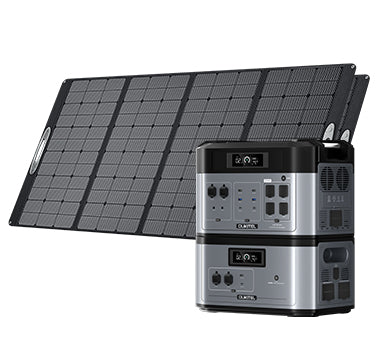
P2001 Plus (2,048Wh / 2,400W, surge 4,800W; adjustable AC charge 400–1,800 W):
[a][b]
Best ~5kWh single-box (≈ 5,000–5,200Wh): the Storm-Ready Tank

Who it’s for: home backup (multi-appliance/longer outage), mobile work base, cabin users.
Spec targets:
- ~5,120 Wh capacity in one chassis
- 2,200–3,600 W inverter; surge ≥ 4,000 W
- Fast AC input (~1,800 W) to full in ≲3 h; 1,000 W solar input class
- Wheels + telescopic handle (weight is real here)
- EPS/“UPS-like” transfer under 10 ms for critical loads
Why it wins on Black Friday: Less common but high impact. If you see a major price drop or a panel bundle at a fair delta vs buying separate, that’s a go-signal.
Example to compare:
-
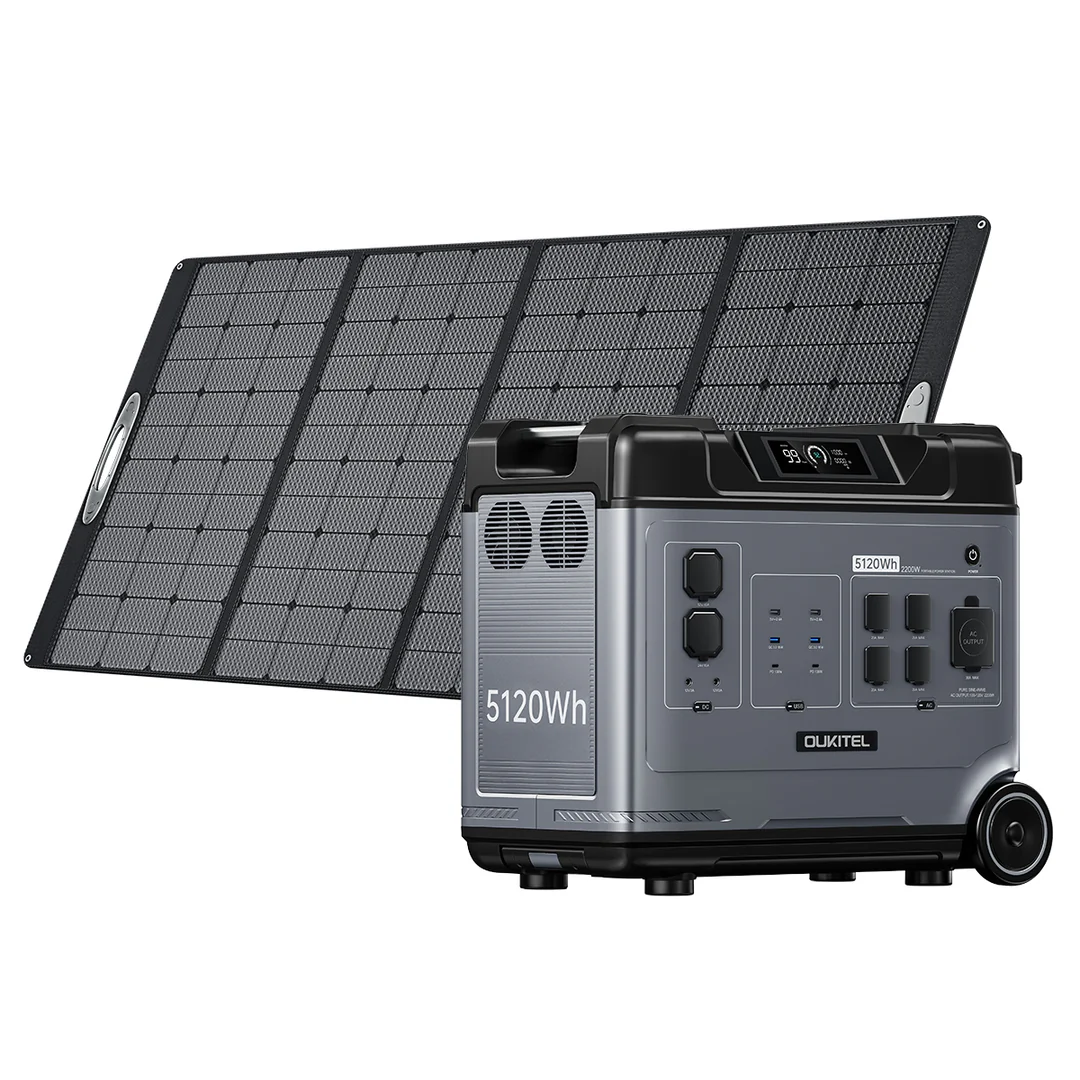
P5000 (5,120Wh / 2,200W, 1,800 W AC input; 1,000 W solar class):
Use the PDP to validate weight, wheels, handle, and how quickly you can refuel it between outage windows.
Best expandable stack (2–16kWh+): the Grow-With-You System
Who it’s for: serious backup that scales over time (off-grid cabins, frequent storm zones), or RVers who eventually want big arrays.
Spec targets:
- Base unit ~2 kWh + expansion batteries to 4/6/8/10+ kWh
- 2,200–3,300 W inverter (or more), dual input (AC + solar)
- EPS/“UPS-like” and an app that shows per-module status
- Rollable or stack-secure designs (safety & cable management)
Why it wins on Black Friday: The bundle math can be excellent: base + 1–2 expansions or base + panels. Calculate $ per Wh and compare to single-box alternatives.
Deal Radar: simple table you can use in your cart
|
Capacity target |
Good sale signs |
Red flags |
|
~600Wh |
PD 100 W, quiet fans, AC <2 h |
Heavy for size, weak PD/DC mix |
|
~1kWh |
0–80% ≈ 39–60 min, EPS <10 ms |
Only slow AC input, no PD 100 W |
|
~2kWh |
2.2–2.4 kW inverter, surge ≥ 4.8 kW |
Loud at modest loads, limited DC |
|
~5kWh |
1,800 W AC input, 1,000 W solar, wheels |
Tiny solar input cap, no wheels |
|
Expandable |
AC+solar dual input, clean stacking |
Fussy cabling, unclear app telemetry |
How to verify a real Black Friday portable power station deal
- Baseline the normal price (MSRP vs typical selling price).
- Check the bundle premium: Is panel/trolley actually cheaper than buying separate?
- Read the fine print: Warranty (look for 3-year), LiFePO₄ cycles (3,500–5,000+), and return window.
- Noise & fan curve: Claims like “<30 dB at <500 W” or “<50 dB under load” are extremely meaningful.
- Input limits: Fast AC is great; ensure the solar voltage/amp window suits the panel you own (or plan to buy).
- App & ports: PD 100 W + app control makes everyday use smoother.
Buyer’s quick math (so you don’t over/under-buy)
- Daily Wh = sum of (device watts × hours).
- Pick capacity = Daily Wh × 1.2–1.3 (headroom).
- Inverter size ≥ your simultaneous watts + 20–30%.
- Surge must cover motors/compressors (fridge, pump).
- If you’ll solar recharge, aim panel watts to match or exceed daily Wh / PSH (peak sun hours).
Where the best bundles usually appear
- ~1kWh stations with 100–200 W panels (compact camp/van set).
- ~2kWh stations with 200–400 W panels (RV/home hybrid).
- ~5kWh with 400–1,000 W solar (serious backup).
- Trolley/wheels, extra cables, and extended warranty often sweeten the cart.
Three example product pages to benchmark (feature sanity checks)
-
~1kWh class: P1000 Plus (1,024Wh / 1,800W, 0–80% ≈ 39 min)
/collections/portable-power-station/products/oukitel-p1000-plus-portable-power-station -
~2kWh class: P2001 Plus (2,048Wh / 2,400W, surge 4,800W; adjustable AC charge)
/collections/portable-power-station/products/oukitel-p2001-plus-portable-power-station -
~5kWh class: P5000 (5,120Wh / 2,200W; 1,800 W AC input; up to 1,000 W solar)
/collections/portable-power-station/products/oukitel-p5000-portable-power-station
Use these as reference points while you shop deals on portable power station offers across the web—focus on capacity, inverter, fast charge, solar input, and noise.
Pro tips to stretch your Black Friday dollar
- Don’t overbuy inverter watts you’ll never use—focus on Wh and quiet operation.
- DC first: If your loads can run on USB-C PD / 12 V, you’ll extend runtime.
- Charge modes: If the unit lets you dial AC input (e.g., 400/800/1200/1800 W), you can balance speed vs battery longevity.
- Check EPS: If you plan to use it like a “UPS-lite” for PCs/routers, <10 ms is the spec to watch.
- Think logistics: For 5 kWh class, wheels + telescopic handle are not luxuries—they’re sanity savers.
- Coupons & wheel spinners: Many stores add an extra code at checkout (newsletter or spin-to-win). Stack it.
Frequently Asked Questions
Are Black Friday portable power station deals actually worth it?
Yes—especially in the ~1kWh and ~2kWh tiers where competition is fiercest. You’ll often see deep discounts or bundles (station + solar) that beat spring pricing.
What size should I buy for home backup?
For fridge + lights + router, ~2kWh is a practical starting point. If you want multi-day resilience, consider ~5kWh or modular expansion—then add solar so you can recharge during daylight.
What’s the difference between 1kWh and 2kWh in real life?
It’s not just double the runtime; the ~2kWh tier usually brings a 2.2–2.4 kW inverter, dual input, and better surge handling—so you can power more while running longer.
How important is fast AC charging?
Crucial if you’re topping up between outages or before leaving for a trip. 0–80% in ~39–60 minutes on ~1kWh units is a huge convenience; 1–1.5 h to 80% on ~2kWh units is excellent.
Do I need solar?
If your goal is extended off-grid or long outages, yes. For regular home backup, solar is optional but nice to have—especially if your area has multi-hour grid issues.
Are LiFePO₄ batteries really better?
For longevity and stability, yes. Look for 3,500–5,000+ cycles to ~80% capacity. That’s why many 2025 portable power station deals emphasize LFP.
Sample cart strategy (copy/paste)
- Pick a capacity bucket (800Wh / 1kWh / 2kWh / 5kWh).
- Shortlist 3 models; compare: Wh, W, surge, AC fast charge, solar input, weight, noise.
- Price check bundle math vs buying separate (panels, trolley).
- Apply a stackable coupon (newsletter/spin wheel).
- Confirm warranty (aim for 3-year on power station).
- Checkout—done.
Final word
The best Black Friday portable power station deals are the ones that fit your actual loads, not just your FOMO. Decide your capacity tier, check the handful of specs that matter (fast charge, quiet, EPS, solar input), and lock in a bundle when the math works. Whether you’re prepping for storms, outfitting a van, or just want reliable backup for your home office, there’s a Black Friday win waiting in the ~1kWh and ~2kWh sweet spots—and some can’t-miss offers in ~5kWh if you’re going big this year.


Looking for something else?
mAh to kWh: How to Convert and Understand Battery Capacity
LEARN MORE
How Many mA in an Amp: Understanding Electrical Conversion
LEARN MORE
Solar Array Roof: How to Mount on Pitched and Non-Pitched Roofs
LEARN MORE
Power Tool Battery Standardization: Benefits and Guidelines
LEARN MORELooking for something else?
What Size Portable Power Station Do I Need: Complete Guide
LEARN MORE
Watts to BTU/hr: How to Convert and Apply the Formula
LEARN MORE
OUKITEL Energy Storage Shines at the 139th Canton Fair, Global Customers Experience Product Strength On-Site
LEARN MOREYou may also like

OUKITEL P2001 Plus+2*200W Solar Generator

OUKITEL P2001 Plus+200W Solar Generator

OUKITEL BP3000 Portable Power Station 3200W | 2048Wh
OUKITEL P5000 Pro+400W Solar Generator

OUKITEL BP2000+400W Solar Generator

OUKITEL P5000+2*400W Solar Generator
Further reading
Portable Power Station for Van Life: 1-7 Day System Sizing Guide
Portable Power Station for Apartment Blackouts: Indoor Backup Guide