








 Flashlight
 Solar
Extension Cable
Solar
Extension Cable


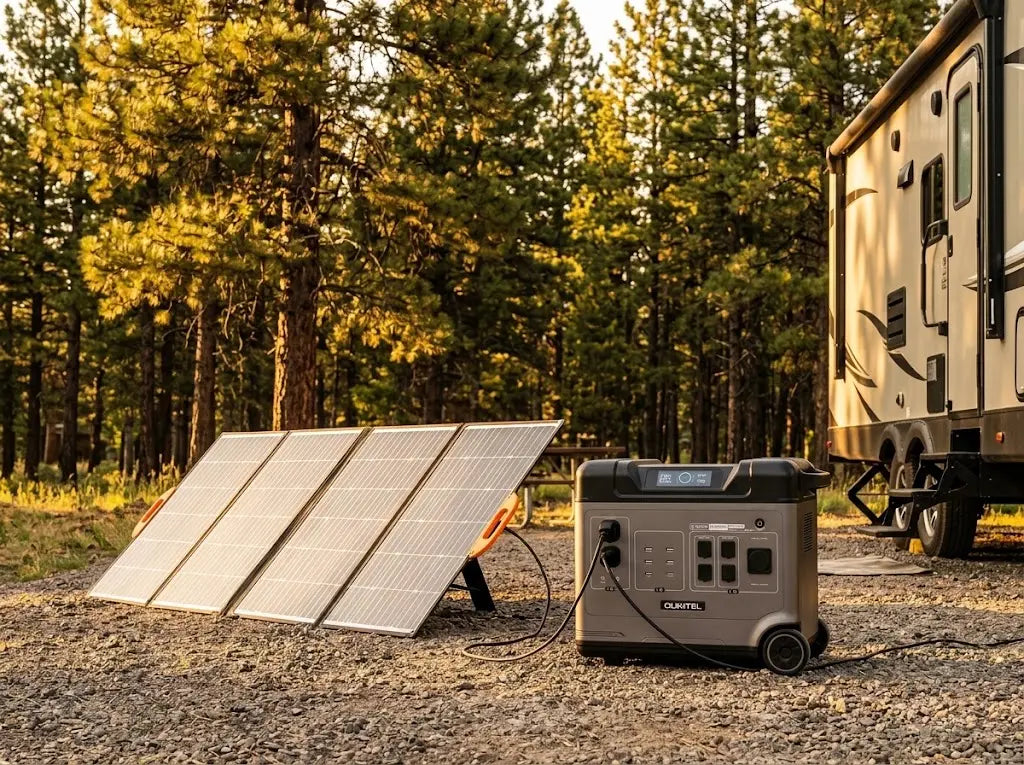
What Size Portable Power Station Do I Need? Calculator + 10 Real Scenarios
What size portable power station you need depends on what you plug in, how long it has to run, and whether anything on the list has a motor. Phones and a CPAP fit on a 500Wh unit. A refrigerator through a day long outage needs closer to 2,000Wh.
Most buyers get it wrong in one of two ways.
Some buy on battery size alone and find the inverter cannot start their fridge. Others pick the biggest unit on the page and end up with 120 lb of battery that mostly charges a laptop. The five steps below avoid both, and the 10 scenarios give you a number to check against.
Quick answer: the three formulas
Battery capacity (Wh) = each device’s watts x hours, added up, then ÷ 0.85
Continuous output (W) = watts of everything running at once x 1.2
Surge (W) = loads already running + the largest startup draw
What Size Portable Power Station Do I Need by Capacity?
Start here. Find the row closest to how you will use it, then confirm with the math further down. The example models come from the OUKITEL portable power station lineup, with ratings taken from the current product pages.
|
Capacity band
|
Best for
|
Typical loads
|
Example model
|
|
300 to 600Wh
|
Day trips, remote work, one CPAP night
|
Phones, laptop, router, LED lights
|
P800: 512Wh, 800W
|
|
1,000 to 1,500Wh
|
Weekend camping, short outages
|
CPAP, TV, compact fridge, fan
|
P1000 Plus: 1,024Wh, 1,800W
|
|
2,000 to 3,000Wh
|
Fridge backup, RV weekends, family camping
|
Full size fridge, sump pump, tools
|
P2001 Plus: 2,048Wh, 2,400W
|
|
5,000Wh and up
|
Multi day outages, off grid, heavy loads
|
Fridge plus freezer, window AC, well pump
|
P5000 Pro: 5,120Wh, 3,600W
|
Weight catches people out. The P800 is about 13 lb and goes anywhere. A 5,120Wh unit is over 115 lb, so it stays in the garage or rolls on its own wheels.
Watts vs Watt Hours: Which Number Decides the Size?
Both of them. They answer different questions.
Watts tell you what the station can run at one moment. Watt hours tell you how long it keeps going. The U.S. Department of Energy rates storage the same way, with power and stored energy listed as two separate figures.
A 2,500Wh battery on a 1,500W inverter cannot run a 2,000W space heater at all. Put 2,000W of output in front of a 500Wh battery and the same heater runs for roughly 12 minutes.
Surge and voltage come next. Motors pull a short spike when they start, and a 120V only unit will not run a 240V well pump however large the battery is.
How to Calculate the Size You Need in 5 Steps
Step 1: List Devices and Mark What Runs Together

Walk through the house with a notepad. The wattage is printed on the label, the power brick, or in the manual. If a label lists amps only, multiply by 120 for a standard US outlet. Circle anything that might run at the same time as something else.
Step 2: Add Running Watts and Multiply by 1.2
Add the circled items and multiply by 1.2. A 1,000W coffee maker plus an 80W laptop is 1,080W, so look for about 1,300W of continuous output.
Step 3: Check the Largest Startup Surge
Most guides skip this step. Take the load already running, add the biggest startup draw on your list, and compare the total with the surge rating. With 300W running and a fridge that needs 600W to start, the station has to deliver about 900W for that first second.
Step 4: Convert Hours into Watt Hours
Now switch to hours. Multiply each device’s watts by the hours you will actually use it, then add the results. Typical figures are below. Your own labels are better.
|
Device
|
Running watts
|
Typical use
|
Energy used
|
|
Phone charging
|
10 to 20W
|
2 hours
|
20 to 40Wh
|
|
Laptop
|
60W
|
4 hours
|
240Wh
|
|
WiFi router
|
15W
|
24 hours
|
360Wh
|
|
CPAP, no heated humidifier
|
40W
|
8 hours
|
320Wh
|
|
Full size refrigerator
|
100 to 200W, cycles
|
24 hours
|
Measure it: often 1,000 to 2,000Wh
|
|
Coffee maker
|
1,000W
|
6 minutes
|
100Wh
|
|
Window AC
|
800W
|
4 full load hours
|
3,200Wh
|
Step 5: Divide by 0.85 and Keep a Reserve
Divide the total by 0.85. The inverter loses some energy turning the battery’s DC into AC, and this covers it. After that, round up to the next size class. Sizing to the exact number leaves nothing for a cold night or one more phone.
The 1.2 multiplier does not cover surge
Compressors and pumps can briefly pull 2 to 3 times their running watts. The multiplier in Step 2 is headroom for steady loads only, so check the surge rating separately.
10 Real Scenarios: What Size Power Station Do You Need?
These are the setups we get asked about most. Swap our wattages for yours and the method still works.
|
#
|
Scenario
|
Energy used
|
÷ 0.85
|
Size class
|
|
1
|
Phone 2h, laptop 4h, router 8h
|
380Wh
|
447Wh
|
500Wh
|
|
2
|
CPAP 40W for 8 hours
|
320Wh
|
376Wh
|
500Wh
|
|
3
|
Refrigerator, 10 hour outage (measured)
|
850Wh
|
1,000Wh
|
1,000 to 1,500Wh
|
|
4
|
Fridge, router, lights, phones for 10 hours
|
1,190Wh
|
1,400Wh
|
1,500 to 2,000Wh
|
|
5
|
Weekend camping for two, per day
|
540Wh
|
635Wh
|
700 to 1,000Wh
|
|
6
|
Family camping with portable fridge
|
1,780Wh
|
2,094Wh
|
2,000 to 2,500Wh
|
|
7
|
Weekend RV, per day
|
1,800Wh
|
2,118Wh
|
2,000 to 3,000Wh
|
|
8
|
Sump pump 800W, 15 min per hour, 8 hours
|
1,600Wh
|
1,882Wh
|
2,000Wh + high surge
|
|
9
|
Window AC, 4 full load hours
|
3,200Wh
|
3,765Wh
|
About 4,000Wh
|
|
10
|
Essential home loads for 24 hours
|
3,000Wh
|
3,529Wh
|
3,500 to 5,000Wh
|
Scenarios 3 to 7: Refrigerator, Camping and RV
The refrigerator is what pushes most buyers past 1,000Wh. A closed fridge keeps food safe for about 4 hours without power, according to FoodSafety.gov, and plenty of outages run longer than that.
In our experience, a full size fridge measures somewhere between 1,000 and 2,000Wh a day. That is less than the label implies, because the compressor switches on and off.
The OUKITEL P2001 Plus fits scenarios 4, 6 and 7. It holds 2,048Wh with 4,800W of surge, enough to start most home refrigerators, and B2000 batteries can be added later. If a freezer is on the list too, our guide on how to size a power station for a refrigerator and freezer covers the pair.
Scenarios 8 to 10: Pumps, AC and 24 Hour Home Backup

Pumps and air conditioners are where small units fail. The sump pump in scenario 8 uses only about 200Wh an hour, yet it needs a strong startup surge every time the float trips.
Whole home backup is a different scale. The average U.S. household uses about 10,500kWh a year, roughly 29kWh a day, according to the EIA. No portable station covers that, so pick essentials.
For a 240V well pump, look at the BP5000 Pro Max. It supplies 120/240V split phase power at 5,000W continuous and 10,000W peak.
Placement is simpler than with a gas generator, which the CPSC says must run outdoors at least 20 feet from the home. A battery station has no exhaust. It can sit in the kitchen beside the fridge.
How Long Will a Portable Power Station Last?
Multiply the rated watt hours by 0.85, then divide by the average load. The result is runtime in hours.
At a steady 100W, the P1000 Plus (1,024Wh) lasts about 8.7 hours and the P2001 Plus (2,048Wh) about 17. The P5000 Pro (5,120Wh) runs a 300W load for around 14.5 hours.
Expect less in cold weather.
Service life is a separate question from runtime. For that, see how many years a LiFePO4 power station lasts.
How Recharging and Expansion Change the Size

If you can recharge every day, a smaller battery can work. Weather is the catch.
Say you use 1,500Wh a day and your panels put back 700Wh. You fall 800Wh short each day, and two cloudy days in a row can empty the battery. Solar input also has a limit: 500W on the P1000 Plus and 1,000W on the P5000 Pro.
Expansion batteries add watt hours but not inverter output. A bigger battery still will not start a load the inverter cannot handle.
Common Sizing Mistakes to Avoid
-
Reading 2,000W as 2,000Wh. One is output, the other is storage.
-
Fridge math done as running watts x 24, which overstates use. A plug in meter gives the real figure.
-
Skip the surge check and a pump may never start.
-
A 120V unit will not run a 240V appliance.
-
No reserve at all, sized to the exact total.
Conclusion: Size for Real Loads, Then Add Reserve

Size for the loads you actually have, then add a margin. We’ve found most households need less capacity than they expect once the space heater comes off the list.
-
List your devices and hours, then run the three formulas.
-
Find your band in the capacity table and the closest of the 10 scenarios.
-
Compare models in the OUKITEL portable power station lineup, or browse the full range at OUKITEL.
FAQs
Is a 500Wh portable power station enough?
For small electronics, yes.
You get about 425Wh of usable AC power. That covers a day of remote work or one night on a CPAP. It will not carry a full size fridge through an outage.
Roughly what 425Wh runs:
-
50W load: about 8.5 hours
-
CPAP at 40W, around 10 hours
-
A 60W laptop for 7 hours
-
Not a refrigerator for any real outage
Is a 1000Wh portable power station enough, and how long will it last?
Usually, for camping and short outages.
About 850Wh is usable. If your total from Step 5 already sits near that, move up one size.
Runtime at a steady load:
-
100W: about 8.5 hours
-
At 200W, a little over 4 hours
-
500W drains it in under 2 hours
-
Cycling fridge: measure its Wh first
What size portable power station do I need for a refrigerator?
What size portable power station you need for a refrigerator is usually 1,000 to 2,000Wh for one day.
The label overstates daily use because the compressor cycles. A plug in meter left on for 24 hours gives the real number, and the inverter still has to handle the startup spike.
Checklist:
-
Measure Wh over 24 hours
-
Divide by 0.85
-
Surge: 2 to 3 times running watts
-
With a freezer, go up one size class
What size portable power station do I need for a CPAP machine?
A 500Wh unit, for most machines without heated humidification.
Heated humidifiers and heated tubing can double the draw. Cleveland Clinic suggests asking your CPAP provider about battery options before a trip without power.
Plan around:
-
40W for 8 hours needs about 376Wh
-
With humidifier heat on, size up to 1,000Wh
-
Flying: the FAA bans power stations over 160Wh on passenger aircraft
What can a 2000W portable power station run?
Anything adding up to less than 2,000W, as long as the startup surge fits.
The output rating says nothing about runtime. That comes from the Wh figure.
Loads that usually fit:
-
Fridge, TV and router together
-
One kitchen appliance at a time, such as a microwave
-
Circular saws and small air compressors
-
Not 240V equipment
Is 2000Wh enough for home backup?
For essentials over about one day, yes.
About 1,700Wh is usable. Space heaters, window AC and electric cooking drain it within a few hours, so leave them off.
What it can carry:
-
A fridge for 12 to 20 hours
-
Router, lights and phones on top
-
Several nights of CPAP use
-
Whole home heating or cooling: no
How much portable power do I need for a 24 hour outage?
Add each essential’s watts x hours over 24 hours, then divide by 0.85.
A fridge, router, lights, phones and two laptops often come to about 3,000Wh. That points to roughly 3,500Wh of rated capacity.
To bring the number down:
-
Drop space heaters and electric cooking
-
Solar panels can recharge during the day
-
Keep the fridge door shut
-
Charge phones and laptops before the storm


Looking for something else?
Best Solar Generator for Home Backup: 2026 Buyer's Guide
LEARN MORE
What Size Solar Generator Do You Need? 2026 Sizing Guide by Real Use Case
LEARN MORE
What Can a 1200 Watt Generator Run? 2026 Appliance Guide
LEARN MORE
Are Solar Generators Worth It in 2026? Honest Buyer Analysis
LEARN MORELooking for something else?

How Much Solar Do You Need for Your RV? 2026 Sizing Guide by Use Case
LEARN MORE
Can You Take a Solar Generator on a Plane? 2026 TSA + FAA Rules
LEARN MORE
OUKITEL 2026 Prime Day & Membership Guide: Rewards, Points, and Limited-Time Offers
LEARN MOREYou may also like

OUKITEL BP2000+400W Solar Generator
$1,269.00
$1,799.00

OUKITEL P5000+2*400W Solar Generator
$2,098.00
$3,599.00

OUKITEL P5000 Pro+2*400W Solar Generator
$2,398.00
$3,398.00

OUKITEL BP2000+2*400W Solar Generator
$1,869.00
$2,399.00

OUKITEL BP2000+2*B2000 Home Backup
$2,099.00
$2,799.00
Further reading

How Long Will a 2048Wh Battery Last? 30 Appliances + Formula
Leave a 100W device running on a 2048Wh battery and you can expect somewhere around 17 or 18 hours before it shuts off. Bump the load up to 500W and you're looking at three and a half hours or so....

What Can a 3300W Power Station Run? Home Backup Load Planning
A 3300W power station can run most of what you'd plug in during a blackout. Think fridge, freezer, a few lamps, the WiFi, a TV and laptops, even the microwave or a small window AC. The only rule i...

What Can a 2400W Power Station Run? 25 Appliances and Safe Load Combos
A 2400W power station can run your fridge, WiFi router, lights, TV, laptops, CPAP and a fan at once, plus one big appliance like a microwave or coffee maker. It won’t run central air, an electric ...