








 Flashlight
 Solar
Extension Cable
Solar
Extension Cable


What Can a 2000W Power Station Run? Device List, Surge and Runtime
What a 2000W power station can run comes down to two numbers, really: how many watts you have switched on at once, and the extra jolt a motor asks for in the first second after it starts. Stay under both and a fridge, the WiFi, a few lamps, the TV, a couple of laptops and a CPAP will all run, with room for one kitchen appliance at a time. You won't run central air, an electric dryer or a tank water heater.
People often mix up the 2,000W on the box with how long the unit lasts. That second part comes from the battery, which is measured in watt hours. Put the same 2,000W inverter in front of a 1,000Wh battery and then a 2,048Wh one, and you get two very different nights.
Below, the OUKITEL team walks through a device list, how surge works, what the runtimes look like and which combinations usually trip the inverter.
What Can a 2000W Power Station Run? Device List
These are typical numbers. The label on your appliance, or a cheap plug in energy meter, will tell you what yours actually pulls.
|
Device
|
Running watts
|
Startup surge
|
On a 2000W station
|
|
Phone, laptop, router
|
10 to 100W
|
None
|
Yes, all day
|
|
LED lights, fans
|
10 to 75W
|
Low
|
Yes
|
|
TV and streaming box
|
60 to 200W
|
None
|
Yes
|
|
CPAP machine
|
30 to 90W
|
None
|
Yes, several nights
|
|
Refrigerator or freezer
|
100 to 250W
|
Brief spike at compressor start
|
Yes, leave headroom
|
|
Slow cooker
|
150 to 300W
|
None
|
Yes
|
|
Coffee maker
|
600 to 1,200W
|
None
|
Yes, on its own
|
|
Microwave (input watts)
|
1,000 to 1,500W
|
Low
|
Yes, alone
|
|
Kettle, hair dryer, space heater
|
1,200 to 1,800W
|
None
|
Short use only
|
|
Small window AC
|
500 to 900W
|
High
|
Often, check surge
|
|
Circular saw
|
1,200 to 1,800W
|
High
|
Sometimes
|
|
Central AC, dryer, range, water heater
|
3,000W and up, often 240V
|
High
|
No
|
What Does 2000W Mean on a Power Station?

It's the continuous AC output of the inverter. If you plug in more than that, the station cuts power to the outlets to protect itself, and you'll need to unplug something and switch AC back on. On the spec sheet you'll also see a surge figure, which is how much the inverter can give for a second or two while a motor gets going, and a watt hour figure, which is the size of the battery.
Running Watts vs Startup Surge

Take a fridge that hums along at 150W. When its compressor switches on, it can pull several times that for a moment, and it does this again and again through the day. That spike doesn't arrive into an empty house either. If the TV, lamps and a laptop are already drawing 600W, the inverter has to carry all of it in that same second. Our rule of thumb, and the one we give customers on the phone, is to keep whatever runs steadily under about 80% of the rating.
How Long Will a 2000W Power Station Run?
The math is simple enough. You take the usable watt hours and divide by the load, but usable is the key word, because about 15% disappears as heat inside the inverter. On a 2,048Wh unit that leaves roughly 1,740Wh you can actually use (2,048 × 0.85). Here's what that looks like for common loads.
|
Load
|
Average draw
|
Runtime on 2,048Wh
|
|
Modem and router
|
20W
|
About 87 hours
|
|
Laptop
|
60W
|
About 29 hours
|
|
Refrigerator, cycling
|
60 to 100W
|
17 to 29 hours
|
|
CPAP
|
30 to 90W
|
19 to 58 hours
|
|
Slow cooker, low
|
250W
|
About 7 hours
|
|
Microwave
|
1,000W
|
About 100 minutes of cooking
|
|
Space heater
|
1,500W
|
About 70 minutes
|
CPAP users tend to land at the high end if they use a heated humidifier or heated hose. Our CPAP sizing guide explains how to measure a real night instead of guessing from the adapter.
What Can a 2000W Power Station Run at the Same Time?
Forget counting plugs. Ten phone chargers and lamps barely make 100W. Two space heaters, on the other hand, get you to almost 3,000W with nothing else plugged in.
A normal outage evening fits easily. Add up the fridge, router, a couple of lamps, a laptop and the TV and you're only around 370W. Make coffee in the morning on a 900W machine and you're at about 1,050W. Later on, a 1,000W microwave reheating leftovers brings it to around 1,150W, which still leaves the fridge enough room to kick on.
Trouble starts when two heating appliances overlap. A microwave and a kettle together are about 2,700W. A space heater and a coffee maker come to 2,400W, and a hair dryer with the microwave is roughly 2,800W. We've seen setups at 1,900W on paper shut off anyway because the fridge picked that moment to start. Spacing the big appliances a few minutes apart usually fixes it.
|
Watch out: Anything that makes heat, like a kettle, toaster or heater, empties the battery quicker than the rest of the house combined. Run them one at a time and turn them off when you're done.
|
Can a 2000W Power Station Run a Refrigerator or AC?
Refrigerator and Freezer
In most homes, yes. FoodSafety.gov says a closed fridge keeps food safe for about 4 hours without power and a full freezer for about 48, so the station is really there for the hours after that. The age of the fridge matters. ENERGY STAR estimates a model over 15 years old can cost about $95 more a year to run, and on a battery that extra use shows up as fewer hours.
Window AC vs Central Air
A small window unit will often run, as long as its compressor surge fits and you aren't running much else. How many hours you get then comes down to the battery, and our window AC runtime guide works through it by BTU. Central air is a different story. According to EIA data, air conditioning makes up 19% of home electricity use, more than any other single use, and most central systems run on 240V.
What a 2000W Power Station Can't Run
Central air and heat pumps are out, along with electric dryers, ranges, ovens and tank water heaters. Most well pumps are too, since they often need 240V and a big starting current. Two heating appliances at once will also go over the limit.
One thing a battery does better than a gas generator is work indoors. The CPSC warns against running a portable generator inside a home or garage even with the windows open, and says to keep it at least 20 feet from the house.
Using a 2000W Power Station for Camping, RVs and Tools

Camping is the easy case. A 12V cooler fridge, string lights, a fan and everybody's phones rarely get past 200W, so there's plenty left over for the kettle or coffee in the morning. In an RV, a TV, roof fan, laptop and short microwave sessions are fine, though the rooftop AC is usually too much. For tools, drills, sanders and smaller saws work one at a time. A saw rated close to 1,800W doesn't leave much room for its own start.
How Solar Charging Extends Runtime

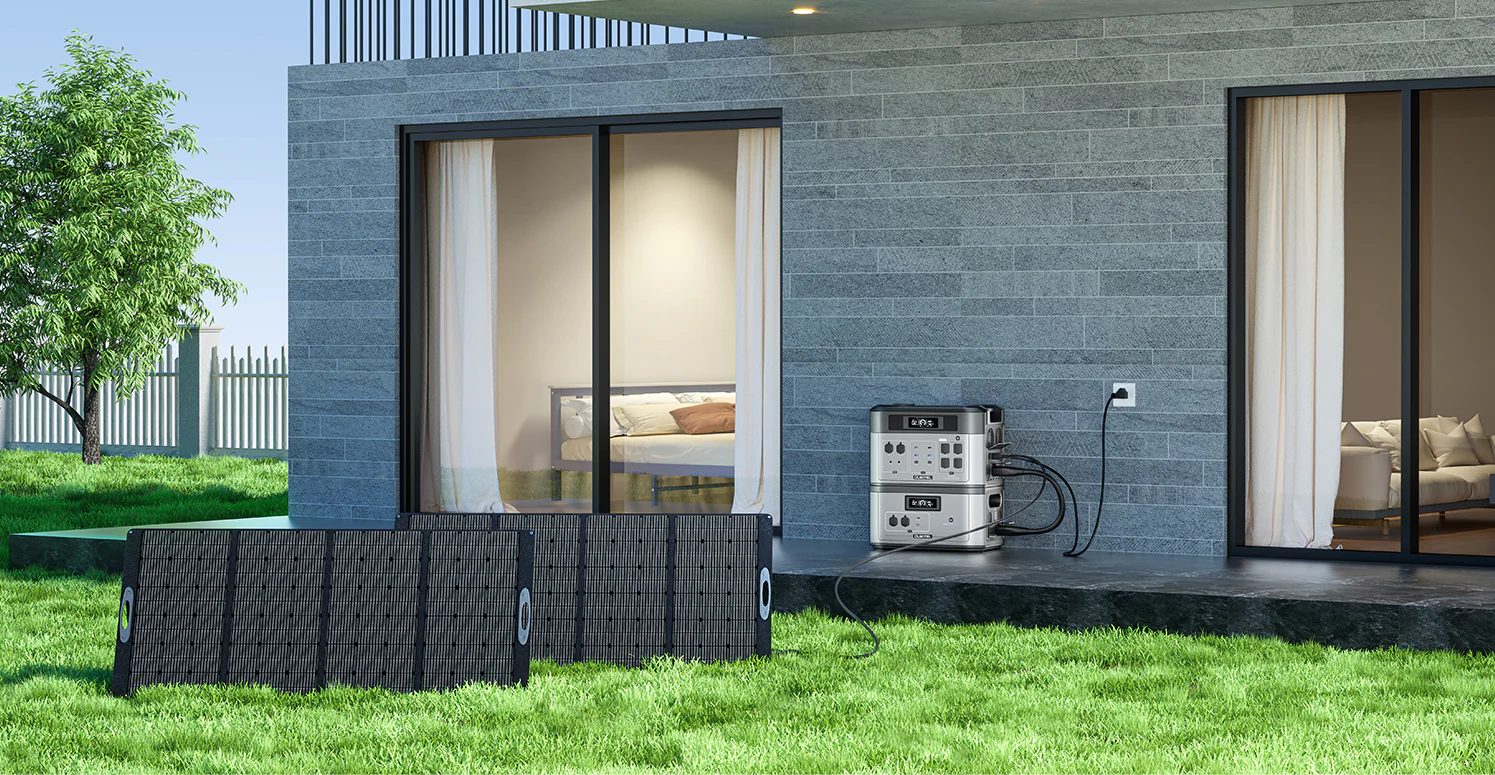
Panels don't change the 2,000W ceiling. What they do is refill the battery during the day, so the fridge and router make it into a second or third night. Five hours of decent sun on 400W of panels can put back something like 1,200 to 1,600Wh. How much you really get depends on the sun reaching them, the angle and any shade, as the U.S. Department of Energy notes, so don't plan on the number printed on the panel. Check the station's maximum solar input, too, before buying more panels than it can take.
Which OUKITEL 2000W Class Station Fits?
|
Model
|
Capacity
|
Output
|
Best for
|
|
2,048Wh
|
2,400W, 4,800W surge
|
Fridge backup, RV, CPAP
|
|
|
BP2000 Pro with B2000
|
2,048Wh, expands to 16,384Wh
|
3,300W
|
Multi day outages, heavier overlap
|
On paper the P2001 Plus is a 2,400W unit, so it has 400W more headroom than a basic 2000W station. From the wall it gets to 80% in about an hour, it takes up to 500W of solar, and if the grid drops it switches over in under 10ms, fast enough that most routers don't notice. The BP2000 Pro is the one for longer outages. You can add up to seven B2000 batteries to it, and it'll take 1,000W of solar. Both units are built on LiFePO4 cells. If you'd like to see ports and charging options next to each other, the full portable power station range has them.
|
Tip: If your power tends to stay off for more than a day at a time, get a model you can expand. Buying one extra battery later costs a lot less than buying a second station.
|
Plan Your 2000W Setup in 3 Steps
-
Make a list of what you'll have on together, then add up the running watts.
-
Find the biggest motor on it (usually the fridge), add its startup surge, and check that number against the surge rating.
-
Work out runtime last: watts times hours for each item, add those up, divide by 0.85, and see how it compares with the battery's Wh.
Conclusion
In short, what a 2000W power station can run is most of what keeps a home livable in an outage. That means the fridge, WiFi, lights, TV and a CPAP, plus one kitchen appliance at a time. The watt rating limits what's on together. Whether motors start depends on surge, and how long you last depends on the battery. Use heating appliances in short bursts, give the compressor room, and buy enough capacity for the outages you actually get. If those go on for days, buy a unit that can expand.
FAQs
How Long Will a 2000 Watt Power Station Run a Refrigerator?
Usually 17 to 29 hours if the battery is around 2,048Wh. A fridge isn't running flat out all day. Its compressor switches on and off, which works out to an average of 60 to 100W for most models, and roughly 1,740Wh of the battery actually reaches the plug. A warm kitchen or lots of door opening will pull that toward the lower number. If you want your own figure, leave an energy meter on the fridge for a full day.
Is 2000W Enough to Power a House?
It's enough for the essentials, not the whole house. A fridge, router, lights, TV and phone chargers fit inside 2,000W without much trouble. Central air, a dryer or a water heater won't, and anything on 240V needs a split phase unit.
Can I Run a Refrigerator on a 2000 Watt Generator?
Yes. Running watts are rarely the problem, since most fridges sit between 100 and 250W. The startup spike is what catches people out. Leave some room for it, or use a unit with a big surge rating such as the 4,800W on the P2001 Plus. And skip the long, thin extension cord if you can. Plug the fridge straight in.
What Will a 3000 Watt Power Station Run?
Everything a 2000W unit does, with more room for overlap, so a microwave and coffee maker together or a bigger window AC. It won't last longer on its own, though. A 3,000W unit with a 2,048Wh battery runs the same load for the same time as a 2,000W one.
What Is a Good Portable Power Station With 2000W?
We'd start with the battery: around 2,000Wh, ideally LiFePO4 since it holds up for thousands of cycles. Then check for a pure sine wave inverter, a surge rating about double the continuous one, fast wall charging and a decent solar input. If long outages happen a lot in your area, it's worth paying for expansion. Check the weight as well. The P2001 Plus is 48.5 pounds.
Will a Generator Run a Crockpot?
Yes, easily. Most slow cookers only pull 150 to 300W. The catch is how long it stays on. Six hours at 250W comes to 1,500Wh, and that's most of a 2,048Wh battery gone on one stew. The low setting and a full pot help, because the cooker cycles less once it's hot.
Will a 400W Solar Panel Run a Fridge?
Not on its own, but paired with a power station it can keep one going. On a sunny day a 400W panel puts back roughly 1,200 to 1,600Wh, which is close to what a lot of fridges use. Overnight and on cloudy days, it's all on the battery.
Will a Fridge Stay Cold for 8 Hours Without Power?
Not safely. Food in a closed fridge is only considered safe for about 4 hours. Freezers do better, around 48 hours when full and 24 when half full. So past four hours you either get the fridge back on power or move the meat and dairy into a cooler with ice.


Looking for something else?
Best Solar Generator for Home Backup: 2026 Buyer's Guide
LEARN MORE
What Size Solar Generator Do You Need? 2026 Sizing Guide by Real Use Case
LEARN MORE
What Can a 1200 Watt Generator Run? 2026 Appliance Guide
LEARN MORE
Are Solar Generators Worth It in 2026? Honest Buyer Analysis
LEARN MORELooking for something else?

How Much Solar Do You Need for Your RV? 2026 Sizing Guide by Use Case
LEARN MORE
Can You Take a Solar Generator on a Plane? 2026 TSA + FAA Rules
LEARN MORE
OUKITEL 2026 Prime Day & Membership Guide: Rewards, Points, and Limited-Time Offers
LEARN MOREYou may also like

OUKITEL P800 Portable Power Station 800W | 512Wh
$259.00
$399.00

OUKITEL B2000 Expansion Battery | 2048Wh
$699.00
$999.00
OUKITEL BP5000 PRO MAX Portable Power Station 5000W | 5120Wh
$1,999.00
$2,999.00

OUKITEL BP2000 PRO Portable Power Station 3300W
$879.00
$1,599.00

OUKITEL C01 Car Jump Starter 1350A | 80Wh | PD60W
$169.00
$299.00
OUKITEL BP3000 Portable Power Station 3200W | 2048Wh
$959.00
$1,599.00
Further reading

How Long Will a 2048Wh Battery Last? 30 Appliances + Formula
Leave a 100W device running on a 2048Wh battery and you can expect somewhere around 17 or 18 hours before it shuts off. Bump the load up to 500W and you're looking at three and a half hours or so....

What Can a 3300W Power Station Run? Home Backup Load Planning
A 3300W power station can run most of what you'd plug in during a blackout. Think fridge, freezer, a few lamps, the WiFi, a TV and laptops, even the microwave or a small window AC. The only rule i...

What Can a 2400W Power Station Run? 25 Appliances and Safe Load Combos
A 2400W power station can run your fridge, WiFi router, lights, TV, laptops, CPAP and a fan at once, plus one big appliance like a microwave or coffee maker. It won’t run central air, an electric ...