








 Flashlight
 Solar
Extension Cable
Solar
Extension Cable


Portable Power Station for Van Life: 1–7 Day System Sizing Guide
Someone on r/urbancarliving posted that they were starting van life and felt completely lost on what power setup to buy. We get that question constantly, and our first reply is always the same: what does your van use in a day, in watt-hours? Most builds come in somewhere between 600 and 1,200Wh with a fridge, a laptop, lights and an overnight fan, and that figure decides which portable power station for van life makes sense far more than any brand name does.
Stretch that over a three day trip and a 1,000 to 2,000Wh station usually does it. A whole week is a different animal: 800Wh a day turns into 5,600Wh, more battery than anyone wants bolted into a Transit, so on longer trips the roof and the alternator do most of the work.
What Size Portable Power Station Do You Need for Van Life?
If it's just phones, an LED strip and a fan for the weekend, you'll rarely see more than 600Wh a day. 500 to 1,000Wh is plenty.
The 12V fridge is what moves people up a size. It runs day and night, and most vans with one land at 600 to 1,000Wh, so we steer those owners to 1,000 to 1,500Wh.
Starlink and a laptop for a full workday push usage to 900 to 1,500Wh; buy 1,500 to 2,000Wh.
Full timers vary the most. We've seen them anywhere from 1,200 to 2,000Wh a day, usually on a 2,000 to 3,000Wh station, and anyone cooking on induction or running a roof air conditioner should start at 3,000Wh.
Sizing by Trip Length: 1 to 7 Days
Run the numbers for a van using 800Wh a day, with 85% inverter efficiency, and you get something like this. One night: about 1,000Wh, and charging hardly matters. A long weekend: 2,000 to 3,000Wh if you're relying on the battery alone, though 1,000 to 1,500Wh is enough when the roof or the alternator adds 500Wh a day. Four or five days is where people start buying more battery than they need, 4,000 to 5,000Wh against 1,500 to 2,000Wh with charging. For a full week it's 5,600 to 6,600Wh without a top up, roughly 2,000 to 2,500Wh with one.
How Do You Calculate Your Daily Van Power Needs?
Four steps. Ten minutes with a notepad.
Every AC appliance runs through the inverter, which turns the battery's DC power into AC, as the U.S. Department of Energy explains. Expect to lose something like 15% there, and a little more if you leave the inverter on with nothing plugged in.
-
Walk through the van and list everything that plugs in. The phone charger counts. So does the vent fan.
-
Find the watts on the label or the power brick, or multiply volts by amps (12V at 5A is 60W).
-
Then estimate hours per day, honestly. Most people underestimate the laptop.
-
Add up the column. Divide by 0.85.
|
Device
|
Typical Draw
|
Hours per Day
|
Wh per Day
|
|
12V compressor fridge
|
40 to 60W, cycling
|
24
|
300 to 500
|
|
Laptop
|
60W
|
6
|
360
|
|
Starlink Mini
|
25 to 40W
|
8
|
200 to 320
|
|
Roof vent fan
|
20W
|
8
|
160
|
|
LED lights
|
10W
|
5
|
50
|
|
Electric kettle
|
1,000W
|
0.1
|
100
|
|
Induction cooktop
|
1,500W
|
0.5
|
750
|
For a couple with a fridge, one laptop, the roof fan, lights and two phones, our worksheet usually lands near 1,000Wh. The battery then has to hand over about 1,180Wh. A 1,024Wh station can't do that alone in a day. Some sun or a short drive closes the gap.
Tip: Run the fridge through a meter, or watch the station's app, for a full day. We've watched the same 12V fridge use a lot more in 100°F Arizona heat, lid opening every hour, than the label suggests.
Why Recharging Matters More Than Battery Size
Here is the formula we give every customer: what the van uses in a day, minus what it gets back. The leftover is your daily deficit.
Big deficit, big battery.
Solar Charging
We usually see a 400W roof array put back 1,200 to 1,600Wh on a clear summer day, which is about 3 to 4 peak sun hours. Clouds knock that down, and so does heat; the DOE notes that hot panels lose voltage.
Alternator Charging
Driving days are the predictable ones. Through the cigarette socket you'll get maybe 100 to 120W, so two hours of driving adds 200 to 240Wh. A dedicated alternator charger running around 500W is a different story; the same two hours puts back roughly 1,000Wh.
Warning: Keep gas generators outside. They make carbon monoxide, and the CPSC wants them running outdoors, at least 20 feet from anywhere people sleep.
Which OUKITEL Power Station Fits Your Van Setup?
All four OUKITEL Power stations below use LiFePO4 cells rated for 3,500 to 4,000+ cycles to 80% capacity, and the full lineup is on our portable power stations page.
|
Model
|
Capacity
|
AC Output (Surge)
|
Max Solar
|
Weight
|
Best Fit
|
|
P800
|
512Wh
|
800W (1,600W)
|
200W
|
13.2 lb
|
A weekend of phones and lights
|
|
P1000 Plus
|
1,024Wh
|
1,800W (3,600W)
|
500W
|
26.5 lb
|
A fridge plus a laptop
|
|
P2001 Pro
|
2,048Wh
|
3,200W (6,400W)
|
1,000W
|
47.4 lb
|
Two remote workers, induction
|
|
BP3000
|
2,048Wh, up to 16kWh
|
3,200W
|
1,000W
|
52.9 lb
|
Full time, or still guessing
|
OUKITEL P800: Light Weekend Trips

512Wh. Enough for phones, lights, a fan and a few hours of laptop work. The OUKITEL P800 weighs 13.2 lb, so carrying it out to a picnic table is easy, though it was not designed to keep a fridge running all day.
OUKITEL P1000 Plus: Fridge and Electronics
Most fridge and laptop vans end up here. The OUKITEL P1000 Plus has 1,024Wh behind an 1,800W inverter, so the kettle works too. Plug it into a campground outlet for 39 minutes and it's back to 80%. Below 500W it runs under 29 dB, which you'll appreciate when it's three feet from your pillow.
OUKITEL P2001 Pro: Remote Work and Electric Cooking
Two people working remotely, Starlink on all day, an induction burner at dinner. The OUKITEL P2001 Pro was built for exactly that kind of day: 2,048Wh, 3,200W continuous and 6,400W surge.
OUKITEL BP3000: Full Time and Expandable

The OUKITEL BP3000 begins at 2,048Wh and grows to about 16kWh with up to seven B2000L expansion batteries. Get the base unit first. After a month, the app's history will tell you whether a second battery is worth hauling around.
Can You Plug a Camper Van Into a Portable Power Station?

Yes. Run a properly rated cord or adapter from the station into the van's shore power inlet and the van's own outlets work as if you were parked at a campground.
The cord doesn't raise the limit, though; the inverter does. Plug a 30A shore cord into a 3,200W station and you still only have 3,200W to play with. Before you connect, switch off anything that starts itself on shore power:
-
The converter or house battery charger
-
Electric water heater
-
A fridge left in AC mode
-
Roof air conditioning
According to the EIA, air conditioning and space heating use more electricity than anything else in American homes, and in a van they hit the battery just as hard.
Conclusion: Size Your Van Power System in 3 Steps
Back to that Reddit post for a second. Nobody can size your van from a forum thread, us included, although most of the vans we've helped ended up between 1,000 and 2,000Wh. Build the portable power station for van life around one measured day plus a reserve and let the roof and alternator take care of the rest.
-
Log an ordinary day and divide the total by 0.85.
-
Count your nights away from a plug, and be honest about sun and driving.
-
Choose the station that covers whatever is left over. Our guides on how long portable power stations last and what size solar generator runs a refrigerator are worth reading next.
Worn out batteries belong at a recycling drop-off, not the bin, as the EPA explains.
FAQs
What size power station do I need for van life?
For most vans, somewhere between 1,000 and 2,000Wh.
We've found that owners who drive most days are fine with 1,000 to 1,500Wh, whereas anyone planning to sit at one campsite for three or four days should go to 2,000Wh.
-
Phones, lights, fan: 500 to 1,000Wh
-
Add a fridge and laptop: 1,000 to 1,500Wh
-
Working remotely or living in it: 1,500 to 3,000Wh
What is the best portable power station for camper vans?
It depends on two things, really: how much you use in a day and what your biggest appliance is.
A large battery with a small inverter still won't run induction cooking, and every extra pound comes out of payload.
-
LiFePO4 cells, 3,500+ cycles
-
Inverter rated above your largest appliance
-
500W or more of solar input for full time use
Can I plug my RV into a portable power station?
Yes, you can run it through the shore power inlet.
You'll need a properly rated cord, and the total load still has to stay under the station's continuous AC output, whatever the plug says.
-
Turn off high draw circuits
-
Stay under continuous output
-
Run one large appliance at a time
How many hours will a portable power station last?
Anywhere from a few hours to a few days, because how long a portable power station lasts depends on its usable watt-hours and on the load you put on it.
Take a 1,024Wh unit. About 870Wh of it is usable, which works out to 8.7 hours at 100W. Fridges stretch that, because the compressor isn't always on.
-
512Wh at 50W: about 8.7 hours
-
2,048Wh running a 150W average: about 11.6 hours
-
Fridge loads vary, so measure first
How long does a 1000W power station last?
You can't tell from the 1000W figure alone.
1000W is the output rating, while runtime comes from capacity. The P1000 Plus has 1,800W of output and 1,024Wh of storage, so a 500W load runs about 1.7 hours and a lone 60W laptop around 14.5 hours.
-
Watts: what it can run
-
Watt-hours: how long
-
Runtime = Wh × 0.85 ÷ load
What is the best power system for van life?
A portable station, roof solar and an alternator charger.
You get power parked in the sun and on cloudy days spent driving.
-
Solar: parked in sun
-
Alternator: driving days
-
AC: quick refills at campgrounds
What is the best budget portable power station?
The smallest one that covers your measured day plus some reserve.
Unless a fridge is in the van, 512Wh is usually plenty.
-
Compare cost per usable Wh
-
Check cycle rating and warranty
-
Skip solar input you won't use


Looking for something else?

Portable Power Station for Freezer Backup: Runtime by Size and Temperature
LEARN MORE
Portable Power Station for a Sump Pump: Starting Watts, Runtime and Setup
LEARN MORE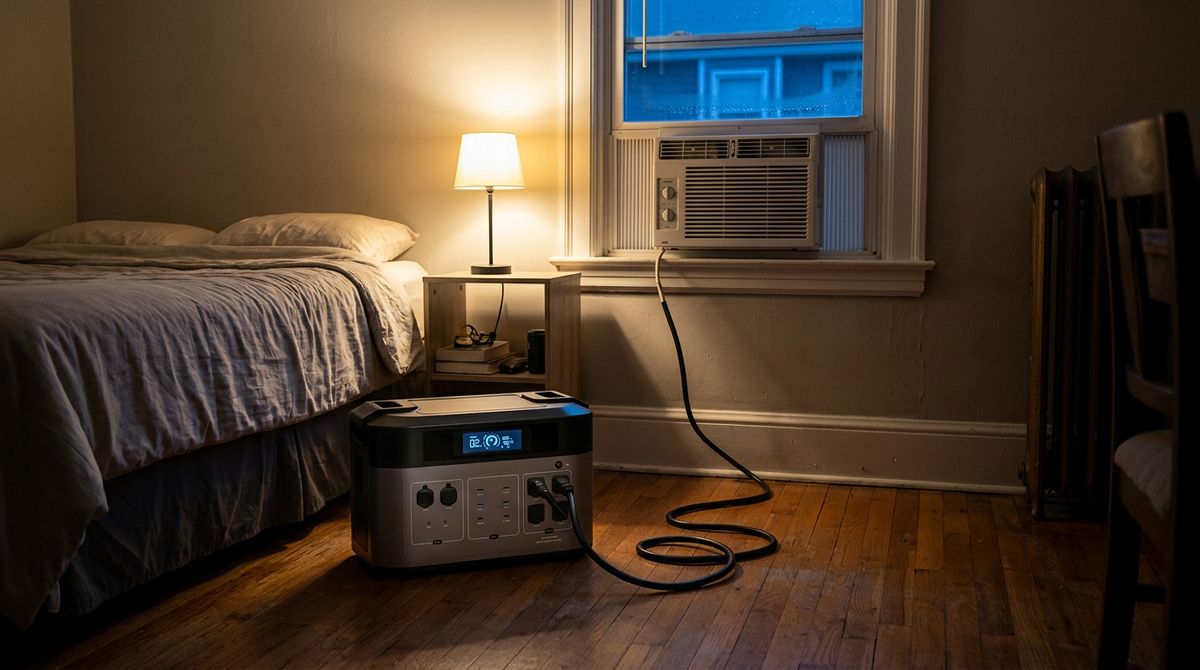
Can a Solar Generator Run a Window Air Conditioner? Size and Runtime Guide
LEARN MORE
Hurricane, Wildfire and Winter Outage Power Checklist
LEARN MORELooking for something else?

OUKITEL Showcases Energy Storage Solutions at Intersolar South America 2026, Accelerating Expansion into Latin America
LEARN MORE
Portable Power Station for Starlink: Runtime, Solar and Off-Grid Setup
LEARN MORE
Portable Power Stations for Power Tools and Job Sites: Surge, Runtime and Safety
LEARN MOREYou may also like

OUKITEL P5000 Pro Portable Power Station 5120Wh | 3600W
$1,629.00
$2,199.00

OUKITEL P5000 Solar Generator for Home with 400W Solar Panel
$1,499.00
$2,999.00

OUKITEL P800 Portable Power Station 800W | 512Wh
$259.00
$399.00

OUKITEL B2000 Expansion Battery | 2048Wh
$699.00
$999.00

OUKITEL BP5000 PRO MAX Portable Power Station 5000W | 5120Wh
$1,999.00
$2,999.00

OUKITEL BP2000 PRO Portable Power Station 3300W
$879.00
$1,599.00
Further reading

OUKITEL P2001 Plus vs BLUETTI AC200L: Which 2kWh Station Is Better for You?
Put the OUKITEL P2001 Plus vs BLUETTI AC200L spec sheets next to each other and the first thing you see is how much they share. Same 2,048Wh LiFePO4 battery. Same 2,400W inverter rating.
So the re...

OUKITEL P2001 Plus vs EcoFlow DELTA 2 Max: 2048Wh Power Station Comparison
We went through the P2001 Plus vs EcoFlow DELTA 2 Max spec sheets line by line for this guide, and they match on the numbers most shoppers read first: 2,048Wh of LiFePO4 and a 2,400W inverter with...

OUKITEL vs BLUETTI: Expandability, Runtime and Price Compared
Put OUKITEL vs BLUETTI side by side and the spec sheets look almost the same. Both run on LiFePO4 cells. Each brand has a 2,048Wh station that takes extra batteries, and both print big inverter nu...